











Air Temperatures – The following maximum temperatures were recorded across the state of Hawaii Wednesday:
86 Lihue, Kauai
82 Honolulu, Oahu
85 Molokai
91 Kahului, Maui – just missed the record high temperature of 92 degrees…back in 1992
86 Kona, Hawaii
82 Hilo, Hawaii
Air Temperatures ranged between these warmest and coolest spots near sea level – and on the highest mountain tops around the state…as of 830pm Wednesday evening:
Kailua Kona – 81
Hilo, Hawaii – 72
Haleakala Summit – 43 (near 10,000 feet on Maui)
Mauna Kea Summit – 37 (13,000+ feet on the Big Island)
Hawaii’s Mountains – Here’s a link to the live web cam on the summit of near 13,800 foot Mauna Kea on the Big Island of Hawaii. This web cam is available during the daylight hours here in the islands…and when there’s a big moon shining down during the night at times. Plus, during the nights you will be able to see stars, and the sunrise and sunset too… depending upon weather conditions. Here’s the Haleakala Crater webcam on Maui – if it’s working.
Aloha Paragraphs

Lighter than normal winds, showers
at times…some locally heavy –
improving this weekend
The following numbers represent the most recent top wind gusts (mph), along with directions as of Wednesday evening:
15 Mana, Kauai – NW
17 Kuaokala, Oahu – N
17 Molokai – N
30 Kahoolawe – E
22 Lipoa, Maui – SE
27 Upolu airport, Big Island – ENE
Here are the latest 24-hour precipitation totals (inches) for each of the islands as of Wednesday evening:
2.40 Mount Waialeale, Kauai
7.60 Wilson Tunnel, Oahu
0.08 Molokai
0.00 Kahoolawe
3.43 Kaupo Gap, Maui
2.96 Saddle Quarry, Big Island
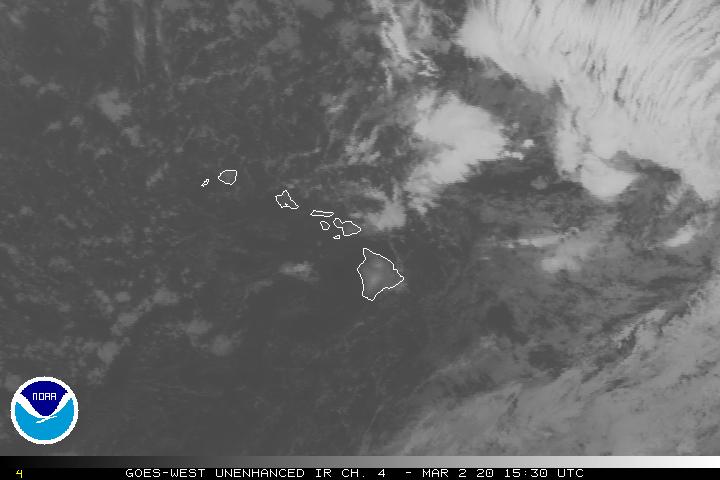
We can use the following links to see what’s going on in our area of the north central Pacific Ocean. Here’s the latest NOAA satellite picture – the latest looping satellite image… and finally the latest looping radar image for the Hawaiian Islands.
~~~ Hawaii Weather Narrative ~~~
The trade winds will remain quite light, with localized daytime sea breezes…through Friday morning. Here’s a weather chart showing a near 1026 millibar high pressure system located to the northeast of our islands. This high pressure system will keep light east to southeast breezes over the islands for the time being, locally a bit stronger at times. For the moment, these trades will allow onshore sea breezes to develop during the days, making for rather hot and muggy weather near the beaches. The models continuing pointing out that it will take until later Friday into the weekend…before the trade winds rebound fully. These trades should prevail well into the new month of June.
Satellite imagery shows clouds over the ocean, and around the islands in place too…with new high cirrus clouds migrating towards us from the west. Here’s the looping radar image, showing showers riding along in the east to southeasterly breezes. The island of Oahu has had the most of this heavy precipitation by far during the last 24 hours…with flooding statements occurring at times since yesterday. An upper level trough of low pressure remains still relatively near the state, which has been responsible for enhancing showers that have fallen lately. This trough will keep our overlying atmosphere unstable, and in turn shower prone…for just a little while longer. This upper level low pressure system will move away Thursday, making way for more stable conditions then into Friday, with less of a threat of heavy showers. The trade winds will return later Friday into the weekend, which should usher back in fairly normal weather conditions, with our common windward biased showers. I’ll be back with your next new weather narrative early Thursday morning. Aloha for now…Glenn.
Here at my place in Kula, Maui, it was clear and calm…the air temperature was 64.8F degrees – at 8400pm this evening.
World-wide tropical cyclone activity:
Atlantic Ocean/Caribbean Sea: There are no active tropical cyclones / Here’s a link to the National Hurricane Center in Miami…which covers tropical cyclone activity in the Atlantic, Caribbean Sea…and the Gulf of Mexico. The hurricane season in the Atlantic, Caribbean, and the Gulf of Mexico all begin as of June 1.
Gulf of Mexico: There are no active tropical cyclones
Eastern Pacific Ocean: Tropical storm Barbara remains active…located about 60 miles southeast of Coatzacoalcos, Mexico. Maximum sustained winds are near 45 mph, with Barbara presently moving towards the north at 09 mph. Weakening Barbara is bringing heavy rainfall across portions of southeastern Mexico. Here’s the NHC graphical track map, along with a satellite image. Here’s what the weather models are showing for tropical storm Barbara
DISORGANIZED SHOWER AND THUNDERSTORM ACTIVITY CONTINUES IN ASSOCIATION WITH THE LOW PRESSURE AREA LOCATED ABOUT 650 MILES SOUTH-SOUTHWEST OF THE SOUTHERN TIP OF THE BAJA CALIFORNIA PENINSULA. WHILE ENVIRONMENTAL CONDITIONS DO NOT FAVOR SIGNIFICANT STRENGTHENING…THERE REMAINS SOME POTENTIAL FOR THIS SYSTEM TO BECOME A TROPICAL DEPRESSION TONIGHT OR THURSDAY. THE LOW PRESSURE AREA WILL MOVE TOWARD THE NORTHEAST AT ABOUT 10 MPH DURING THE NEXT COUPLE OF DAYS. THIS DISTURBANCE HAS A MEDIUM CHANCE…40 PERCENT…OF BECOMING A TROPICAL CYCLONE DURING THE NEXT 48 HOURS.
(Invest 91E) Here’s what the weather models are showing for invest 91E
ELSEWHERE, TROPICAL CYCLONE FORMATION IS NOT EXPECTED DURING THE NEXT 48 HOURS.
Here’s a wide satellite image that covers the entire area between Mexico, out through the central Pacific…to the International Dateline.
Central Pacific Ocean: There are no active tropical cyclones / Here’s a link to the Central Pacific Hurricane Center (CPHC)…covering our central Pacific. The hurricane season in this part of the Pacific begins as of June 1st.
Western Pacific Ocean: There are no active tropical cyclones / Here’s a link to the Joint Typhoon Warning Center (JTWC), which covers tropical cyclone activity in the western Pacific, and the North and South Indian Ocean…and adjacent Seas.
South Pacific Ocean: There are no active tropical cyclones
North and South Indian Oceans: There are no active tropical cyclones / In the Bay of Bengal, there’s an area of disturbed weather located approximately 55 NM south-southeast of Kolkata, India. Satellite imagery shows a consolidating low level circulation center, with improved deep convective banding. Upper level analysis indicates moderate to strong 20-30 knot (23-35 mph) vertical wind shear. The close proximity of nearby land is a limiting factor for development, although there is a slight chance that this system may intensify further as it tracks slowly northward across the Bay of Bengal. Due to these environmental factors, the Joint Typhoon Warning Center (JTWC) is giving a medium chance of this disturbance developing into a tropical cyclone…before it tracks inland over southern Bangladesh. Maximum sustained surface winds are running 25-30 knots (29-35 mph).
 Email Glenn James:
Dave Says:
Hi Glenn, for vog conditions, I like this tool: http://weather.hawaii.edu/vmap/hysplit/index.cgi?banner=uhmet&domain=haw&variable=so2&orient=
Mahalo, Dave~~~Hi Dave, I put a link on my narrative page, its much appreciated! Aloha, Glenn
David Says:
Aloha, Glenn,
Soon to be moving to Maui in the Makawao/Pukalani area, and find ii difficult to get a good sense of the actual weather. While recognizing the variation in altitude affects temps, with temps often cited in Kahului and Kula, it’s hard to know quite what’s going on in Makawao/Pukalani. Our house is about 1300-1400 foot elevation – any suggestions on how to get more accurate readings? From doing some research there appear to be “official” weather measurement devices in Kula and Makawao, although not sure where or how to access their readings or if they are representative enough? Any suggestions. Mahalo!~~~Hi David, those two that you found are likely to be the most representative. I’d say you made a very good choice, you can’t beat upcountry Maui as far as I’m concerned! Best of luck, Aloha, Glenn
Gayle Says:
I’ve just found your site and love it. Can you recommend (or consider including on your page) ways to monitor vog affecting all the islands, including Kaua’i? I’m highly sensitive, and I’m having a hard time finding reliable forecasts or even status reports. I’m aware of VMAP and AIRNow, but they don’t cover Kaua’i and information seems spotty. I check NOAA and TV weather reports. Haze will be mentioned one day and then not the next. Is it coming? Has it dissipated? Who knows, especially when winds are light or variable as they are now? Mahalo!~~~Hi Gayle, glad you found me! Vog is tricky, especially on Kauai…its the furthest away from the vents on the Big Island. I follow vog closely, and will mention it in my narratives whenever I can. I honestly don’t have any fool proof websites that cover it well, I just look at wind directions, and out the window, and on visible satellite imagery during the days. I wish I had more to offer you up there on the far side of the island chain. Aloha, Glenn
Eliza Says:
Aloha Glenn – Just back from a short trip to Kaua’i. Am curious – is there no weather station for temp data in Kapa’a? We were there at high noon and it felt like it was as hot as Lahaina gets in the late summer. Terribly hard to have fun with that sort of heat and lack of tradewinds around. Also, had the first experience of landing ‘backwards’ at OGG last night. Most fun to come in over the ocean. Happy mid-week to you ~ Aloha ~ Eliza~~~Hi Eliza, welcome back from Kauai! There isn’t a station there for either temperature or rainfall. Sounds like downtown Lahaina kine weather during the summer, which sometimes feels almost like too much…unless you’re in the shade! Yes, we’re mostly missing the trade winds again, very unusual for this time of year! Aloha, Glenn