Air Temperatures – The following maximum temperatures were recorded across the state of Hawaii Sunday afternoon:
Lihue, Kauai – 85 Honolulu, Oahu – 88 Kaneohe, Oahu – 83 Kahului, Maui – 88 Hilo, Hawaii – 84
Kailua-kona – 85 Air Temperaturesranged between these warmest and coolest spots near sea level, and on the taller mountains…at 3 p.m. Sunday afternoon:
Kapalua, Maui– 88F Kaheohe, Oahu – 81
Haleakala Crater- missing (near 10,000 feet on Maui)
Mauna Kea summit – missing (near 14,000 feet on the Big Island) Precipitation Totals – The following numbers represent the largest precipitation totals (inches) during the last 24 hours on each of the major islands, as of Sunday afternoon:
0.79 Mount Waialaele, Kauai
0.49 Manoa Valley, Oahu
0.01 Molokai
0.00 Lanai
0.13 Kahoolawe 1.30 Ulupalakua, Maui
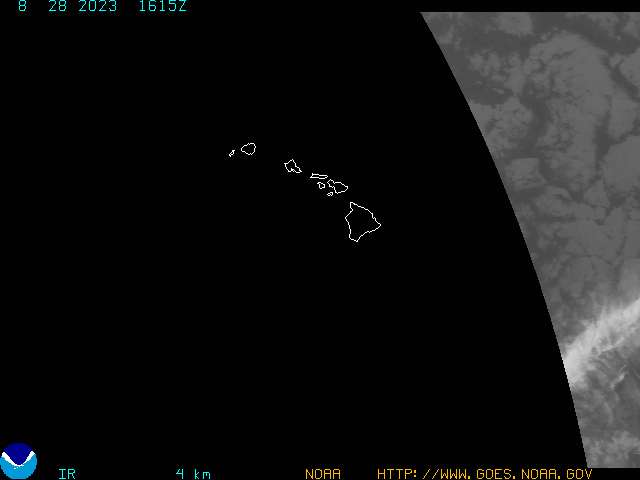
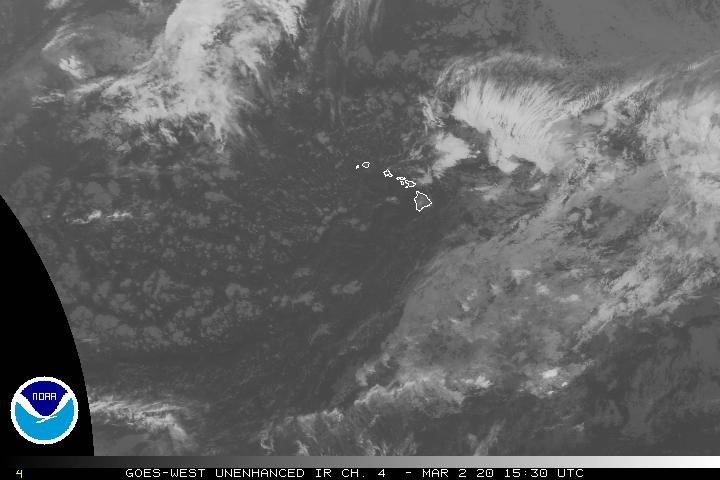
1.16 Honaunau, Big Island Weather Chart – Here’s the latest (automatically updated) weather mapshowing a 1031 millibar high pressure system located far to the northeast of Hawaii. This pressure configuration will keep our trade winds blowing generally in the moderately strong range…although stronger and gusty in those windiest locations. Satellite and Radar Images: To view the cloud conditions we have here in Hawaii, please use the following satellite links, starting off with theInfrared Satellite Image of the islands to see all the clouds around the state during the day and night. This next image is one that gives close images of the islands only during the daytime hours, and is referred to as a Close-up visible image. This next image shows a larger view of the Pacific…giving perspective to the wider ranging cloud patterns in the Pacific Ocean. To help you keep track of where any showers may be around the islands, here’s the latest animatedradar image.
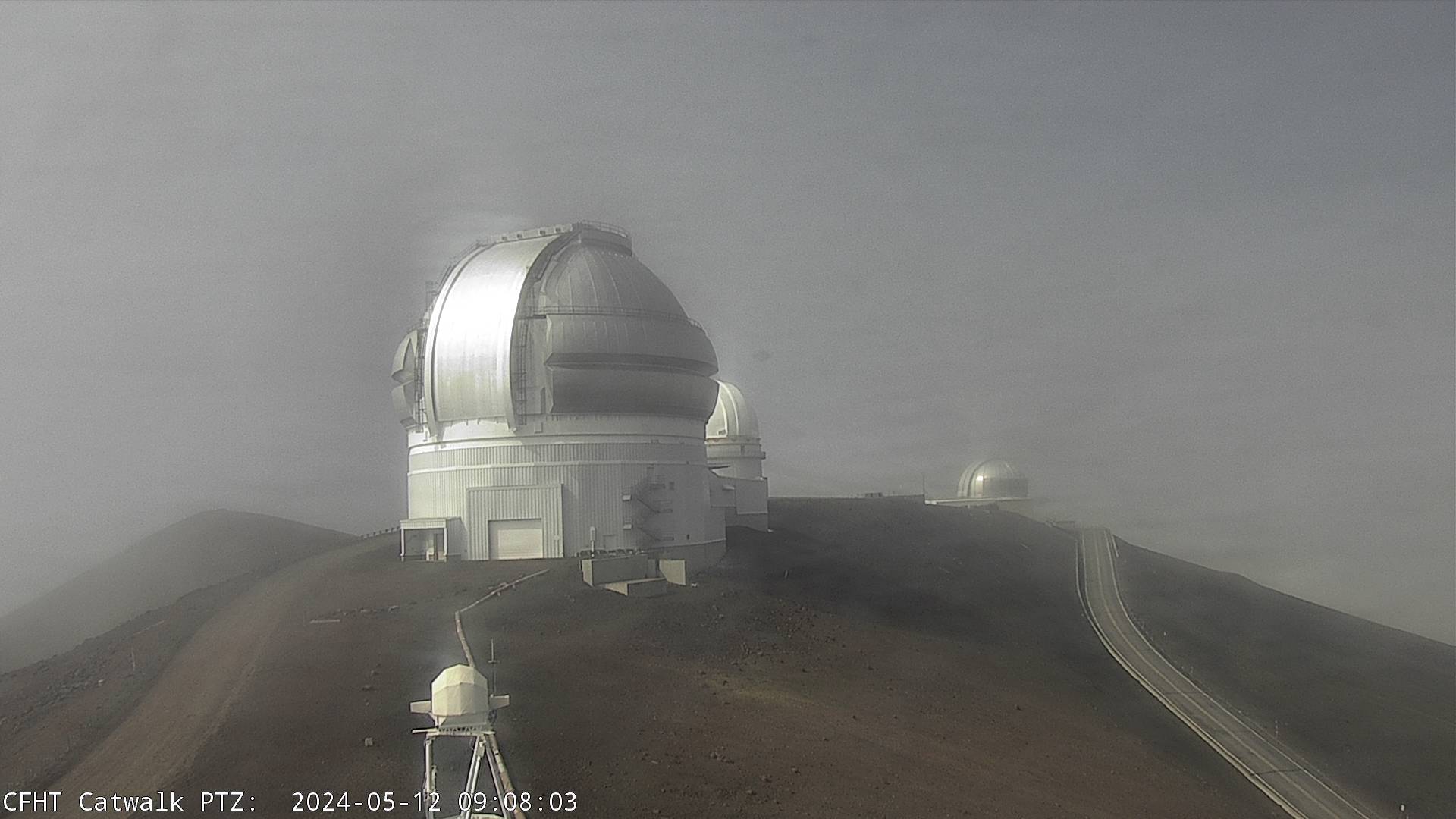
Hawaii’s Mountains – Here’s a link to the live webcam on the summit of near 14,000 footMauna Kea on the Big Island of Hawaii. The tallest peak on the island of Maui is theHaleakala Crater, which is near 10,000 feet in elevation. These two webcams are available during the daylight hours here in the islands…and when there’s a big moon rising just after sunset for an hour or two! Plus, during the nights and early mornings you will be able to see stars, and the sunrise too…depending upon weather conditions.
Aloha Paragraphs
Waipio Valley on the Big Island Photo Credit: flickr.com
Light to moderately strong trade winds will remain well established over the Hawaiian Islands through the next week. As this weather map shows, we have a large 1031 millibar high pressure system far northeast of our islands now…the source of our local winds. In general, light to moderately strong trade winds will prevail…with those typically windier places having higher gusts.
There will be showers at times along the windward sides, followed by less showery periods through Labor Day.The rainfall pattern continues to be one with occasional passing showers…and then returning to drier conditions. There will be some enhancement to our windward biased showers at times, with an occasional heavy shower falling. This will be the result of cooler air aloft, associated with an upper trough of low pressure. The upcountry leeward sides will see afternoon showers at times through the Labor Day holiday as well…some of which could be quite generous on Maui and the Big Island. Dangerous hurricane Gustav has shown some weakening (category 3) as it continues its journey through the Gulf coast. As this track map from the National Hurricane Center in Miami shows…it continues on a straight line towards the Louisiana coast, to the west of New Orleans. The northeast quadrant (upper right portion) of a forward moving hurricane is regarded as the most severe part of the storm. This most most damaging part of the storm remains a distinct threat to the New Orleans area. This hurricane will bring major hurricane force winds…along with extensive flooding and storm surge to the area. Evacuations continue Sunday afternoon, before Gustav makes landfall perhaps as early as Monday morning. Tropical storm force winds are close to reaching the coast Sunday evening. Here’s the latestsatellite image of the hurricane. Here is looping radar image of Gustav as it moves towards the coast.
Meanwhile, tropical storm Hanna, in the Caribbean Sea, will strengthen as it continues on towards the southeast coast of the United States. As this NHC tracking map shows, Hanna is expected to be a hurricane when it makes landfall somewhere between Georgia and South Carolina. Here’s what the hurricane models are showing to be the various tracks over the next several days. Here’s a satellite image of Hanna, which will be the lead headline weather news…after Gustav does his thing along the Gulf coast.
Speaking of tropical systems, there’s an area of low pressure, what we could consider a tropical disturbance, to the south of Hawaii now. This area, which is approximately 600 miles south of Honolulu, is moving in a west-northwest direction. The upper level winds aren’t especially favorable for strengthening, although this concentrated area of deep convection will need to be watched. Here’s a satellite image of the area, look for the small thunderstorm complex directly south of our islands. Here’s what the hurricane models are showing for what’s being called Investigation Area 95C.
It’s late Sunday afternoon here in Kula, Maui, as I begin writing this last paragraph of today’s tropical weather narrative from Hawaii.You know, weather forecasting during a weather pattern such as we now have going on here in the islands…is tough. One day the showers are here, and the next day they aren’t. These all important fluctuations don’t always coincide with, or match exactly what that day’s forecast calls for! It’s somewhat hit or miss, that is, the showers come and go, as do the accurate, and the inaccurate forecasts with them. I was expecting afternoon showers up here on the slopes of the Haleakala Crater Sunday, like yesterday, and sure enough, they are nowhere to be found. Oh well, it’s like life itself I suppose, one can only hope for the best, and take what they get. As I’m fond of saying, or at least thinking: the trick seems to be in the acceptance of what comes our way, using the old analogy…taking responsibility for what we have going on in our lives day by day, right down into the moment by moment reality. I hope you have a great Sunday night wherever you happen to be accepting the present! I’ll be back Monday morning, not as early as most Monday mornings though, as it is a national holiday. Aloha for now…Glenn.
Air Temperatures – The following maximum temperatures were recorded across the state of Hawaii Saturday afternoon:
Lihue, Kauai – 85 Honolulu, Oahu – 88 Kaneohe, Oahu – 83 Kahului, Maui – 88 Hilo, Hawaii – 86
Kailua-kona – 85 Air Temperaturesranged between these warmest and coolest spots near sea level, and on the taller mountains…at 4 p.m. Saturday afternoon:
Barking Sands, Kauai– 86F Princeville, Kauai – 82
Haleakala Crater- 50 (near 10,000 feet on Maui)
Mauna Kea summit – 43 (near 14,000 feet on the Big Island) Precipitation Totals – The following numbers represent the largest precipitation totals (inches) during the last 24 hours on each of the major islands, as of Saturday afternoon:
0.41 Waihina, Kauai 0.83 Manoa Valley, Oahu
0.04 Molokai
0.08 Lanai
0.12 Kahoolawe 0.70 Puu Kukui, Maui
0.50 Piihona, Big Island Weather Chart – Here’s the latest (automatically updated) weather mapshowing high pressure system located far to the north of Hawaii. This pressure configuration will keep our trade winds blowing generally in the moderately strong range…although stronger and gusty in those windiest locations. Satellite and Radar Images: To view the cloud conditions we have here in Hawaii, please use the following satellite links, starting off with theInfrared Satellite Image of the islands to see all the clouds around the state during the day and night. This next image is one that gives close images of the islands only during the daytime hours, and is referred to as a Close-up visible image. This next image shows a larger view of the Pacific…giving perspective to the wider ranging cloud patterns in the Pacific Ocean. To help you keep track of where any showers may be around the islands, here’s the latest animatedradar image.
Hawaii’s Mountains – Here’s a link to the live webcam on the summit of near 14,000 footMauna Kea on the Big Island of Hawaii. The tallest peak on the island of Maui is theHaleakala Crater, which is near 10,000 feet in elevation. These two webcams are available during the daylight hours here in the islands…and when there’s a big moon rising just after sunset for an hour or two! Plus, during the nights and early mornings you will be able to see stars, and the sunrise too…depending upon weather conditions.
Steady, moderately strong trade winds will remain well established over the Hawaiian Islands. As this weather map shows, we have a large 1032 millibar high pressure system far northeast of our islands this weekend…the source of our local winds. The winds remain just below the small craft wind advisory levels in those windier coastal and channel waters. In general, light to moderately strong trade winds will prevail…with those typically windier places having higher gusts.
There will be showers at times along the windward sides, punctuated by less showery periods through this long holiday weekend.The rainfall pattern continues to be one with occasional passing showers…and then returning to drier conditions. There will be some enhancement to our windward biased showers at times, with an occasional heavy shower falling. This will be the result of cooler air aloft, associated with an upper trough of low pressure. The upcountry leeward sides will see occasional showers at times through the Labor Day holiday weekend as well. Dangerous hurricane (category 4) Gustav has shown explosive strengthening, as it heads into the Gulf of Mexico. As this track map from the National Hurricane Center in Miami shows…at the moment, it’s heading towards the Louisiana coast, just slightly to the west of the New Orleans metropolitan area. The northeast quadrant (upper right portion) of a forward moving hurricane is regarded as the most severe part of the storm. This most most damaging part of the storm remains a distinct threat to the New Orleans area. This very dangerous hurricane will cause an extremely windy event…along with extensive flooding the area. Evacuations have begun along those coasts now, and will continue in earnest over the several days, before making landfall at some point Monday. Here’s the latest satellite image of Gustav. Here is looping radar image of Gustav as it heads over Cuba into the Gulf of Mexico.
It’s early Saturday evening here in Kula, Maui, as I begin writing this last paragraph of today’s tropical weather narrative from Hawaii. I woke up last night to the unusual sound of rain falling here in Kula, which was part of those off and on showers that we’re expecting over the next several days. The clouds gathered on the slopes of the Haleakala Crater early in the day Saturday, which lead to a brief period of showers. Radar has shown briefly heavy showers over near Keokea and Ulupalakua this afternoon, where 1.00" per hour rainfall rates have occurred. At the moment, its quite sunny over my area, although I can see quite a few clouds congregating on the horizon in most directions. I anticipate that these off and on showers will continue here and there, although most outdoor activities will remain available during the days…especially down towards the leeward beaches. I’ll be back early Sunday morning with your next new weather narrative, and with more information on dangerous major hurricane Gustav, as it steams its way towards the Gulf coast. I hope you have a great Saturday night wherever you happen to be spending it! Aloha for now…Glenn.
Interesting:
The Indonesian government is to double the size of a national park that is one of the last havens for endangered Sumatran elephants and tigers. TessoNiloNational Park was created in 2004 with 38,000 hectares of forest. Today’s declaration will see that figure increase to 86,000 by the end of this year. "This is an important milestone toward securing a future for the Sumatran elephant and tiger," said Dr. Mubariq Ahmad, WWF-Indonesia’s Chief Executive. “To ensure the commitment is effectively implemented we must redouble our efforts to eliminate poaching and illegal settlements within this special forest.” With more than 4,000 plant species recorded so far, the forest of Tesso Nilo has the highest lowland forest plant biodiversity known to science, with many species yet to be discovered.
WWF has been supporting the government effort to extend and protect the park as the last block of lowland forest in central Sumatra large enough to support a viable elephant population. About 60 to 80 elephants are estimated to live there, along with 50 tigers. Tesso Nilo forest is also an important watershed for more than 40,000 people living in the surrounding 22 villages. “Tesso Nilo is still under serious threat from illegal activities, but if we can protect the forests there it will give some of Sumatra’s most endangered wildlife the breathing room they need to survive,” Dr Ahmad said. “And while we greatly appreciate this precedent for more protection from the Indonesian government, there are other areas on Sumatra that need safeguarding for the sake of its wildlife, its threatened indigenous peoples and to reduce the climate impacts of clearing.”
Interesting2:
A solution to the world’s worst case of ongoing mass poisoning, linked to rising cancer rates in Southern Asia, has been developed by researchers from Queen’s University Belfast. It is estimated that over 70 million people in Eastern India and Bangladesh, experience involuntary arsenic exposure from consuming water and rice; the main staple food in the region. This includes farmers who have to use contaminated groundwater from minor irrigation schemes. It is estimated that for every random sample of 100 people in the Bengal Delta, at least one person will be near death as a result of arsenic poisoning, while five in 100 will be experiencing other symptoms.
Now, researchers have created new low-cost technology to provide arsenic-free water to millions of people in South Asia currently exposed to high levels of the poison in groundwater. Leading an international team, Queen’s researchers have developed a trial plant in Kasimpore, near Calcutta, which offers chemical-free groundwater treatment technology to rural communities for all their drinking and farming needs. The technology is based on recharging a part of the groundwater, after aeration, into a subterranean aquifer (permeable rock) able to hold water. Increased levels of oxygen in the groundwater slow down the arsenic release from the soil. At higher dissolved oxygen levels, soil micro organisms, as well as iron and manganese, reduce the dissolved arsenic level significantly.
Interesting3:
New research strongly suggests that a mix of preventative agents, such as those found in concentrated black raspberries, may more effectively inhibit cancer development than single agents aimed at shutting down a particular gene. Researchers at the Ohio State University Comprehensive Cancer Center examined the effect of freeze-dried black raspberries on genes altered by a chemical carcinogen in an animal model of esophageal cancer. The carcinogen affected the activity of some 2,200 genes in the animals’ esophagus in only one week, but 460 of those genes were restored to normal activity in animals that consumed freeze-dried black raspberry powder as part of their diet during the exposure. These findings, published in recent issue of the journal Cancer Research, also helped identify 53 genes that may play a fundamental role in early cancer development and may therefore be important targets for chemoprevention agents.
“We have clearly shown that berries, which contain a variety of anticancer compounds, have a genome-wide effect on the expression of genes involved in cancer development,” says principal investigator Gary D. Stoner, a professor of pathology, human nutrition and medicine who studies dietary agents for the prevention of esophageal cancer. “This suggests to us that a mixture of preventative agents, which berries provide, may more effectively prevent cancer than a single agent that targets only one or a few genes.” Stoner notes that black raspberries have vitamins, minerals, phenols and phytosterols, many of which individually are known to prevent cancer in animals.
Air Temperatures – The following maximum temperatures were recorded across the state of Hawaii Friday afternoon:
Lihue, Kauai – 84 Honolulu, Oahu – 89 Kaneohe, Oahu – 85 Kahului, Maui – 88 Hilo, Hawaii – 86
Kailua-kona – 84 Air Temperaturesranged between these warmest and coolest spots near sea level, and on the taller mountains…at 4 p.m. Friday afternoon:
Port Allen, Kauai– 88F Kaneohe, Oahu – 82
Haleakala Crater- 50 (near 10,000 feet on Maui)
Mauna Kea summit – 39 (near 14,000 feet on the Big Island) Precipitation Totals – The following numbers represent the largest precipitation totals (inches) during the last 24 hours on each of the major islands, as of Friday afternoon:
0.40 Mount Waialeale, Kauai 0.50 Poamoho 2, Oahu
0.03 Molokai
0.00 Lanai
0.00 Kahoolawe 0.31 Puu Kukui, Maui
0.45 Pahala, Big Island Weather Chart – Here’s the latest (automatically updated) weather mapshowing high pressure system located far to the north of Hawaii. This pressure configuration will keep our trade winds blowing generally in the moderately strong range…although stronger and gusty in those windiest locations. Satellite and Radar Images: To view the cloud conditions we have here in Hawaii, please use the following satellite links, starting off with theInfrared Satellite Image of the islands to see all the clouds around the state during the day and night. This next image is one that gives close images of the islands only during the daytime hours, and is referred to as a Close-up visible image. This next image shows a larger view of the Pacific…giving perspective to the wider ranging cloud patterns in the Pacific Ocean. To help you keep track of where any showers may be around the islands, here’s the latest animatedradar image.
Hawaii’s Mountains – Here’s a link to the live webcam on the summit of near 14,000 footMauna Kea on the Big Island of Hawaii. The tallest peak on the island of Maui is theHaleakala Crater, which is near 10,000 feet in elevation. These two webcams are available during the daylight hours here in the islands…and when there’s a big moon rising just after sunset for an hour or two! Plus, during the nights and early mornings you will be able to see stars, and the sunrise too…depending upon weather conditions.
Aloha Paragraphs
Bodyboarding the north shore of Oahu Photo Credit: flickr.com
A fairly dynamic high pressure center to our north, will keep brisk trades blowing across our area well into the future. These typical late summer winds will remain fixed on our Hawaiian Islands, with no end in sight through at least the next week. The winds aren’t quite strong enough to trigger a small craft wind advisory at the moment, but they are close in those windiest areas around Maui and the Big Island. The daytime hours will have the strongest winds, easing off some during the nights as usual. In general, light to moderately strong trade winds will prevail…with those typically windier places having somewhat higher gusts.
There will be periodic bouts of showers along the windward sides, punctuated by less showery times over the next several days.The rainfall pattern continues to be one with occasional passing showers…and then returning to drier conditions. There may be some enhancement (locally heavy) to our windward biased showers at times, as cooler air aloft, associated with troughs of low pressure, edge in our direction. The upcountry leeward sides may see an afternoon shower at times through the Labor Day holiday weekend as well. Strengthening hurricane Gustav continues to take aim on the vulnerable Gulf of Mexico coast. This soon to be major hurricane will do some shifting around in its path over the very warm waters of the Gulf, so that there remains some uncertainty about exactly where it will strike. As this track map from the National Hurricane Center in Miami shows…at the moment, it’s heading towards the Louisiana coast, just slightly to the west of the New Orleans metropolitan area. The northeast quadrant (upper right portion) of a forward moving hurricane harbors the most severe weather conditions. This most violent part of the storm remains a distinct threat to the New Orleans area. As mentioned in the paragraphs above, the trade winds will continue to blow, carrying areas of showery clouds towards the windward north and east facing parts of the state at times. The most likely occurrences for these moisture laden clouds to arrive, would be Friday evening into the night, and then again around Labor Day. The predictability of these incoming showers is difficult, especially the further out into the future one tries to nail down these showery increases in moisture. Probably the best way to think about it, or plan on it, would be knowing that there will be periods of windward showers at times, which as anyone living on the windward side knows…can happen pretty much anytime the trade winds are blowing! As this satellite image shows, there are those cloud elements upstream, in relation to the trade winds, which will bring their showers with them in an off and on manner.
It’s early Friday evening here in Kihei, Maui, as I begin writing this last paragraph of today’s tropical weather narrative from Hawaii. I’m about ready to head out for the three day long, Labor Day holiday weekend. It’s always a great feeling to have all that free time to fill with anything that catches my fancy. The beginning of this weekend will begin as I take in the new action/adventure film called Traitor (2008), starring Don Cheadle and Guy Pearce among others. This film is being described as a taut international thriller, set against a jigsaw puzzle of covert counter-espionage operations. One critic described it as "a smarter movie about terrorism." Another person says this, "promising premise devolves into a by-the-numbers espionage thriller." It seems to be getting generally a B grade, which seems good enough to get this Maui weatherman in the theater for the opening night. I’m a bit put off by the violent nature of this film, and am hesistant to provide a trailer, so please be forewarned that the trailer, and the film itself, are definitely not for the faint of heart! I’ll be back early Saturday morning with your next new weather narrative, I hope you have a great Friday night until then! Aloha for now…Glenn.
Interesting1:
The Indonesian government is to double the size of a national park that is one of the last havens for endangered Sumatran elephants and tigers. TessoNiloNational Park was created in 2004 with 38,000 hectares of forest. Today’s declaration will see that figure increase to 86,000 by the end of this year. "This is an important milestone toward securing a future for the Sumatran elephant and tiger," said Dr. Mubariq Ahmad, WWF-Indonesia’s Chief Executive. “To ensure the commitment is effectively implemented we must redouble our efforts to eliminate poaching and illegal settlements within this special forest.” With more than 4,000 plant species recorded so far, the forest of Tesso Nilo has the highest lowland forest plant biodiversity known to science, with many species yet to be discovered.
WWF has been supporting the government effort to extend and protect the park as the last block of lowland forest in central Sumatra large enough to support a viable elephant population. About 60 to 80 elephants are estimated to live there, along with 50 tigers. Tesso Nilo forest is also an important watershed for more than 40,000 people living in the surrounding 22 villages. “Tesso Nilo is still under serious threat from illegal activities, but if we can protect the forests there it will give some of Sumatra’s most endangered wildlife the breathing room they need to survive,” Dr Ahmad said. “And while we greatly appreciate this precedent for more protection from the Indonesian government, there are other areas on Sumatra that need safeguarding for the sake of its wildlife, its threatened indigenous peoples and to reduce the climate impacts of clearing.”
Interesting2:
A solution to the world’s worst case of ongoing mass poisoning, linked to rising cancer rates in Southern Asia, has been developed by researchers from Queen’s University Belfast. It is estimated that over 70 million people in Eastern India and Bangladesh, experience involuntary arsenic exposure from consuming water and rice; the main staple food in the region. This includes farmers who have to use contaminated groundwater from minor irrigation schemes. It is estimated that for every random sample of 100 people in the Bengal Delta, at least one person will be near death as a result of arsenic poisoning, while five in 100 will be experiencing other symptoms.
Now, researchers have created new low-cost technology to provide arsenic-free water to millions of people in South Asia currently exposed to high levels of the poison in groundwater. Leading an international team, Queen’s researchers have developed a trial plant in Kasimpore, near Calcutta, which offers chemical-free groundwater treatment technology to rural communities for all their drinking and farming needs. The technology is based on recharging a part of the groundwater, after aeration, into a subterranean aquifer (permeable rock) able to hold water. Increased levels of oxygen in the groundwater slow down the arsenic release from the soil. At higher dissolved oxygen levels, soil micro organisms, as well as iron and manganese, reduce the dissolved arsenic level significantly.
Interesting3:
New research strongly suggests that a mix of preventative agents, such as those found in concentrated black raspberries, may more effectively inhibit cancer development than single agents aimed at shutting down a particular gene. Researchers at the Ohio State University Comprehensive Cancer Center examined the effect of freeze-dried black raspberries on genes altered by a chemical carcinogen in an animal model of esophageal cancer. The carcinogen affected the activity of some 2,200 genes in the animals’ esophagus in only one week, but 460 of those genes were restored to normal activity in animals that consumed freeze-dried black raspberry powder as part of their diet during the exposure. These findings, published in recent issue of the journal Cancer Research, also helped identify 53 genes that may play a fundamental role in early cancer development and may therefore be important targets for chemoprevention agents.
“We have clearly shown that berries, which contain a variety of anticancer compounds, have a genome-wide effect on the expression of genes involved in cancer development,” says principal investigator Gary D. Stoner, a professor of pathology, human nutrition and medicine who studies dietary agents for the prevention of esophageal cancer. “This suggests to us that a mixture of preventative agents, which berries provide, may more effectively prevent cancer than a single agent that targets only one or a few genes.” Stoner notes that black raspberries have vitamins, minerals, phenols and phytosterols, many of which individually are known to prevent cancer in animals.
Air Temperatures – The following maximum temperatures were recorded across the state of Hawaii Thursday afternoon:
Lihue, Kauai – 86 Honolulu, Oahu – 88 Kaneohe, Oahu – 82 Kahului, Maui – 88 Hilo, Hawaii – 83
Kailua-kona – 84 Air Temperaturesranged between these warmest and coolest spots near sea level, and on the taller mountains…at 4 p.m. Thursday afternoon:
Barking Sands, Kauai– 86F Hilo, Hawaii – 80
Haleakala Crater- 52 (near 10,000 feet on Maui)
Mauna Kea summit – 41 (near 14,000 feet on the Big Island) Precipitation Totals – The following numbers represent the largest precipitation totals (inches) during the last 24 hours on each of the major islands, as of Thursday afternoon: 0.06 Mount Waialeale, Kauai
0.58 Oahu Forest NWR, Oahu
0.01 Molokai
0.00 Lanai
0.05 Kahoolawe 1.10 Ulupalakua, Maui 1.18 Piihonua, Big Island Weather Chart – Here’s the latest (automatically updated) weather mapshowing high pressure systems located far to the north, and northeast of Hawaii. This pressure configuration will keep our trade winds blowing generally in the moderately strong range…although stronger and gusty in those windiest locations. Satellite and Radar Images: To view the cloud conditions we have here in Hawaii, please use the following satellite links, starting off with theInfrared Satellite Image of the islands to see all the clouds around the state during the day and night. This next image is one that gives close images of the islands only during the daytime hours, and is referred to as a Close-up visible image. This next image shows a larger view of the Pacific…giving perspective to the wider ranging cloud patterns in the Pacific Ocean. To help you keep track of where any showers may be around the islands, here’s the latest animatedradar image.
Hawaii’s Mountains – Here’s a link to the live webcam on the summit of near 14,000 footMauna Kea on the Big Island of Hawaii. The tallest peak on the island of Maui is theHaleakala Crater, which is near 10,000 feet in elevation. These two webcams are available during the daylight hours here in the islands…and when there’s a big moon rising just after sunset for an hour or two! Plus, during the nights and early mornings you will be able to see stars, and the sunrise too…depending upon weather conditions.
Aloha Paragraphs
The lush tropical green of Hawaii Photo Credit: flickr.com
Broadly speaking, our local trade winds will continue to be moderately strong…with day to day variations in strength through the next week. These cooling and refreshing winds will shift between light to moderate, to fully moderately strong depending upon the day. As is common, the north and east facing windward areas will see the strongest winds. In contrast, the south and west facing leeward sections will be more protected from the easterly trade wind flow. At those times when the trade winds slip a bit, our atmosphere will begin to feel slightly muggy during the days.
There will be a mix of showers falling, sometimes along the windward coasts and slopes, and along the leeward slopes during the afternoons as well.The rainfall pattern continues to be one with occasional passing showers…and then returning to clear skies with no rain. As an upper level trough moves close through the rest of this week, we may see some enhancement to our local showers at times. There aren’t any cold fronts coming our way from the northwest, nor slugs of tropical moisture taking aim on our islands from the east or southeast.
Tropical storm Gustav is a storm that the computer hurricane models bring into the Gulf of Mexico as a strong category 3 hurricane. This hurricane will do some shifting around in its path over the very warm waters of the Gulf. As this track map from the National Hurricane Center in Miami shows…at the moment, it’s heading towards the Louisiana coast, just to the west of New Orleans. Everyone living along the Gulf coast, and in those areas further inland too, should be paying close attention to this dangerous tropical cyclone as it will be strengthening going forward.
It’s early Thursday evening here in Kihei, Maui, as I begin writing this last paragraph of today’s tropical weather narrative from Hawaii. As we move into Thursday night, we find almost completely clear skies in most parts of the state of Hawaii, which a few scattered clouds around the edges. The winds remained quite strong today, and even later in the afternoon, the winds were still gusting to 37 mph at that windy bay in Maalaea, here on Maui. As this satellite image shows, there are more clouds just to the east of our islands, what we call upstream in relation to the trade winds, which will carry the next batch of windward biased showers to us tonight into early Friday morning…especially from Maui up through Oahu, and to a lesser degree to Kauai and the Big island. Otherwise, looking well into the future, we find more of the generally fine weather conditions, which are expected to carry forth through the entirety of the upcoming Labor Day holiday weekend. I’ll be back very early Friday morning with your next new weather narrative from paradise, I hope you have a great Thursday night wherever you happen to be spending it! Aloha for now…Glenn.
Interesting:
A strong earthquake struck off Canada‘s west coast early Thursday near Vancouver Island. There were no immediate reports of major damage or injuries. The epicenter of the magnitude-6.1 quake was 97 miles west of Port Hardy and 293 miles west northwest of Vancouver, the U.S. Geological Survey said. It struck at a depth of about 6 miles. Geological Survey of Canada scientist Garry Rogers said there were no reports of injuries or damages and said it occurred too far off land for there to be any. He said it’s normal activity for the region and there’s nothing to be alarmed about. The quake was the latest in a series of coastal tremors since Monday.
Two quakes rattled the area Wednesday, both with magnitudes of around 5. There have been 18 quakes with a magnitude greater than four in the region this week. Seismologists said the tremors are occurring in a "seismically active" region, and they are too far offshore to be felt on land and too small to generate a tsunami. "Rarely a day goes by where we don’t have an earthquake. Once a year we have a swarm in the high fours, maybe a five. Once a decade we have a six," Rogers said. "It’s one of the most busiest earthquake areas in the world." Rogers said new ocean crust is forming in the area and that’s why it’s so active geologically.
Interesting2:
The Indonesian government is to double the size of a national park that is one of the last havens for endangered Sumatran elephants and tigers. TessoNiloNational Park was created in 2004 with 38,000 hectares of forest. Today’s declaration will see that figure increase to 86,000 by the end of this year. "This is an important milestone toward securing a future for the Sumatran elephant and tiger," said Dr. Mubariq Ahmad, WWF-Indonesia’s Chief Executive. “To ensure the commitment is effectively implemented we must redouble our efforts to eliminate poaching and illegal settlements within this special forest.” With more than 4,000 plant species recorded so far, the forest of Tesso Nilo has the highest lowland forest plant biodiversity known to science, with many species yet to be discovered.
WWF has been supporting the government effort to extend and protect the park as the last block of lowland forest in central Sumatra large enough to support a viable elephant population. About 60 to 80 elephants are estimated to live there, along with 50 tigers. Tesso Nilo forest is also an important watershed for more than 40,000 people living in the surrounding 22 villages. “Tesso Nilo is still under serious threat from illegal activities, but if we can protect the forests there it will give some of Sumatra’s most endangered wildlife the breathing room they need to survive,” Dr Ahmad said. “And while we greatly appreciate this precedent for more protection from the Indonesian government, there are other areas on Sumatra that need safeguarding for the sake of its wildlife, its threatened indigenous peoples and to reduce the climate impacts of clearing.”
Interesting3:
It seems to happen with depressing frequency – sunny skies turn to rain just as the weekend arrives. Now Spanish researchers say they have evidence that in some parts of Europe the weather really does follow a weekly cycle, although not in the straightforward way that the anecdote might suggest. Evidence has been mounting over the years that the weather in certain parts of the world, including the US, Japan and China, can be driven by the weekly cycle of human activity. This is because we tend to produce more air pollution during the week and less at the weekend. Evidence that such an effect occurs in Europe is controversial and has been harder to come by. Arturo Sanchez-Lorenzo of the University of Barcelona, Spain, and his colleagues examined data gathered between 1961 and 2004 from weather stations across Spain to see whether such a pattern existed. They claim to have found it in Spain, as well as hints of weekly changes in air circulation more broadly over western Europe.
Interesting4:
Giant clams two feet long might have helped feed prehistoric humans as they first migrated out of Africa, new research reveals. The species, Tridacna costata, once accounted for more than 80 percent of giant clams in the Red Sea, researcher now say. Today, these mollusks, the first new living species of giant clam found in two decades, represent less than 1 percent of giant clams living there. This novel clam, whose shell has a distinctive scalloped edge, was discovered while scientists were attempting to develop a breeding program for another giant clam species, Tridacna maxima, which is prized in the aquarium trade. The new species appears to live only in the shallowest waters, which makes it particularly vulnerable to overfishing.
"These are all strong indications that T. costata may be the earliest example of marine overexploitation," said researcher Claudio Richter, a marine ecologist at the Alfred-Wegener-Institute for Polar and Marine Research in Bremerhaven, Germany. Fossil evidence that the researchers uncovered suggests the stocks of these giant clams began crashing some 125,000 years ago, during the last interval between glacial periods. During that time, scientists think modern humans first emerged out of Africa, Richter said. These mollusks could have played a key role in feeding people during that crucial era, serving as a prime target due to their large size, the scientists added. Indeed, competition for these clams and other valuable sea resources "may have been an important driver for human expansion.
Air Temperatures – The following maximum temperatures were recorded across the state of Hawaii Wednesday afternoon:
Lihue, Kauai – 87 Honolulu, Oahu – 88 Kaneohe, Oahu – 83 Kahului, Maui – 86 Hilo, Hawaii – 87
Kailua-kona – 86 Air Temperaturesranged between these warmest and coolest spots near sea level, and on the taller mountains…at 4 p.m. Wednesday afternoon:
Port Allen, Kauai– 88F Kaneohe, Oahu – 80
Haleakala Crater- 54 (near 10,000 feet on Maui)
Mauna Kea summit – 41 (near 14,000 feet on the Big Island) Precipitation Totals – The following numbers represent the largest precipitation totals (inches) during the last 24 hours on each of the major islands, as of Wednesday afternoon:
1.21 Mount Waialeale, Kauai
0.48 Oahu Forest NWR, Oahu
0.06 Molokai
0.00 Lanai
0.00 Kahoolawe 0.25 West Wailuaiki, Maui
0.14 Kahua Ranch, Big Island Weather Chart – Here’s the latest (automatically updated) weather mapshowing a 1027 millibar high pressure system located to the northeast of Hawaii…with an associated ridge extending west to the north of our islands. This pressure configuration will keep our trade winds blowing generally in the light to moderately strong range through Friday. Satellite and Radar Images: To view the cloud conditions we have here in Hawaii, please use the following satellite links, starting off with theInfrared Satellite Image of the islands to see all the clouds around the state during the day and night. This next image is one that gives close images of the islands only during the daytime hours, and is referred to as a Close-up visible image. This next image shows a larger view of the Pacific…giving perspective to the wider ranging cloud patterns in the Pacific Ocean. To help you keep track of where any showers may be around the islands, here’s the latest animatedradar image.
Hawaii’s Mountains – Here’s a link to the live webcam on the summit of near 14,000 footMauna Kea on the Big Island of Hawaii. The tallest peak on the island of Maui is theHaleakala Crater, which is near 10,000 feet in elevation. These two webcams are available during the daylight hours here in the islands…and when there’s a big moon rising just after sunset for an hour or two! Plus, during the nights and early mornings you will be able to see stars, and the sunrise too…depending upon weather conditions.
The trade winds will continue blowing across the tropical latitudes of the north central Pacific, although gradually becoming lighter. This long lasting spell of moderately strong trade winds here in the islands, will finally begin to ease up a bit, as they shift from the current moderately strong realms, down into the light to moderately strong range by the weekend. The computer models suggest that as we move into next week, they will rebound again, bringing back their cooling relief from what may become rather sultry conditions around the weekend time frame.
The atmosphere has been quite stable lately, although a trough of pressure may make our air mass a bit more shower prone for the next several days.The precipitation pattern this past week has been one with occasional passing showers along the windward sides…and then returning to clear skies with no rain. As an upper level trough moves close through the rest of the week, we may see more generous showers at times. The leeward sides have been quite dry in general, although as the winds get lighter soon, that we may see an increase in upcountry afternoon showers developing. As the trade winds ramp-up again early next week, the bias for showers will return to the windward sides.
Tropical storm Gustav is a storm that the computer hurricane models bring into the Gulf of Mexico as a strong category 3 hurricane. This hurricane will likely do some shifting around in its path over the very warm waters of the Gulf, although as this track map from the National Hurricane Center in Miami shows…at the moment it’s heading directly towards the New Orleans area! This tropical cyclone will become big news, and I’m sure we will be hearing lots more about it, much of it won’t make for a pretty picture I’m afraid. Fortunately, the Hawaiian Islands, here in the north central Pacific remains free of any tropical storm activity!
It’s early Wednesday evening here in Kihei, Maui, as I begin writing this last paragraph of today’s tropical weather narrative from Hawaii. You know, each day is so different here in the islands, especially in terms of the day to day changes in weather. Today turned out to be more cloudy than normal in many areas, certainly that was the case here on Maui. There was yet another brush fire that broke out in south Maui, up above Kihei Wednesday afternoon. This is the 4th wild brush fire in the last five days! The brush and dead grass this summer is tender and dry, and fires can start so easily. I know that at least one of these fires was caused by people, and more than likely more than that. We need to all be very careful, as sooner or later, one of these blazes will get way out of hand, and people are going to be hurt, along with dwellings going up in smoke as well. I’ll be back very early Thursday morning with your next new weather narrative, I hope you have a great Wednesday night until then! Aloha for now…Glenn.
Interesting:
More ominous signs Wednesday have scientists saying that a global warming "tipping point" in the Arctic is happening before their eyes: Sea ice in the Arctic Ocean has melted to its second lowest level since satellite observations began. The National Snow and IceDataCenter in Boulder, Colo., reported that the extent of sea ice in the Arctic is down to 2.03 million square miles. The lowest point since 1979 is 1.65 million square miles set last September. With about three weeks left in the Arctic summer, this year could wind up breaking the previous record, scientists said. Arctic ice always melts in summer and refreezes in winter. But over the years, more of the ice is lost to the sea and with less of it recovered in winter. While ice reflects the sun’s heat, the open ocean absorbs more heat and the melting accelerates warming in other parts of the world. Sea ice also serves as primary habitat for threatened polar bears. "We could very well be in that quick slide downward in terms of passing a tipping point," said center senior scientist Mark Serreze.
"It’s tipping now. We’re seeing it happen now." Within a few years — "five to less than 10 years" — the Arctic could be free of sea ice in the summer, said NASA ice scientist Jay Zwally. "It also means that climate warming is also coming larger and faster than the models are predicting and nobody’s really taken into account that change yet," he said. Other scientists, including James Hansen, director of NASA’s Goddard Institute of Space Studies in New York, agreed. Hansen in a Wednesday e-mail said the sea ice "is the best current example of a tipping point." Last year was an unusual year when wind currents and other weather conditions coincided with global warming to worsen sea ice melt, Serreze said. Scientists wondered if last year’s melt was an unusual event or the start of a new and disturbing trend. This year’s results suggest the latter because the ice had recovered a bit more than usual thanks to a somewhat cooler winter, Serreze said. Then this month, when the melting rate usually slows, it sped up, he said.
Interesting2:
Scientists have cautioned that a warming planet could melt Greenland‘s vast ice sheet, a potentially catastrophic event that would raise sea levels and inundate coastal communities around the globe. Yet while they puzzle over when and whether this might happen, they’re also mystified over how the giant island formed so much ice in the first place. Greenland’s ice sheet is the second largest in the world, behind only Antarctica. Strangely, other parts of the globe at similar latitudes, including northern Canada and Siberia, don’t have year-round patches of ice anywhere near as extensive or thick. A new study finds that a mysterious drop in greenhouse gases around 3 million years ago allowed Greenland‘s ice to proliferate. The research could help with forecasts about the fate of the ice and the potential for rising seas.
If all of Greenland‘s ice were to melt, perhaps as quickly as in a few centuries, seas would rise 21 feet (6.5 meters) all around the planet, according to the U.S. Geological Survey. And already, an alarming melt is under way there, other studies find. In 2007, the ice melted at a rate of 150 percent of the average going back to 1988. Recent studies have found that as the ice melts more rapidly, water pours through fissures and gets under glaciers, acting like a lubricant to allow the ice to race ever-faster toward the sea. In addition, when snow melts at high altitudes and then refreezes, it can absorb up to four times more sunlight, creating even more melting the next year.
Interesting3:
Tokeep coral reefs from being eaten away by increasingly acidic oceans, humans need to limit the amount of climate-warming greenhouse gases in the atmosphere, a panel of marine scientists said on Wednesday. "The most logical and critical action to address the impacts of ocean acidification on coral reefs is to stabilize atmospheric carbon dioxide concentration," the scientists said in a document called the Honolulu Declaration, for release at a U.S. conference on coral reefs in Hawaii. Ocean acidification is another threat to corals caused by global warming, along with rising sea levels, higher sea surface temperatures and coral bleaching, the scientists said. Coral reefs are a "sentinel ecosystem," a sign that the environment is changing, said one of the experts, Billy Causey of the U.S. National Marine Sanctuary Program.
"Although ocean acidification is affecting the health of our oceans, the same thing — increased carbon dioxide in the atmosphere — is going to in fact be affecting terrestrial environments also," Causey said by telephone from Hawaii. Coral reefs offer economic and environmental benefits to millions of people, including coastal protection from waves and storms and as sources of food, pharmaceuticals, jobs and revenue, the declaration said. But corals are increasingly threatened by warming sea surface temperatures as well as ocean acidification. Oceans are getting more acidic because they have been absorbing some 525 billion tons of the greenhouse gas carbon dioxide over the last two centuries, about one-third of all human-generated carbon dioxide for that period.
Interesting4:
We’ve all been stunned by images showing the dramatic retreat of mountain glaciers. Yet few of us have given much thought to what happens next. Now the first study to look at how life invades soil immediately after mountain glaciers melt has an answer. Primitive bacteria step in to colonize the area, enrich the soil with nutrients, and even cement the ground, preventing landslides, say researchers who have studied the process in the Peruvian Andes. A few studies have looked at the types of plants that colonize mountain valleys that were previously covered in ice. But before plants move in there is usually a period, which at high latitudes and altitudes can last several years, during which the newly uncovered soil appears totally barren.
To investigate what is happening during this period, Steve Schmidt of the University of Colorado and colleagues examined the soil at the retreating edge of the Puca glacier in the Peruvian Andes. Between 2000 and 2005, they sampled the top 10 centimeters of ground that was revealed as the glacier moved uphill at a rate of 20 metres per year. They analyzed the chemical structure of the samples and screened for bacteria. They found that over the years, the "oldest" soil“ the dirt taken from the point that was revealed at the glacier edge in 2000“ changed rapidly. The first organisms to appear in the soil were cyanobacteria. These primitive bacteria are found in many marine ecosystems and some land-based ecosystems. It is these bacteria we have to thank for pumping oxygen into Earth’s atmosphere 3.4 billion years ago, allowing land life to evolve.
Interesting5:
Apilot program that began last year in Vermont in Brattleboro and BellowsFalls to allows consumers to use food stamps at farmers’ markets is now spreading across the state, and the rest of the country. In 2007, the experimental service was set up at the two WindhamCounty markets. While there were a few glitches with the wireless technology, six other markets are also trying the service out this season across the state. And at other markets from Maine to Hawaii, farmers are introducing the electronic debit systems that allow low income families to use their federal food assistance dollars to purchase local fruits and vegetables. The number of farmers’ markets across the country accepting electronic benefit transfer, or EBT, transactions increased from 532 in 2007 to 605 as of June 2008, according to the U.S. Department of Agriculture. USDA Undersecretary for Food, Nutrition and Consumer Services Nancy Montanez Johner, said both food stamp recipients and farmers have benefited from the success of the program. "Farmers’ markets give food stamp recipients opportunities to improve their nutrition by increasing their consumption of fresh fruit and vegetables," Montanez Johner said. "The Food Stamp Program also benefits local farmers by bringing additional customers to their markets to purchase their products."
Interesting 6:
A turtle that toddled alongside the dinosaurs died just days before laying a clutch of eggs. Now, about 75 million years later, paleontologists are announcing their find of the fossilized mother-to-be and the eggs tucked inside her body. Scientists from the Royal Tyrrell Museum of Palaeontology in Canada discovered the turtle in 1999 in a mud-filled channel in the badlands of southeastern Alberta. Then, in 2005, University of Calgary scientists found a nest of 26 eggs laid by another female of the same species in the same region. Both specimens, described this week in the journal Biology Letters, belong to an extinct turtle in the Adocus genus, a large river turtle that resembles today’s slider and cooter turtles. The pregnant turtle represents the first fossil turtle to be unearthed with eggs still inside the body cavity, the scientists say. "Although it is relatively rare to find the eggs and babies of extinct animals, it is even rarer to find them inside the body of the mother," said researcher Darla Zelenitsky, a geoscientist at the University of Calgary in Alberta, who was also involved in the first discovery of a dinosaur with eggs inside its body.
Interesting7:
The Zephyr solar plane has sailed to what may be a record for sun-powered unmanned flight. The 66-pound craft was aloft for 83 hours and 7 minutes. The plane makes use of ultra-lightweight carbon-fiber to save on weight. It flies on solar power generated by paper-thin silicon solar arrays on its wings. The Zephyr solar-powered plane is able to fly autonomously, using GPS to keep on track. Launched by hand, Zephyr charges its batteries during the day for night flying. Initially, the plane was flown remotely to an altitude of 60,000 feet; the plane was able to fly by itself for the remaining time. [The flight is unlikely to be an official record, however, because the company did not meet criteria laid down by the world’s air sports federation.] Other solar-powered surveillance planes are under development, like the Helios craft that has already flown a number of successful test flights. The Zephyr is considered a possible predecessor to the planned DARPA Vulture Five Year Flying Wing. The "five years" part refers to the length of proposed continuous flight time.
Air Temperatures – The following maximum temperatures were recorded across the state of Hawaii Tuesday afternoon:
Lihue, Kauai – 87 Honolulu, Oahu – 89 Kaneohe, Oahu – 84 Kahului, Maui – 87 Hilo, Hawaii – 86
Kailua-kona – 86 Air Temperaturesranged between these warmest and coolest spots near sea level, and on the taller mountains…at 4 p.m. Tuesday afternoon:
Port Allen, Kauai– 88F Molokai airport – 77
Haleakala Crater- 52 (near 10,000 feet on Maui)
Mauna Kea summit – 43 (near 14,000 feet on the Big Island) Precipitation Totals – The following numbers represent the largest precipitation totals (inches) during the last 24 hours on each of the major islands, as of Tuesday afternoon:
0.05 Mount Waialeale, Kauai
0.45 Manoa Valley, Oahu
0.03 Molokai
0.01 Lanai
0.19 Kahoolawe 1.05 Puu Kukui, Maui
0.31 Hilo airport, Big Island Weather Chart – Here’s the latest (automatically updated) weather mapshowing high pressure systems located to the north through northeast of Hawaii…with an associated ridge extending west to the north of our islands. This pressure configuration will keep our trade winds blowing generally in the light to moderately strong range, locally stronger in those windiest areas. Satellite and Radar Images: To view the cloud conditions we have here in Hawaii, please use the following satellite links, starting off with theInfrared Satellite Image of the islands to see all the clouds around the state during the day and night. This next image is one that gives close images of the islands only during the daytime hours, and is referred to as a Close-up visible image. This next image shows a larger view of the Pacific…giving perspective to the wider ranging cloud patterns in the Pacific Ocean. To help you keep track of where any showers may be around the islands, here’s the latest animatedradar image.
Hawaii’s Mountains – Here’s a link to the live webcam on the summit of near 14,000 footMauna Kea on the Big Island of Hawaii. The tallest peak on the island of Maui is theHaleakala Crater, which is near 10,000 feet in elevation. These two webcams are available during the daylight hours here in the islands…and when there’s a big moon rising just after sunset for an hour or two! Plus, during the nights and early mornings you will be able to see stars, and the sunrise too…depending upon weather conditions.
Trade winds will continue to grace our Hawaiian Islands well into the future. Thisweather map,shows high pressure systems located to the north through northeast of Hawaii. This pressure configuration will keep moderately strong winds blowing, locally stronger and gusty. The trades have eased enough now that the NWS forecast office in Honolulu has cancelled the small craft wind advisory active over for the windiest spots around Maui County, down through the Big Island.
Showers will be carried our way on the brisk trade winds, favoring the windward sides of the islands.The leeward sides will remain mostly sunny to partly cloudy during the days, with some localized cloudy periods…and an isolated shower here and there during afternoon hours. The overall weather pattern will remain favorably inclined for the time being, with no organized areas of showers taking aim on the islands into the foreseeable future. Conditions are dry enough now, so that we need to be very careful about brush fires.
It’s that time of year when we can see tropical cyclones here in the central Pacific, although there are none at the moment, thank goodness. Glancing over into the western Pacific though, we have a storm (14W) about ready to move across the northern part of Luzon Island in the Philippines. Looking in the other direction, over towards Mexico, we have dissipating tropical depression Julio bringing rain to northwest Mexico, into the southwest United States. The Caribbean Sea is very active with hurricane Gustav…which looks like it will cause big trouble along some coastline in the Gulf of Mexico this coming weekend!
It’s early Tuesday evening here in Kihei, Maui, as I begin writing this last paragraph of today’s tropical weather narrative from Hawaii. Tuesday started off a bit wetter than expected, at least here on Maui, where morning showers got wetter than they were "suppose to." Those showers headed up to Oahu during the day, where showers fell in places too…and may progress up the chain to Kauai tonight. As this batch of showers moved off, the islands of Maui become sunnier, and ended the day in a dry way. The trade winds are still with us, and will be through the rest of this week, and likely through much of the rest of the summer season into September. Looking out the window here in Kihei, I see mostly sunny skies out there, which should set the stage for a nice sunset, leading into another great sunrise on Wednesday! I hope you enjoy your Tuesday night, and that you will meet me here again Wednesday, when I’ll have your next new weather narrative from paradise waiting for you! Aloha for now…Glenn.
Interesting:
An investigation by the Associated Press (AP) has revealed that the drinking water of at least 41 million people in the United States is contaminated with pharmaceutical drugs. It has long been known that drugs are not wholly absorbed or broken down by the human body. Significant amounts of any medication taken eventually pass out of the body, primarily through the urine. "People think that if they take a medication, their body absorbs it and it disappears, but of course that’s not the case," EPA scientist Christian Daughton said. While sewage is treated before being released back into the environment, and water from reservoirs or rivers is also treated before being funneled back into the drinking water supply, these treatments are not able to remove all traces of medications.
And so far, the EPA has not regulated the presence of pharmaceuticals in drinking water, meaning that there are no laws in existence today that protect consumers from this increasingly dangerous chemical contaminant of the water supply. Medications for animals also contaminating the water supply Drugs given to animals are also entering the water supply. One study found that 10 percent of the steroids given to cattle pass directly through their bodies, while another study found that steroid concentrations in the water downstream of a Nebraska feedlot were four times as high as the water upstream. Male fish downstream of the feedlot were found to have depressed levels of testosterone and smaller than normal heads, most likely due to the pharmaceutical contamination in their water.
Interesting2:
The probability is growing that the global economy—not just the United States—will experience a serious recession. Recent developments suggest that all G7 economies are already in recession or close to tipping into one. Other advanced economies or emerging markets (the rest of the euro zone; New Zealand, Iceland, Estonia, Latvia, and some Southeast European economies) are also nearing a recessionary hard landing. When they reach it, there will be a sharp slowdown in the BRICs (Brazil, Russia, India, and China) and other emerging markets. This looming global recession is being fed by several factors: the collapse of housing bubbles in the United States, United Kingdom, Spain, Ireland, and other euro-zone members; punctured credit bubbles where money and credit was too easy for too long; the severe credit and liquidity crunch following the U.S. mortgage crisis; the negative wealth and investment effects of falling stock markets (already down by more than 20 percent globally); the global effects via trade links of the recession in the United States (which still counts for about 30 percent of global GDP); the U.S. dollar’s weakness, which reduces American trading partners’ competitiveness; and the stagflationary effects of high oil and commodity prices, which are forcing central banks to increase interest rates to fight inflation at a time when there are severe downside risks to growth and financial stability. Official data suggest that the U.S. economy entered into a recession in the first quarter of this year. The economy rebounded—in a double-dip, W-shaped recession—in the second quarter, boosted by the temporary effects on consumption of $100 billion in tax rebates. But those effects will fade by late summer.
Interesting3: Alternative fishing technology has been shown to save turtles while not affecting fish catches, according to a report released by WWF and the Inter-American Tropical Tuna Commission (IATTC). The report demonstrates how changing from the classic J hook to circular hooks, providing adequate training and tools to release turtles accidentally hooked and enhancing sustainable fishing practices, can dramatically reduce incidental catch (bycatch) of marine turtles without impacting fishing activity. “The results keep demonstrating that changing to circular hooks is the right choice, since it favours turtle conservation without having an impact on the economy of artisanal fisheries," said Moises Mug, Coordinator of the WWF Bycatch Initiative for the Eastern Pacific. "Together with fishermen we are building a culture for sustainable fishing practices that will guarantee fish stocks in the long term.”
The report – Bycatch Initiative: Eastern Pacific Program, A Vehicle Towards Sustainable Fisheries – is a comprehensive analysis of data collected during four years of work in eight different countries in the Eastern Pacific – Mexico, Panama, Costa Rica, El Salvador, Guatemala, Colombia, Ecuador and Peru. “Our goal is to reduce the incidental catch of marine turtles from the long-line fishing operations without affecting the fisheries activity which is a main source of food and income for local communities,” explained Martin Hall, Principal Researcher for the IATTC. Data gathered showed an overall significant trend of bycatch reduction, with a reduction of up to 89 per cent in the marine turtle bycatch per thousand hooks. Ninety-five per cent of all turtles caught in long-line fishing were recovered alive, while circle hooks performed as well as J hooks in the catch rates of tuna, billfishes and sharks fishery.
Interesting4: The race to go green has taken to the high seas with two Japanese companies saying they would begin work on the world’s first ship to have propulsion engines partially powered by solar energy. Japan’s biggest shipping line Nippon Yusen KK and Nippon Oil Corp said solar panels capable of generating 40 kilowatts of electricity would be placed on top of a 60,000 tonne car carrier to be used by Toyota Motor Corp. The solar panels would help conserve up to 6.5 percent of fuel oil used in powering diesel engines that generate electricity at any given moment. Solar panels for an average home usually generate 3.5 kilowatts of electricity.
The system is expected to help reduce carbon dioxide emissions by 1-2 percent, or about 20 tonnes per year, said Hideyuki Dohi, general manager at Nippon Oil’s energy system development department. Nippon Yusen will invest about 150 million yen ($1.4 million) in the solar panel system to be designed by Nippon Oil. Solar panels capable of generating several kilowatts of electricity have been used on large vessels before but their use has been limited to power for the crew’s living quarters. Damage to the panels from salt and vibration remain hurdles to be overcome. The ship is scheduled to be completed in December.
Interesting 5: Traces of a chemical once used by power plants leave birds looking fit, but singing another tune altogether. Wild chickadees exposed to permitted levels of polychlorinated biphenyls (PCBs) can’t keep a tune as well as other birds. Because females go for males with the best songs, PCB-exposed birds might lose out on mates, says Sara DeLeon, an ecologist at CornellUniversity in Ithaca, New York, who presented her research at a recent conference at the university. "The birds are living, not dying, but [PCBs] are affecting some part of their life cycle," she says. Researchers have long known that some chemicals, such DDT, can throw off a bird’s song, but none have determined whether exposure to trace amounts in the wild can influence songs and mating.
Interesting6:
The Zephyr solar plane has sailed to what may be a record for sun-powered unmanned flight. The 66-pound craft was aloft for 83 hours and 7 minutes. The plane makes use of ultra-lightweight carbon-fiber to save on weight. It flies on solar power generated by paper-thin silicon solar arrays on its wings. The Zephyr solar-powered plane is able to fly autonomously, using GPS to keep on track. Launched by hand, Zephyr charges its batteries during the day for night flying. Initially, the plane was flown remotely to an altitude of 60,000 feet; the plane was able to fly by itself for the remaining time. [The flight is unlikely to be an official record, however, because the company did not meet criteria laid down by the world’s air sports federation.] Other solar-powered surveillance planes are under development, like the Helios craft that has already flown a number of successful test flights. The Zephyr is considered a possible predecessor to the planned DARPA Vulture Five Year Flying Wing. The "five years" part refers to the length of proposed continuous flight time.
Air Temperatures – The following maximum temperatures were recorded across the state of Hawaii Monday afternoon:
Lihue, Kauai – 87 Honolulu, Oahu – 89 Kaneohe, Oahu – 79 Kahului, Maui – 88 Hilo, Hawaii – 85
Kailua-kona – 85 Air Temperaturesranged between these warmest and coolest spots near sea level, and on the taller mountains…at 6 p.m. Monday evening:
Barking Sands, Kauai– 85F Hilo, Hawaii – 78
Haleakala Crater- 52 (near 10,000 feet on Maui)
Mauna Kea summit – 37 (near 14,000 feet on the Big Island) Precipitation Totals – The following numbers represent the largest precipitation totals (inches) during the last 24 hours on each of the major islands, as of Monday afternoon: 1.10 Mount Waialeale, Kauai
0.38 Manoa Valley, Oahu
0.02 Molokai
0.00 Lanai
0.09 Kahoolawe 1.08 Puu Kukui, Maui
0.36 Kamuela Upper, Big Island Weather Chart – Here’s the latest (automatically updated) weather mapshowing high pressure systems located to the northeast of Hawaii…with an associated ridge extending southwest to the north of our islands. This pressure configuration will keep our trade winds blowing generally at the moderately strong level, locally stronger in those windiest areas. Satellite and Radar Images: To view the cloud conditions we have here in Hawaii, please use the following satellite links, starting off with theInfrared Satellite Image of the islands to see all the clouds around the state during the day and night. This next image is one that gives close images of the islands only during the daytime hours, and is referred to as a Close-up visible image. This next image shows a larger view of the Pacific…giving perspective to the wider ranging cloud patterns in the Pacific Ocean. To help you keep track of where any showers may be around the islands, here’s the latest animatedradar image.
Hawaii’s Mountains – Here’s a link to the live webcam on the summit of near 14,000 footMauna Kea on the Big Island of Hawaii. The tallest peak on the island of Maui is theHaleakala Crater, which is near 10,000 feet in elevation. These two webcams are available during the daylight hours here in the islands…and when there’s a big moon rising just after sunset for an hour or two! Plus, during the nights and early mornings you will be able to see stars, and the sunrise too…depending upon weather conditions.
Moderately strong trade winds will blow well into the future here in the islands. Thisweather map,shows high pressure systems stretched out to the northwest and northeast of here Monday night. This pressure configuration will keep moderately strong winds in our area, locally stronger and gusty. The trades are somewhat stronger now, enough in fact, that the NWS forecast office in Honolulu is keeping the small craft wind advisory active over for the windiest spots around Maui County, down through the Big Island. At the same time, the winds are blowing rather strongly over the summits of those two islands…where a wind advisory is in place.
Periods of showers will be carried into the windward coasts and slopes at times…although nothing out of the ordinary.The leeward sides will remain mostly sunny during the days, with generally dry conditions prevailing. There’s always that chance of a couple of afternoon showers along the Kona coast of the Big Island as well. The overall weather pattern will remain really nice for the time being, with no organized areas of showers taking aim on the islands into the foreseeable future.
It’s early Monday evening here in Kula, Maui, as I update this last paragraph of today’s narrative. Monday was a gorgeous day here in the Hawaiian Islands! Clouds were at a minimum, while our famous sunshine was the dominate weather element, that is besides the locally gusty trade winds. All the dry weather here on the leeward side of Maui, from Wailea up through north Kihei, has our local vegetation very dry now. Dry enough in fact, that we had a serious brush fire near Maui Meadows, up above south Kihei and Wailea this past weekend. Today we had a second brush fire break out in north Kihei, near the Tesoro gas station along the Piilani Highway. The fire got very near several houses, and the highway itself was shut down for a time. This had the Maui Police Department re-directing traffic down along the coast road, which snarled the traffic for the commuters coming home from work! I was very fortunate, in that one lane opened up just as I was leaving Kihei for the upcountry area. We all need to be very careful about not starting fires in this dry weather that we’re finding along those leeward sides of all the islands! I’ll be back very early Tuesday morning with your next new weather narrative, I hope you have a great Monday night until then! Aloha for now…Glenn.
Interesting: At least three tornadoes touched down near Denver in Colorado on Sunday afternoon as severe thunderstorms swept across the state. The National Weather Service issued tornado warnings across southern Colorado after storms spawned funnel clouds just south of Denver. There were no reports of injuries or loss of life, as the tornadoes miraculously avoided built-up areas around the towns of Castle Rock and Parker. However, trees and power lines were torn up and left strewed along the tornadoes’ paths. Spectacular lightning displays were observed around Douglas and Elbert counties along with torrential rain that gave rise to temporary flash flooding.
Much of Parker was pounded with hailstones as the storms moved away east leaving it resembling a winter scene for many. Sunday’s isolated cluster of severe thunderstorms developed in result of an upper level disturbance. The storms broke out during the afternoon when ground heating from the sun was at its highest. The storms raged through the afternoon until they dissipated on Sunday evening. Much of Colorado can expect some drier and more settled weather for the rest of today with only a few scattered showers likely.
Interesting2:
With the boom in consumption of organic foods creating a pressing need for natural insecticides and herbicides that can be used on crops certified as "organic," biopesticide pioneer Pam G. Marrone, Ph.D., is reporting development of a new "green" pesticide obtained from an extract of the giant knotweed in a report scheduled for presentation here today at the 236th national meeting of the American Chemical Society. That 12-foot-high Goliath, named for the jointed swollen nodes on its stem, invaded the U.S. from Japan years ago and grows along the East Coast and other areas. "The product is safe to humans, animals, and the environment," says Marrone, founder and CEO of Marrone Organic Innovations Inc., in Davis, Calif.
The new biopesticide has active compounds that alert plant defenses to combat a range of diseases, including powdery mildew, gray mold and bacterial blight that affect fruits, vegetables, and ornamentals. The product will be available this October for conventional growers, according to Marja Koivunen, Ph.D., director of research and development for Marrone Organic Innovations. A new formulation has also been developed for organic farmers and will be available in 2009. In one of the presentations by Marrone Organic Innovations (MOI), the progress toward discovery of an "organic Roundup" — the Holy Grail of biopesticide research — an environmentally friendly and natural version of the world’s most widely used herbicide was discussed.
Interesting3:
Logging of a Ghanaian forest submerged 40 years ago by a hydroelectric dam could point to an underwater timber bonanza worth billions of dollars in tropical countries, a senior Ghanaian official said on Monday. Exploiting submerged rot-resistant hardwoods such as ebony, wawa or odum trees in LakeVolta, the largest man-made lake in Africa, can also slow deforestation on land and curb emissions of greenhouse gases linked to burning of forests. "Logging will start in October," Robert Bamfo, head of Climate Change at the government’s Forestry Commission, told Reuters on the sidelines of a U.N. August 21-27 climate conference in Accra. "This will reduce the pressure on our forests." "The project aims to harvest 14 million cubic meters (494.4 million cu ft) of timber worth about $4 billion," he said.
Logging will be led by a privately owned Canadian company, CSR Developments, which says it aims to invest $100 million in Ghana. Cutting equipment can be mounted on barges, guided by sonars to grab trees below water. "There are very similar circumstances in numerous countries around the world including Ivory Coast, Cameroon, Brazil, Surinam, Malaysia and others," Bamfo said of forgotten forests swamped by hydroelectric dams. "The potential is there — they are awaiting to see the outcome of the Ghana project," he said. He told the conference there were estimates that there were "5 million hectares (12.36 million acres) of salvageable submerged timber in the hydroelectric reservoirs in the tropics with the potential to supplement global demand for timber."
Interesting4:
American natural gas production is rising at a clip not seen in half a century, pushing down prices of the fuel and reversing conventional wisdom that domestic gas fields were in irreversible decline. The new drilling boom uses advanced technology to release gas trapped in huge shale beds found throughout North America — gas long believed to be out of reach. Natural gas is the cleanest fossil fuel, releasing less of the emissions that cause global warming than coal or oil. Rising production of natural gas has significant long-range implications for American consumers and businesses. A sustained increase in gas supplies over the next decade could slow the rise of utility bills, obviate the need to import gas and make energy-intensive industries more competitive.
Interesting 5: Just up the fish-rich rivers that surround this tiny bush town on Bristol Bay is a discovery of copper and gold so vast and valuable that no one seems able to measure it all. Then again, no one really knows the value of the rivers, either. They are the priceless headwaters of one of the world’s last great runs of Pacific salmon. “Perhaps it was God who put these two great resources right next to each other,” said John T. Shively, the chief executive of a foreign consortium that wants to mine the copper and gold deposit. “Just to see what people would do with them.” What people are doing is fighting as Alaskans hardly have before. While experts say the mine could yield more than $300 billion in metals and hundreds of jobs for struggling rural Alaska, unearthing the metals could mean releasing chemicals that are toxic to the salmon that are central to a fishing industry worth at least $300 million each year.|
And while the metals are a finite discovery, the fish have replenished themselves for millenniums. “If they have one spill up there, what’s going to happen?” said Steve Shade, 50, an Alaska Native who has fished on Bristol Bay all his life, for dinner and for a living. “This is our livelihood. They’re going to ruin it for everybody.” Rarely are Alaskans at odds over which of their natural resources they want to exploit. Oil? Timber? Minerals? Fish? While outsiders and some state residents may urge restraint, most people here typically just select all. Eskimos, Aleuts and Athabascan Indians and other Alaska Native people who want the jobs the new mine could bring versus those who fear it threatens thousands of years of culture.
Interesting6:
Some of the gullies that cut the sides of Martian craters were likely formed by melt water from glaciers that existed a few million years ago, when Mars was wetter than it is now, a new study suggests. The gully features are similar to ones seen in the Dry Valleys of Antarctica, say the authors of the study, which is detailed in the Aug. 25 issue of the journal Proceedings of the National Academy of Sciences. So this polar region of Earth can act as an analog for Mars’ past. The gullies, young features geologically speaking, were discovered in 2000 by NASA’s orbiting Mars Global Surveyor, which is now out of commission. The discovery came as a surprise because scientists had thought that Mars was too dry in the past few million years to host liquid water at its surface, as it is today.
Though water ice was confirmed this summer by NASA’s Phoenix Mars Lander just a few inches below the surface of Mars’ arctic regions, the planet’s below-freezing temperatures and low atmospheric pressure ensure that any ice exposed to the air turns into vapor. When the gullies were discovered, some scientists proposed that the features were formed either by dry avalanches or by groundwater pushing up from below the surface and running down the sides of craters. But in a study of gullies within a 6.5 mile- (10.5 kilometer-) diameter crater located in the much larger Newton Crater, James Head of Brown University and his colleagues found that accumulated ice and snow were more likely the source of the water that sculpted the gullies.
Interesting7:
A study of Google Earth satellite images has revealed that herds of cattle tend to face in the north-south direction of Earth’s magnetic lines. Staring at cows may not equal the thrill of spotting celebrities in public or rubbernecking at car accidents, but the researchers found nonetheless that our bovine friends display this strange sixth sense for direction. Their field observations of red and roe deer also showed those animals facing toward magnetic north or south. "Google Earth is perfect for this kind of research, because the animals are undisturbed by the observer," said Sabine Begall, a zoologist at the University of Duisburg-Essen in Germany and coauthor on the study detailed in the journal Proceedings of the National Academy of Sciences.
Wind and time of day did not offer better explanations for why 8,510 cattle in 308 locations around the world would mostly face north-south. Shadows suggested that many of the images were taken on cloudless, sunny days, so Begall’s group also factored in direct ground observations of cattle herds. A strong wind or sunlight on a cold day have typically proved more the "exceptions to the rule" that might cause large animals to face away from magnetic north-south. The data on 2,974 deer came from direct ground observations and photos in the CzechRepublic. Researchers also examined fresh beds left by resting deer in the snow, where the animals had sought shelter deep in the forest away from the wind.
Air Temperatures – The following maximum temperatures were recorded across the state of Hawaii Sunday afternoon:
Lihue, Kauai – 86 Honolulu, Oahu – 90 Kaneohe, Oahu – 84 Kahului, Maui – 87 Hilo, Hawaii – 84
Kailua-kona – 85 Air Temperaturesranged between these warmest and coolest spots near sea level, and on the taller mountains…at 4 p.m. Sunday afternoon:
Kapalua, Maui– 88F Hilo, Hawaii – 81
Haleakala Crater- 55 (near 10,000 feet on Maui)
Mauna Kea summit – missing (near 14,000 feet on the Big Island) Precipitation Totals – The following numbers represent the largest precipitation totals (inches) during the last 24 hours on each of the major islands, as of Sunday afternoon: 2.13 Mount Waialeale, Kauai
0.39 South Fork Kauhonakua, Oahu
0.03 Molokai
0.00 Lanai
0.00 Kahoolawe 0.14 Puu Kukui, Maui
0.01 Mountain View, Big Island Weather Chart – Here’s the latest (automatically updated) weather mapshowing high pressure system located northwest and north east of Hawaii. Our local trade winds will remain active, blowing generally in the moderately strong range, locally stronger in those windiest areas through Tuesday. Satellite and Radar Images: To view the cloud conditions we have here in Hawaii, please use the following satellite links, starting off with theInfrared Satellite Image of the islands to see all the clouds around the state during the day and night. This next image is one that gives close images of the islands only during the daytime hours, and is referred to as a Close-up visible image. This next image shows a larger view of the Pacific…giving perspective to the wider ranging cloud patterns in the Pacific Ocean. To help you keep track of where any showers may be around the islands, here’s the latest animatedradar image.
Hawaii’s Mountains – Here’s a link to the live webcam on the summit of near 14,000 footMauna Kea on the Big Island of Hawaii. The tallest peak on the island of Maui is theHaleakala Crater, which is near 10,000 feet in elevation. These two webcams are available during the daylight hours here in the islands…and when there’s a big moon rising just after sunset for an hour or two! Plus, during the nights and early mornings you will be able to see stars, and the sunrise too…depending upon weather conditions.
Aloha Paragraphs
Nice sunset over the Kona coast Photo Credit: flickr.com
The trade winds will continue blowing across the Hawaiian Islands through the new work week ahead. Thisweather map,shows high pressure systems stretched out to the northwest and northeast of here Sunday night. This pressure configuration will keep moderately strong winds in our area, locally stronger and gusty. The trades are expected to pick up some, enough in fact, that the NWS forecast office in Honolulu has issued a small craft wind advisory over for the windiest spots around Maui County, down through the Big Island.
There will be off and on showers falling along the windward sides of the islands into Monday…mostly at night.The leeward sides will remain mostly sunny for the most part during the days, with generally dry conditions prevailing. There’s always that chance of a couple of afternoon showers along the Kona coast of the Big Island as well. The overall weather pattern will remain really nice for the time being, with no organized areas of showers taking aim on the islands into the foreseeable future. An interesting event happened here on Maui today, called Cycle to the Sun. It’s billed as the steepest bike ride on pavement in the world. The distance is 36 miles from sea level in Paia, on the north shore, to the top of the Haleakala Crater, whose summit is 10, 023 feet. Personally, this seems insane, but if you’re in excellent conditions, I suppose it would be one of the ultimate tests of stamina. Apparently bike riders from all around the world some to Maui to participate. Wow!
It’s late afternoon here in Kula, Maui, as I update this last paragraph of today’s narrative. I see no reason that our nice looking late summer weather conditions won’t continue on through the next several days…at least. The trade winds will increase a touch Monday and Tuesday, which may bring a slight increase in windward biased showers in turn…but nothing out of the ordinary is expected. Thus, we find more favorably inclined weather on tap well into the new work week ahead. I’ll be back very early Monday morning with your next new weather narrative from paradise, I hope you have a great Sunday night until then! Aloha for now…Glenn.
Interesting:Alaska’s Arctic is opening up a new navigable ocean in the extreme north, allowing oil tankers, fishing vessels and even cruise ships to venture into a realm once trolled mostly by indigenous hunters. The Coast Guard expects so much traffic that it opened two temporary stations on the nation’s northernmost waters, anticipating the day when an ocean the size of the contiguous United States could be ice-free for most of the summer. "We have to prepare for the world coming to the Arctic," said Rear Adm. Gene Brooks, commander of the Coast Guard’s Alaska district. Scientists say global warming has melted the polar sea ice each summer to half the size it was in the 1960s, opening vast stretches of water. Last year, it thawed to its lowest level on record. The rapid melting has raised speculation that Canada‘s Northwest Passage linking the Atlantic and Pacific oceans could one day become a regular shipping lane. And there is a huge potential for natural resources in a region that may contain as much as 25 percent of the world’s undiscovered oil and gas.
Interesting2:An aerial survey by government scientists in Alaska’s Chukchi Sea this week found at least nine polar bears swimming in open water — with one at least 60 miles from shore — raising concern among wildlife experts about their survival. Geoff York, the polar bear coordinator for WWF’s Arctic Programme, said that when polar bears swim so far from land, they could have difficulty making it safely to shore and are at risk of drowning, particularly if a storm arises. “To find so many polar bears at sea at one time is extremely worrisome because it could be an indication that as the sea ice on which they live and hunt continues to melt, many more bears may be out there facing similar risk,” he said. “As climate change continues to dramatically disrupt the Arctic, polar bears and their cubs are being forced to swim longer distances to find food and habitat.” Scientists say the Arctic is changing more rapidly and acutely than anywhere on the planet, noting that 2007 witnessed the lowest sea ice coverage in recorded history. Satellite images indicate that ice was absent in most of the region where the bears were found on August 16, 2008, and some experts predict this year’s sea ice loss could meet or exceed the record set last year.
Interesting3: The world’s growing food crisis — which triggered riots and demonstrations in over 30 developing nations early this year — is being aggravated primarily by wastage and overconsumption. "Obesity is a much bigger problem than undernourishment," said Professor Jan Lundqvist of the Stockholm International Water Institute (SIWI). He pointed out that there are 850 million people worldwide who suffer from hunger and starvation daily compared with over 1.2 billion people who are overweight and obese, which can lead to a vast range of health problems like diabetes and heart disease. Speaking on the sidelines of the Stockholm International Water Conference, Lundqvist told reporters Thursday that "improving water productivity and reducing the quantity of food wasted can enable us to provide a better diet for the poor and enough food for growing populations."
A study titled "Saving Water" released here argues that while the risk of under-nourishment is reduced with an increasing supply of food — provided access is ensured — the risk of over-eating and wastage is also likely to increase when food becomes more abundant in some societies. In the United States, as much as 30 percent of food products, worth some 48.3 billion dollars, is thrown away annually just by households alone. "That’s like leaving the tap running and pouring 40 trillion litres of water into the garbage can — enough water to meet the household needs of 500 million people," says the report co-authored by SIWI, along with the Food and Agriculture Organisation (FAO) in Rome and the International Water Management Institute (IWMI) in Sri Lanka. The study also says that wasted food is wasted water because of the large quantum of water that goes into the cultivation and processing of food.
Interesting4:
Up to a quarter of fish in stores and restaurants in New York City was mislabeled as a more expensive variety, according to samples collected by two US teenagers and tested with genetic "bar-coding" methods. In the worst cases, two samples of filleted fish sold as red snapper, caught mostly off the southeast United States and in the Caribbean, were instead the endangered Acadian redfish from the North Atlantic, according to the tests, revealed on Friday. "We never expected these results. People should get what they pay for," said Kate Stoeckle, 18, of the project with Louisa Strauss, 17.The two classmates from New York‘s Trinity school collected and sent off 60 fish samples to the University of Guelph in Canada. Of 56 samples that could be identified by the DNA bar-coding identification technique, 14 were mislabeled.
Interesting 5:
Essay on Wildfires: Wildfires in California are a threat not only to residents living in the wildland-urban interface, but also to firefighters. Some believe it is not worth the lives of firefighters to save these communities from catastrophic wildfires. In May 2007, "USA Today" quoted TomHarbour, national director of fire and aviation management for the Forest Service, saying, "We are not going to die for property. It’s time for homeowners to take responsibility for the protection of their homes." But many people think that letting a fire destroy so many homes—expensive or not—will hurt the welfare of Californians, and put a big damper on the economy. The question is: how do we save the people, the homes, and the firefighters?
As an economist working with fire ecologists and fire managers, I walk a fine line between two logical worlds—a place where one plus one does not always equal two. Economists, as social theorists, believe that people behave rationally and can make wise decisions for themselves. Many fire managers disagree: If everyone behaved rationally, why would so many Californians choose to live in high fire risk areas? Why wouldn’t firefighters abandon a fire if their lives could be at stake? I never doubt that people can make wise choices for themselves. We just need to get into their heads and figure out why their choices appeal to them. If we understood how people made choices, then perhaps it wouldn’t seem so bizarre that Californians would risk everything they own to live in fire-prone areas. Maybe we could even prevent the death of firefighters.
Air Temperatures – The following maximum temperatures were recorded across the state of Hawaii Saturday afternoon:
Lihue, Kauai – 86
Honolulu, Oahu – 88 Kaneohe, Oahu – 84 Kahului, Maui – 89 Hilo, Hawaii – 86
Kailua-kona – 85 Air Temperaturesranged between these warmest and coolest spots near sea level, and on the taller mountains…at 4 p.m. Saturday afternoon:
Port Allen, Kauai– 86F Princeville, Kauai – 81
Haleakala Crater- missing (near 10,000 feet on Maui)
Mauna Kea summit – 45 (near 14,000 feet on the Big Island) Precipitation Totals – The following numbers represent the largest precipitation totals (inches) during the last 24 hours on each of the major islands, as of Saturday afternoon: 1.41 Mount Waialeale, Kauai
0.68 Oahu Forest NWR, Oahu
0.01 Molokai
0.00 Lanai
0.06 Kahoolawe 0.48 Puu Kukui, Maui
0.39 Honaunau, Big Island Weather Chart – Here’s the latest (automatically updated) weather mapshowing two high pressure systems, one located northwest of Hawaii…the orther far northwest. Our local trade winds will remain active, blowing generally in the moderately strong range, locally stronger in those windiest areas. Satellite and Radar Images: To view the cloud conditions we have here in Hawaii, please use the following satellite links, starting off with theInfrared Satellite Image of the islands to see all the clouds around the state during the day and night. This next image is one that gives close images of the islands only during the daytime hours, and is referred to as a Close-up visible image. This next image shows a larger view of the Pacific…giving perspective to the wider ranging cloud patterns in the Pacific Ocean. To help you keep track of where any showers may be around the islands, here’s the latest animatedradar image.
Hawaii’s Mountains – Here’s a link to the live webcam on the summit of near 14,000 footMauna Kea on the Big Island of Hawaii. The tallest peak on the island of Maui is theHaleakala Crater, which is near 10,000 feet in elevation. These two webcams are available during the daylight hours here in the islands…and when there’s a big moon rising just after sunset for an hour or two! Plus, during the nights and early mornings you will be able to see stars, and the sunrise too…depending upon weather conditions.
The trade winds will continue blowing across the tropical latitudes of the Hawaiian Islands for at least the next week. Thisweather map,shows high pressure systems stretched out to the northwest and northeast of here. This pressure configuration will keep moderately strong winds in our area, locally stronger and gusty. The trades have calmed down enough so that the NWS forecast office in Honolulu has cancelled the small craft wind advisory over for the windiest spots around Maui County, down through the Big Island.
There will be off and on showers falling along the windward sides of the islands through the weekend…mostly at night.The leeward sides will quite sunny for the most part during the days, with generally dry conditions prevailing. The influence of an upper level trough of low pressure, with its shower enhancing cool air aloft, may enhance a few showers along the windward sides…where a briefly heavy shower may occur over the next couple of days. There’s always that chance of a couple of afternoon showers along the Kona coast of the Big Island as well. It’s early Saturday evening here in Kula, Maui, as I begin writing this last paragraph of today’s narrative. Our weather will remain very nice through the rest of this typical summer weekend, punctuated at times with some passing shower activity along our windward coasts and slopes. On another note, Friday evening I went to see the new film called Vicky Cristina Barcelona (2008), directed by Woody Allen. This tragicomedy, charms with beautiful views of the Spanish city, and a marvelously well-matched cast. This cast includes: Scarlett Johansson, Penelope Cruz, Rebecca Hall, Javier Bardem and Chris Messina. The synopsis: two young Americans spend a summer in Spain and meet a flamboyant artist (Javier Bardem) and his beautiful but insane ex-wife (Penelope Cruz). Vicky (Rebecca Hall) is straight-laced and about to be married. Cristina (Scarlett Johansson) is a sexually adventurous free spirit. When they all become amorously entangled, the results are both hilarious and harrowing. How could this film be anything but good, with its adventurous theme…especially considering the lovely ladies, and Javier Bardem, who if you remember, was the very bad guy, the killer, who starred in the highly praised, Oscar winning No Country for Old Men. If this has your interest by now, here’s thetrailer.
~~~ I found this film to be very entertaining, which was just what I needed after a long rather intense work week. My car was in the shop all week too, and I sort of suffered over that, which made it a bit uncomfortable on some level. There are certain things that I become attached to in life, and my automobiles are one of those. In this case, the outcome was not easy to accept. At any rate, back to this film, Woody Allen hit paydirt in my opinion. Scarlett, with her shiny Marilyn Monroe blond hair was dazzling in her beauty, especially in those soft scenes with the Spanish sunshine beaming down…highlighting her perfection. Penelope was simply a hot head, the one person who pushed the film into the outer realms of emotionality…in a fun way. The other lady, less famous, Rebecca, was my favorite of these three intriguing women. Her self doubting nature made her character so human, so approachable in some way. Then there was Javier, who is quickly becoming one of my favorite male actors, who charmed the pants off of every woman in sight! Writing about the film this morning, reminds me of just how much I enjoyed sitting there last evening with my unbuttered popcorn in hand…I could recommend this film whole heartedly, that is if you appreciate beauty, and are a romantic at heart. It was the kind of film that at the end, there was a moment of sadness that I felt at having it be over.
~~~ A friend who I haven’t seen in quite a long time invited me over for dinner this evening, so that gives me something to look forward to later in the day. I’ll be back with your next weather narrative updates Sunday morning, although, there really isn’t a whole lot to discuss at this time. I hope have a great Saturday night until then! Aloha for now…Glenn.
Interesting:Alaska’s Arctic is opening up a new navigable ocean in the extreme north, allowing oil tankers, fishing vessels and even cruise ships to venture into a realm once trolled mostly by indigenous hunters. The Coast Guard expects so much traffic that it opened two temporary stations on the nation’s northernmost waters, anticipating the day when an ocean the size of the contiguous United States could be ice-free for most of the summer. "We have to prepare for the world coming to the Arctic," said Rear Adm. Gene Brooks, commander of the Coast Guard’s Alaska district. Scientists say global warming has melted the polar sea ice each summer to half the size it was in the 1960s, opening vast stretches of water. Last year, it thawed to its lowest level on record. The rapid melting has raised speculation that Canada‘s Northwest Passage linking the Atlantic and Pacific oceans could one day become a regular shipping lane. And there is a huge potential for natural resources in a region that may contain as much as 25 percent of the world’s undiscovered oil and gas.
Interesting2:An aerial survey by government scientists in Alaska’s Chukchi Sea this week found at least nine polar bears swimming in open water — with one at least 60 miles from shore — raising concern among wildlife experts about their survival. Geoff York, the polar bear coordinator for WWF’s Arctic Programme, said that when polar bears swim so far from land, they could have difficulty making it safely to shore and are at risk of drowning, particularly if a storm arises. “To find so many polar bears at sea at one time is extremely worrisome because it could be an indication that as the sea ice on which they live and hunt continues to melt, many more bears may be out there facing similar risk,” he said. “As climate change continues to dramatically disrupt the Arctic, polar bears and their cubs are being forced to swim longer distances to find food and habitat.” Scientists say the Arctic is changing more rapidly and acutely than anywhere on the planet, noting that 2007 witnessed the lowest sea ice coverage in recorded history. Satellite images indicate that ice was absent in most of the region where the bears were found on August 16, 2008, and some experts predict this year’s sea ice loss could meet or exceed the record set last year.
Interesting3: The world’s growing food crisis — which triggered riots and demonstrations in over 30 developing nations early this year — is being aggravated primarily by wastage and overconsumption. "Obesity is a much bigger problem than undernourishment," said Professor Jan Lundqvist of the Stockholm International Water Institute (SIWI). He pointed out that there are 850 million people worldwide who suffer from hunger and starvation daily compared with over 1.2 billion people who are overweight and obese, which can lead to a vast range of health problems like diabetes and heart disease. Speaking on the sidelines of the Stockholm International Water Conference, Lundqvist told reporters Thursday that "improving water productivity and reducing the quantity of food wasted can enable us to provide a better diet for the poor and enough food for growing populations."
A study titled "Saving Water" released here argues that while the risk of under-nourishment is reduced with an increasing supply of food — provided access is ensured — the risk of over-eating and wastage is also likely to increase when food becomes more abundant in some societies. In the United States, as much as 30 percent of food products, worth some 48.3 billion dollars, is thrown away annually just by households alone. "That’s like leaving the tap running and pouring 40 trillion litres of water into the garbage can — enough water to meet the household needs of 500 million people," says the report co-authored by SIWI, along with the Food and Agriculture Organisation (FAO) in Rome and the International Water Management Institute (IWMI) in Sri Lanka. The study also says that wasted food is wasted water because of the large quantum of water that goes into the cultivation and processing of food.
Interesting4:
Up to a quarter of fish in stores and restaurants in New York City was mislabeled as a more expensive variety, according to samples collected by two US teenagers and tested with genetic "bar-coding" methods. In the worst cases, two samples of filleted fish sold as red snapper, caught mostly off the southeast United States and in the Caribbean, were instead the endangered Acadian redfish from the North Atlantic, according to the tests, revealed on Friday. "We never expected these results. People should get what they pay for," said Kate Stoeckle, 18, of the project with Louisa Strauss, 17.The two classmates from New York‘s Trinity school collected and sent off 60 fish samples to the University of Guelph in Canada. Of 56 samples that could be identified by the DNA bar-coding identification technique, 14 were mislabeled.
Interesting 5:
Essay on Wildfires: Wildfires in California are a threat not only to residents living in the wildland-urban interface, but also to firefighters. Some believe it is not worth the lives of firefighters to save these communities from catastrophic wildfires. In May 2007, "USA Today" quoted TomHarbour, national director of fire and aviation management for the Forest Service, saying, "We are not going to die for property. It’s time for homeowners to take responsibility for the protection of their homes." But many people think that letting a fire destroy so many homes—expensive or not—will hurt the welfare of Californians, and put a big damper on the economy. The question is: how do we save the people, the homes, and the firefighters?
As an economist working with fire ecologists and fire managers, I walk a fine line between two logical worlds—a place where one plus one does not always equal two. Economists, as social theorists, believe that people behave rationally and can make wise decisions for themselves. Many fire managers disagree: If everyone behaved rationally, why would so many Californians choose to live in high fire risk areas? Why wouldn’t firefighters abandon a fire if their lives could be at stake? I never doubt that people can make wise choices for themselves. We just need to get into their heads and figure out why their choices appeal to them. If we understood how people made choices, then perhaps it wouldn’t seem so bizarre that Californians would risk everything they own to live in fire-prone areas. Maybe we could even prevent the death of firefighters.
Air Temperatures – The following maximum temperatures were recorded across the state of Hawaii Friday afternoon:
Lihue, Kauai – 86 Honolulu, Oahu – 88 Kaneohe, Oahu – 85 Kahului, Maui – 86 Hilo, Hawaii – 83
Kailua-kona – 84 Air Temperaturesranged between these warmest and coolest spots near sea level, and on the taller mountains…at 5 p.m. Friday evening:
Barking Sands, Kauai– 85F Hilo, Hawaii – 78
Haleakala Crater- missing (near 10,000 feet on Maui)
Mauna Kea summit – 32 (near 14,000 feet on the Big Island) Precipitation Totals – The following numbers represent the largest precipitation totals (inches) during the last 24 hours on each of the major islands, as of Friday afternoon:
0.87 Mount Waialeale, Kauai
0.50 Waiawa, Oahu
0.61 Molokai
0.00 Lanai
0.01 Kahoolawe 1.15 West Wailuaiki, Maui
0.38 Glenwood, Big Island Weather Chart – Here’s the latest (automatically updated) weather mapshowing a 1027 millibar high pressure system located north-northwest of Hawaii. Our local trade winds will remain active, blowing generally in the moderately strong range, locally stronger in those windiest areas. Satellite and Radar Images: To view the cloud conditions we have here in Hawaii, please use the following satellite links, starting off with theInfrared Satellite Image of the islands to see all the clouds around the state during the day and night. This next image is one that gives close images of the islands only during the daytime hours, and is referred to as a Close-up visible image. This next image shows a larger view of the Pacific…giving perspective to the wider ranging cloud patterns in the Pacific Ocean. To help you keep track of where any showers may be around the islands, here’s the latest animatedradar image.
Hawaii’s Mountains – Here’s a link to the live webcam on the summit of near 14,000 footMauna Kea on the Big Island of Hawaii. The tallest peak on the island of Maui is theHaleakala Crater, which is near 10,000 feet in elevation. These two webcams are available during the daylight hours here in the islands…and when there’s a big moon rising just after sunset for an hour or two! Plus, during the nights and early mornings you will be able to see stars, and the sunrise too…depending upon weather conditions.
The trade winds will continue blowing across the tropical latitudes of the Hawaiian Islands for at least the next week. Thisweather map,shows a moderately strong, 1027 millibar high pressure system Friday night, located to the north-northwest of our islands…keeping moderately strong winds in our area, locally stronger and gusty. The trades remain strong enough so that the NWS forecast office in Honolulu is keeping the small craft wind advisory up over for the windiest spots around Maui County, down through the Big Island. Winds are gusty atop the summits on the Big Island, where a wind advisory is active…which may extend over to the Haleakala Crater soon.
There will be off and on showers falling along the windward sides of the islands through the weekend.The leeward sides will remain quite sunny for the most part during the days, with generally dry conditions prevailing. The influence of an upper level trough of low pressure, with its shower enhancing cold air aloft, may enhance a few showers along the windward sides…where a few briefly heavy showers may occur. There’s always that chance of a couple of afternoon showers along the Kona coast of the Big Island as well. As this satellite image shows, there is no lack of clouds coming our way on the trade winds. It’s early Friday evening here in Kihei, Maui, as I begin writing this last paragraph of today’s narrative.The satellite link just above shows a fair amount of clouds being carried our way on the trade wind flow. Other than those windward biased showers, the leeward sides should remain quite nice. All and all, our weather going into the weekend, looks favorable for just about all outdoor activities. I’m about ready to head over to Kahului, after working all day at the Pacific Disaster Center. I’m going to see the new film called Vicky Cristina Barcelona (2008), the new project by Woody Allen. This, what’s being called a beguiling tragicomedy, charms with beautiful views of the Spanish city, and a marvelously well-matched cast. This cast includes: Scarlett Johansson, Penelope Cruz, Rebecca Hall, Javier Bardem and Chris Messina. The synopsis: two young Americans spend a summer in Spain and meet a flamboyant artist (Javier Bardem) and his beautiful but insane ex-wife (Penelope Cruz). Vicky (Rebecca Hall) is straight-laced and about to be married. Cristina (Scarlett Johansson) is a sexually adventurous free spirit. When they all become amorously entangled, the results are both hilarious and harrowing. How could this film be anything but good, with its adventurous theme…especially considering the lovely ladies, and Javier Bardem, who if you remember, was the very bad guy, the killer, who starred in the highly praised, Oscar winning No Country for Old Men. If this has your interest by now, here’s thetrailer. I’ll be back early Saturday morning with my personal review of the film, embedded in the next new weather narrative from paradise. I hope you have a great Friday night until then! Aloha for now…Glenn.
Interesting:Rapidly on Alaska’s Arctic is opening up a new navigable ocean in the extreme north, allowing oil tankers, fishing vessels and even cruise ships to venture into a realm once trolled mostly by indigenous hunters. The Coast Guard expects so much traffic that it opened two temporary stations on the nation’s northernmost waters, anticipating the day when an ocean the size of the contiguous United States could be ice-free for most of the summer. "We have to prepare for the world coming to the Arctic," said Rear Adm. Gene Brooks, commander of the Coast Guard’s Alaska district. Scientists say global warming has melted the polar sea ice each summer to half the size it was in the 1960s, opening vast stretches of water. Last year, it thawed to its lowest level on record. The rapid melting has raised speculation that Canada‘s Northwest Passage linking the Atlantic and Pacific oceans could one day become a regular shipping lane. And there is a huge potential for natural resources in a region that may contain as much as 25 percent of the world’s undiscovered oil and gas.
Interesting2:An aerial survey by government scientists in Alaska’s Chukchi Sea this week found at least nine polar bears swimming in open water — with one at least 60 miles from shore — raising concern among wildlife experts about their survival. Geoff York, the polar bear coordinator for WWF’s Arctic Programme, said that when polar bears swim so far from land, they could have difficulty making it safely to shore and are at risk of drowning, particularly if a storm arises. “To find so many polar bears at sea at one time is extremely worrisome because it could be an indication that as the sea ice on which they live and hunt continues to melt, many more bears may be out there facing similar risk,” he said. “As climate change continues to dramatically disrupt the Arctic, polar bears and their cubs are being forced to swim longer distances to find food and habitat.” Scientists say the Arctic is changing more rapidly and acutely than anywhere on the planet, noting that 2007 witnessed the lowest sea ice coverage in recorded history. Satellite images indicate that ice was absent in most of the region where the bears were found on August 16, 2008, and some experts predict this year’s sea ice loss could meet or exceed the record set last year.
Interesting3: The world’s growing food crisis — which triggered riots and demonstrations in over 30 developing nations early this year — is being aggravated primarily by wastage and overconsumption. "Obesity is a much bigger problem than undernourishment," said Professor Jan Lundqvist of the Stockholm International Water Institute (SIWI). He pointed out that there are 850 million people worldwide who suffer from hunger and starvation daily compared with over 1.2 billion people who are overweight and obese, which can lead to a vast range of health problems like diabetes and heart disease. Speaking on the sidelines of the Stockholm International Water Conference, Lundqvist told reporters Thursday that "improving water productivity and reducing the quantity of food wasted can enable us to provide a better diet for the poor and enough food for growing populations."
A study titled "Saving Water" released here argues that while the risk of under-nourishment is reduced with an increasing supply of food — provided access is ensured — the risk of over-eating and wastage is also likely to increase when food becomes more abundant in some societies. In the United States, as much as 30 percent of food products, worth some 48.3 billion dollars, is thrown away annually just by households alone. "That’s like leaving the tap running and pouring 40 trillion litres of water into the garbage can — enough water to meet the household needs of 500 million people," says the report co-authored by SIWI, along with the Food and Agriculture Organisation (FAO) in Rome and the International Water Management Institute (IWMI) in Sri Lanka. The study also says that wasted food is wasted water because of the large quantum of water that goes into the cultivation and processing of food.
Interesting4:
Up to a quarter of fish in stores and restaurants in New York City was mislabeled as a more expensive variety, according to samples collected by two US teenagers and tested with genetic "bar-coding" methods. In the worst cases, two samples of filleted fish sold as red snapper, caught mostly off the southeast United States and in the Caribbean, were instead the endangered Acadian redfish from the North Atlantic, according to the tests, revealed on Friday. "We never expected these results. People should get what they pay for," said Kate Stoeckle, 18, of the project with Louisa Strauss, 17.The two classmates from New York‘s Trinity school collected and sent off 60 fish samples to the University of Guelph in Canada. Of 56 samples that could be identified by the DNA bar-coding identification technique, 14 were mislabeled.
Interesting 5:
Essay on Wildfires: Wildfires in California are a threat not only to residents living in the wildland-urban interface, but also to firefighters. Some believe it is not worth the lives of firefighters to save these communities from catastrophic wildfires. In May 2007, "USA Today" quoted TomHarbour, national director of fire and aviation management for the Forest Service, saying, "We are not going to die for property. It’s time for homeowners to take responsibility for the protection of their homes." But many people think that letting a fire destroy so many homes—expensive or not—will hurt the welfare of Californians, and put a big damper on the economy. The question is: how do we save the people, the homes, and the firefighters?
As an economist working with fire ecologists and fire managers, I walk a fine line between two logical worlds—a place where one plus one does not always equal two. Economists, as social theorists, believe that people behave rationally and can make wise decisions for themselves. Many fire managers disagree: If everyone behaved rationally, why would so many Californians choose to live in high fire risk areas? Why wouldn’t firefighters abandon a fire if their lives could be at stake? I never doubt that people can make wise choices for themselves. We just need to get into their heads and figure out why their choices appeal to them. If we understood how people made choices, then perhaps it wouldn’t seem so bizarre that Californians would risk everything they own to live in fire-prone areas. Maybe we could even prevent the death of firefighters.

















 Email Glenn James: