Air Temperatures – The following maximum temperatures were recorded across the state of Hawaii Thursday afternoon:
Lihue, Kauai – 86 Honolulu, Oahu – 88 Kaneohe, Oahu – 84 Kahului, Maui – 86 Hilo, Hawaii – 87
Kailua-kona – 86 Air Temperaturesranged between these warmest and coolest spots near sea level, and on the taller mountains…at 5 p.m. Thursday evening:
Barking Sands, Kauai– 84F Princeville, Kauai – 77
Haleakala Crater- 45 (near 10,000 feet on Maui)
Mauna Kea summit – 36 (near 14,000 feet on the Big Island) Precipitation Totals – The following numbers represent the largest precipitation totals (inches) during the last 24 hours on each of the major islands, as of Thursday afternoon:
0.39 Mount Waialeale, Kauai
0.47 Palisades, Oahu
0.03 Molokai
0.01 Lanai
0.07 Kahoolawe 0.75 Puu Kukui, Maui
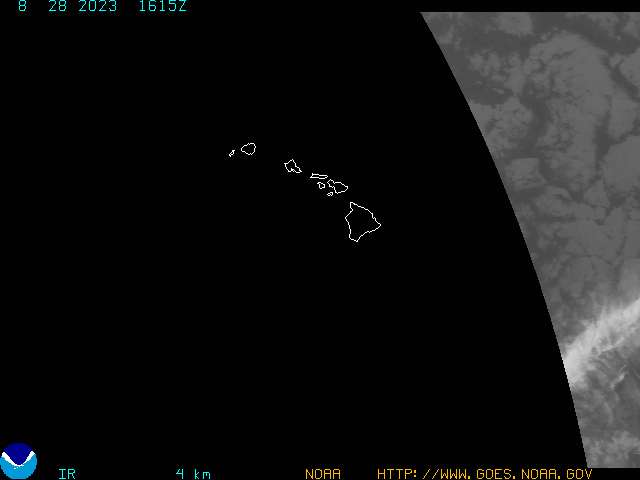
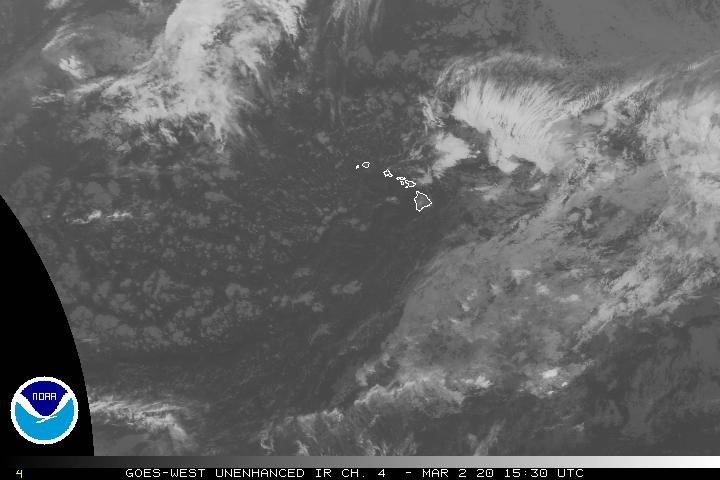
0.13 Glenwood, Big Island Weather Chart – Here’s the latest (automatically updated) weather mapshowing a pair of 1026 millibar high pressure systems located north and northwest of Hawaii. Our local trade winds will remain active, blowing generally in the moderately strong range, locally stronger in those windiest areas. Satellite and Radar Images: To view the cloud conditions we have here in Hawaii, please use the following satellite links, starting off with theInfrared Satellite Image of the islands to see all the clouds around the state during the day and night. This next image is one that gives close images of the islands only during the daytime hours, and is referred to as a Close-up visible image. This next image shows a larger view of the Pacific…giving perspective to the wider ranging cloud patterns in the Pacific Ocean. To help you keep track of where any showers may be around the islands, here’s the latest animatedradar image.
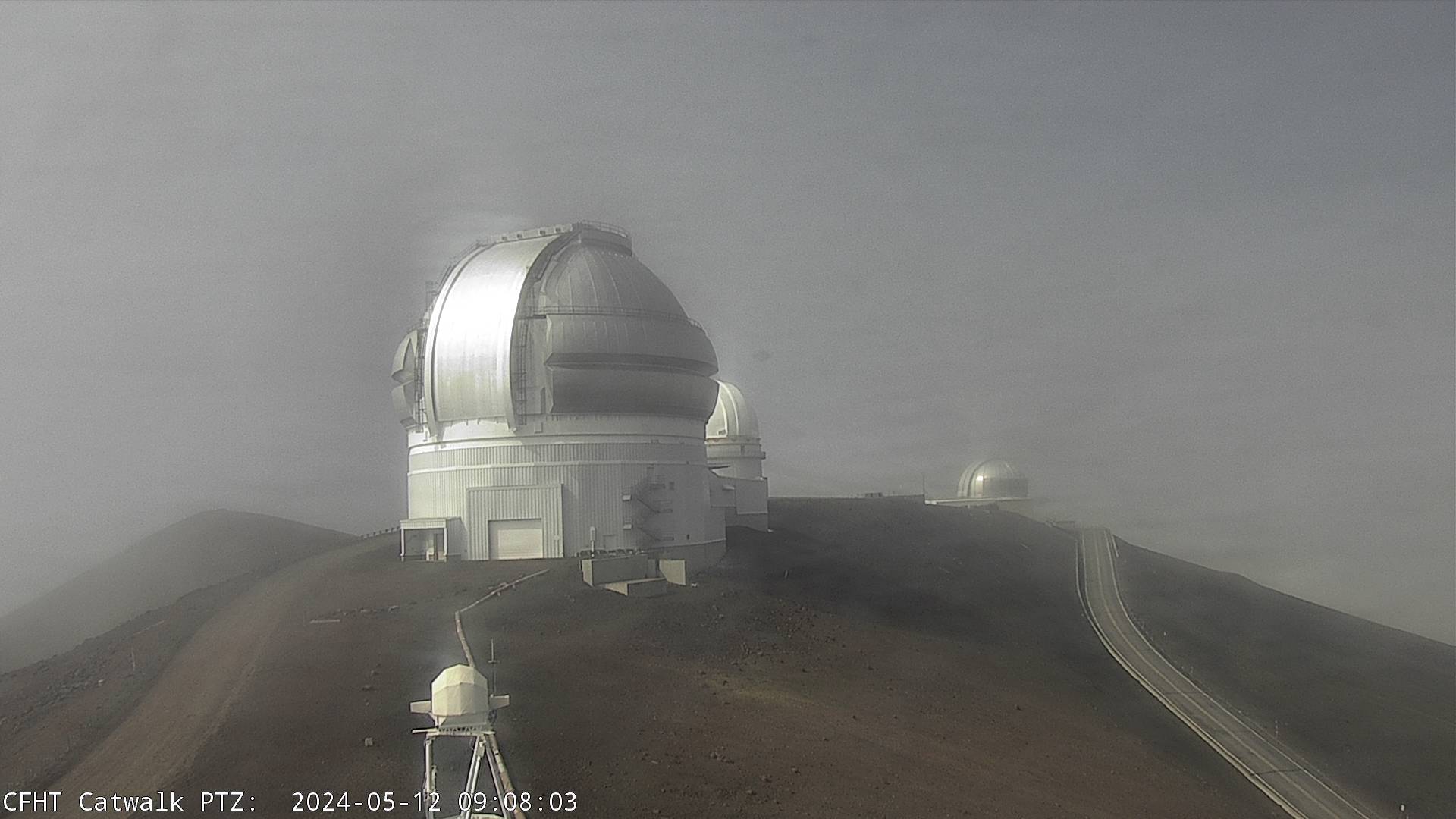
Hawaii’s Mountains – Here’s a link to the live webcam on the summit of near 14,000 footMauna Kea on the Big Island of Hawaii. The tallest peak on the island of Maui is theHaleakala Crater, which is near 10,000 feet in elevation. These two webcams are available during the daylight hours here in the islands…and when there’s a big moon rising just after sunset for an hour or two! Plus, during the nights and early mornings you will be able to see stars, and the sunrise too…depending upon weather conditions.
Aloha Paragraphs
Black sand beach near Hana, Maui Photo Credit: flickr.com
As is typical during the later summer season, our trade winds continue to be the main driver in our Hawaiian Island weather picture.The most recent computer forecast models show the trade winds continuing through this week, right on into next week. Thisweather map,shows a pair of moderately strong 1026 millibar high pressure systems, located to the north and northwest of our islands…keeping moderately strong winds in our area, locally stronger and gusty. The trades have increased a notch, enough so that the NWS forecast office in Honolulu has issued a small craft wind advisory for the windiest spots around Maui County, down through the Big Island.
The trade winds will continue to carry showers our way at times, favoring the windward sides during the nights and mornings.The leeward sides will remain quite sunny for the most part during the days, with generally dry conditions prevailing. The influence of an upper level trough of low pressure, with its shower enhancing cold air aloft, will keep incoming showers along the windward sides. These showers will remain more active than normal through the next couple of days. There may be a few briefly heavy showers, with the chance of a few afternoon showers along the Kona coast of the Big Island as well. As this satellite image shows, there is no lack of clouds coming our way on the trade winds. It’s early Thursday evening here in Kula, Maui, as I begin writing this last paragraph of today’s narrative. I started this day writing about how normal it was, and as soon as I left the house, I realized that I had underestimated the influence of cold air aloft, associated with an upper level trough of low pressure. There were much more than the normal amount of showers that fell around Maui, which then moved up the island chain later in the morning. It showered up here in Kula, all along the windward sides from Hana along the coast to Kapalua and Napili. It even reached over the West Maui Mountains into Lahaina town, where drizzle fell for a time. This shower enhancing trough will keep the chance of showers in the forecast for the next several days, falling most generously during the night and early morning hours. During the day Thursday though, once those morning showers ended, we had plentiful sunshine beaming down. Looking over towards the windward side at the time of this writing, before sunset, there is a nice rainbow shining in the clouds…with a light mist making its way all the way over here into the lee of the Haleakala Crater in Kula. Friday may very well be a repeat of Thursday, which may continue on into Saturday…generally nice weather, punctuated by those passing showers at times. I’ll be back very early Friday morning with your next new narrative, I hope you have a great Thursday night until then! Aloha for now…Glenn. Interesting:
The impact of global warming in the Arctic may differ from the predictions of computer models of the region, according to a pair of Penn State biologists. The team — which includes Eric Post, a PennState associate professor of biology, and Christian Pederson, a PennState graduate student — has shown that grazing animals will play a key role in reducing the anticipated expansion of shrub growth in the region, thus limiting their predicted and beneficial carbon-absorbing effect. The team’s results will be published in the online Early Edition of the journal Proceedings of the National Academy of Sciences. Most computer models indicate that shrubs will thrive and spread as a result of global warming. And because shrubs have an increased ability over grasses and other small plants to absorb the greenhouse gas carbon dioxide, many scientists believe that shrubs will absorb some of this carbon dioxide and, thereby, lessen the impact of climate change.
While Post and Pederson agree that global warming will promote the growth of shrubs, they argue that grazing by muskoxen and caribou will reduce the carbon-mitigating benefit of the plants. "If you imagine a chessboard on which the dark squares are shrubs and the light squares are grasses, warming alone would tend to increase the size of the dark squares until the chess board is completely filled in," said Post. "Our experiment suggests that herbivores, like caribou and muskoxen, will slow this process, inhibit it, or perhaps even increase the size of the white squares on the chessboard."
Interesting2:
Leadwheel weights, widely used to balance vehicle tires but considered a threat to drinking water, will be phased out in California by the end of next year under a court settlement approved Wednesday. The settlement ends a lawsuit filed in May by the Oakland-based Center for Environmental Health against Chrysler and the three largest makers of lead wheel weights for the U.S. market. Some observers see the settlement as a first step toward a broader ban on the products.
Interesting3
:
MayorMichael Bloomberg has proposed a renewable energy program for
New York City that would include placing windmills on city bridges, solar panels on skyscrapers, and the use of tidal, geothermal and nuclear energy. Bloomberg unveiled the outlines of his plan late Tuesday at a major clean energy summit in Las Vegas organized by the University of Nevada. "Just five years ago last week — on August 14th, 2003 — this country got an object lesson in how big a gamble we’re taking with our future if we don’t change course," said Bloomberg, referring to the giant blackout that cut off power for 50 million people across the northeastern United States and Canada. Hundreds of people were rescued from high-rise elevators, and thousands more were rescued from stalled trains in the city’s subway system. "We learned that this time, the enemy was us and our failure to take care of our infrastructure," he said.
"The world’s greatest nation was shown to have a power grid that was seriously over-strained and out-of-date." Bloomberg said he is determined to keep the city’s energy usage at or near its current level even as the population grows. But the city has to increase production of clean energy, he said. "I believe that we’ve got to be willing to do what some other nations — such as France — have already done, and increase our capacity of safe and clean nuclear-generated power," he said. Clean energy projects could also "draw power from the tides of the Hudson and EastRivers — something we’re already doing on a pilot basis," he said. Bloomberg proposed increasing rooftop solar power production, "which we’ve estimated could meet nearly 20 percent of the city’s need for electricity."
Interesting4: Penguin guano isn’t usually considered an environmental hazard. Yet, according to new research, it is the main source of arsenic accumulation in Antarctic soil. Zhouqing Xie of the Institute of Polar Environment at the University of Science and Technology of China and colleagues looked at how much arsenic was found in the droppings of three bird species and two seal species that live on ArdleyIsland, off the Antarctic peninsular. The droppings of the gentoo penguin contained far more than those of the other species – nearly twice as much as the droppings of the southern giant petrel and up to three times more than the local seals. What’s more, sediments from another Antarctic island that has no resident penguins but has a similar geology contained half the levels of arsenic compared with sediment sampled on ArdleyIsland.
So Xie’s team tried to find out how arsenic levels change with the number of penguins in the area. They took a 34 centimetre mud core from the bottom of a lake on ArdleyIsland. This allowed them to measure how arsenic levels have fluctuated over the past 1,800 years and also to estimate how the local penguin population changed: a study published in 2000 (Nature) showed that penguin droppings alter the geochemical composition of lake sediments. Xie found that changes in the local penguin population were followed by changes in the arsenic levels in the lake. More penguins means more arsenic. Arsenic is an environmental contaminant that is naturally present. It is there in the water, which is absorbed by krill and then accumulates in the food chain, passing to predators such as penguins.
Interesting5:
Glider pilots harness upward-moving thermal air currents to keep them aloft for hours, while soaring birds use them to save energy. Uncrewed aerial vehicles may soon borrow the same technique to save precious fuel, using software that identifies regions of rising air. "It could increase the vehicles’ endurance during surveillance missions," says Rhys Watkin of Roke Manor Research in Hampshire, UK, a member of the team that developed the system. To seek out nearby thermal currents, the software first analyses video of the sky taken by an on-board camera. It searches for the telltale grey, dome-shaped clouds that are formed by rapidly rising hot air. The system combines this with real-time weather forecasts and computer simulations of air flow across the local terrain to predict the locations of further thermal currents.
The team also fed the software information from anecdotal reports by expert gliders, highlighting areas of rising air in specific locations and in various weather conditions. During a mission, the software uses all of this data, together with the aircraft’s GPS coordinates, to plan a route that passes through as many thermals as possible. So far, the system has only been used to suggest the path for a glider pilot to follow, but the team is developing software to enable an autonomous vehicle to fly solo. In the future, Watkin hopes to add further software that will analyse maps of the local area and estimate how well ground surfaces emit heat, which also helps predict the location of thermals.
Interesting6:
A man-sized grouper that trolls the tropical waters of the Eastern Pacific Ocean for octopuses and crabs has been identified as a new fish species after genetic tests. Called the goliath grouper, the fish can grow to six feet (1.8 meters) in length and weigh a whopping 1,000 pounds (454 kg). Until now, scientists had grouped this species with an identical looking fish (also called the goliath grouper, or Epinephelus itajara) living in the Atlantic Ocean. "For more than a century, ichthyologists have thought that Pacific and Atlantic goliath grouper were the same species," said lead researcher Matthew Craig of the Hawaii Institute of Marine Biology, "and the argument was settled before the widespread use of genetic techniques." Once upon a time, about 3.5 million years ago — before the Caribbean and the Pacific were separated by present-day Panama — they were, in fact, the same species.
Now, DNA tests have revealed the two populations have distinct genes, indicating they likely evolved into two separate species after their ocean homes were divided by Central America. Scientists disagree about how to define the term "species" and what separates species from one another biologically, though some say that a species is a group that can mate with one another and produce offspring that are not sterile. However, this biological definition doesn’t always hold up, for instance, with coyotes and wolves (considered separate species), which can successfully produce fertile offspring. In this study, the scientists relied on differences in the fishes’ genetic codes to establish the separate grouper species.
Interesting7:
The male peacock’s tail was a vexing problem for the father of evolutionary theory, Charles Darwin, who struggled to explain why the bird should have such a seemingly burdensome trait. Darwin finally struck upon the idea of sexual selection, which posits that extravagant traits like the peacock’s colorful fan of feathers provided an advantage in the competition for mates that outweighed other disadvantages. Biologists think that certain physical characteristics are signals to potential mates that the individual they’re scoping out is healthy and vigorous; the process even works in humans, who are attracted to symmetrical faces and other outward signs of fitness.
Some researchers are now turning their attention from why showy traits evolved, to how they evolved and why they tend to do so more often in males. To help answer these questions, scientists at the University of Wisconsin-Madison studied fruit fly derrieres and found that ancient genetic switches have evolved to manipulate the appearance of animals in a way that favored their selection as mates, providing a possible explanation for how peacocks evolved their spectacular tails.
Air Temperatures – The following maximum temperatures were recorded across the state of Hawaii Wednesday afternoon:
Lihue, Kauai – 86 Honolulu, Oahu – 89 Kaneohe, Oahu – 85 Kahului, Maui – 86 Hilo, Hawaii – 86
Kailua-kona – 83 Air Temperaturesranged between these warmest and coolest spots near sea level, and on the taller mountains…at 5 p.m. Wednesday evening:
Barking Sands, Kauai– 85F Kahului, Maui – 79
Haleakala Crater- 46 (near 10,000 feet on Maui)
Mauna Kea summit – 39 (near 14,000 feet on the Big Island) Precipitation Totals – The following numbers represent the largest precipitation totals (inches) during the last 24 hours on each of the major islands, as of Wednesday afternoon: 0.43 Mount Waialeale, Kauai
0.20 Oahu Forest NWR, Oahu
0.00 Molokai
0.00 Lanai
0.00 Kahoolawe 0.17 Puu Kukui, Maui
0.01 Kahuku Ranch, Big Island Weather Chart – Here’s the latest (automatically updated) weather mapshowing a 1026 millibar high pressure system located north of Hawaii. Our local trade winds will remain active, blowing generally in the light to moderately strong range, although locally a bit stronger in those windiest areas. Satellite and Radar Images: To view the cloud conditions we have here in Hawaii, please use the following satellite links, starting off with theInfrared Satellite Image of the islands to see all the clouds around the state during the day and night. This next image is one that gives close images of the islands only during the daytime hours, and is referred to as a Close-up visible image. This next image shows a larger view of the Pacific…giving perspective to the wider ranging cloud patterns in the Pacific Ocean. To help you keep track of where any showers may be around the islands, here’s the latest animatedradar image.
Hawaii’s Mountains – Here’s a link to the live webcam on the summit of near 14,000 footMauna Kea on the Big Island of Hawaii. The tallest peak on the island of Maui is theHaleakala Crater, which is near 10,000 feet in elevation. These two webcams are available during the daylight hours here in the islands…and when there’s a big moon rising just after sunset for an hour or two! Plus, during the nights and early mornings you will be able to see stars, and the sunrise too…depending upon weather conditions.
Aloha Paragraphs
Windsurfing action offshore from Kaanapali, Maui Photo Credit: flickr.com
The trade wind speeds have slipped a touch, blowing now in the light to moderately strong category.As usual, the windy MaalaeaBay on Maui, with its venture wind acceleration, will have considerably higher gusts than most other areas around the state.The winds are light enough in fact, that the NWS has cancelled the long lasting small craft wind advisory. The computer models show the trade winds continuing through this week, right on into next week. This weather map, shows a moderately strong 1027 millibar high pressure system, located to the north-northwest of our islands…the source of our trade winds now. That same weather chart shows what we call a cyclone family of low pressure systems…stretching from off of Japan, across the western Pacific, through the International Dateline…into our central Pacific. This is a rather unusual example of low pressure systems lined up more or less a row.
There will be just the normal amount of passing shower activity along the windward sides for the time being. An area of showers, associated with an old cold front, missed most of the state, impacting only Kauai and Oahu…where light to moderately heavy showers fell. Maui and the BigIsland were too far south to poke into this minor batch of showers. The leeward sides will remain quite sunny for the most part during the days, with generally dry conditions prevailing. The one exception might be for a few showers to spill over the lower mountains on the smaller islands, and on the slopes above Kona during the afternoons. We may see a slight increase in windward showers later on Thursday or Friday, due to the arrival of a shower enhancing upper level low pressure trough then. There are no organized rain makers heading in our direction at this time…with exceptionally dry air well upstream of the islands. It’s early Wednesday evening here in Kula, Maui, as I begin writing this last paragraph of today’s narrative. When I left the Pacific Disaster Center, in Kihei, I found unusually clear skies on the drive upcountry. As a matter of fact, looking out towards the windward side, towards Paia and Haiku, there really isn’t a cloud in sight. Here in Kula, where clouds gathered during the afternoon hours, and showers fell, the clouds are long gone as well. Glancing back downcountry, I see that the West Mountains are still wearing their customary cap of clouds. It’s really one of those rare summer evenings, when clouds are nearly non-existent. Looking at this satellite image, we see just a few clouds, which don’t look like particularly wet ones to the east…being carried our way on the light to moderately strong trade winds. I anticipate Thursday should continue the long string of fair weather days that we’ve seen during the last week. I hope you have a great night, and that you’ll plan on meeting me here again on Thursday for the next new weather narrative from paradise. I’ll be up well before sunrise preparing the text for that narrative, as usual. Aloha for now…Glenn. Interesting:
Most Americans think that the worst of the fuel price spike that pushed gasoline above $4 per gallon has passed, but they have little hope that the housing market will stage a swift recovery, according to a Reuters/Zogby poll released on Wednesday. The economy has jumped to the top of voters’ concerns this election year, eclipsing the Iraq War, and that has put the housing bust and rising inflation squarely in the spotlight. The poll of 1,089 likely voters found that just under 13 percent thought gasoline prices would rise a lot between now and the end of the year. About one quarter thought prices would rise a little, while one in three thought they would drop a little and 18 percent said they would stay about the same.
The survey was conducted August 14-16, when oil prices had come down some $30 from a July 11 peak above $147 per barrel, and the national average price for a gallon of gasoline fell back below the psychologically significant $4 mark.
Pollster John Zogby said the swift rise in fuel prices earlier this year had fundamentally changed U.S. consumer behavior, and a pullback below $115 per barrel was not sufficient to alter that. "The lines are not forming to buy Hummers," he said, referring to the big luxury trucks that are notorious for their poor fuel mileage. Mounting costs for necessities like food and gasoline have strained household budgets, leaving less money for spending on discretionary items. That has put a dent in the U.S. economy, which was already struggling to overcome the housing slump and financial market turmoil.
Interesting2: The U.S. public, while aware of the deteriorating global environment, is concerned predominantly with local and national environmental issues, according to results from a recent survey. "The survey’s core result is that people care about their communities and express the desire to see government action taken toward local and national issues," said David Konisky, a policy research scholar with the Institute of Public Policy and assistant professor in the Truman School of Public Affairs at the University of Missouri, who conducted the study. "People are hesitant to support efforts concerning global issues even though they believe that environmental quality is poorer at the global level than at the local and national level.
This is surprising given the media attention that global warming has recently received and reflects the division of opinion about the severity of climate change." Konisky recently surveyed 1,000 adults concerning their attitudes about the environment. The survey polled respondents about their levels of concern for the environment and preferences for government action to address a wide set of environmental issues. A strong majority of the public expressed general concern about the environment. According to the survey, the top three issues that the public wants the government to address are protecting community drinking water, reducing pollution of U.S. rivers and lakes, and improving urban air pollution issues like smog. In the survey, global warming ranks eighth in importance.
Interesting3
:
The confirmation of Martian water ice by the Phoenix Mars Lander may hint at the planet’s potential for supporting life — or at least human life. NASA scientists have quietly developed technologies such as microwave beams for future explorers to extract water from the moon or Mars, even as the Phoenix team focuses on finding out more about the Martian climate and history of water. "If there is an outpost, there’s a need for water, and we don’t want to bring water from Earth," said Edwin Ethridge, a materials scientist at NASA’s MarshallSpaceFlightCenter in Huntsville, Ala. Water could provide more than just an extraterrestrial drink: the right equipment could break down water for oxygen and even fuel for a human mission. That could lighten the load and cost of any future mission heading for the moon or Mars. Ethridge spends most of his time working on the Ares rockets slated to return NASA astronauts to the moon.
So perhaps it’s no surprise that he devotes his spare moments to tinkering with a device that can beam microwaves down to help extract underground water ice. "One of the chief advantages of microwaves is that it will penetrate the soil, and so would greatly minimize if not eliminate requirement to dig," Ethridge told SPACE.com. Eliminating the need to dig would also reduce the chance for dust to cause problems with astronauts and their equipment. Microwaves could also work better on the moon given its near-vacuum environment and super-insulating lunar dust. Ethridge worked with colleague Bill Kaukler, also at NASA Marshall, to run demonstration tests on simulated lunar permafrost. They found that they could remove 98 percent of water ice through sublimation, or converting the frozen water directly into a gas, and could also capture 99 percent of the extracted water.
Interesting4:
Whether an ant becomes a dominant queen or a lowly worker is determined by both nature and nurture, it turns out. A new study found that an ant’s social status in its colony depends both on its genetic inheritance and the food it eats when it is young. Researchers studied Florida harvester ants (Pogonomyrmex badius) to investigate what factors decide a particular ant’s social caste. "Basically what we found is that things are more complicated than previously thought," said researcher Christopher R. Smith, a former graduate student at the University of Illinois at Urbana-Champaign and now a postdoctoral researcher at Arizona State University.
"Our study shows that there is a large genetic component to caste determination, but that there is also a very strong environmental component." The study, led by University of Illinois at Urbana-Champaign biologist Andrew Suarez, was detailed in the August issue of the journal American Naturalist. In P. badius societies there is only one social trajectory for males — they are produced about once a year and "do nothing but mate and die," Smith said.
Interesting5:Tiny transmitters attached to Atlantic salmon are helping to solve a mystery about their lengthy and sometimes fatal ocean treks and why the fish’s population numbers are dropping. Adult salmon are champion swimmers, often trekking more than 2,500 miles (4,000 km) from rivers to the ocean feeding grounds and back to these same rivers to reproduce. Once salmon hatchlings emerge from their eggs in freshwater rivers, they spend the first two to three years of their lives in that water before migrating to the ocean. However, for every, say, 140 salmon that reach the ocean, only one fish returns to the river, said Mike Stokesbury, director of research for the Ocean Tracking Network (OTN), headquartered at Dalhousie University in Nova Scotia.
"They know the fish are dying in the ocean, but they don’t know where." The transmitters showed that significant numbers of the fish are at least making it well into the sea, rather than dying as soon as they enter the ocean. About 30 percent of a tagged group migrated from a river in Maine at least 370 miles (600 km) in the ocean to a region off the coast of Halifax, Nova Scotia, on their way to feeding grounds off of Greenland. "Salmon are an iconic fish, but they’re becoming endangered and people want to know what’s happening to the population," Stokesbury said. "This is the first step to finding out where in the ocean the salmon are dying and what’s causing the decline."
Interesting6: Hordes of mountain pine beetles are decimating British Columbian forests. Rising temperatures due to global warming have boosted the beetles’ numbers by increasing their reproductive rate and reducing their winter die-off. Now, in a perverse twist, a new study shows that in a few years, the pests will have turned the once climate-friendly forests into net emitters of carbon dioxide (CO2). Since 2000, the beetles have killed off more than 32 million acres of forest, according to Werner A. Kurz and a team of scientists from the Canadian Forest Service. Kurz and colleagues say the current outbreak is an order of magnitude larger than any previous mountain-pine-beetle explosion, and they predict it will take another twelve years or so to taper off.
That’s a lot of dead trees, which release CO2 as they decompose. Meanwhile, there are fewer healthily growing trees left to absorb the greenhouse gas through photosynthesis. Using a computer model, Kurz’s team calculated that by 2020, the beetles will have killed so much forest that their net effect will be the equivalent of five years of CO2 emissions by all the cars and trucks of Canada. Kurz and his team are the first to account for large-scale insect outbreaks in an analysis of forest carbon balances — and to show the positive feedback loop between climate change and insect pests. They’re unlikely to be the last, however, given the risk of more boreal forests falling prey to warmth-loving insects. The research was detailed in the journal Nature.
Interesting7:
Here’s the new taste sensation — your tongue might be able to taste calcium. The capability to taste calcium has now been discovered in mice. With these rodents and humans sharing many of the same genes, the new finding suggests that people might also have such a taste. The four tastes we are most familiar with are sweet, sour, salty and bitter. Recently scientists have discovered tongue molecules called receptors that detect a fifth distinct taste — "umami," or savory. "But why stop there?" asked researcher Michael Tordoff, a behavioral geneticist at the MonellChemicalSensesCenter in Philadelphia. "My group has been investigating what we believe is another taste quality — calcium." So assuming the human palate can detect calcium, what does the mineral taste like? "Calcium tastes calcium-y," Tordoff said. "There isn’t a better word for it.
It is bitter, perhaps even a little sour. But it’s much more because there are actual receptors for calcium, not just bitter or sour compounds." One way we might regularly perceive calcium is when it comes to minute levels found in drinking water. "In tap water, it’s fairly pleasant," Tordoff said. "But at levels much above that, the taste becomes increasingly bad." There may be a strong link between the bitterness of certain vegetables and their calcium level. High-calcium vegetables include collard greens, bok choy, kale and bitter melon. One reason some people might avoid these veggies, Tordoff suggests, is because of their calcium taste. Ironically, while milk and other dairy products are loaded with calcium, the mineral tends to bind to fats and proteins, which prevents you from tasting it in these foods.
Air Temperatures – The following maximum temperatures were recorded across the state of Hawaii Tuesday afternoon:
Lihue, Kauai – 87 Honolulu, Oahu – 88 Kaneohe, Oahu – 85 Kahului, Maui – 86 Hilo, Hawaii – 85
Kailua-kona – 85 Air Temperaturesranged between these warmest and coolest spots near sea level, and on the taller mountains…at 4 p.m. Tuesday afternoon:
Port Allen, Kauai– 88F Hilo, Hawaii – 82
Haleakala Crater- 50 (near 10,000 feet on Maui)
Mauna Kea summit – 45 (near 14,000 feet on the Big Island) Precipitation Totals – The following numbers represent the largest precipitation totals (inches) during the last 24 hours on each of the major islands, as of Tuesday afternoon:
0.10 Kokee, Kauai
0.11 Poamoho 2, Oahu
0.00 Molokai
0.00 Lanai
0.00 Kahoolawe 0.25 West Wailuaiki, Maui
0.18 Laupahoehoe, Big Island Weather Chart – Here’s the latest (automatically updated) weather mapshowing a 1027 millibar high pressure system located north of Hawaii. Our local trade winds will remain active, blowing generally in the light to moderately strong range, although locally a bit stronger in those windiest areas. Satellite and Radar Images: To view the cloud conditions we have here in Hawaii, please use the following satellite links, starting off with theInfrared Satellite Image of the islands to see all the clouds around the state during the day and night. This next image is one that gives close images of the islands only during the daytime hours, and is referred to as a Close-up visible image. This next image shows a larger view of the Pacific…giving perspective to the wider ranging cloud patterns in the Pacific Ocean. To help you keep track of where any showers may be around the islands, here’s the latest animatedradar image.
Hawaii’s Mountains – Here’s a link to the live webcam on the summit of near 14,000 footMauna Kea on the Big Island of Hawaii. The tallest peak on the island of Maui is theHaleakala Crater, which is near 10,000 feet in elevation. These two webcams are available during the daylight hours here in the islands…and when there’s a big moon rising just after sunset for an hour or two! Plus, during the nights and early mornings you will be able to see stars, and the sunrise too…depending upon weather conditions.
Aloha Paragraphs
Sailing offshore from Molokai Photo Credit: flickr.com
There will be a slight softening of our local trade winds now, although they will remain active through the rest of this week. The winds are still strong enough that the NWS is keeping a small craft wind advisory active over those windiest areas from Molokai down through Maui, to the Big Island Tuesday night. The computer models show the trade winds continuing through this week, right on into next week. This weather map, shows two moderately strong 1026 millibar high pressure systems, located to the north of our islands…the source of our trade winds now. The winds are rather gusty atop the summits on the Big Island, where a NWS issued wind advisory remains in force for those near 14,000′ peaks.
We can expect a few windward showers, increasing some later this evening into Wednesday from Kauai to Maui…less on the Big Island.The leeward sides will be nice and sunny for the most part during the days, with generally dry conditions prevailing. Looking at satellite pictures, there’s an area of clouds being carried in our direction by the trade winds. This batch of clouds are part of an old cold front, which was active several days ago far to the northeast of Hawaii. We may see a second more modest increase in windward showers later on Thursday or Friday, due to the arrival of a shower enhancing upper level low pressure trough then.
As many of you know, I attended a Pacific Disaster Center organized Climate Conference at the East-West Center last week. It was an impressive group of professionals, many of which were the top climate scientists from around the world. The long and short of the discussions concluded that the planet Earth is in trouble on many fronts. The scope of the problem is so large, and daunting, that it’s very difficult to know where to begin finding a solution. Actually, what was discussed was finding small, localized solutions (going green is a good way of describing this) rather than trying to tackle the big problems as a whole. Looking specifically at the Hawaiian Islands, what we will likely find is a trend toward having more El Nino like weather patterns. El Nino manifests as dry weather here in Hawaii, which can lead to severe droughts…and at the same time, more frequent tropical storms and hurricanes during summer into the fall months. Thus, we need to plan for conserving water, and preparing for storms that bring strong winds, high waves, and of course flooding over the upcoming decades, that is…if things continue to go in the direction they’re going now in the world. It’s early Tuesday evening here in Kihei, Maui, as I begin writing this last paragraph of today’s narrative. We’re in the dog days of August now, down here in the tropical latitudes of the north central Pacific. The days are on the hot side, especially near sea level. Fortunately, the trade winds continue to blow, bringing their cooling and refreshing relief from the heat. Tuesday was yet another very nice day, the kind of day that sun worshippers love! It turned out to be about as normal a summer day as possible, just the way almost everyone who spent any time outside, could have wanted it. As noted above, satellite imagery shows an area of showery clouds moving into the windward sides of the islands…although the Big Island appears to be just out of reach of these showers. We can look for off and on showers into the night, and likely into Wednesday, which will go a long ways towards keeping our lush tropical vegetation watered. I’ll be back very early Wednesday morning with your next new weather narrative, I hope you have a great Tuesday night! Aloha for now…Glenn. Interesting:
Hawaii has announced the results of its beverage containerrecycling efforts for the fiscal year 2008, and the state increased recycling by four percent to reach 72 percent recovery, an all-time high. The state says this means more than 680 million containers were recycled from July 1, 2007 to June 30, 2008. State law requires that if more than 70 percent of containers are recycled there would be an increase in the container recycling fee (this cover costs of collection and sorting), but the director of health decided to waive the fee increase (it’s currently one cent per container). Hawaii is one of 11 states to offer a beverage container deposit, meaning consumers pay a fee (in this case six cents) when purchasing containers and get a refund when the containers are recycled. Part of the increase may have to do with the expansion of Hawaii’s HI-5¢ program in 2007. See what your state is doing regarding recycling using Earth911’s Act Locally section.
Interesting2: The U.S. public, while aware of the deteriorating global environment, is concerned predominantly with local and national environmental issues, according to results from a recent survey. "The survey’s core result is that people care about their communities and express the desire to see government action taken toward local and national issues," said David Konisky, a policy research scholar with the Institute of Public Policy and assistant professor in the Truman School of Public Affairs at the University of Missouri, who conducted the study. "People are hesitant to support efforts concerning global issues even though they believe that environmental quality is poorer at the global level than at the local and national level.
This is surprising given the media attention that global warming has recently received and reflects the division of opinion about the severity of climate change." Konisky recently surveyed 1,000 adults concerning their attitudes about the environment. The survey polled respondents about their levels of concern for the environment and preferences for government action to address a wide set of environmental issues. A strong majority of the public expressed general concern about the environment. According to the survey, the top three issues that the public wants the government to address are protecting community drinking water, reducing pollution of U.S. rivers and lakes, and improving urban air pollution issues like smog. In the survey, global warming ranks eighth in importance.
Interesting3
:
The word "planet" has meant many different things over the millennia and even still its definition is evolving. The word is typically traced back to the ancient Greeks, who believed the Earth was stationary at the center of the universe while objects in the sky revolved around it. The Greek term asters planetai mean "wandering stars" and described the tiny lights that moved across the sky more dramatically than stars when compared over weeks and months. These wandering stars, back then, amounted to Mercury, Venus, Mars, Jupiter and Saturn. Some think the Greeks and Romans of ancient times considered the sun and Earth’s moon as planets.
An Elizabethan-era stage play and comedy published in 1597, called "The Woman in the Moon," depicted the solar system with seven planets, including Saturn, Jupiter, Mars, Mercury, Venus, Sol (the sun) and Luna (the moon). Nicolaus Copernicus, in 1543, published his mathematical evidence of a heliocentric universe where the six planets revolved around the sun. Only six planets, including Earth, were known until the 18th Century. In 1781, Sir William Herschel discovered Uranus in that he determined the point of light was a planet and not another star as it had been considered until then.
Interesting4:
Dips in the sun’s activity have triggered centuries-long droughts in eastern North America, according to a new study that examined the geologic record stored within a stalagmite from a West Virginia cave. The link between periodic droughts and changes in solar activity initially was proposed by geologist Gerald Bond. He suggested that every 1,500 years, weak solar activity caused by fluctuations in the sun’s magnetic fields cooled the North Atlantic Ocean and created more icebergs and ice rafting, or the movement of sediment to the ocean floor. This caused less precipitation to fall, creating drought conditions. The climate record preserved by trace elements such as strontium, carbon and oxygen in stalagmites is clearer and more detailed than records previously taken from lake sediments. During dry periods, strontium is concentrated in stalagmites. Carbon isotopes also record drought because drier soils slow biological activity.
For the new study, researchers cut and polished a stalagmite taken from Buckeye Creek Cave, and drilled out 200 samples. The metals and isotopes in the stalagmites’ growth layers were weighed and analyzed to determine how the concentrations changed over time. The stalagmite’s record provides evidence that there were at least seven major droughts during the Holocene era in eastern North America. Some of these, from about 6,300 to 4,200 years ago, were particularly pronounced, lasting for decades or even entire centuries. "This really nails down the idea of solar influence on continental drought," said geologist Gregory Spring of Ohio University and the study’s leader. The results of the study are detailed online in the journal Geophysical Research Letters.
Air Temperatures – The following maximum temperatures were recorded across the state of Hawaii Monday afternoon:
Lihue, Kauai – 87 Honolulu, Oahu – 89 Kaneohe, Oahu – 84 Kahului, Maui – 87 Hilo, Hawaii – 83
Kailua-kona – 86 Air Temperaturesranged between these warmest and coolest spots near sea level, and on the taller mountains…at 4 p.m. Monday afternoon:
Port Allen, Kauai– 86F Princeville, Kauai – 82
Haleakala Crater- 57 (near 10,000 feet on Maui)
Mauna Kea summit – 41 (near 14,000 feet on the Big Island) Precipitation Totals – The following numbers represent the largest precipitation totals (inches) during the last 24 hours on each of the major islands, as of Monday afternoon: 0.35 Mount Waialaele, Kauai
0.02 Oahu Forest NWR, Oahu
0.00 Molokai
0.00 Lanai
0.00 Kahoolawe 0.20 West Wailuaiki, Maui
0.17 Kealakekua, Big Island Weather Chart – Here’s the latest (automatically updated) weather mapshowing a pair of 1025 millibar high pressure systems located north of Hawaii. Our local trade winds will remain active, blowing generally at the moderately strong level, although locally stronger in those windier areas…a little lighter Wednesday. Satellite and Radar Images: To view the cloud conditions we have here in Hawaii, please use the following satellite links, starting off with theInfrared Satellite Image of the islands to see all the clouds around the state during the day and night. This next image is one that gives close images of the islands only during the daytime hours, and is referred to as a Close-up visible image. This next image shows a larger view of the Pacific…giving perspective to the wider ranging cloud patterns in the Pacific Ocean. To help you keep track of where any showers may be around the islands, here’s the latest animatedradar image.
Hawaii’s Mountains – Here’s a link to the live webcam on the summit of near 14,000 footMauna Kea on the Big Island of Hawaii. The tallest peak on the island of Maui is theHaleakala Crater, which is near 10,000 feet in elevation. These two webcams are available during the daylight hours here in the islands…and when there’s a big moon rising just after sunset for an hour or two! Plus, during the nights and early mornings you will be able to see stars, and the sunrise too…depending upon weather conditions.
Aloha Paragraphs
The Hamakua coast on the Big island of Hawaii Photo Credit: flickr.com
The trade winds, which have been blowing in the moderately strong category…will gradually get slightly lighter over the next couple of days.The winds are still strong enough as we start off this new work week however, that the NWS is keeping the small craft wind advisory active over those windiest areas from Molokai down through Maui, to the Big Island. The computer models show the trade winds continuing through this new week, although coming down in strength a little starting Tuesday onward. This weather map, shows two moderately strong 1025 millibar high pressure systems, pretty much directly north of our islands…the source of our trade winds at this time. The long range computer models don’t show any sign of our islands losing the trade wind flow anytime soon.
We can expect some windward biased showers Monday…perhaps increasing some later Tuesday into Wednesday, and then again Thursday into Friday.The leeward sides will be nice and sunny for the most part, with generally dry conditions prevailing…although the Kona area could see some afternoon showers locally. Looking at satellite pictures, there’s an area of clouds being carried in our direction by the trade winds, generally taking aim on Maui and the Big Island. As this satellite image shows, there’s an another area of potential showers, located to the north and northeast of Hawaii…which may bring some windward biased showers to the state later Tuesday into Wednesday. The Thursday increase (noted in bold above), in showers may occur due to the arrival of a trade wind shower enhancing upper level low pressure trough then. It’s early Monday evening here in Kihei, Maui, as I begin writing this last paragraph of today’s narrative. Monday was another good day here in the Aloha state, with abundant, and I might add very warm sunshine, beaming down on us. There were a few showers falling, although most of them exclusively along the windward coasts and slopes. Tuesday will be another beauty, although as noted in the paragraph above, clouds should increase, along with their associated showers later in the day, into early Wednesday. This shower area is what’s left of an old cold front…which is being carried our way on the trade wind flow. I must admit, that Monday was a rather slow day, at least that’s how it felt to me. I attribute this to the deep relaxation that set in during my mini-vacation on the island of Oahu recently. It was a little difficult to get myself amped-up, although my mid-morning espresso definitely helped to some degree. I’ll be back very early Tuesday morning with your next new weather narrative from paradise, and hopefully with a bit more energy after a good nights sleep. I hope you have a great Monday night wherever you happen to be spending it! Aloha for now…Glenn. Interesting:
New York City’s yellow taxi fleet now will go green at the rate of 300 new hybrid cars a month, Mayor Michael Bloomberg said, citing an agreement with car-makers to supply the fuel-light cabs.There are already more than 1,300 hybrid taxis in the city, and each one saves its drivers about $6,500 a year, Taxi and Limousine Commission Chairman Matthew Daus said in a joint statement with the mayor. Bloomberg aims to accomplish 127 green initiatives before his second and final four-year term ends in 2010. In December, the Taxi and Limousine Commission voted to require all vehicles that join the taxi fleet to be hybrids by Oct. 1.
The only exception is for cabs specially equipped for the handicapped. Nissan Motor has promised the city to supply up to 200 of its Altima hybrids per month, while General Motors will provide 50 Chevrolet Malibu hybrids and Ford Motor Co promised 50 of its Escape hybrids, the mayor said. That adds up to 90 more cars per month than the Taxi and Limousine Commission had said were needed to meet its goals, which aim to ensure that by 2012, the entire taxi fleet will be all-hybrid or a mix that includes other cars with similar high mile-per-gallon ratings. Fast-growing demand for hybrids in an era of soaring gasoline prices is one of the brightest markets for automobile companies and New York City is not alone in emphasizing taxis. Ford, for example, says San Francisco put its first Escape hybrid taxi on the streets in 2005, followed by other cities, including Chicago.
Interesting2:
The Dead Sea has been a religious and cultural landmark of the Middle East for thousands of years. Saltier than the oceans, the lake is like none other in the world. But in the past 30 years, the Dead Sea has lost about a third of its surface area. As much as 95 percent of the flow of its main tributary, the Jordan River, has been diverted for agriculture and domestic use. Excessive mineral mining for potash and magnesium chloride is removing water at a rate of 150 million cubic meters per year.
As water levels drop by as much as one meter per year, the combination of diversion and evaporation is threatening both economic development and the natural oases that support the Dead Sea‘s unique ecosystem. In an effort to halt the sea’s rapid disappearance, Jordan, Israel, and the Palestinian Authority, with the help of the World Bank, are proposing a project to import water from the Red Sea in the south. While dramatic engineering may be necessary to save this timeless attraction, environmentalists warn that less-risky alternatives are being ignored.
If built, the Red-Dead conduit is expected to cost $15 billion. Projects of this scale are not unprecedented, especially as water demand grows rapidly in many regions of the world.
Interesting3
: Question: Where Does Smog Occur?
Answer: Severe smog and ground-level ozone problems exist in many major cities around the world, from Mexico City to Beijing. In the United States, smog affects much of California, from San Francisco to San Diego, the mid-Atlantic seaboard from Washington, DC, to southern Maine, and major cities in the South and Midwest.
To varying degrees, the majority of U.S. cities with populations of 250,000 or more have experienced problems with smog and ground-level ozone. According to some studies, more than half of all U.S. residents live in areas where the smog is so bad that pollution levels routinely exceed safety standards set by the U.S. Environmental Protection Agency.
Interesting4:
Ahuge comet-like object has been spotted inside the orbit of Neptune. The object, at least 30 miles wide, is on the return leg of a 22,500-year journey around the sun, astronomers announced today. Catalogued as 2006 SQ372, the interloper is just over two billion miles (3.2 billion km) from Earth, though its elongated trek takes it to a distance of 150 billion miles (241 billion km), or nearly 1,600 times the distance from the Earth to the sun. The only known object with a comparable orbit is Sedna — a distant, Pluto-like dwarf planet discovered in 2003. But 2006 SQ372’s travels take it more than 1.5 times farther from the sun. Its diameter is estimated at 30 to 60 miles (50 to 100 km).
"It’s basically a comet, but it never gets close enough to the sun to develop a long, bright tail of evaporated gas and dust," said Andrew Becker of the University of Washington. Comet tails form when solar energy boils material off a comet. The object is not a threat to Earth, which is good. A comet that size would cause global devastation. The space rock that contributed to the demise of dinosaurs 65 million years ago was about 6 miles (10 km) wide. The comet Hale-Bopp, which put on a spectacular display in the late 1990s, is about 31 miles (50 km) in diameter. Yet many comets are just a mile or two wide.
Air Temperatures – The following maximum temperatures were recorded across the state of Hawaii Sunday afternoon:
Lihue, Kauai – 86
Honolulu, Oahu – 87 Kaneohe, Oahu – 84 Kahului, Maui – 88 Hilo, Hawaii – 84
Kailua-kona – 86 Air Temperaturesranged between these warmest and coolest spots near sea level, and on the taller mountains…at 8 p.m. Sunday evening:
Barking Sands, Kauai– 81F Hilo, Hawaii – 73
Haleakala Crater- 43 (near 10,000 feet on Maui)
Mauna Kea summit – 37 (near 14,000 feet on the Big Island) Precipitation Totals – The following numbers represent the largest precipitation totals (inches) during the last 24 hours on each of the major islands, as of Sunday evening: 2.38 Mount Waialaele, Kauai
0.54 Oahu Forest NWR, Oahu
0.01 Molokai
0.00 Lanai
0.00 Kahoolawe 0.71 Puu Kukui, Maui
0.24 Glenwood, Big Island Weather Chart – Here’s the latest (automatically updated) weather mapshowing a 1026 millibar high pressure system located far to the north of Hawaii. Our local trade winds will remain active, blowing generally at the moderately strong level, although locally stronger in those windier areas…a little lighter Tuesday. Satellite and Radar Images: To view the cloud conditions we have here in Hawaii, please use the following satellite links, starting off with theInfrared Satellite Image of the islands to see all the clouds around the state during the day and night. This next image is one that gives close images of the islands only during the daytime hours, and is referred to as a Close-up visible image. This next image shows a larger view of the Pacific…giving perspective to the wider ranging cloud patterns in the Pacific Ocean. To help you keep track of where any showers may be around the islands, here’s the latest animatedradar image.
Hawaii’s Mountains – Here’s a link to the live webcam on the summit of near 14,000 footMauna Kea on the Big Island of Hawaii. The tallest peak on the island of Maui is theHaleakala Crater, which is near 10,000 feet in elevation. These two webcams are available during the daylight hours here in the islands…and when there’s a big moon rising just after sunset for an hour or two! Plus, during the nights and early mornings you will be able to see stars, and the sunrise too…depending upon weather conditions.
Aloha Paragraphs
Waimanalo Beach on the windward side of Oahu Photo Credit: flickr.com
Our local trade winds have increased in strength some this weekend…remaining moderately strong through Monday. The winds are strong enough now, that the NWS is keeping a small craft wind advisory active for those windiest areas from Molokai down through Maui, to the Big Island. The computer models show the trade winds continuing into the new week, although coming down in strength a little starting Tuesday onward.
We’re into a well established summertime trade wind weather pattern, with just a few windward showers. The leeward sides will be nice and sunny for the most part, with generally dry conditions prevailing…although with some high cirrus clouds sweeping overhead at times. Former eastern Pacific tropical cyclone Hernan, now just a harmless trough of low pressure, is moving by south of the Hawaiian Islands. The northern fringe may clip the southern portion of the Big Island, but the other islands in the chain won’t see any showers from this source of moisture.
It’s early Sunday morning here in Kailua Beach, on the windward side of Oahu. I had a great experience at the climate conference that I attended Thursday and Friday over in Honolulu. Actually, the conference occurred at the East-West Center, on the campus of the University of Hawaii…Manoa Valley. I was picked up by a good friend after the conference, and brought to the beautiful windward side of Oahu. The picture up this page shows the area, which is simply one of the best beaches in the islands! Saturday my friend (Kaleo Ahina) and I went surfing on the north shore, at a surf spot called Laniakea…a famous winter time surf spot. While out there I was introduced to one of the most well known stars of the surfing world (Ken Bradshaw), who I was flattered to find out watches my TV weather show most days. We stopped by another good friend’s house on the way back home (Ian Masterson), and had a good visit at this beach side farm. Then it was back home, for a short nap, and a quick shot of espresso. We, Kaleo and his lovely wife Rebecca, who will be having a baby in 12 days, then drove a short distance over to an estate right on Lanikai Beach, for a swim in the ocean, and then into the big pool and jacuzzi on this amazing, coconut palm tree studded property. We headed out to two parties that evening, and ended up dancing pool side to a great live band…under the full moon!
~~~ After a good night’s sleep, with the most lovely passing showers falling on the roof, we’re about to have a nice breakfast, with a shot or two of fresh espresso. We then will head out to Waimanalo Beach, to hopefully meet another friend, who happens to be the foremost surf forecaster in the state of Hawaii (Pat Caldwell). We’re hoping to do a bit of bodysurfing in the warm ocean. This has been a dream mini-vacation, to say the least! I head back to Maui during the afternoon, on a quick 22 minute flight from Oahu. I’m pretty sure that I’ll be tuckered out when I get back home to Kula, so that I think we’d better plan on having my next update on this website, be very early Monday morning. I hope you have a great Sunday wherever you happen to be spending it! Aloha for now…Glenn.
Air Temperatures – The following maximum temperatures were recorded across the state of Hawaii Saturday afternoon:
Lihue, Kauai – 87 Honolulu, Oahu – 87 Kaneohe, Oahu – 83 Kahului, Maui – 87 Hilo, Hawaii – 84
Kailua-kona – 86 Air Temperaturesranged between these warmest and coolest spots near sea level, and on the taller mountains…at 5 p.m. Saturday afternoon:
Barking Sands, Kauai– 88F Hilo, Hawaii – 77
Haleakala Crater- 52 (near 10,000 feet on Maui)
Mauna Kea summit – 36 (near 14,000 feet on the Big Island) Precipitation Totals – The following numbers represent the largest precipitation totals (inches) during the last 24 hours on each of the major islands, as of Saturday afternoon:
0.13 Mount Waialaele, Kauai
0.13 Oahu Forest NWR, Oahu
0.00 Molokai
0.00 Lanai
0.05 Kahoolawe 0.46 West Wailuaiki, Maui
0.19 Mountain View, Big Island Weather Chart – Here’s the latest (automatically updated) weather map showing a high pressure system located to the north of Hawaii. Trade winds will pick up some this weekend, blowing generally in the moderately strong realms…locally stronger and gusty. Satellite and Radar Images: To view the cloud conditions we have here in Hawaii, please use the following satellite links, starting off with theInfrared Satellite Image of the islands to see all the clouds around the state during the day and night. This next image is one that gives close images of the islands only during the daytime hours, and is referred to as a Close-up visible image. This next image shows a larger view of the Pacific…giving perspective to the wider ranging cloud patterns in the Pacific Ocean. To help you keep track of where any showers may be around the islands, here’s the latest animatedradar image.
Hawaii’s Mountains – Here’s a link to the live webcam on the summit of near 14,000 footMauna Kea on the Big Island of Hawaii. The tallest peak on the island of Maui is theHaleakala Crater, which is near 10,000 feet in elevation. These two webcams are available during the daylight hours here in the islands…and when there’s a big moon rising just after sunset for an hour or two! Plus, during the nights and early mornings you will be able to see stars, and the sunrise too…depending upon weather conditions.
Aloha Paragraphs
Near where I’m staying on the windward side of Oahu Photo Credit: flickr.com
Our local trade winds will increase in strength some this weekend. The trades will bounce back into the moderately strong category now, after being lighter for a few days recently. The winds are strong enough now, that the NWS has issued a small craft wind advisory for those windiest areas from Molokai down through Maui, to the Big Island. The computer models show the trade winds continuing into next week, with no end in sight to these winds from this vantage point.
We’re into a well established summertime trade wind weather pattern, with just a few windward showers. The leeward sides will be nice and sunny for the most part, with generally dry conditions prevailing. There’s a chance, that former eastern Pacific tropical cyclone Hernan, will bring an increase of tropical moisture towards the Big Island Saturday night…with a possible modest increase in windward showers on the other islands Sunday.
It’s early Saturday morning here in Kailua Beach, on the windward side of Oahu. I had a great experience at the climate conference that I attended Thursday and Friday over in Honolulu. Actually, the conference occurred at the East-West Center, on the campus of the University of Hawaii…Manoa Valley. I was picked up by a good friend after the conference, and brought to the beautiful windward side of Oahu. The picture up this page shows the area, which is simply one of the best beaches in the islands! We kayaked out to a small island offshore (one of the Mokulua’s), swam around in the ocean, and watched the large sea birds swirling around in the trade wind breezes. We paddled back to shore, put the kayak away, and had a great swim in a large pool with a jacuzzi…then sat out in the sunshine and talked story, as we call chatting here in the islands. Last evening we went back into town (Honolulu), which is across the Koolou Mountains from the windward side. We had dinner at a great dinner at a place called Hiroshi’s, met some nice folks there, and then, high-tailed it back to windward side. We’re about ready to go surfing at a north shore surfing spot called Laniakea, where we’ll meet some friends for a surf session. I’ll check back in with you later, that is if I don’t get swept away in the social scene. We have plans to go to a couple of parties this evening, so there’s a good chance that I won’t back with you again until Sunday morning. I hope you have a great Saturday night wherever you happen to be spending it! Aloha for now…Glenn.
Air Temperatures – The following maximum temperatures were recorded across the state of Hawaii Thursday afternoon:
Lihue, Kauai – 86
Honolulu, Oahu – 85 Kaneohe, Oahu – 82 Kahului, Maui – 90 Hilo, Hawaii – 81
Kailua-kona – 85 Air Temperaturesranged between these warmest and coolest spots near sea level, and on the taller mountains…at 7 a.m. Friday morning:
Lihue, Kauai– 80F Hilo, Hawaii – 70
Haleakala Crater- 43 (near 10,000 feet on Maui)
Mauna Kea summit – 36 (near 14,000 feet on the Big Island) Precipitation Totals – The following numbers represent the largest precipitation totals (inches) during the last 24 hours on each of the major islands, as of Friday morning:
0.70 Mount Waialaele, Kauai
0.44 Wilson Tunnel, Oahu
0.01 Molokai
0.07 Lanai
0.01 Kahoolawe 0.78 Oheo Gulch, Maui
0.71 Mountain View, Big Island Weather Chart – Here’s the latest (automatically updated) weather map showing a high pressure system located to the north of Hawaii. Trade winds will pick up some this weekend, blowing generally in the moderately strong realms…locally stronger and gusty. Satellite and Radar Images: To view the cloud conditions we have here in Hawaii, please use the following satellite links, starting off with theInfrared Satellite Image of the islands to see all the clouds around the state during the day and night. This next image is one that gives close images of the islands only during the daytime hours, and is referred to as a Close-up visible image. This next image shows a larger view of the Pacific…giving perspective to the wider ranging cloud patterns in the Pacific Ocean. To help you keep track of where any showers may be around the islands, here’s the latest animatedradar image.
Hawaii’s Mountains – Here’s a link to the live webcam on the summit of near 14,000 footMauna Kea on the Big Island of Hawaii. The tallest peak on the island of Maui is theHaleakala Crater, which is near 10,000 feet in elevation. These two webcams are available during the daylight hours here in the islands…and when there’s a big moon rising just after sunset for an hour or two! Plus, during the nights and early mornings you will be able to see stars, and the sunrise too…depending upon weather conditions.
Aloha Paragraphs
The windward side of Oahu Photo Credit: flickr.com
Our local trade winds will increase in strength Friday into the weekend. The trades will bounce back into the moderately strong category now, after being quite light over the last few days.The computer models show the trade winds continuing into next week, with no end in sight to our trade winds from this vantage point.
We’re moving back into a normal summertime trade wind weather pattern, with just a few windward showers. The leeward sides will be nice and sunny for the most part, with generally dry conditions prevailing. There’s a chance too, that former eastern Pacific tropical cyclone Hernan, will bring an increase of tropical moisture towards the Big Island later this weekend into Monday. A storm far to the north of Hawaii…generated an out of season north-northwest swell earlier this week. This swell train of waves will arrive along our north shores later Friday. These waves won’t be near as large as what we would expect during our winter season, but nonetheless, the surfing community will find some nice waves to ride! At the same time, we’re find a rise in surf along our east shores too, which was generated by former hurricane Hernan while it was in the eastern Pacific.
It’s early Friday morning here in my hotel room in Waikiki Beach, on the island of Oahu. Several friends and I went out last evening for a drink, and ended up walking to a place in Waikiki…it was fun to be out on the town! The climate conference that I’m attending is going very well. I’m impressed with the caliber of people who are attending, including several nobel laureates. The Pacific Disaster Center, where I work in Kihei, Maui, is putting on this conference, with invited guests…many of whom are the top climate change people in the world. The conference ends Friday afternoon, at which point I’ll be picked up by friends who live over on the windward side of Oahu. I’ll be spending the weekend over at their house, and visiting with many of my other Oahu friends until Sunday afternoon, when I’ll fly back to Maui. During this time, my website updates will be irregular, although I’ll try and jump back online a couple of times and let you know how much fun I’m having! I hope you’re having fun yourself, wherever you happen to be at the moment. Aloha for now…Glenn.
Interesting: The first scientific mission with Sentry, a newly developed robot capable of diving as deep as 5,000 meters (3.1 miles) into the ocean, has been successfully completed by scientists and engineers from the Woods Hole Oceanographic Institution (WHOI) and the University of Washington (UW). The vehicle surveyed and helped pinpoint several proposed deep-water sites for seafloor instruments that will be deployed in the National Science Foundation (NSF)’s planned Ocean Observatories Initiative (OOI). Sentry is a state-of-the-art, free-swimming underwater robot that can operate independently, without tethers or other connections to a research ship. The autonomous underwater vehicle, or AUV, is pre-programmed with guidance for deep-water surveying, but it can also make its own decisions about navigation on the terrain of the seafloor. "This investment into emerging technologies is paying off in delivering state-of-the-art science support," said Julie Morris, director of NSF’s Division of Ocean Sciences. "In the near future, Sentry will conduct high-resolution oceanographic surveys that would be otherwise impossible.
Interesting2:Park benches of the future could be made from computers of the past. Scientists in China have developed a new recycling method that makes a strong construction material out of printed circuit boards (PCBs), which had been thought to be worthless. As more electrical and electronic equipment has become obsolete, the issue of electronic-waste removal has intensified, say Zhenming Xu at ShanghaiJiaoTongUniversity and colleagues. PCBs account for about 3 percent by weight of all electronic waste, Xu says. Although metals from the circuit boards, such as copper and aluminum, are recycled, landfill disposal has been the primary method for treating their nonmetallic materials, which have been difficult to recycle, the paper says. The new process pulverizes the non-metallic parts of the circuit boards, adds a little resin, then hot presses them into useable plates. Being almost as strong as reinforced concrete, the recycled material makes a good substitute for wood the researchers write in the July 15 issue of Environmental Science & Technology. It could be used to make sewer grates, fences and park benches. "There is no doubt that the technique has potential in the industry for recycling nonmetallic materials of PCBs," Xu said.
Interesting3:The US Navy has agreed to further limit use of low-frequency active sonar to prevent possible harm to whales and other creatures, reports said Wednesday. The new limits were included in a federal court-approved settlement with environmental groups and would ban the use of the low-frequency active sonar in areas in the Pacific Ocean that are known to be whale breeding grounds and key habitat, such as the Humpback Whale National Marine Sanctuary off Hawaii. The Navy must also limit testing seasonally and in coastal areas. The settlement brings to an end a protracted battle between the sides over the risk to whales and other marine life posed by underwater noise from sonar exercises. Navy officials insist that the sonar exercises are essential for sailors to train to detect ultra-quiet submarines being developed by nations such as Iran and North Korea. Scientists say sonar damages the hearing organs of sea mammals, disrupts their lives and has caused many whale species to beach themselves on shores. Environmentalists urged the Navy to conduct the training in areas spots where whales are not common.
Air Temperatures – The following maximum temperatures were recorded across the state of Hawaii Thursday afternoon:
Lihue, Kauai – 86
Honolulu, Oahu – 85 Kaneohe, Oahu – 82 Kahului, Maui – 90 Hilo, Hawaii – 81
Kailua-kona – 85 Air Temperaturesranged between these warmest and coolest spots near sea level, and on the taller mountains…at 4 p.m. Thursday afternoon:
Kahului, Maui– 88F Hilo, Hawaii – 77
Haleakala Crater- 55 (near 10,000 feet on Maui)
Mauna Kea summit – 39 (near 14,000 feet on the Big Island) Precipitation Totals – The following numbers represent the largest precipitation totals (inches) during the last 24 hours on each of the major islands, as of Thursday afternoon:
0.16 Kapahi, Kauai
0.56 Wilson Tunnel, Oahu
0.17 Molokai
0.07 Lanai
0.82 Kahoolawe 2.35 Oheo Gulch, Maui
0.82 Mountain View, Big Island Weather Chart – Here’s the latest (automatically updated) weather map showing a high pressure system located to the northeast of Hawaii. Trade winds will pick up some as we move into the weekend, blowing generally in the moderately strong realms. Satellite and Radar Images: To view the cloud conditions we have here in Hawaii, please use the following satellite links, starting off with theInfrared Satellite Image of the islands to see all the clouds around the state during the day and night. This next image is one that gives close images of the islands only during the daytime hours, and is referred to as a Close-up visible image. This next image shows a larger view of the Pacific…giving perspective to the wider ranging cloud patterns in the Pacific Ocean. To help you keep track of where any showers may be around the islands, here’s the latest animatedradar image.
Hawaii’s Mountains – Here’s a link to the live webcam on the summit of near 14,000 footMauna Kea on the Big Island of Hawaii. The tallest peak on the island of Maui is theHaleakala Crater, which is near 10,000 feet in elevation. These two webcams are available during the daylight hours here in the islands…and when there’s a big moon rising just after sunset for an hour or two! Plus, during the nights and early mornings you will be able to see stars, and the sunrise too…depending upon weather conditions.
Aloha Paragraphs
Sky mirror on the island of Kauai Photo Credit: flickr.com
Our local trade winds will be lighter Thursday, then rebound Friday into the weekend. These winds will be lighter in strength due to the presence of an out of season winter-like storm far north of Hawaii. The atmosphere is going to be feeling sultry for the time being as our trade winds have faltered. As we move into Friday and the weekend, the trades will bounce back into the moderately strong category, with stronger gusts in those typically windier locations. The computer models show the trade winds continuing into next week, with no end in sight to our trade winds from this vantage point.
A trough of low pressure moving through the islands is bringing somewhat unusual summer rains. As the trade winds are lighter now too, we’ll find some increase in our afternoon convective cumulus cloudiness, with a good chance of showers breaking out locally along the leeward coasts and slopes Thursday. This trough, which extends northward from a tropical disturbance moving by to the south of the state, is bringing this much welcomed increase in showers to our islands. The bulk of the showers will be over Oahu Thursday, gradually moving on to Kauai…while Maui and the Big Island will find clearing skies. There’s a chance too, that former eastern Pacific tropical cyclone Hernan, will bring a second dose of tropical moisture towards the Big Island later this weekend into Monday. As this area of tropical showers passes westward, we will return to a normal trade wind weather pattern into the weekend. As noted above, we have one more batch of showers, now out to the east, that will move through later Sunday into Monday. Then it appears, that a normal summertime trade wind weather pattern will take us through most of next week. The storm, which is now in the Gulf of Alaska, which is causing our temporary lull, or softening of the trade winds…generated an out of season north-northwest swell. This swell train of waves will arrive along our north shores later in the day Thursday. These waves won’t be near as large as what we would expect during our winter season, but nonetheless, the surfing community will find some nice waves to ride!
It’s early Thursday morning here in my hotel room in Waikiki Beach, on the island of Oahu. It’s so warm, at least compared to my home in the upcountry area of Kula, on Maui. I can hear the waves lapping on the beach down below, and am looking forward to having an early swim, before heading over to the climate conferenece at the University of Hawaii at Manoa. I’ll be able, more than likely, to come back online for some further updates later Thursday, that is if I don’t get too swept up in the activity of the conference…or social engagements with the participants afterwards. If that happens, I will be able to come back early Friday morning for more updates. I don’t know which way it will go at this point. At any rate, I’d like to wish you a great Thursday wherever you happen to be reading from! Aloha for now…Glenn.
Note: I’m here in Honolulu on the island of Oahu, attending a Climate Conference at the East West Center, on the campus of the University of Hawaii, Thursday and Friday. Friends on Oahu, who live on the windward side in Kailua, have invited me to spend some time with them Friday night, Saturday and Sunday. I will fly back to Maui late Sunday afternoon. This means that I will not be doing my tv weather show on Thursday, and then again not on Friday…which is a local state holiday. I will not be updating this website as regularly as usual, although I will have a laptop computer with me, and I will do my best to come back online as often as I can. The daily forecasts, in the upper left hand column on this, and all the other pages, will continue to have the latest Hawaiian weather information available. Glenn
Interesting: The first scientific mission with Sentry, a newly developed robot capable of diving as deep as 5,000 meters (3.1 miles) into the ocean, has been successfully completed by scientists and engineers from the Woods Hole Oceanographic Institution (WHOI) and the University of Washington (UW). The vehicle surveyed and helped pinpoint several proposed deep-water sites for seafloor instruments that will be deployed in the National Science Foundation (NSF)’s planned Ocean Observatories Initiative (OOI). Sentry is a state-of-the-art, free-swimming underwater robot that can operate independently, without tethers or other connections to a research ship. The autonomous underwater vehicle, or AUV, is pre-programmed with guidance for deep-water surveying, but it can also make its own decisions about navigation on the terrain of the seafloor. "This investment into emerging technologies is paying off in delivering state-of-the-art science support," said Julie Morris, director of NSF’s Division of Ocean Sciences. "In the near future, Sentry will conduct high-resolution oceanographic surveys that would be otherwise impossible.
Interesting2:Park benches of the future could be made from computers of the past. Scientists in China have developed a new recycling method that makes a strong construction material out of printed circuit boards (PCBs), which had been thought to be worthless. As more electrical and electronic equipment has become obsolete, the issue of electronic-waste removal has intensified, say Zhenming Xu at ShanghaiJiaoTongUniversity and colleagues. PCBs account for about 3 percent by weight of all electronic waste, Xu says. Although metals from the circuit boards, such as copper and aluminum, are recycled, landfill disposal has been the primary method for treating their nonmetallic materials, which have been difficult to recycle, the paper says. The new process pulverizes the non-metallic parts of the circuit boards, adds a little resin, then hot presses them into useable plates. Being almost as strong as reinforced concrete, the recycled material makes a good substitute for wood the researchers write in the July 15 issue of Environmental Science & Technology. It could be used to make sewer grates, fences and park benches. "There is no doubt that the technique has potential in the industry for recycling nonmetallic materials of PCBs," Xu said.
Interesting3:The US Navy has agreed to further limit use of low-frequency active sonar to prevent possible harm to whales and other creatures, reports said Wednesday. The new limits were included in a federal court-approved settlement with environmental groups and would ban the use of the low-frequency active sonar in areas in the Pacific Ocean that are known to be whale breeding grounds and key habitat, such as the Humpback Whale National Marine Sanctuary off Hawaii. The Navy must also limit testing seasonally and in coastal areas. The settlement brings to an end a protracted battle between the sides over the risk to whales and other marine life posed by underwater noise from sonar exercises. Navy officials insist that the sonar exercises are essential for sailors to train to detect ultra-quiet submarines being developed by nations such as Iran and North Korea. Scientists say sonar damages the hearing organs of sea mammals, disrupts their lives and has caused many whale species to beach themselves on shores. Environmentalists urged the Navy to conduct the training in areas spots where whales are not common.
Air Temperaturesranged between these warmest and coolest spots near sea level, and on the taller mountains…at 3 p.m. Wednesday afternoon:
Lihue, Kauai– 85F Hilo, Hawaii – 77
Haleakala Crater- missing (near 10,000 feet on Maui)
Mauna Kea summit – 45 (near 14,000 feet on the Big Island)
Precipitation Totals – The following numbers represent the largest precipitation totals (inches) during the last 24 hours on each of the major islands, as of Wednesday afternoon: 0.65 Mount Waialaele, Kauai
0.18 Ahuimanu Loop, Oahu
0.03 Molokai
0.00 Lanai
0.00 Kahoolawe
0.17 Hana airport, Maui
0.10 Honokaa, Big Island
Weather Chart – Here’s the latest (automatically updated) weather mapshowing high pressure systems located to the northwest through northeast of Hawaii. A deep low pressure system, in the Gulf of Alaska, with its associated cold front, will cause somewhat lighter trade winds across our area into Friday.
Satellite and Radar Images: To view the cloud conditions we have here in Hawaii, please use the following satellite links, starting off with theInfrared Satellite Image of the islands to see all the clouds around the state during the day and night. This next image is one that gives close images of the islands only during the daytime hours, and is referred to as a Close-up visible image. This next image shows a larger view of the Pacific…giving perspective to the wider ranging cloud patterns in the Pacific Ocean. To help you keep track of where any showers may be around the islands, here’s the latest animatedradar image.
Hawaii’s Mountains – Here’s a link to the live webcam on the summit of near 14,000 footMauna Kea on the Big Island of Hawaii. The tallest peak on the island of Maui is theHaleakala Crater, which is near 10,000 feet in elevation. These two webcams are available during the daylight hours here in the islands…and when there’s a big moon rising just after sunset for an hour or two! Plus, during the nights and early mornings you will be able to see stars, and the sunrise too…depending upon weather conditions.
Our local trade winds will be getting a bit lighter through Thursday, then rebound later Friday into the weekend. These winds will ease up in strength through the next several days, blowing in the light to moderately strong realms…due to the presence of a winter-like storm far north of Hawaii. This weather map shows this early season storm moving into the Gulf of Alaska, with its associated cold front. The atmosphere is going to be feeling sultry for the next few days. As we move into later Friday and the weekend, the trades will bounce back into the moderately strong category, with stronger gusts in those typically windier locations. The computer models show the trade winds continuing into next week, with no end in sight to our trade winds from this vantage point. The trade winds, despite their easing up a bit, will continue to bring us passing windward biased showers at times. As the trade winds are lighter now, we’ll find some increase in our afternoon convective cumulus cloudiness, with a good chance of showers breaking out locally along the leeward coasts and slopes through Thursday. An area of tropical moisture associated with a former tropical disturbance to the east-southeast of the Big Island, is bringing an increase in showers to that island, Maui and the other islands eventually too…into Thursday. There’s a chance too, that former eastern Pacific tropical cyclone Hernan, will bring a second dose of tropical moisture into the state late this weekend or on Monday.
A fairly major storm far north of the islands, at least for the summer season, has weakened our trade wind producing high pressure systems to the north and northeast…with our local trade winds faltering some for the next day or two. They won’t fade away completely, but will get a notch lighter temporarily. At the same time, we’re seeing the arrival of an area of tropical moisture moving through the state. This is causing an increase in showers along the windward sides of the islands. This moisture will cause the afternoon clouds around the mountains, and along the leeward sides, to be more shower prone too. Conditions will dry out Friday into the weekend, just as the trade winds make a re-entry into the Hawaiian Island weather picture. This will occur before the next batch of tropical showers arrives later in the day later Sunday or on Monday. All of these summer showers are helping to push back our drought conditions…which is a very good thing! Please be sure to read the Note paragraph below. Aloha for now…Glenn.
Note: I’m flying to Honolulu late Wednesday afternoon, to attend a Climate Conference at the East West Center, on the campus of the University of Hawaii, Thursday and Friday.
Friends on Oahu, who live on the windward side in Kailua, have invited me to spend some time with them Friday night, Saturday and Sunday. I will fly back to Maui late Sunday afternoon. This means that I will not be doing my tv weather show on Thursday, and then again not on Friday…which is a local state holiday. I will not be updating this website as regularly as usual, although I will have a laptop computer with me, and I will do my best to come back online as often as I can. The daily forecasts, in the upper left hand column on this, and all the other pages, will continue to have the latest Hawaiian weather information available. Glenn
Interesting: The first scientific mission with Sentry, a newly developed robot capable of diving as deep as 5,000 meters (3.1 miles) into the ocean, has been successfully completed by scientists and engineers from the Woods Hole Oceanographic Institution (WHOI) and the University of Washington (UW). The vehicle surveyed and helped pinpoint several proposed deep-water sites for seafloor instruments that will be deployed in the National Science Foundation (NSF)’s planned Ocean Observatories Initiative (OOI). Sentry is a state-of-the-art, free-swimming underwater robot that can operate independently, without tethers or other connections to a research ship. The autonomous underwater vehicle, or AUV, is pre-programmed with guidance for deep-water surveying, but it can also make its own decisions about navigation on the terrain of the seafloor. "This investment into emerging technologies is paying off in delivering state-of-the-art science support," said Julie Morris, director of NSF’s Division of Ocean Sciences. "In the near future, Sentry will conduct high-resolution oceanographic surveys that would be otherwise impossible.
Interesting2:Park benches of the future could be made from computers of the past. Scientists in China have developed a new recycling method that makes a strong construction material out of printed circuit boards (PCBs), which had been thought to be worthless. As more electrical and electronic equipment has become obsolete, the issue of electronic-waste removal has intensified, say Zhenming Xu at ShanghaiJiaoTongUniversity and colleagues. PCBs account for about 3 percent by weight of all electronic waste, Xu says. Although metals from the circuit boards, such as copper and aluminum, are recycled, landfill disposal has been the primary method for treating their nonmetallic materials, which have been difficult to recycle, the paper says. The new process pulverizes the non-metallic parts of the circuit boards, adds a little resin, then hot presses them into useable plates. Being almost as strong as reinforced concrete, the recycled material makes a good substitute for wood the researchers write in the July 15 issue of Environmental Science & Technology. It could be used to make sewer grates, fences and park benches. "There is no doubt that the technique has potential in the industry for recycling nonmetallic materials of PCBs," Xu said.
Interesting3:
The US Navy has agreed to further limit use of low-frequency active sonar to prevent possible harm to whales and other creatures, reports said Wednesday. The new limits were included in a federal court-approved settlement with environmental groups and would ban the use of the low-frequency active sonar in areas in the Pacific Ocean that are known to be whale breeding grounds and key habitat, such as the Humpback Whale National Marine Sanctuary off Hawaii. The Navy must also limit testing seasonally and in coastal areas. The settlement brings to an end a protracted battle between the sides over the risk to whales and other marine life posed by underwater noise from sonar exercises. Navy officials insist that the sonar exercises are essential for sailors to train to detect ultra-quiet submarines being developed by nations such as Iran and North Korea. Scientists say sonar damages the hearing organs of sea mammals, disrupts their lives and has caused many whale species to beach themselves on shores. Environmentalists urged the Navy to conduct the training in areas spots where whales are not common.
Air Temperaturesranged between these warmest and coolest spots near sea level, and on the taller mountains…at 4 p.m. Tuesday afternoon:
Barking Sands, Kauai– 86F Kaneohe, Oahu – 80
Haleakala Crater- 55 (near 10,000 feet on Maui)
Mauna Kea summit – 45 (near 14,000 feet on the Big Island)
Precipitation Totals – The following numbers represent the largest precipitation totals (inches) during the last 24 hours on each of the major islands, as of Tuesday afternoon: 1.18 Mount Waialaele, Kauai
1.36 Manoa Valley, Oahu
0.14 Molokai
0.00 Lanai
0.00 Kahoolawe 1.58 Puu Kukui, Maui
0.54 Honaunau, Big Island
Weather Chart – Here’s the latest (automatically updated) weather mapshowing high pressure systems located to the northwest through northeast of Hawaii. A deep low pressure system, in the Gulf of Alaska, with its associated cold front, will cause lighter trade winds across our area into Friday.
Satellite and Radar Images: To view the cloud conditions we have here in Hawaii, please use the following satellite links, starting off with theInfrared Satellite Image of the islands to see all the clouds around the state during the day and night. This next image is one that gives close images of the islands only during the daytime hours, and is referred to as a Close-up visible image. This next image shows a larger view of the Pacific…giving perspective to the wider ranging cloud patterns in the Pacific Ocean. To help you keep track of where any showers may be around the islands, here’s the latest animatedradar image.
Hawaii’s Mountains – Here’s a link to the live webcam on the summit of near 14,000 footMauna Kea on the Big Island of Hawaii. The tallest peak on the island of Maui is theHaleakala Crater, which is near 10,000 feet in elevation. These two webcams are available during the daylight hours here in the islands…and when there’s a big moon rising just after sunset for an hour or two! Plus, during the nights and early mornings you will be able to see stars, and the sunrise too…depending upon weather conditions.
Our local trade winds will be getting a bit lighter through Thursday, then rebound later Friday into the weekend. These winds will ease up in strength through the next several days, blowing in the light to moderately strong realms…due to the presence of a wind softening, winter-like storm far north of Hawaii. This weather map shows this early season storm, weighing-in at a remarkably deep 980 millibars…at least for the middle of our summer month of August. The winds may get light enough locally, that daytime sea breezes will dominate, especially along some of our trade wind sheltered leeward coasts. As we move into Friday and the weekend, they will surge back into the moderately strong category, with stronger gusts in those typically windier locations through the weekend. The computer models show the trade winds continuing into next week, with no end in sight to our trade winds from this vantage point. The trade winds, despite their easing up, will continue to bring us passing windward biased showers at times…favoring the cooler night and early morning hours, when the atmosphere is most saturated. As the trade winds get lighter, we’ll likely find some increase in our afternoon convective cumulus cloudiness, with chance of a shower or two along the leeward coasts and slopes through Thursday. An area of tropical moisture associated with a former tropical disturbance to the east-southeast of the Big Island, will bring an increase in showers to that island, Maui and the other islands eventually too…Wednesday into Thursday. There’s a chance too, that former eastern Pacific hurricane Hernan, now downgraded into a tropical storm, may bring an even more productive slug of tropical moisture into the state this weekend. This satellite image shows these moisture areas, both with tropical origins…generally to the east of our islands, moving our way. Here’s a looping radar image, so we can keep track of these incoming shower areas.It’s early Tuesday evening here in Kihei, Maui, as I begin writing this last section of today’s narrative.
The most interesting weather elements in the Pacific Ocean, at least those that might have some bearing on our weather here in Hawaii…continue to be tropical systems generally to our east. The first, and closest, is a diminished tropical disturbance to the ESE of the Big Island. Looking at satellite pictures, we find that all the recent thunderstorms have faded, leaving only a low level swirl of clouds as a marker for this weak tropical vortex. Nonetheless, it will prove capable of bringing increased showers into the Big Island and Maui, arriving Wednesday…then spreading up along the other islands through the night into Thursday, most generously along the windward sides, and around the mountains. Then, what was hurricane Hernan in the eastern Pacific, now downgraded to a tropical depression, continues to weaken. The latest track forecast has whatever is left of Hernan, slipping by to the south of the state, as perhaps a tropical disturbance with time. It appears that there is a very good chance of another potentially more substantial dose of showers, with their eastern Pacific tropical origins eventually too. At any rate, Tuesday was a lovely day here in the islands, with an extraordinary amount of warm Hawaiian sunshine beaming down! The trade winds remained somewhat stronger than expected, with a gust of 42 mph at Upolu Point on the Big Island, at 5pm, substantiating that fact! I’ll be back very early Wednesday morning with your next new weather narrative from paradise, I hope you have a great Tuesday night until then! Aloha for now…Glenn.
I will be flying to Honolulu late Wednesday afternoon, to attend a Climate Conference at the East West Center, on the campus of the University of Hawaii, Thursday and Friday. Friends on Oahu, who live on the windward side in Kailua, have invited me to spend some time with them Friday night, Saturday and Sunday. I will fly back to Maui late Sunday afternoon. This means that I
will not be doing my tv weather show on Thursday, and then again not on Friday…which is a local state holiday. I will not be updating this website as regularly as usual, although will try to find time here and there for some comments along the way. The daily forecasts, in the upper left hand column on this and all other pages, will continue to have the latest Hawaiian weather information however. Glenn
Interesting:
Some large whale species such as the humpback, minke and southern right whale are recovering from a threat of extinction, helped by curbs on hunts since the 1980s, the world’s largest conservation network said on Tuesday. A review of cetaceans — about 80 types of whales, dolphins and porpoises — showed almost a quarter were in danger, mostly small species. Entanglement in fishing gear was the main threat, the International Union for Conservation of Nature (IUCN) said. "For the large whales the picture looks guardedly optimistic," Randall Reeves, chair of the cetacean specialist group of the IUCN, told Reuters of the assessment of marine mammals for the IUCN’s "Red List" of endangered species. "The large whales, the commercially important ones, have for the most part responded well under protection," he said.
The IUCN groups governments, scientists and conservationists. The world imposed a moratorium on all hunts in 1986 after many species were driven towards extinction by decades of exploitation for meat, oil and whalebone. Japan, Norway and Iceland still hunt minke whales, arguing they are plentiful. The humpback whale, which grows up to 50 feet and is found in all the world’s oceans, was moved to "least concern" from "vulnerable" in the new Red List. The southern right whale, found in the southern hemisphere, and the common minke whale, living in the North Pacific and North Atlantic, were shifted down to the "least concern" category from the "lower risk" grouping.
Interesting2:
Heavy rain and thunderstorms which drenched the capital Beijing on Sunday continued into Monday, helping to clear the air and bringing more comfortable conditions for the Olympic competitors. Pollution has been a major worry in the run up to the Olympics. The Beijing Government has gone to extraordinary lengths to remedy the problem by closing down factories and moving as many as 2 million vehicles off the roads. On Saturday the air pollution index was recorded as 94 for the opening day of competition, where below 50 is considered healthy air. An index of over 100 is considered to be harmful to some people.
On Saturday a third of cyclists dropped out of the men’s road race unable to cope with the hot and stuffy conditions. Some relief arrived Sunday in the form of heavy rain and thunderstorms, though some events experienced delays or had to be re-scheduled. Beijing woke to clearer conditions on Monday and lower temperatures, with the haze having cleared. Pollution levels taken on Monday indicated that the pollution index had more than halved, dropping to 38. Scattered showers over the next few days should help to maintain the lower pollution levels. However, it will remain hot with highs near 29 or 30C (84-86F) and with relatively high humidity.
Interesting3:
A U.S. Coast Guard cutter will embark on an Arctic voyage this week to determine the extent of the continental shelf north of Alaska and map the ocean floor, data that could be used for oil and natural gas exploration.U.S. and University of New Hampshire scientists on the Coast Guard Cutter Healy will leave Barrow, Alaska, on Thursday on a three-week journey. They will create a three-dimensional map of the Arctic Ocean floor in a relatively unexplored area known as the Chukchi borderland. The Healy will launch again on September 6, when it will be joined by Canadian scientists aboard an icebreaker, who will help collect data to determine the thickness of sediment in the region. That is one factor a country can use to define its extended continental shelf. With oil at $114 a barrel, after hitting a record $147 in July, and sea ice melting fast, countries like Russia and the United States are looking north for possible energy riches.
"These are places nobody’s gone before, in essence, so this is a first step," said Margaret Hays, the director of the oceanic affairs office at the U.S. State Department. She said the data collected may provide information to the public about future oil and natural gas sources for the United States. This will be the fourth year that the United States has collected data to define the limits of its continental shelf in the Arctic. Russia, which has claimed 460,000 square miles of Arctic waters, last summer planted its flag on the ocean floor of the North Pole. Hays said the Alaskan continental shelf may lie up to 600 nautical miles from the coastline, far beyond the 200-mile (322-km) limit where coastal countries have sovereign rights over natural resources. The research could also shed light on other potential energy resources, like methane frozen in ice under the ocean, that Hays said might one day have some commercial interest. Larry Mayer, a university scientist, said melting sea ice, presumably from global warming, helped last year’s mission. "It was bad for the Arctic, but very very good for mapping."
Interesting4:
Climatechange has shifted the boundaries of plant and animal habitats, with some birds in the United States extending their boundaries northward and trees moving farther up mountains, new studies show. Between 2000 and 2005, New York state’s Department of Environmental Conservation had thousands of volunteers all over the state observe and report the birds they could identify, creating a Breeding Bird Atlas of the various species’ breeding ranges. Researchers at the State University of New York (SUNY) compared this atlas to another one conducted between 1980 and 1985 for 83 species of birds that traditionally have bred in New York and found that many had extended their range boundaries northward, some by as many as 40 miles (64 kilometers).
"But the real signal came out with some of the northerly species that are more common in Canada and the northern part of the U.S.," said Benjamin Zuckerberg, a Ph.D. student at SUNY. "Their southern range boundaries are actually moving northward as well, at a much faster clip." Some of the species making this southern boundary shift are the Nashville warbler, a little bird with a yellow belly; the pine siskin, a common finch that resembles a sparrow; and the red-bellied woodpecker, considered the most common woodpecker in the Southeast. The shifts, announced today, are occurring in a relatively short amount of time, the researchers also pointed out, happening in a matter of decades. These changes are also consistent with the predictions of regional warming, they added.














 Email Glenn James: