Air Temperaturesranged between these warmest and coolest spots near sea level, and on the taller mountains at 4 p.m. Thursday afternoon:
Port Allen, Kauai– 88F Princeville, Kauai – 81
Haleakala Crater- 52F (near 10,000 feet on Maui)
Mauna Kea summit – 34 (near 14,000 feet on the Big Island)
Precipitation Totals – The following numbers represent the largest precipitation totals (inches) during the last 24 hours on each of the major islands, as of Thursday afternoon: 1.14 Mount Waialeale, Kauai
0.06 Manoa Valley, Oahu
0.07 Molokai
0.00 Lanai
0.00 Kahoolawe
0.26 West Wailuaiki, Maui
0.40 Kealakekua, Big Island
Weather Chart – Here’s the latest (automatically updated) weather mapshowing a 1029 millibar high pressure system far to the northwest of Hawaii…moving further away towards the northwest. Our local trade winds will become lighter Friday into Saturday.
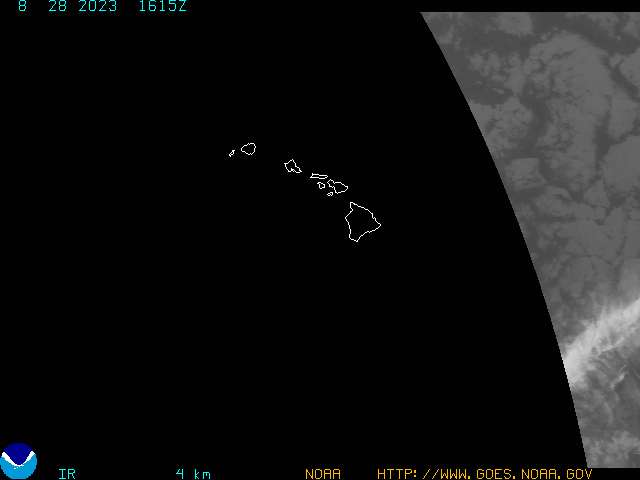
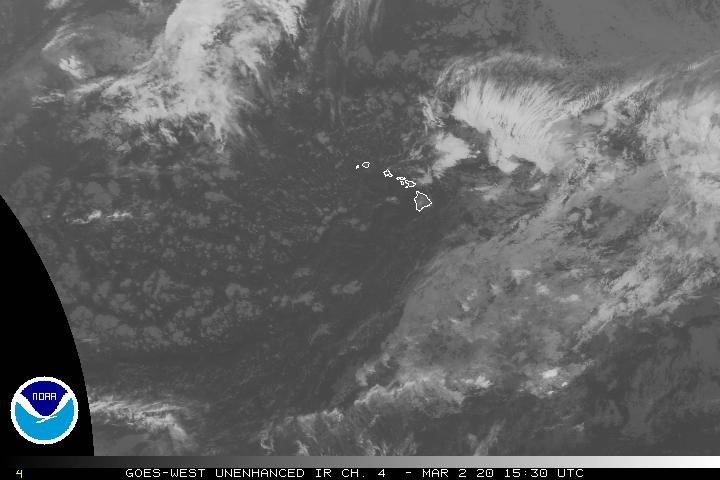
Satellite and Radar Images: To view the cloud conditions we have here in Hawaii, please use the following satellite links, starting off with theInfrared Satellite Image of the islands to see all the clouds around the state during the day and night. This next image is one that gives close images of the islands only during the daytime hours, and is referred to as a Close-up visible image. This next image shows a larger view of the Pacific…giving perspective to the wider ranging cloud patterns in the Pacific Ocean. To help you keep track of where any showers may be around the islands, here’s the latest animatedradar image.
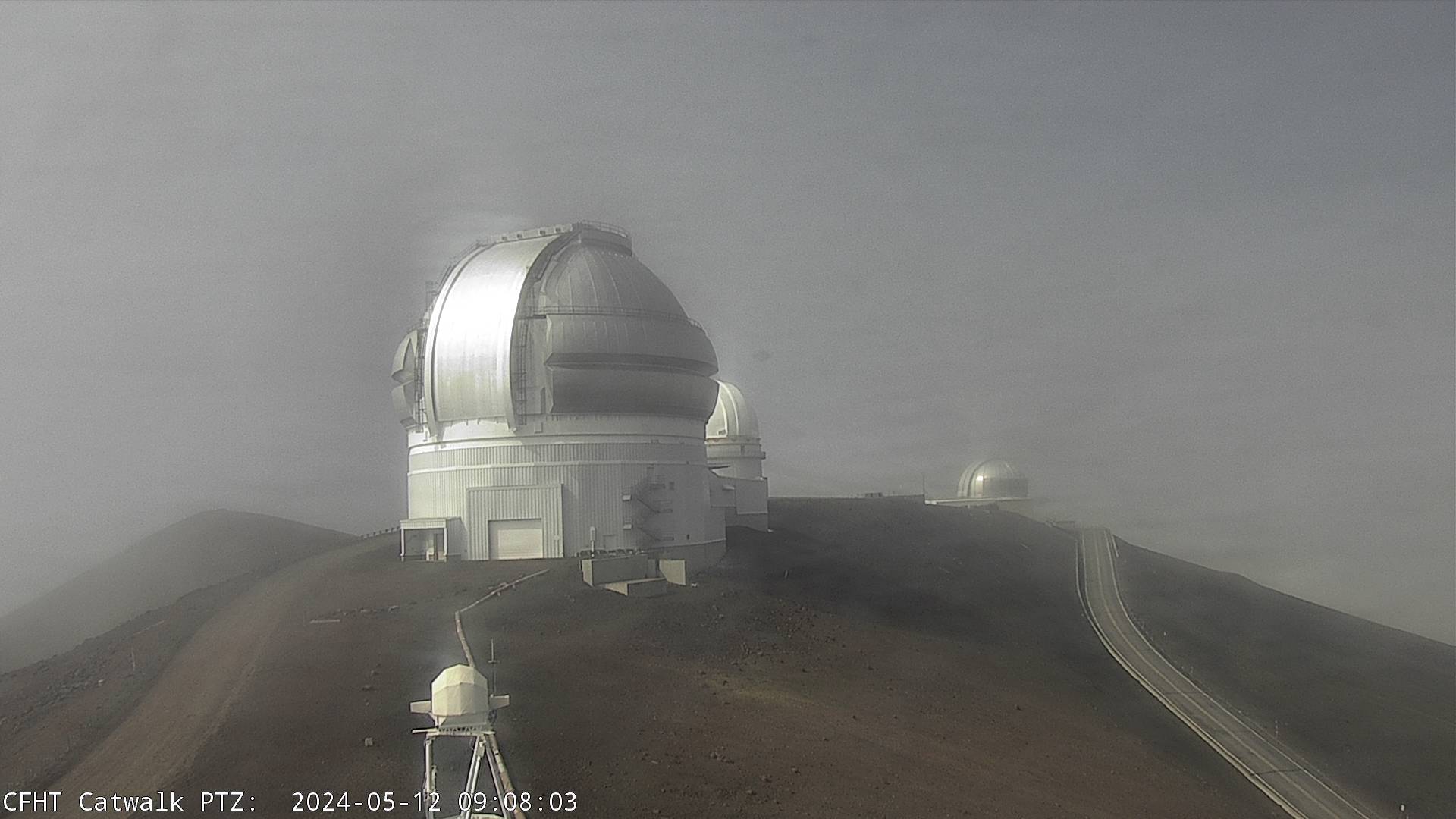
Hawaii’s Mountains – Here’s a link to the live webcam on the summit of near 14,000 footMauna Kea on the Big Island of Hawaii. The tallest peak on the island of Maui is theHaleakala Crater, which is near 10,000 feet in elevation. These two webcams are available during the daylight hours here in the islands…and when there’s a big moon rising just after sunset for an hour or two! Plus, during the nights and early mornings you will be able to see stars, and the sunrise too…depending upon weather conditions.
Aloha Paragraphs
The big city of Honolulu on the island of Oahu Photo Credit: flickr.com
The trade winds will continue here in the islands, although become lighter Friday into the weekend…increasing again early next week. As an upper level trough of low pressure moves closer to Hawaii soon, and as our long lasting high pressure system to the north, moves westward…our wind speeds will become noticeably lighter over the next couple of days. The trade winds may become soft enough, in those less exposed coastal areas, that some places will begin to feel rather sultry over the weekend.
As we move into the early part of next week, the models suggest that our local winds will increase in strength again, taking the edge off the temporary muggy conditions.
Whatever few showers that are around now, will continue to end up along the windward sides, leaving the leeward sides with nice weather.These showers won’t amount to much, as there isn’t very much cloudiness upstream from the islands. As the trade winds weaken this weekend, we may begin to see some form of afternoon convective activity increasing, with localized upcountry showers. The leftover showery clouds from former eastern Pacific tropical cyclone Genevieve, will bring some additional increase in showers later this weekend as well. As the trade winds return early next week, we’ll find a normal distribution of passing showers along the windward sides exclusively.
It’s early Thursday evening here in Kihei, Maui, as I start updating this last section of today’s narrative. Our fairly normal trade wind weather pattern, that we’ve seen all this week, will start to break down some soon. The trade winds won’t stop blowing altogether, but they will falter enough that we’ll see some changes in our local Hawaiian Island weather picture. The lighter winds will prompt somewhat uncomfortably warm and muggy conditions to develop, especially along the coasts, that have the least exposure to the cooling and refreshing trade winds. The daytime heating, along with afternoon sea breezes, will cause cumulus clouds to stack-up over and around the mountains.
~~~ As Sunday rolls around, we should see at least some tropical moisture arrive, thanks to what was hurricane Genevieve in the eastern Pacific. This retired tropical system now has no wind involved, but has held together just enough, in terms of its clouds and showers…to hopefully bring some showers to Maui and the Big Island. As we move into the early part of next week, the upper trough will depart, high pressure will become established again to our north, and the moisture from old Genevieve will have pushed off to the west. This will bring us around full circle, with just a typical early August trade wind weather pattern carrying us through most of the rest of next week. I’ll be back very early Friday morning with your next new weather narrative. I hope you have a great Thursday night until then! Aloha for now…Glenn.
Interesting:
Scientists have long searched for traces of ancient life on Earth in order to understand the history of life on our planet. Fossilized bones have helped us understand the age of the dinosaurs. Insects trapped in drops of amber have inspired Hollywood films and researchers alike. These remnants of ancient life on Earth provide important clues about our planet’s past. Now, a team of researchers working in New Mexico has found traces of life inside salty halite crystals. The discovery is "an invaluable resource for understanding the evolutionary record [of Earth] over a geological time frame," according to Jack Griffith of the University of North Carolina, Chapel Hill and his colleagues, who recently published their work in the journal Astrobiology.
The finding may even help scientists search for signs of life on other planets. Halite is more commonly known as "rock salt" and can be found all over the planet in the form of salty crystals. These crystals may not seem all that interesting at first glance. However, inside of them are tiny pockets of water that can be very valuable for scientists. Halite crystals form in liquid as evaporation occurs. The crystals naturally trap small amounts of liquid during this process. These water pockets and all that they contain can be protected inside halite crystals for extremely long periods of time. The crystals in the recent study had drops of water that were 250 million years old.
Interesting2:
The ocean is a noisy place. Although we don’t hear much when we stick our heads underwater, the right instruments can reveal a symphony of sound. The noisemakers range from the low-frequency bass tones of a fish mating ritual to the roar of a motorboat. The study of how underwater animals hear is a growing topic in marine science, especially with regards to naval sonar and whales. This summer at the MBL, zoologist T. Aran Mooney will be the first scientist to look at cephalopod hearing, using the squid, Loligo pealeii, as a model. To learn how sensitive the translucent animals are to noise, he is monitoring squid brain waves as they respond to various sounds, specifically the echolocation clicks of its main predators: the sperm whale, beaked whale, and dolphin. In addition to the brain wave experiments, he also plans to condition squid to avoid certain sounds.
“Sound is one of the most important cues for marine animals. Light doesn’t travel well through the ocean. Sound does much better," says Mooney, who is a Grass Fellow at the MBL and beginning postdoctoral research at Woods Hole Oceanographic Institution this fall. He predicts that squid probably hear very low-frequency sounds, which means they pick up on fish tones and boat traffic. A better understanding of what these animals hear could reveal how human-induced noise affects cephalopods and how their auditory system evolved separately from that of fish.
Air Temperaturesranged between these warmest and coolest spots near sea level, and on the taller mountains at 4 p.m. Wednesday afternoon:
Honolulu, Oahu– 87F Hilo, Hawaii – 73 (Light rain)
Haleakala Crater- 52F (near 10,000 feet on Maui)
Mauna Kea summit – 37 (near 14,000 feet on the Big Island)
Precipitation Totals – The following numbers represent the largest precipitation totals (inches) during the last 24 hours on each of the major islands, as of Wednesday afternoon: 2.56 Mount Waialeale, Kauai
1.83 South Fork Kaukonahua, Oahu
0.07 Molokai
0.00 Lanai
0.00 Kahoolawe
0.27 West Wailuaiki, Maui
0.39 Kealakekua, Big Island
Weather Chart – Here’s the latest (automatically updated) weather mapshowing a 1033 millibar high pressure system to the north-northwest of Hawaii. Our local trade winds will remain generally in the moderately strong category through Thursday…locally somewhat stronger and gusty.
Satellite and Radar Images: To view the cloud conditions we have here in Hawaii, please use the following satellite links, starting off with theInfrared Satellite Image of the islands to see all the clouds around the state during the day and night. This next image is one that gives close images of the islands only during the daytime hours, and is referred to as a Close-up visible image. This next image shows a larger view of the Pacific…giving perspective to the wider ranging cloud patterns in the Pacific Ocean. To help you keep track of where any showers may be around the islands, here’s the latest animatedradar image.
Hawaii’s Mountains – Here’s a link to the live webcam on the summit of near 14,000 footMauna Kea on the Big Island of Hawaii. The tallest peak on the island of Maui is theHaleakala Crater, which is near 10,000 feet in elevation. These two webcams are available during the daylight hours here in the islands…and when there’s a big moon rising just after sunset for an hour or two! Plus, during the nights and early mornings you will be able to see stars, and the sunrise too…depending upon weather conditions.
Aloha Paragraphs
The newest beaches being made on the Big Island! Photo Credit: Konaboy
We’re now dropping back into a fairly normal trade wind weather pattern, with off and on showers falling along the windward sides.This classic late July situation should last into the first couple of days of August…with sunshine prevailing over the generally dry leeward coasts. As this satellite image shows, we have an area of showery clouds reaching the windward sides of Maui and the Big Island Wednesday evening. There appears to be a break then, before the next batch of clouds arrives during the night…with embedded showers. The computer models show a trough of low pressure approaching the state over the next few days, whose influence may ratchet-up the shower activity some over the windward sides into the weekend. The one main question is whether there will be enough available moisture around, to feed those showers that the models are indicating. One ample source of moisture, is the leftover showery clouds associated with now retired tropical cyclone Genevieve, which was active in the eastern Pacific well over a week ago…and has been moving westward in our direction on the trade wind flow.
The trade winds, which have been rather strong and gusty during the last week, but will mellow-out quite a bit as we get into the weekend. A long lasting, and extremely large, trade wind producing high pressure system remains anchored far to the north of Hawaii at mid-week.
This weather map shows the extent of this exceptionally broad area. This high pressure cell is weighing-in at 1033 millibars, amply strong to spin-out moderately strong trade winds across our tropical latitudes here in the islands. This high is expected to drift out of its position to our north soon, although keep our local trade winds blowing. As we move into the early part of next week, the models suggest that our local winds will edge upward in strength, with no real end in sight from this vantage point.
It’s early Wednesday evening here in Kihei, Maui, as I start updating this last section of today’s narrative. Wednesday’s trade winds remained a bit stronger and gusty than what the models had projected. Late in the day, the strongest wind gusts around included 28 mph at Port Allen, Kauai; 32 mph at Kahuku on Oahu; 35 mph on the island of Lanai; 40 at Maalaea Bay, Maui; and 29 mph at South Point on the Big Island. There will be a slow down in our local trade wind speeds, but it may take until Friday into the weekend before it really starts to be noticeable for most folks. Otherwise, nothing too out of the ordinary is expected in our Hawaiian Island weather picture. The beaches along the leeward sides will be most suitable for framing, I mean beaching, during the morning hours…before the afternoon trade winds add white caps to the ocean surface…like they have the last several days in Kihei and Wailea, Maui. I’ll be back very early Thursday morning with your next new weather narrative from paradise, I hope you have a great Wednesday night until then! Aloha for now…Glenn.
Interesting:
Beijing’s pollution levels dropped Wednesday to less than half of the previous day’s, the lowest reading since authorities began pulling cars off the road and shutting down factories to address athletes’ concerns about air quality ahead of the Olympic Games. A cooling wind and some rain helped sweep away pollutants and gave Beijingers a respite from the sultry heat and humidity that had cloaked the city for days. The polluted skies over the Olympic host city have been one of the biggest worries for Olympics organizers. The concerns prompted Beijing officials to institute drastic measures earlier this month, included pulling half the city’s 3.3 million vehicles off the roads, halting most construction and closing some factories in the capital and surrounding provinces. The measures are having the desired effect, Du Shaozhong, deputy director of Beijing‘s Environmental Protection Bureau, told The Associated Press in an interview. "The daily data since July 20 shows an improvement in air quality. It reflects the results since we restricted traffic and stopped heavy-polluting factories and construction," he said. "That’s why we say the measures have been effective."
Interesting2:
Arctic sea ice is unlikely to shrink below a 2007 record low this year in a reprieve from the worst predictions of climate change even though new evidence confirms a long-term thaw is under way, experts said. The 2007 record raised worries of a melt that could leave the North Pole ice-free this year, threaten indigenous hunters and thaw ice vital for creatures such as polar bears. It would also help open the Arctic to shipping and oil and gas firms. "Most likely there will not be a new record minimum ice year in the Arctic this September," said Ola M. Johannessen of the Nansen Environmental and RemoteSensingCenter in west Norway. Arctic sea ice area reaches an annual summer low in September but is about 1 million square kms (386,100 sq mile) bigger than at the same time in late July 2007 at about 6 million sq kms, an area almost as big as Australia. It is still far smaller than the average of recent decades.
"It’s looking rather unlikely that we will beat the record sea ice minimum of 2007," said Mark Serreze, a senior research fellow at the U.S. National Snow and Ice Data Center (NSIDC), adding there could still be surprises. "The North Pole is likely safe for at least this year," he said. The NSIDC had suggested in May that it was "quite possible" that the pole could be ice-free this year. "The basic reason that while last summer saw an ideal atmospheric pattern for melting sea ice — essentially a "perfect storm" — the pattern so far this summer has been characterized by somewhat cooler conditions," he said. The 2007 low area of 4.13 million sq kms shattered a 2005 record and was among factors adding pressure on governments to slow a build-up of greenhouse gases from factories, power plants and cars. Governments have agreed to negotiate a new climate treaty by the end of 2009 to succeed the U.N.’s Kyoto Protocol.
Interesting3:
Birds have been moving north in Europe over the past 25 years because of climate change in the vanguard of likely huge shifts in the ranges of plants and animals, scientists said on Wednesday. A study of 42 rare bird species in Britain showed that southern European bird species such as the Dartford warbler, Cirl bunting, little egret or Cetti's warbler had become more common in Britain from 1980-2004. And species usually found in northern Europe, such as the fieldfare, redwing or Slavonian grebe, had become less frequent in Britain. "The species are almost certainly responding to the changing climate," said Brian Huntley of DurhamUniversity in England of a report he wrote with researchers at CambridgeUniversity and the Royal Society for the Protection of Birds.
The study tried to filter out other factors that would affect counts of rare birds, including growing public interest that could mean more sightings. Shifts in farming, pollution, expansion of cities and conservation efforts have all affected wildlife. Birds and butterflies are among the first to adapt to climate change because they can fly long distances to seek a cooler habitat. Other creatures and plants can take far longer if their traditional range gets too warm. "It depends on the mobility of the species. Birds and butterflies are two of the groups where there is the best evidence that species are already showing responses to the changing climate," Huntley told Reuters of the study in Royal Society journal Biology Letters.
Air Temperaturesranged between these warmest and coolest spots near sea level, and on the taller mountains at 4 p.m. Tuesday afternoon:
Barking Sands, Kauai– 89F Princeville, Kauai – 81
Haleakala Crater- 54F (near 10,000 feet on Maui)
Mauna Kea summit – 46 (near 14,000 feet on the Big Island)
Precipitation Totals – The following numbers represent the largest precipitation totals (inches) during the last 24 hours on each of the major islands, as of Tuesday afternoon: 1.17 Mount Waialeale, Kauai
0.61 Manoa Valley, Oahu
0.05 Molokai
0.00 Lanai
0.00 Kahoolawe 4.54 Puu Kukui, Maui
3.24 Glenwood, Big Island
Weather Chart – Here’s the latest (automatically updated) weather mapshowing a 1032 millibar high pressure system to the north of Hawaii. Our local trade winds will remain generally in the moderately strong category through Thursday…locally stronger and gusty.
Satellite and Radar Images: To view the cloud conditions we have here in Hawaii, please use the following satellite links, starting off with theInfrared Satellite Image of the islands to see all the clouds around the state during the day and night. This next image is one that gives close images of the islands only during the daytime hours, and is referred to as a Close-up visible image. This next image shows a larger view of the Pacific…giving perspective to the wider ranging cloud patterns in the Pacific Ocean. To help you keep track of where any showers may be around the islands, here’s the latest animatedradar image.
Hawaii’s Mountains – Here’s a link to the live webcam on the summit of near 14,000 footMauna Kea on the Big Island of Hawaii. The tallest peak on the island of Maui is theHaleakala Crater, which is near 10,000 feet in elevation. These two webcams are available during the daylight hours here in the islands…and when there’s a big moon rising just after sunset for an hour or two! Plus, during the nights and early mornings you will be able to see stars, and the sunrise too…depending upon weather conditions.
Aloha Paragraphs
Diamond Head Crater…Honolulu just to the left Photo Credit: flickr.com
We’ve just moved through quite a flurry of rain showers, which in places got rather generous along the windward sides the last several days.Maui and the BigIslandhit the jackpot, at least locally, picking up enough precipitation to push the drought conditions back nicely. Those windward biased showers last night on the BigIsland, got heavy enough in places, that the NWS forecast office in Honolulu had to issue a flood advisory, which was cancelled earlier Tuesday morning. The largest rainfall total occurred at one of the rainiest places here in the islands, and no it wasn’t at MountWaialaele on Kauai for a change…but rather atop the West Maui Mountains, at the Puu Kukui rain gauge, where 4.54” of the wet stuff rained down! Honokaa and Glenwood, both on the BigIsland, ended up with 3.17” and 3.24”…which isn’t too shabby either.
At least some of those incoming showers were part of the leftover moisture from retired hurricane Fausto, when it was active in the eastern Pacific.Several moisture pockets are just upwind of Maui and the Big Island, which should arrive on the windward side of Oahu later in the evening. Looking even further east, in what we can consider upstream (in reference to the trade winds), there are more showers in that direction. The brighter white clouds to our south and west, are the tops of towering cumulus, and thunderstorms. The ones to our south and southeast are part of the inter-tropical convergence zone (ITCZ)…a broad zone of low pressure running parallel to the equator. The white clouds, with cold cloud tops, are thunderstorms associated with a trough of low pressure over near the International Dateline.
As thissatellite imageshows, the leading edge of former hurricane Genevieve, once active in the eastern Pacific, has appeared in the right hand side of the picture.You’ll see this by running an imaginary line just about straight to the right of the Big Island. If it can retain its organization, and not get too pulled apart by the trade winds, we would see it arriving with more showers at some point this weekend.
It’s early Tuesday evening here in Kihei, Maui, as I start writing this last section of today’s narrative. It was a a nice day there in the islands, as the rather abundant showers of the last few days, especially along the windward sides of the islands…diminished shortly after sunrise. The winds remain up however, with blustery conditions in many areas. Looking at the strongest gust late in the afternoon, we found that be 43 mph at that windy bay in Maalaea. The next strongest gusts were 37 mph at both Kahului, Maui, and on the island of Lanai. We should find rather typical weather conditions through the next four days or so, although the trade winds will be somewhat stronger than normal locally. As we move into Sunday, we still have that chance of increased showers, only time will tell if we actually receive them or not. I’ll be back very early Wednesday morning with your next new weather narrative from paradise, I hope you have a great Tuesday night until then! Aloha for now, Glenn.
Interesting: Environmental officials say their efforts are starting to clear the haze above Beijing, while strong wind and some rain have also raised hopes of blue skies when the Olympic Games start in just over a week. The city has put in place a series of drastic pollution controls since July 20 that included pulling half the city’s 3.3 million vehicles off the roads, halting most construction and closing some factories in the capital and surrounding provinces. But Beijing has been dogged in the last week by a persistent haze that cloaked the city, threatening assurances by Chinese authorities that skies will be clear when the games start on Aug. 8. Tuesday’s relatively clearer skies highlighted how much weather conditions play a part in the overall equation for curbing pollution. Winds and rain were a "major factor" in causing pollutants to dissipate, said spokeswoman Zhai Xiaohui with the Beijing Municipal Environmental Protection Bureau.
The government has worked on cloud seeding to control rain, but has acknowledged the wind remains an unpredictable factor. A cold front pushing through northeastern China brought light rains and temporary relief from sweltering temperatures. A top environmental official said Tuesday that the air in July had greatly improved when compared to the same month last year. After the adoption of these measures, we have seen visible improvements," Du Shaozhong, deputy director of Beijing‘s Environmental Protection Bureau, told a news conference. There have been 25 days of clean air in July, two more than the same period last year, he said. Du did not say what constituted clean air, but said since July 1, major pollutants have been reduced by 15 to 20 percent.
Interesting2: U.S. beaches were in poor health last year, according to the Natural Resources Defense Council, which said Tuesday that pollution in 2007 led to the second-highest number of beach closings and advisory days in 18 years. Human and animal fecal matter were to blame for much of the pollution, the council said in its annual report, leaving many beachgoers vulnerable to illnesses including gastroenteritis, dysentery and hepatitis. The council also blamed outdated water quality standards and called for more rigorous monitoring of beaches. Last year there were 22,571 beach closings and advisory days, the group said, citing data from the Environmental Protection Agency. The number was second only to 2006, when there were 25,643 such days. From 2006 to 2007, the number of beach closings and advisory days due to sewage spills and overflows more than tripled to 4,097, the council said.
The largest known pollution source continues to be storm water contamination, which caused more than 10,000 closing and advisory days in 2007, the council said. Storm water dumps street pollution onto beaches and coastal waters without treatment whenever it rains. Unknown sources of pollution caused more than 8,000 closing and advisory days, the NRDC said. “Some families can’t enjoy their local beaches because they are polluted and kids are getting sick — largely because of human and animal waste in the water,” Nancy Stoner, director of the council’s clean water project, said in a statement released with the report. "Nationally, 7 percent of beach water samples violated health standards, showing no improvement from 2006," the NRDC said. "In the Great Lakes, 15 percent of beach water samples violated those standards — the highest level of contamination of any coastal region in the continental U.S."
Interesting3:Ice is in retreat worldwide as glaciers melt, Arctic ice floes vanish, and Antarctic ice shelves break apart. Will all of it eventually disappear as the globe warms? Not necessarily, say André Bornemann of the University of Leipzig in Germany and several colleagues. From sediment cores drilled out of the Atlantic seafloor, they retrieved fossils of tiny, shell-encased marine organisms called foraminifers that lived 91 million years ago during the Cretaceous Thermal Maximum, when tropical seas were about 12 Fahrenheit degrees warmer than they are today. The fossils’ shells contained a high proportion of oxygen-18, an isotope that increases in the ocean relative to oxygen-16 when water evaporates from the sea and gets trapped on land as ice. The isotope data suggest that even during the hot spell, an ice sheet half the size of the current Antarctic ice cap existed — but where? It couldn’t have been near the North Pole, which the fossil record shows was then home to heat-loving crocodiles. Instead, Bornemann thinks the ice cap covered high mountain ranges near the South Pole. The warm weather prevailing elsewhere would have injected plenty of moisture into the air to fall as snow on high altitudes way down south. But make no mistake. Compared with today, a lot of ice was missing back then, and sea levels were much higher — a history that seems to be on the verge of repeating itself. The research was detailed earlier this year in the journal Science.
Interesting4:Two small, manned submarines reached the bottom of Lake Baikal, the world’s deepest freshwater lake, on Tuesday, Russian news reports said. The "Mir-1" and "Mir-2" submersibles descended 1.05 miles (1,680 meters) to the bottom of the vast Siberian lake, reports said. Scientists on board will take samples of water and soil from Lake Baikal, which is home to more than 1,700 species of plants and animals, reports said. They also will plant a small pyramid bearing the Russian flag in the lake bed, reports said. Russian news agencies earlier cited organizers as saying the expeditions set a world record for the deepest descent in a freshwater lake. State Duma deputy and expedition leader Artur Chilingarov later said no such record was broken Tuesday, the Interfax news agency said. Mission chief Anatoly Sagalevich said the mission will make a total of 60 dives. Organizers then will compile a list of recommendations at how best to preserve Lake Baikal, a UNESCO World Heritage site. Last August, the "Mir-1" and "Mir-2" descended below the North Pole, with Russians on board planting their country’s flag in a titanium capsule on the Arctic Ocean floor to symbolically claim the seabed.
Air Temperaturesranged between these warmest and coolest spots near sea level, and on the taller mountains at 4 p.m. Monday afternoon:
Barking Sands, Kauai– 86F Hilo, Hawaii – 77
Haleakala Crater- 54F (near 10,000 feet on Maui)
Mauna Kea summit – 41 (near 14,000 feet on the Big Island)
Precipitation Totals – The following numbers represent the largest precipitation totals (inches) during the last 24 hours on each of the major islands, as of Monday afternoon: 2.13 Mount Waialeale, Kauai
0.97 Oahu Forest NWR, Oahu
0.14 Molokai
0.03 Lanai
0.01 Kahoolawe 2.25 Puu Kukui, Maui
0.37 Wiakea Uka, Big Island
Weather Chart – Here’s the latest (automatically updated) weather mapshowing a 1033 millibar high pressure system to the north of Hawaii. Our local trade winds will remain generally in the moderately strong category through Tuesday…locally stronger and gusty.
Satellite and Radar Images: To view the cloud conditions we have here in Hawaii, please use the following satellite links, starting off with theInfrared Satellite Image of the islands to see all the clouds around the state during the day and night. This next image is one that gives close images of the islands only during the daytime hours, and is referred to as a Close-up visible image. This next image shows a larger view of the Pacific…giving perspective to the wider ranging cloud patterns in the Pacific Ocean. To help you keep track of where any showers may be around the islands, here’s the latest animatedradar image.
Hawaii’s Mountains – Here’s a link to the live webcam on the summit of near 14,000 footMauna Kea on the Big Island of Hawaii. The tallest peak on the island of Maui is theHaleakala Crater, which is near 10,000 feet in elevation. These two webcams are available during the daylight hours here in the islands…and when there’s a big moon rising just after sunset for an hour or two! Plus, during the nights and early mornings you will be able to see stars, and the sunrise too…depending upon weather conditions.
This new work week has started off with moderate to fresh and gusty trade winds.As thisweather mapshows, we continue to see that same long lasting 1033 millibar high pressure center located far to the north of Hawaii. This high is filling up most of the Pacific Ocean from well west of the International Dateline to our west, all the way over to the west coast of north American, then southward to the Baja coast of Mexico to the east and southeast. The computer models suggest that this brand of trade winds will remain in place through Tuesday. The NWS office in Honolulu has issued a small craft wind advisory for almost all of Hawaii’s coastal and channel waters. The winds are strong enough, now, and extending up to near 20,000 feet in height, so that atop the Haleakala Crater, Maui… a wind advisory is active. Winds on the summit of Haleakala, are running 25-35 mph, with some higher gusts. The strongest winds near sea level, at least in gusts, were topping out at 44 mph at one anemometer on Kahoolawe. Our local trade winds will begin to taper off a little in strength starting Wednesday.
Most of the showers that fall in Hawaii will end up along the windward coasts and slopes through the next several days.At least some part of these active shower bands, are from the remnant moisture brought our way by former eastern Pacific tropical cyclone Fausto. An area of high cirrus clouds have arched northward from the deeper tropics at higher altitudes of the atmosphere, which are sending some strands of those high level clouds through our area Monday. Here’s alooping satellite imageshowing that most of it is staying south of our main Hawaiian Islands. In addition to the high clouds, you can see lower level bands of clouds, more or less paralleling the windward sides, moving in our direction on the stiff trade wind flow…bringing numerous showers to the windward sides. Given that the trade winds are so thick, some of the showers will stray over into the leeward sides on the smaller islands at times. Meanwhile, there remains the chance that late this coming weekend, another retired tropical system (Genevieve), will bring an increase in tropical showers…as it gets carried our way on the trades.
It’s early Monday evening here in Kihei, Maui, as I start writing this last section of today’s narrative. The winds were stronger than normal today, and there were more than the usual showers falling along the windward sides as well. There’s been a fairly steady stream of incoming showers along the windward sides. This looping radar image shows these showers riding in on the gusty trade winds. By the way, the arched shaped area on the southeast side of the Big Island, and the smaller version of it on Kauai, isn’t rainfall, but rather sea spray that the low level radar beam is picking up. This more generous than normal shower activity will continue overnight, and into Tuesday. The leeward sides are finding less of this, and actually have remained dry, at least on the Big Island and Maui, while some showers are sneaking over into the leeward sides on the smaller islands. The gusty trades will remain in place through Tuesday or Wednesday, and then back off some, along with the windward showers then too. I’ll be back very early Tuesday morning with your next new weather narrative, I hope you have a great Monday night until then! Aloha for now…Glenn
Volcanic haze, better known as vog, has become quite an issue here in the islands lately. A friend in Kula, Maui, Jim McCall, sent me this good link showing current webcam shots of the vents, and also readings for vog on many of the islands.
Interesting:
Olympic host city Beijing was shrouded in haze on Monday 11 days before the Games begin, raising anxieties about whether it can deliver the clean skies promised for the world’s top athletes. Beijing has ordered many of its 3.3 million cars off roads and halted much construction and factory production in an effort to cut pollution before the Games open on August 8. But a sultry haze persisted on Monday, and state media said Beijing might be forced to restrict more cars and shut more factories if the pollution persists. City officials had earlier said the haze was due to humid weather, not pollution. But state media on Monday suggested Games organizers were also worried and considering more pollution cuts. "More vehicles could go off the roads and all construction sites and some more factories in Beijing and its neighboring areas could be closed temporarily if the capital’s air quality deteriorates during the Olympic Games," the China Daily said.
Xinhua said air quality in Beijing on Monday was Grade II, making it officially a "blue sky day" despite the grey haze, with the main pollutant being particulate matter. Many athletes have delayed arriving in Beijing until the last minute to avoid bad air and the International Olympic Committee said it may reschedule endurance events to prevent health risks to athletes if pollution is bad. Marathon world record holder Haile Gebrselassie has already pulled out of the marathon over fears of damaging his health. On Monday, the Australian Olympic Committee said its athletes would be allowed to withdraw if pollution poses a threat. "For us the athlete’s attitude to the event is paramount," AOC vice president Peter Montgomery told reporters. For four days up to Monday, Beijing had not experienced a "blue sky day", when the pollution index meets the national standard for "good air quality." Hong Kong, host of the equestrian events, was also badly polluted on Monday after a week of clear, blustery weather.
Interesting2:
Stricken boat off the coast of Bali underscores the threats from unregulated fishing.
This discovery highlights that efforts to prevent illicit fishing activities from occurring have been unsuccessful, activities that make it all but impossible to manage fish stocks and ensure that fishing boats are sound and secure from oil leaks. The region, site of many key WWF projects, is widely recognised as the most important area of marine biodiversity on the planet, and is often referred to as the nursery of the seas. Insufficient monitoring has left it susceptible to activities that could destabilise its unique marine biodiversity, a system that directly sustains the lives of nearly 130 million people across six countries of south-east Asia.
"The health of the Coral Triangle is critical to the livelihoods of millions of people and it is crucial that adequate management systems are in place to prevent the kinds of scenes we have seen in Bali over the last week, and to reduce the threat of oil spills and overfishing," said the leader of WWF’s Coral Triangle Program, Lida Pet Soede. The sustainable management of these locations is especially important, and particularly difficult, as over-exploitation of marine resources is exacerbated by a combination of extreme dependence of coastal economies, population growth and poverty. WWF is calling for increased protection of sensitive areas, monitoring of fishing activities, and more accountability for owners of vessels, especially considering this week’s discovery. This news comes amid the recent announcement that up to half of all remaining coral reefs could disappear within the next twenty years. "It is crucial that we properly manage the Coral Triangle’s unique marine wilderness for the benefit of the whole planet," Ms Soede said.
Interesting3:
Birds, like moths, are attracted to light at night and if they become disoriented, will fly in circles around the lights in a tall building, often hitting the building, or dropping exhausted to the ground. The phenomenon is not understood by scientists, but a researcher at the BellMuseum in Minneapolis, along with the Minnesota Department of Natural Resources, is spearheading a program to turn off the lights to protect migrating birds. Participants in the programs, including the owners, tenants, and management companies from 32 buildings Minneapolis, St. Paul, Bloomington, and Rochester, will dim their building lights during the spring and fall bird migration seasons. Similar programs are in place in Toronto, New York, and Chicago. Adding the Minnesota cities is important, said BellMuseum ornithologist Bob Zink, because they are located along the Mississippi River flyway, a major thoroughfare for migrating birds. In addition to lowering the light in the night migration routes, researchers are also trying to determine why birds fly into some buildings at a much higher rate than others. In Minneapolis, 67 percent of the bird kills were caused by just two of the city’s skyscrapers.
Air Temperaturesranged between these warmest and coolest spots near sea level, and on the taller mountains at 4 p.m. Sunday afternoon:
Port Allen, Kauai– 88F Molokai airport – 81
Haleakala Crater- 52F (near 10,000 feet on Maui)
Mauna Kea summit – 41 (near 14,000 feet on the Big Island)
Precipitation Totals – The following numbers represent the largest precipitation totals (inches) during the last 24 hours on each of the major islands, as of Sunday afternoon: 0.67 Mount Waialeale, Kauai
0.10 Pailolo Fire Station, Oahu
0.01 Molokai
0.00 Lanai
0.00 Kahoolawe
0.31 Puu Kukui, Maui 0.74 Honaunau, Big Island
Weather Chart – Here’s the latest (automatically updated) weather mapshowing a 1033 millibar high pressure system to the north of Hawaii. Our local trade winds will remain generally in the moderately strong category through Tuesday…locally stronger and gusty.
Satellite and Radar Images: To view the cloud conditions we have here in Hawaii, please use the following satellite links, starting off with theInfrared Satellite Image of the islands to see all the clouds around the state during the day and night. This next image is one that gives close images of the islands only during the daytime hours, and is referred to as a Close-up visible image. This next image shows a larger view of the Pacific…giving perspective to the wider ranging cloud patterns in the Pacific Ocean. To help you keep track of where any showers may be around the islands, here’s the latest animatedradar image.
Hawaii’s Mountains – Here’s a link to the live webcam on the summit of near 14,000 footMauna Kea on the Big Island of Hawaii. The tallest peak on the island of Maui is theHaleakala Crater, which is near 10,000 feet in elevation. These two webcams are available during the daylight hours here in the islands…and when there’s a big moon rising just after sunset for an hour or two! Plus, during the nights and early mornings you will be able to see stars, and the sunrise too…depending upon weather conditions.
Aloha Paragraphs
Lovely Kee Beach on Kauai Photo Credit: flickr.com
The moderately strong trade winds will prevail into Monday. These balmy breezes will provide good weather all around, keeping just enough wind around to temper our hot afternoons at the beach. As thisweather mapshows, we have a robust high pressure center located far to the north of Hawaii…which will be the source of our trades through the next several days. The computer models suggest that these trade winds will remain in place through Tuesday. We may see some softening in the trade wind speeds around the middle of the new week.
Leeward areas will remain mostly dry, with showers falling along the windward sides…increasing some early Monday into Monday night. Those windward biased showers will fall during the nights and early mornings for the most part. There’s a good chance that we will see an increase in showers Monday, from the remnant moisture brought our way by former eastern Pacific tropical cyclone Fausto. A batch of high cirrus clouds have arched northward from the deeper tropics, which should provide a good sunset Sunday, and likely a colorful sunrise on Monday, here’s a looping satellite image of that high cloudiness. Meanwhile, there remains the chance that late next weekend, another retired tropical system (Genevieve), will bring a second increase in tropical showers…as it gets carried our way on the trades. ~~~It’s early Sunday evening here in Kula, Maui, as I start updating this last section of today’s narrative. If you had a chance to read down through the two paragraphs above, you will know that nothing unusual seems to be occurring here in the islands now. Besides the chance for a modest increase in windward showers Monday, smooth sailing seems to be on tap through most of the new week ahead. The trade winds will continue, along with a minor bump up in our south shore surf starting later Monday. Other than those minor weather features, our weather will remain fairly normal through the last few days of July into early August.
~~~ I had the luxury of staying home most of the day today, although I did go out to shop in Paia briefly, and then right back to Kula. I made, what I thought was going to be a corn and potato soup, which turned out to be quite a bit more than that. That’s because I added carrot, mushrooms, swiss chard, a can of northern beans…so that it became more of a vegetable stew I guess. For the rest of the evening I’ll be just relaxing further, in anticipation of another strong work week ahead. It’s interesting, as much as I look forward to my weekends, and I definitely do…I almost as much look forward to starting the new week of work. It’s those weather changes, and how to describe them to you, that keep me going. I’ll be back very early Monday morning with your next new weather narrative from paradise. I hope you have a great Sunday night wherever you happen to be reading from! Aloha for now…Glenn.
Air Temperaturesranged between these warmest and coolest spots near sea level, and on the taller mountains at 4 p.m. Saturday afternoon:
Port Allen, Kauai– 88F Kaneohe, Oahu – 81
Haleakala Crater- 61F (near 10,000 feet on Maui)
Mauna Kea summit – mm (near 14,000 feet on the Big Island)
Precipitation Totals – The following numbers represent the largest precipitation totals (inches) during the last 24 hours on each of the major islands, as of Saturday afternoon: 0.44 Mount Waialeale, Kauai
0.19 Poamoho 2, Oahu
0.00 Molokai
0.00 Lanai
0.00 Kahoolawe
0.33 West Wailuaiki, Maui 0.98 Honaunau, Big Island
Weather Chart – Here’s the latest (automatically updated) weather mapshowing a 1033 millibar high pressure system to the north of Hawaii. Our local trade winds will remain generally in the moderately strong category through Sunday…locally gusty.
Satellite and Radar Images: To view the cloud conditions we have here in Hawaii, please use the following satellite links, starting off with theInfrared Satellite Image of the islands to see all the clouds around the state during the day and night. This next image is one that gives close images of the islands only during the daytime hours, and is referred to as a Close-up visible image. This next image shows a larger view of the Pacific…giving perspective to the wider ranging cloud patterns in the Pacific Ocean. To help you keep track of where any showers may be around the islands, here’s the latest animatedradar image.
Hawaii’s Mountains – Here’s a link to the live webcam on the summit of near 14,000 footMauna Kea on the Big Island of Hawaii. The tallest peak on the island of Maui is theHaleakala Crater, which is near 10,000 feet in elevation. These two webcams are available during the daylight hours here in the islands…and when there’s a big moon rising just after sunset for an hour or two! Plus, during the nights and early mornings you will be able to see stars, and the sunrise too…depending upon weather conditions.
The moderately strong trade winds will prevail Sunday into Monday. These balmy breezes will provide good weather all around, keeping just enough wind around to temper our hot afternoons at the beach. As thisweather mapshows, we have a robust high pressure center located far to the north of Hawaii…which will be the source of our trades through the next several days. The computer models suggest that this trade wind reality will remain in place through Tuesday. We may see some softening in the trade wind speeds around the middle of the week.
Dry weather will continue in most areas, with just a few light showers falling along the windward sides Sunday. Those windward biased showers will drop during the nights and early mornings for the most part. The leeward sides will bask in daytime sunshine, with no rainfall expected. There’s a good chance that we might see an increase in showers early Monday, from the remnant moisture brought our way by former eastern Pacific tropical system Fausto. Meanwhile, there remains the chance that around next weekend, another retired tropical system (the current tropical storm Genevieve), now in the eastern Pacific, will bring a second increase in tropical showers…as it gets carried in our direction on the trades. ~~~ Last evening when I got off work in Kihei, I went to see the new film X-Files: I want to Believe (2008). This film stars David Duchovny, Gillian Anderson, and Amanda Peet, among others. This adaptation of the popular tv series, brings together the two paranormal agents once again. The truth is that I wasn’t drawn to the tv show, and found the movie last evening to be a little too spooky for my liking. There were too many disturbing features of this film, and I could have easily given it a pass. I’m sure it was a fine piece of work, if you’re drawn to that kind of subject matter, but I know now that I’m not.
~~~It’s early Saturday evening here in Kula, Maui, as I start updating this last section of today’s narrative.
I ended up lazing around all day, never getting anywhere near my car, much less driving anywhere. The weather has been fabulous all day just about everywhere in Hawaii. Looking over towards the windward side, towards Paia and Haiku, I don’t see even one cloud in the sky! Speaking of Haiku, I’ll be heading over that way soon, as I have a friend’s birthday party to attend. I understand that there will be lots of good food to eat, a bonfire, and a disc jockey spinning CD’s for the guests dancing pleasure. Typically, parties aren’t a big draw for this Maui weatherman, but when I’m told that there will be good music and dancing, that will sometimes pull me in. I’ll let you know how it was Sunday morning, when I have your next new weather narrative available here. It may not be at the crack of dawn, or before that, like it usuallly is during the weekdays, and often Saturday mornings too. I need one day, Sunday, to get up when I feel like it, without having an alarm clock in my ear at 4am. So, I hope you have a nice Saturday night yourself, perhaps out dancing yourself, or whatever! Aloha for now…Glenn.
Interesting: China’s efforts to clear the skies over its polluted capital are having an effect, officials said on Friday, insisting that Beijing’s air would be safe for Olympic athletes despite persistent smog over the city.Beijing authorities have taken cars off the road and opened new subway lines in the past week, in addition to halting some construction and suspending factory production, in a last-ditch effort to ensure clear skies when the Games open on August 8. "For the effects of the measures we have taken to be increasingly felt, we will have to make continued efforts," Du Shaozhong, of the Beijing Environmental Protection Bureau, told a news conference. "Given the geographical location of Beijing, it is rather difficult to improve air quality and cut emissions," he said. The city’s chronic pollution, a source of respiratory illness, has been one of the biggest worries for Games organizers, who have had to deflect international criticism over air quality and who have struggled to contain the environmental effects of China’s breakneck economic growth.
Athletes have also expressed concern, with Ethiopia’s Haile Gebrselassie saying he will take part in the 10,000m race, but not the marathon, in Beijing due to worries about air quality, and others saying pollution levels could affect performance. Du conceded that Beijing‘s air quality on Friday was below par, meeting only level 3 on China‘s five-point scale air pollution index. But he said that the overall trend was improving, with a 20 percent reduction in carbon monoxide, nitrogen dioxide and particulate matter — all pollutants related to vehicle emissions — since the same period last year. According to China‘s Air Pollution Index, 22 days this month have been "blue-sky days", Du said. But the index is not internationally recognized, does not calculate the cumulative effect of different pollutants and omits several of them.
Interesting2:Companies seeking oil in the Arctic will need better technology to clean up spills onto ice and could new face hazards such as rougher seas caused by climate change, experts said on Friday. The U.S. Geological Survey estimated this week that 22 percent of the world’s undiscovered, technically recoverable reserves of oil and gas were in the Arctic, raising environmentalists’ worries about possible impact on wildlife. "The Exxon Valdez showed what a catastrophe can be caused by oil in the Arctic," said Ilan Kelman, a scientist at the Centre for International Climate and Environmental Research in Oslo. "The environment is remote, harsh and vulnerable." The Exxon Valdez tanker ran aground off Alaska in 1989, spilling 11 million U.S. gallons of oil off Alaska and killing thousands of birds and marine mammals. Commercial Arctic oil exploitation began in Canada in the 1920s at Norman Wells but oil companies still lack full technology to handle spills, for instance, if oil seeps into or below ice floating on the sea.
"Responding to major oil spills remains a major challenge in remote, icy environments. This is especially true for spills in waters where ice is present," according to a 2007 report by the Arctic Council, grouping all governments with Arctic territory.New cleanup technologies "have yet to be fully tested…spill prevention should be the first priority for all petroleum activities," according to the study for the United States, Canada, Russia, Sweden, Denmark, Finland, Norway and Iceland. Governments and oil companies are developing stringent safety standards to minimize risks of spills.The WWF environmental group urged a moratorium on all oil and gas exploration until there was proper anti-spill technology and an ability to deploy clean-up equipment quickly to remote sites hit by winter darkness.
Interesting3:
A new report released by Oceana today concludes that sharks are invaluable to maintaining healthy ocean ecosystems.Predators as Prey: Why Healthy Oceans Need Sharks shows that as shark populations decline, the oceans suffer unpredictable and devastating consequences. Sharks have unfortunately fallen victim to the man-hungry "Jaws" stereotype society has created for them. But as Shark Week nears, Oceana wants the world to know that what we should really fear are oceans without sharks. Sharks now represent the largest group of threatened marine species on the World Conservation Union’s (IUCN) Red List of threatened species. "Humans represent the greatest threat facing sharks today," said Elizabeth Griffin, marine wildlife scientist at Oceana.
"Without proper management and increased enforcement, some shark species are likely to go extinct." Each year, humans kill more than 100 million sharks worldwide. Shark finning alone kills 26 to 73 million sharks annually. Because shark carcasses are bulky, take up a lot of space and are less valuable, they are often thrown overboard. In fact, the practice of shark finning is extremely wasteful and only uses between one and five percent of the shark. Sharks also are incidentally captured as "bycatch," a term used for unintended catch, in commercial fisheries. It is estimated that tens of millions of sharks are caught as bycatch each year, which is nearly half of the total shark catch worldwide. When sharks are caught as bycatch they are often thrown overboard, many of them dead or seriously injured.
Air Temperaturesranged between these warmest and coolest spots near sea level, and on the taller mountains at 4 p.m. Friday afternoon:
Kapalua, Maui – 86F Hilo, Hawaii – 72 (Light rain)
Haleakala Crater- 54F (near 10,000 feet on Maui)
Mauna Kea summit – 46 (near 14,000 feet on the Big Island)
Precipitation Totals – The following numbers represent the largest precipitation totals (inches) during the last 24 hours on each of the major islands, as of Friday afternoon: 0.45 Mount Waialeale, Kauai
0.29 Oahu Forest NWR, Oahu
0.01 Molokai
0.00 Lanai
0.00 Kahoolawe
0.17 Puu kukui, Maui 1.23 Kealakekua, Big Island
Weather Chart – Here’s the latest (automatically updated) weather mapshowing a 1034 millibar high pressure system to the north, with a 1025 millibar cell far to the northeast of Hawaii. Our local trade winds will remain generally in the moderately strong category through Sunday…locally gusty.
Satellite and Radar Images: To view the cloud conditions we have here in Hawaii, please use the following satellite links, starting off with theInfrared Satellite Image of the islands to see all the clouds around the state during the day and night. This next image is one that gives close images of the islands only during the daytime hours, and is referred to as a Close-up visible image. This next image shows a larger view of the Pacific…giving perspective to the wider ranging cloud patterns in the Pacific Ocean. To help you keep track of where any showers may be around the islands, here’s the latest animatedradar image.
Hawaii’s Mountains – Here’s a link to the live webcam on the summit of near 14,000 footMauna Kea on the Big Island of Hawaii. The tallest peak on the island of Maui is theHaleakala Crater, which is near 10,000 feet in elevation. These two webcams are available during the daylight hours here in the islands…and when there’s a big moon rising just after sunset for an hour or two! Plus, during the nights and early mornings you will be able to see stars, and the sunrise too…depending upon weather conditions.
Aloha Paragraphs
Catching the trade winds in those colorful sails Photo Credit: flickr.com
High pressure centers to the north and northeast of Hawaii, will keep our trade winds blowing well into the future. These breezes will remain blowing in the more or less moderately strong realms…although still locally gusty. The small craft wind advisory will stay alive over the windiest coastal and channel waters in the southern part of the island chain. The computer models show no end in sight for these cooling and refreshing winds, keeping them active through the rest of July…right on into the deep summer month of August.
As is common during a trade wind weather pattern, we’ll see a few passing showers falling along the windward sides. These showers will arrive in an off and on fashion through the weekend into next week. The leeward areas will see less cloudiness and showers, and more sunshine and dry weather continuing. There’s a decent chance that we might see an increase in showers at the beginning of the new week, from the remnant moisture brought our way by former eastern Pacific tropical system Fausto. Additionally, there remains the chance that late next week, another old tropical system (the current hurricane Genevieve), now in the eastern Pacific, will bring a second increase in tropical showers…as it gets carried in our direction on the trades.
~~~ The eastern Pacific Ocean has been quite busy thus far into the 2008 hurricane season. We’ve seen four hurricanes already, which is about two weeks ahead of the average date for four of them to have occurred…which is August 10th. At this point, the eastern Pacific has already had more hurricanes than all of the 2007 hurricane season combined. Unless there’s a big slow down, we’ll see more hurricanes spinning up over there. Here in the central Pacific, we’ve seen no tropical cyclone activity yet, although former hurricane Elida (the third eastern Pacific hurricane), crossed over into our area as a tropical disturbance…prompting gusty trade winds and generous showers recently, as it passed just south of our islands. Here’s atracking mapshowing hurricane Genevieve in relation to the Hawaiian Islands. This hurricane will be running over a cooler sea surface soon, which will take some of the steam out of its sails…stepping it down through the tropical storm, tropical depression stages, into a much weaker tropical disturbance before it moves into our central Pacific. Here’s alooping satellite imageof that wild lady, spinning the waters far to our east. ~~~ It’s early Friday evening here in Kihei, Maui, as I start updating this last paragraph of today’s narrative. As
expected, our weather has taken a turn fully back into the late July normal realms. That means gusty trade winds, lots of sunshine, just a few windward biased showers…along with warm air and ocean! This weekend looks like a great one, with nothing out of the usual anywhere in sight. As we move into the new week, we may see some increase in windward showers at some point Monday into Tuesday, and then again later in the week…as the moisture of retired tropical cyclones from the eastern Pacific, get carried our way on the trade wind flow. This evening, I can’t quite decide if I’ll go see the new The X-Files: I Want To Believe film, or The Dark Knight (Batman) film. It will be one or the other, and I’ll be here early Saturday morning with my review. The next new narrative will be here before I take off to surf the Lahaina side in the morning, where I expect to find small waves, similar to last weekend…perhaps just barely large enough to make the drive worth it. At any rate, I hope you have a great Friday night wherever you happen to be spending it! Aloha for now…Glenn.
Interesting: China’s efforts to clear the skies over its polluted capital are having an effect, officials said on Friday, insisting that Beijing’s air would be safe for Olympic athletes despite persistent smog over the city.Beijing authorities have taken cars off the road and opened new subway lines in the past week, in addition to halting some construction and suspending factory production, in a last-ditch effort to ensure clear skies when the Games open on August 8. "For the effects of the measures we have taken to be increasingly felt, we will have to make continued efforts," Du Shaozhong, of the Beijing Environmental Protection Bureau, told a news conference. "Given the geographical location of Beijing, it is rather difficult to improve air quality and cut emissions," he said. The city’s chronic pollution, a source of respiratory illness, has been one of the biggest worries for Games organizers, who have had to deflect international criticism over air quality and who have struggled to contain the environmental effects of China’s breakneck economic growth.
Athletes have also expressed concern, with Ethiopia’s Haile Gebrselassie saying he will take part in the 10,000m race, but not the marathon, in Beijing due to worries about air quality, and others saying pollution levels could affect performance. Du conceded that Beijing‘s air quality on Friday was below par, meeting only level 3 on China‘s five-point scale air pollution index. But he said that the overall trend was improving, with a 20 percent reduction in carbon monoxide, nitrogen dioxide and particulate matter — all pollutants related to vehicle emissions — since the same period last year. According to China‘s Air Pollution Index, 22 days this month have been "blue-sky days", Du said. But the index is not internationally recognized, does not calculate the cumulative effect of different pollutants and omits several of them.
Interesting2:Companies seeking oil in the Arctic will need better technology to clean up spills onto ice and could new face hazards such as rougher seas caused by climate change, experts said on Friday. The U.S. Geological Survey estimated this week that 22 percent of the world’s undiscovered, technically recoverable reserves of oil and gas were in the Arctic, raising environmentalists’ worries about possible impact on wildlife. "The Exxon Valdez showed what a catastrophe can be caused by oil in the Arctic," said Ilan Kelman, a scientist at the Centre for International Climate and Environmental Research in Oslo. "The environment is remote, harsh and vulnerable." The Exxon Valdez tanker ran aground off Alaska in 1989, spilling 11 million U.S. gallons of oil off Alaska and killing thousands of birds and marine mammals. Commercial Arctic oil exploitation began in Canada in the 1920s at Norman Wells but oil companies still lack full technology to handle spills, for instance, if oil seeps into or below ice floating on the sea.
"Responding to major oil spills remains a major challenge in remote, icy environments. This is especially true for spills in waters where ice is present," according to a 2007 report by the Arctic Council, grouping all governments with Arctic territory.New cleanup technologies "have yet to be fully tested…spill prevention should be the first priority for all petroleum activities," according to the study for the United States, Canada, Russia, Sweden, Denmark, Finland, Norway and Iceland. Governments and oil companies are developing stringent safety standards to minimize risks of spills.The WWF environmental group urged a moratorium on all oil and gas exploration until there was proper anti-spill technology and an ability to deploy clean-up equipment quickly to remote sites hit by winter darkness.
Interesting3:
A new report released by Oceana today concludes that sharks are invaluable to maintaining healthy ocean ecosystems.Predators as Prey: Why Healthy Oceans Need Sharks shows that as shark populations decline, the oceans suffer unpredictable and devastating consequences. Sharks have unfortunately fallen victim to the man-hungry "Jaws" stereotype society has created for them. But as Shark Week nears, Oceana wants the world to know that what we should really fear are oceans without sharks. Sharks now represent the largest group of threatened marine species on the World Conservation Union’s (IUCN) Red List of threatened species. "Humans represent the greatest threat facing sharks today," said Elizabeth Griffin, marine wildlife scientist at Oceana.
"Without proper management and increased enforcement, some shark species are likely to go extinct." Each year, humans kill more than 100 million sharks worldwide. Shark finning alone kills 26 to 73 million sharks annually. Because shark carcasses are bulky, take up a lot of space and are less valuable, they are often thrown overboard. In fact, the practice of shark finning is extremely wasteful and only uses between one and five percent of the shark. Sharks also are incidentally captured as "bycatch," a term used for unintended catch, in commercial fisheries. It is estimated that tens of millions of sharks are caught as bycatch each year, which is nearly half of the total shark catch worldwide. When sharks are caught as bycatch they are often thrown overboard, many of them dead or seriously injured.
Air Temperaturesranged between these warmest and coolest spots near sea level, and on the taller mountains at 4 p.m. Thursday afternoon:
Barking Sands, Kauai – 88F Hilo, Hawaii – 82
Haleakala Crater- 55F (near 10,000 feet on Maui)
Mauna Kea summit – 41 (near 14,000 feet on the Big Island)
Precipitation Totals – The following numbers represent the largest precipitation totals (inches) during the last 24 hours on each of the major islands, as of Thursday afternoon: 1.81 Mount Waialeale, Kauai
0.79 South Fork Kaukonahua, Oahu
0.07 Molokai
0.00 Lanai
0.00 Kahoolawe
1.08 Puu kukui, Maui
0.98 Waiakea Uka, Big Island
Weather Chart – Here’s the latest (automatically updated) weather mapshowing a 1034 millibar high pressure system to the north, with a 1024 millibar cell far to the northeast of Hawaii. Our local trade winds will remain rather gusty Friday…although blowing generally in the moderately strong category through Saturday.
Satellite and Radar Images: To view the cloud conditions we have here in Hawaii, please use the following satellite links, starting off with theInfrared Satellite Image of the islands to see all the clouds around the state during the day and night. This next image is one that gives close images of the islands only during the daytime hours, and is referred to as a Close-up visible image. This next image shows a larger view of the Pacific…giving perspective to the wider ranging cloud patterns in the Pacific Ocean. To help you keep track of where any showers may be around the islands, here’s the latest animatedradar image.
Hawaii’s Mountains – Here’s a link to the live webcam on the summit of near 14,000 footMauna Kea on the Big Island of Hawaii. The tallest peak on the island of Maui is theHaleakala Crater, which is near 10,000 feet in elevation. These two webcams are available during the daylight hours here in the islands…and when there’s a big moon rising just after sunset for an hour or two! Plus, during the nights and early mornings you will be able to see stars, and the sunrise too…depending upon weather conditions.
Aloha Paragraphs
Great breaking wave shot! Photo Credit: Flickr.com
Trade wind producing high pressure systems to the north of the islands, will keep our winds rather gusty into Friday…softening a little going into the weekend. Our trade winds will come down a notch or two in strength over the next couple of days, bringing them in line with what could be considered normal for this mid-summer period. We continue to see small craft wind advisory flags waving over the windiest coastal and channel waters in the southern part of the island chain. These winds are famous for bringing their cooling and refreshing relief from the July tropical heat.
These breezy trade winds will continue to carry occasional passing showers to our windward sides. These showers will arrive in an off and on manner through the rest of this week into next week. The night and early morning hours will be the favored times for these trade wind showers. The leeward areas will see less cloudiness and showers, and more sunshine and dry weather continuing. There’s some chance that we might see an increase in showers late next week…as an old tropical system (Genevieve), now in the eastern Pacific, gets carried in our direction on the trades.
~~~It’s early Thursday evening here in Kihei, Maui, as I begin updating this last section of today’s narrative. We now find ourselves in the beginning of what looks to be a prolonged period of trade winds. The winds will vary a bit in strength from day to day, but in general we’re looking for moderately strong trade winds continuing well into the future. Thursday turned out to be a lovely day, with a ton of sunshine beaming down, and considerably less cloudiness than we’ve seen over the last several days. The atmosphere has dried out right on schedule too, keeping showers limited for the most part to a couple of windward sections. The trade winds remained active, and still on the gusty side of the wind spectrum. Looking at the strongest gusts late Thursday afternoon, the island of Lanai, and Maalaea Bay here on Maui, showed 36 and 39 mph. Friday looks like it will be another nice summer day, which will lead right on into a pleasant weekend. I’ll be back very early Friday morning with your next new weather narrative from paradise. Aloha for now…Glenn.
Interesting: The world’s wetlands, threatened by development, dehydration and climate change, could release a planet-warming "carbon bomb" if they are destroyed, ecological scientists said recently. Wetlands contain 771 billion tons of greenhouse gases, one-fifth of all the carbon on Earth and about the same amount of carbon as is now in the atmosphere, the scientists said before an international conference linking wetlands and global warming. If all the wetlands on the planet released the carbon they hold, it would contribute powerfully to the climate-warming greenhouse effect, said Paulo Teixeira, coordinator of the Pantanal Regional Environment Program in Brazil."We could call it the carbon bomb," Teixeira said by telephone from Cuiaba, Brazil, site of the conference.
"It’s a very tricky situation." Some 700 scientists from 28 nations are meeting this week at the INTECOL International Wetlands Conference at the edge of Brazil‘s vast Pantanal wetland to look for ways to protect these endangered areas.Wetlands are not just swamps: they also include marshes, peat bogs, river deltas, mangroves, tundra, lagoons and river flood plains. Together they account for 6 percent of Earth’s land surface and store 20 percent of its carbon. They also produce 25 percent of the world’s food, purify water, recharge aquifers and act as buffers against violent coastal storms. Historically, wetlands have been regarded as an impediment to civilization. About 60 percent of wetlands worldwide have been destroyed in the past century, mostly due to draining for agriculture. Pollution, dams, canals, groundwater pumping, urban development and peat extraction add to the destruction.
Interesting2:
A young whale pokes its melon-shaped head into the cool morning air near this remote island, a sign its herd is thriving despite mounting threats in Russia’s melting Arctic. Cameras and microphones capture the whale’s every move as scientists use the species only shore-side breeding ground to see how they are coping as fleets of oil tankers replace melting ice in their traditional feeding grounds. "Belugas are a bellwether species… what happens to them reflects the effects of pollution and global warming on the whole ecosystem," said Vsevolod Belkovich, a professor at the RussianAcademy of Science who is leading the study. Scientists have recorded a small drop in the whale population that they attribute in part to human activity in Arctic regions.
"As global warming continues, the threats are going to grow dramatically," Belkovich said. Since monitoring began scores of whales have traveled hundreds of miles (kilometers) each year to this White Sea sandbank to mate, frolic and train their young. Distinctive markings on the whales’ backs allow the researchers to track the population from year to year, monitoring their health, longevity and interactions with rival herds. "It’s the only place in the world they come so close to the shore," said Vladimir Baranov, a senior researcher with Moscow’s Institute of Oceanology, who films the Belugas close up underwater in their natural setting.
Interesting3:Older people are known to be lousy sleepers, but a new study suggests it might all be in their heads, at least for many of them. Medications, poor health, bad bedtime habits (such as watching a movie or drinking coffee or booze), circadian rhythms, and too much or too little in their personal "sleep bank" have all taken the blame for seniors’ common complaints of insomnia. Elizabeth Klerman of Brigham and Women’s Hospital and the Harvard Medical School set out to clear it up once and for all with a controlled study of 18 subjects ages 60 to 76 and 35 younger subjects, ages 18 to 32, all healthy and not on medication that might affect sleep.
Even people who had crossed more than one time zone in the past 3 months were disqualified, as well as those who had worked night or rotating shifts in the past three years. After monitoring their sleep at home, the subjects were regularly instructed to lie quietly with their eyes closed and to try to sleep, for as much as 16 hours daily for several days in a row. They had all the time in the world. The bottom line was that the seniors simply needed less sleep — about 1.5 hours less. he results are detailed online in the July 24 issue of the journal Current Biology. Younger subjects slept for an average of 9 hours compared to 7.5 for older people, said Klerman and her colleague Derk-Jan Dijk of the Surrey Sleep Research Centre in England.
Interesting4:
Seagrassmeadows, which are vital for the survival of much marine life and a source of household materials in Europe and Africa, face a mounting threat from global warming. The report, from the Swiss-based International Union for the Conservation of Nature (IUCN), said the submerged meadows — many around the Mediterranean — could be saved through concerted action by governments and scientists. "Seagrass habitats are already declining due to increasing water temperatures, algae (seaweed) growth and light reduction, which are all effects of global change," said IUCN specialist Mats Bjork, one of the authors of the report.
The report said the grass — flowering plants found in shallow waters around the globe — provides food and shelter for prawn and fish populations and is used traditionally as mattress filling, roof covering and for medicines. If much of it were to disappear, a wide range of species — including dugongs, sea turtles, sea urchins and seabirds who feed on it — would also come under increased threat, according to the report. The report said some of the healthiest seagrass areas known to exist today were off the North African coast of Libya and Tunisia in areas where there had been little industrial or tourism development. Carl Gustaf Lundin, head of IUCN’s Global Marine Programme, said the meadows could be saved by making seagrass more resilient to climbing temperatures through mixing genetically more diverse populations.
Haleakala Crater- 54F (near 10,000 feet on Maui)
Mauna Kea summit – 36 (near 14,000 feet on the Big Island)
Precipitation Totals – The following numbers represent the largest precipitation totals (inches) during the last 24 hours on each of the major islands, as of Wednesday afternoon: 0.45 Mount Waialeale, Kauai
1.06 South Fork Kaukonahua, Oahu
0.13 Molokai
0.10 Lanai
0.00 Kahoolawe 6.34 Puu kukui, Maui
4.01 Glenwood, Big Island
Weather Chart – Here’s the latest (automatically updated) weather mapshowing high pressure systems far to the north-northwest through northeast of Hawaii. Our local trade winds will remain rather gusty…although blowing generally in the moderately strong category through Friday.
Satellite and Radar Images: To view the cloud conditions we have here in Hawaii, please use the following satellite links, starting off with theInfrared Satellite Image of the islands to see all the clouds around the state during the day and night. This next image is one that gives close images of the islands only during the daytime hours, and is referred to as a Close-up visible image. This next image shows a larger view of the Pacific…giving perspective to the wider ranging cloud patterns in the Pacific Ocean. To help you keep track of where any showers may be around the islands, here’s the latest animatedradar image.
Hawaii’s Mountains – Here’s a link to the live webcam on the summit of near 14,000 footMauna Kea on the Big Island of Hawaii. The tallest peak on the island of Maui is theHaleakala Crater, which is near 10,000 feet in elevation. These two webcams are available during the daylight hours here in the islands…and when there’s a big moon rising just after sunset for an hour or two! Plus, during the nights and early mornings you will be able to see stars, and the sunrise too…depending upon weather conditions.
Aloha Paragraphs
The sheer walls of Mount Waialeale, Kauai…
one of the wettest places on Earth Photo Credit: Flickr.com
The trade winds will remain rather strong and gusty for another day…then mellow out some Friday. An old tropical cyclone from the eastern Pacific (Elida) is now to the southwest of the Hawaiian Islands. This retired tropical cyclone, now simply a vortex, or a counterclockwise swirling area of low pressure…will keep our local trade winds enhanced for a little while longer. These locally blustery winds will begin to relax Friday, and remain at the more or less normal moderately strong realms through the weekend, into early next week.
The strong and gusty trade winds have carried lots of showers our way, some of which were the northern fringe of former Elida. The Big Island and Maui received the most generous showers…with over 4.00" on the Big Island, and over 6.00" on Maui in the wettest spots! The island of Oahu picked up a bit of the moisture, being carried along the gusty trade winds, while Kauai was too far north to catch many. There will be more showers arriving along the windward sides, although satellite imagery shows drier conditions heading our way soon. ~~~ The tropical disturbance, which passed by to our south, continues to move away towards the west. If you click on this looping satellite image, you will see what’s left of Elida to the lower left of the Hawaiian Islands. This area of low pressure will continue its journey westward, leaving a drier atmosphere in its wake. As the old tropical system moves away, the pressure gradient over the islands will relax, which simply means that our local trade wind speeds will return to more normal realms soon.
~~~It’s early Wednesday evening here in Kihei, Maui, as I begin updating this last section of today’s narrative. The rich tropical moisture brought into the islands, with its higher than normal atmospheric water content, has made for hot and sultry conditions. The high temperatures haven’t broken any records, but it sure has felt hot and muggy during the days…especially right down near the coasts, and in particular where the trade winds haven’t been able to reach! My car thermometer during my lunch break, here in Kihei, was reading 96F degrees again early this afternoon!
~~~ The bulk of the high clouds streaming up from the departing tropical disturbance, which provided a great sunrise Wednesday morning, have mostly thinned out and are located to the west of Kauai. There may still be a few thin strands left behind, which could provide a few nice colors here and there. All and all, we’re heading back towards a normal summertime trade wind weather pattern. The next thing of interest will be the rising surf along our south and west facing leeward beaches. I’ll be back very early Thursday morning with your next new weather narrative from paradise. I hope you have a great Wednesday night until then! Aloha for now…Glenn.
Interesting:
A tiny Canadian satellite is gearing up for a mission to hunt wayward space rocks that may pose a threat to Earth. Only the size of a suitcase, the Near Earth Object Surveillance Satellite (NEOSSat) has a 5.9-inch (15-cm) telescope and weighs about 143 pounds (65 kg). But it’s designed to hunt for threatening space rocks from Earth orbit, where the telescope can avoid interference from the planet’s atmosphere. “That’s why a small telescope in space can be a lot more comparable to a large telescope on the ground,” said Alan Hildebrand, planetary scientist at the University of Calgary and head of the asteroid search project for NEOSSat.
The Canadian microsatellite would also keep an eye on Earth’s satellite traffic for both U.S. and Canadian space commands, swiveling around to target space rocks and satellites hundreds of times a day. That requires a revolutionary turning system for the $12 million-satellite to do its job upon launch in early 2010. Astronomers have particular interest in Near Earth Objects, because such objects might threaten Earth in the near or distant future. Nearby asteroids could likewise serve as targets for future spacecraft missions to investigate. NEOSSat will also shed more light on the less famous Inner Earth Objects, or asteroids found close to the sun within Earth’s orbit, mission managers said.
Interesting2:
Like humans with a nose for the best restaurants, roundworms also use their senses of taste and smell to navigate. And now, researchers may have found how a worm’s brain does this: It performs calculus. Worms calculate how much the strength of different tastes is changing — equivalent to the process of taking a derivative in calculus — to figure out if they are on their way toward food or should change direction and look elsewhere, says University of Oregon biologist Shawn Lockery, who thinks humans and other animals do the same thing. This research could one day benefit some of the more than 200,000 Americans who detect a foul smell or taste that is actually pleasant or have a weakened or depleted ability to appreciate the scent of a lilac or savor the flavor of a juicy burger.
"The more we know about how taste and smell function — not just at the level of primary sensory neurons, but downstream in the brain — the better prepared we will be to understand when the system is broken," Lockery says. With the aid of salt and chili peppers, Lockery reached the calculating-worms conclusion by studying two anatomically identical neurons from the worm’s brain that collectively regulate behavior. These two neurons function like "on" and "off" gates in a computer in response to changes in salt concentration levels. This dubiously delicious discovery, detailed in the July 3 issue of the journal Nature, hints at the method for smelling and tasting that is thought to be common among a wide variety of species, including humans.
Interesting3: Within a decade, most new cars will be equipped with clean-drive technology and a host of easy to serve technical gadgets that will make driving much more comfortable and safer than today. Engineers are currently working on several technologies that were still fiction in the 1980s American television series Knight Rider in which David Hasselhoff is partnered by an autonomous car called KITT with artificial intelligence. Like KITT, the car of the future recognises its owner with a mini iris-recognition camera. The front-mounted "scan bar" in KITT is similar to the mini cameras currently being tested that perceive the car surroundings, informing the driver of possible danger zones. It even brakes automatically if the driver does not react. Some of the gadgets such as night vision and brake-assist are already available in premium cars such as the new BMW 7-Series but will become the norm in a few years time.
Once the driver sits into the car, the vehicle automatically adjusts the seat and steering wheel settings to the ideal position. The car entertainment system meanwhile plays his/her favourite music while the navigation system begins to choose the best route. Like KITT, the car could theoretically drive itself, drop its driver outside the office and choose the next available parking space. Cars will be in contact with other cars and traffic information centers picking up information on accidents, traffic jams or parking areas. Many of the functions presently in use have complicated menu programs, switches or buttons. In future you will be able to speak to your car like Hasselhoff to KITT, telling it what to do.
Volkswagen has just released a new website on www.Volkswagen2028.com showing its vision of the car in the year 2028, which according to VW’s Dr Wolfgang Steiger, will be entirely emission-free and built with sustainable materials. VW’s head of future research and trend transfer Wolfgang Mueller-Pietralla says that the car of the future will be a "lot more fun, evolving from purely a vehicle to a living space" where we can do most of the things we do at home or in the office like phoning, shopping, watching television or surfing the internet. Car assistance systems will eliminate most of the risks we have on the road today. Camera-assisted fatigue recognition systems tell the driver when to rest. The mini cameras with night vision monitor the vehicle surroundings by 180 degrees, picking up possible dangers from any angle, informing the vehicle information system on what action to take.
Air Temperaturesranged between these warmest and coolest spots near sea level at 4 p.m. Tuesday afternoon:
Port Allen, Kauai – 86F Molokai airport – 79
Precipitation Totals – The following numbers represent the largest precipitation totals (inches) during the last 24 hours on each of the major islands, as of Tuesday afternoon: 2.21 Mount Waialeale, Kauai
0.96 Manoa Valley, Oahu
0.00 Molokai
0.01 Lanai
0.00 Kahoolawe
1.50 Puu kukui, Maui
0.82 Pahoa, Big Island
Weather Chart – Here’s the latest (automatically updated) weather mapshowing high pressure systems far to the north of Hawaii. Our local trade winds will be on the increase later Tuesday into Wednesday, as that high pressure strengthens to our north, and the tropical vortex of former tropical cyclone Elida moves by to our south.
Satellite and Radar Images: To view the cloud conditions we have here in Hawaii, please use the following satellite links, starting off with theInfrared Satellite Image of the islands to see all the clouds around the state during the day and night. This next image is one that gives close images of the islands only during the daytime hours, and is referred to as a Close-up visible image. This next image shows a larger view of the Pacific…giving perspective to the wider ranging cloud patterns in the Pacific Ocean. To help you keep track of where any showers may be around the islands, here’s the latest animatedradar image.
Hawaii’s Mountains – Here’s a link to the live webcam on the summit of near 14,000 footMauna Kea on the Big Island of Hawaii. The tallest peak on the island of Maui is theHaleakala Crater, which is near 10,000 feet in elevation. These two webcams are available during the daylight hours here in the islands…and when there’s a big moon rising just after sunset for an hour or two! Plus, during the nights and early mornings you will be able to see stars, and the sunrise too…depending upon weather conditions.
Aloha Paragraphs
Breezy trade winds into Wednesday Photo Credit: Flickr.com
We’ll find increasingly strong trade winds blowing across the Hawaiian Islands into Wednesday. Strengthening, trade wind producing high pressure centers to the north of Hawaii, will be the source of our temporary surge in trade winds. At the same time, a former eastern Pacific tropical cyclone (named Elida), is passing by to the south of our islands. The combination of high pressure to our north, and the low pressure vortex moving by to our south…will enhance our local trade winds noticeably. The NWS has issued a small craft wind advisory for most of our marine waters, with a wind advisory now in effect for the summit of the Haleakala Crater on Maui, and the summits on the Big Island as well. These blustery winds will calm down already starting Thursday, and remain at the more normal moderately strong realms through the rest of the week…into next week.
Note: Winds were gusting to just below 50 mph at Maalaea Bay, Maui at 3pm Tuesday afternoon.
This surge of trade winds will carry increasing showers to the islands, especially to the windward sides. The leading edge of the tropical moisture associated with, what was Elida, arrived over the Big Island Tuesday morning, which will move up the island chain to Maui during the evening…with a chance of bring showers to the other islands Tuesday night into Wednesday morning. The most generous showers will fall along the windward sides of the Big Island. There are some isolated thunderstorms embedded in this rich tropical moisture, which could bring localized flooding to parts of the Big Island. Here’s a looping radar image, so we can monitor the incoming showers. Drier weather will follow in the wake of this temporary surge in shower activity by Thursday, remaining nice through the rest of the week. ~~~It’s early Tuesday evening here in Kihei, Maui, as I begin writing this last section of today’s narrative. We’re experiencing locally windy and wet trade wind weather in places. Almost everywhere has experienced, or will see stronger than normal trade winds, although its still not clear exactly how far north, up the island chain, the showery weather will extend. The Big Island will see lots of showers, some heavy. The islands of Maui County may see some of this action too, although not as much as the Big Island. Oahu and Kauai are less likely to see this moisture, although will find fairly ordinary trade wind showers arriving at times too. If you click on this satellite image, you will see what’s left of Elida, to the south of the Hawaiian Islands…as it spins westward. Here’s a looping picture showing the tropical disturbance in motion.
~~~ Elida was a hurricane earlier in her life while in the eastern Pacific, but is now simply a low level swirl of clouds, with towering cumulus clouds and thunderstorms popping-up around the center of this tropical disturbance. As this vortex (area of low pressure) moves away to the west later Wednesday into Thursday, our trade winds will slow down, and our shower activity will diminish. All this wind has kicked up high surf along our east facing showers. As we get into Thursday, the winds will calm down, the showers will decrease, and we’ll push back into a normal summery trade wind weather pattern through the rest of the week. I’ll be back very early Wednesday morning with your next new weather narrative from paradise. I hope you have a great Tuesday night wherever you happen to be spending it! Aloha for now…Glenn.
Interesting:
Based on the projected path of Tropical Storm Dolly, the U.S. Census Bureau today calculated that about 1.5 million people could feel the storm’s effects as it makes landfall along the Texas coast. The National Hurricane Center predicts that Dolly could arrive near the southern most part of Texas by late Tuesday night or early Wednesday morning. A hurricane warning is in effect for the Texas coast from Brownsville to Corpus Christi. A hurricane warning means that hurricane conditions are expected within the warning area within the next 24 hours.
The storm, currently in the Gulf of Mexico, is about 230 miles southeast of Brownsville, with a population of more than 172,000. According to the Census Bureau’s 2006 American Community Survey, the median housing value in Brownsville (the county seat of CameronCounty) is $68,500. Nearly 60 percent of the homes were built before 1990. The median household income is about $26,000, and nearly 41 percent of the population live in poverty. Additionally, about 12 percent of the 50,000 occupied homes are without access to a vehicle.
Interesting2:
After 30 years of waiting, the most famous tortoise on the Galapagos Islands, Lonesome George, may finally become a father and promote his robust genes for another generation. Six healthy-looking eggs were found in the compound where the 80- year-old tortoise lives with females of his species, national media in Ecuador reported Tuesday, citing national park officials. George, said by scientists at the Charles Darwin Research Station to be one of the last known of his tortoise subspecies, was found in 1972 on the islands, but has not fathered any hatchlings. To ensure some female offspring, scientists have taken some of the eggs and put them in a brooder set at 29.5 degrees Celsius known to favor females. The others are being kept at 28 degrees, to favor male offspring.
But scientists must wait 120 to 130 days, the normal gestation period, to even find out whether fertilization took place, officials at the Charles Darwin Station on Santa Cruz Island said. The search for tortoises like George, which can reach 270 kilograms, has taken scientists to Pinta. They have searched in vain for ones that have the characteristic long neck like George, but the 90-kilogram creature apparently took a shine to the females of the subspecies Geochelone Beckl, officials said. The Galapagos Islands are located in the Pacific Ocean about 1,000 kilometers off the coast of Ecuador, to which they belong. Charles Darwin, the19th Century father of the theory of evolution, took inspiration for his study from the exotic and singular wildlife found on the isolated island group.
Interesting3:
Welcome to the German garbage crisis: the country doesn’t have too much, but too little to feed its furnaces. Since legislation went into force in 2005 banning untreated household garbage from landfills, incineration plants have been built all over the country. Many use the heat to produce steam or hot water and some turn turbines to produce electricity. "In effect, the flow of garbage has been diverted into incineration," explained economist Christoph Partisch of Dresdner Bank in Frankfurt. What is more, solid waste can be a cheap fuel alternative to gas and oil, which are soaring in price. On its own, the refuse is still worthless and a nuisance, but it can be a desirable material for owners of a waste-to-energy plant, since they not only receive money to incinerate it but also a small amount of income from the heat it gives off.
Under German government legislation, such energy plants also gain a valuable exemption from carbon-emissions rules. They are free to release carbon dioxide gas because they do not use up fossil fuel. The result is likely to be a shortage of solid waste to feed the furnaces of Germany. German households eject about 14 million tons of solid waste a year, not counting their paper, glass, old packaging and compost which are collected separately to be recycled. The Environment Ministry in Berlin says there are so far 68 incineration plants with an annual capacity of nearly 18 million tons to burn household garbage as well as factory and office waste
.
Interesting4:Disease spread to wild bees from commercially bred bees used for pollination in agriculture greenhouses may be playing a role in the mysterious decline in North American bee populations, researchers said on Tuesday. Bees pollinate numerous crops, and scientists have been expressing alarm over their falling numbers in recent years in North America. Experts warn the bee disappearance eventually could harm agriculture and the food supply. Scientists have been struggling to understand the recent decline in various bee populations in North America. For example, a virus brought from Australia has been implicated in massive honeybee deaths last year.
Canadian researchers studied another type of bee, the bumblebee, near two large greenhouse operations in southern Ontario where commercially reared pollination bees are used in the growing of crops such as tomatoes, bell peppers and cucumbers. The researchers first observed that the commercial bumblebees regularly flew in and out of vents in the sides of the greenhouses, escaping from the facilities. The researchers then devised a mathematical model to predict how disease might spread from this "spillover" of runaway commercial bees to their wild cousins. The model predicted a relatively slow build-up of infection in nearby wild bumblebee populations over weeks or months culminating in a burst of transmission generating an epidemic wave that could affect nearly all of wild bees exposed.














 Email Glenn James: