Air Temperaturesranged between these warmest and coolest spots near sea level at 4 p.m. Monday afternoon:
Barking Sands, Kauai – 85F Honolulu, Oahu– 80
Precipitation Totals – The following numbers represent the largest precipitation totals (inches) during the last 24 hours on each of the major islands, as of Monday afternoon: 0.62 Mount Waialeale, Kauai
0.33 Poamoho 2, Oahu
0.09 Molokai
0.04 Lanai
0.00 Kahoolawe 2.91 Puu kukui, Maui
0.27 Kapapala Ranch, Big Island
Weather Chart – Here’s the latest (automatically updated) weather mapshowing high pressure systems far to the north of Hawaii. Our local trade winds will be on the increase Tuesday into Wednesday, as that high pressure strengthens to our north, and the tropical vortex of of former Elida moves by to our south.
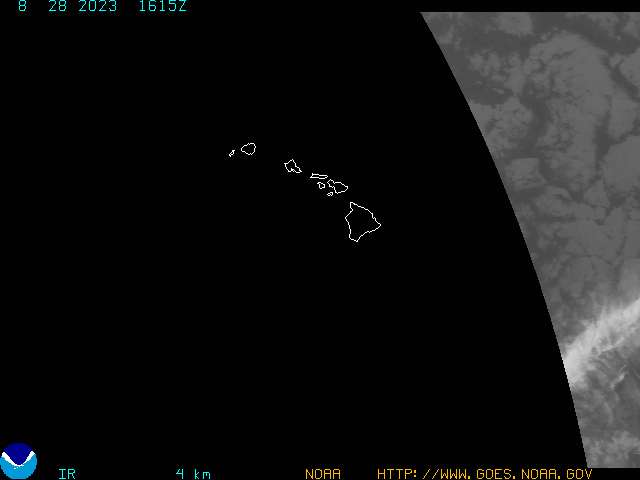
Satellite and Radar Images: To view the cloud conditions we have here in Hawaii, please use the following satellite links, starting off with theInfrared Satellite Image of the islands to see all the clouds around the state during the day and night. This next image is one that gives close images of the islands only during the daytime hours, and is referred to as a Close-up visible image. This next image shows a larger view of the Pacific…giving perspective to the wider ranging cloud patterns in the Pacific Ocean. To help you keep track of where any showers may be around the islands, here’s the latest animatedradar image.
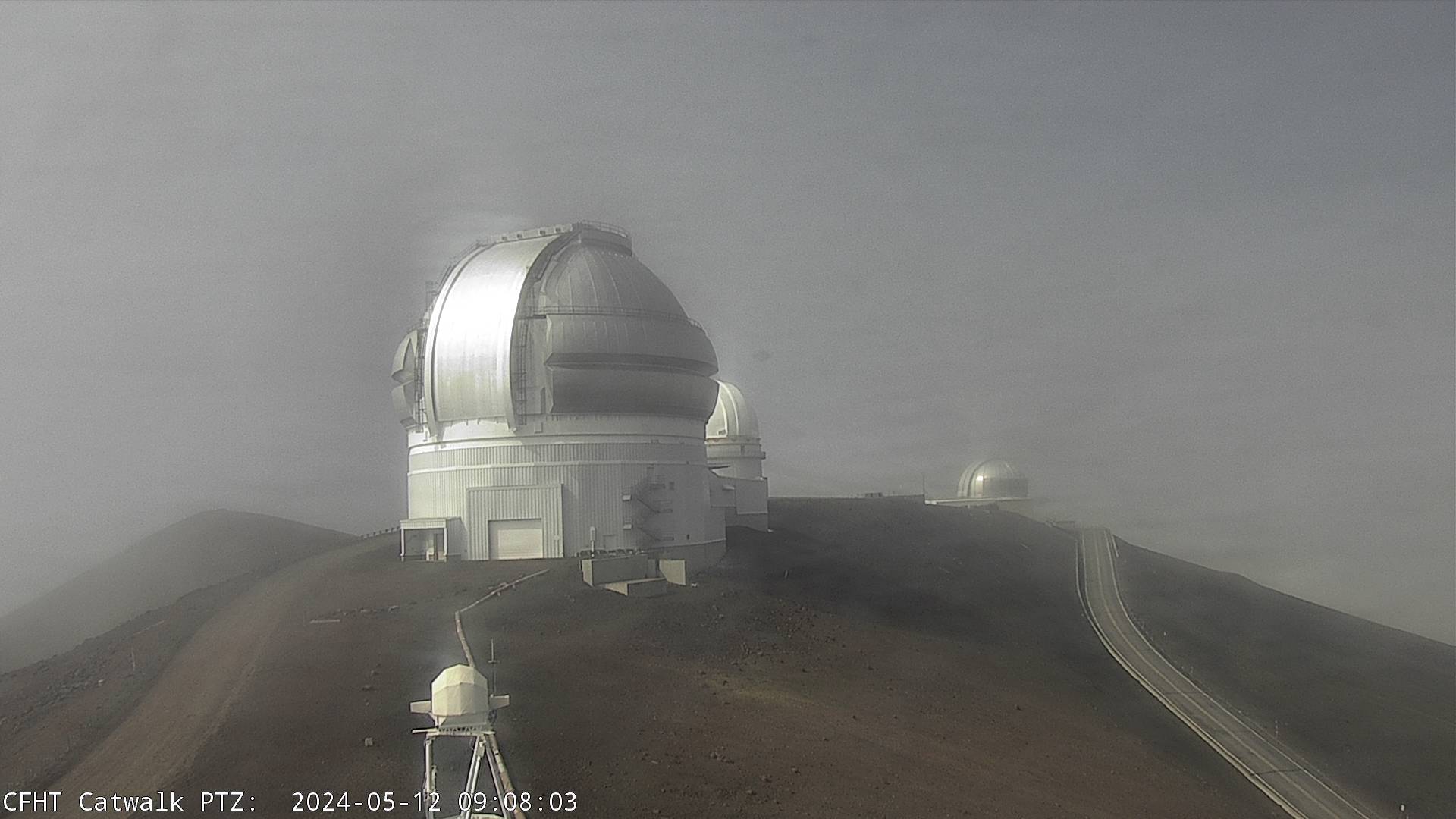
Hawaii’s Mountains – Here’s a link to the live webcam on the summit of near 14,000 footMauna Kea on the Big Island of Hawaii. The tallest peak on the island of Maui is theHaleakala Crater, which is near 10,000 feet in elevation. These two webcams are available during the daylight hours here in the islands…and when there’s a big moon rising just after sunset for an hour or two! Plus, during the nights and early mornings you will be able to see stars, and the sunrise too…depending upon weather conditions.
Our local trade winds will surge in strength Tuesday and Wednesday. The fairly normal trade winds we saw Monday, will pick up Tuesday, becoming rather strong and gusty into Thursday.The passage of a tropical vortex, the remains of former tropical cyclone Elida, as it passes to the south of the islands, combined with strengthening high pressure to the north of Hawaii… will be the source of our stronger trade wind flow. The NWS has issued a small craft wind advisory for those windiest marine waters in the southern part of the state. Later in the week, by Friday into the weekend, our local winds will drop down into the more moderately strong realms.
The remnant moisture from a now retired eastern Pacific hurricane, will bring increased showers to our islands. The leading edge of this tropical moisture will arrive over the Big Island Tuesday, moving up the island chain to Maui during the day…and may bring showers to the other islands Tuesday night into Wednesday morning. The most generous showers will fall along the windward sides of the Big Island, and perhaps Maui. There are still some strands of high cirrus here and there, but it will generally be quite thin…perhaps just enough to provide some nice sunset colors Monday evening. We will see off and on showers reaching the windward sides of the islands Monday night into Tuesday morning. Here’s a looping radar image, so we can begin to monitor the incoming showers that will be around for the next several days. ~~~It’s early Monday evening here in Kihei, Maui, as I begin updating this last section of today’s narrative. The most interesting weather feature, or at least will be soon, is what’s left of Elida, approaching our general area from the east-southeast of the Big Island. If you click on this looping satellite image, you will see what’s left of Elida, to the lower right of the Hawaiian Islands…as it spins westward. Elida was a hurricane earlier in her life while in the eastern Pacific, but is now simply a low level swirl of clouds, with an occasional towering cumulus cloud, or a couple of thunderstorms popping-up near the center of this tropical disturbance. As this counterclockwise rotating vortex (area of low pressure) moves away to the west later Wednesday into Thursday, our trade winds will slow down, and our shower activity will fade.
~~~ Just so that everyone is clear, former Elida poses no danger to the Hawaiian Islands. We will see our local winds increasing Tuesday, as high pressure strengthens to our north, and the tropical vortex of former Elida passes by to our south Wednesday. This won’t be anything radical by any means, but it will be gustier than normal for a couple of days. The fringe moisture from this area of disturbed weather should extend far enough northward to bring an increase in showers, falling mostly along the windward sides. As we move through the second half of the week, our weather will snap back into what we call a normal trade wind weather pattern. I’ll be back very early Tuesday morning with your next new weather narrative, I hope you have a great Monday night until then! Aloha for now…Glenn.
Interesting: The town of Cherrapunjee, in the north-eastern Indian state of Meghalaya, is reputed to be the wettest place in the world.But there are signs that its weather patterns may be being hit by global climate change. "Not without reason has Cherrapunjee achieved fame as being the place with the heaviest rainfall on earth," wrote German missionary Christopher Becker more than 100 years ago. "One must experience it to have an idea of the immense quantity of rain which comes down from the skies, at times day and night without a stop. It is enough to go a few steps from the house to be drenched from head to foot. An umbrella serves no purpose." But according to Cherrapunjee’s most renowned weather-watcher, Denis Rayen, the climate of the town is changing fast. "In the days of the Raj, the British used to come here to the the Khasi hills to escape the heat – we are 4,823ft (1,484m) above sea level," he says.
"But today I am not sure they would be able to do that, because it is getting a lot hotter here and the monsoon is arriving later." Official figures compiled by the Indian Meteorological Office in the nearby city of Guwahati back up Mr Rayen’s arguments that north-east India as a whole is getting hotter. "The average temperature for Guwahati at this time of the year should be around 32C – but this year the temperature has been as high as 38C," said weather expert Harendas Das. It’s too early yet to say precisely what is happening, but the evidence suggests that higher temperatures mean the whole area is experiencing less rainfall."
Interesting2:
Half of Beijing‘s drivers left their cars at home and took public transportation instead on Monday, the first workday under new restrictions meant to clear this city’s notoriously polluted skies before next month’s Olympics. Under a two-month plan that started Sunday, half of the capital’s 3.3 million cars will be removed from city streets on alternate days, depending on whether the license plate ends in an odd or even number. Those caught driving on days they shouldn’t will be fined $14, a pricey penalty even for China‘s capital. Drivers with even-numbered plates were forced Monday to take public transportation, where crowds remained surprisingly manageable.
That’s likely because employers have been asked to stagger work schedules, and public institutions will open an hour later than normal. "It seems that the subway isn’t as busy as I expected. There are fans and air conditioning, so you don’t feel very hot," said Chen Songde, who normally drives to work in Beijing. Traffic still snaked along main thoroughfares and highways Monday, but it moved at a steady pace. "Before we would be at a dead standstill," said a taxi driver who would give only his surname, Zhang, as he steered around cars. "Now it’s better." Interesting3:The Arctic may get some temporary relief from global warming if the annual North American wildfire season intensifies, according to a new study by researchers at the University of Colorado and NOAA. Smoke transported to the Arctic from northern forest fires may cool the surface for several weeks to months at a time, according to the most detailed analysis yet of how smoke influences the Arctic climate relative to the amount of snow and ice cover. "Smoke in the atmosphere temporarily reduces the amount of solar radiation reaching the surface. This transitory effect could partly offset some of the warming caused by the buildup of greenhouse gases and other pollutants," said Robert Stone, an atmospheric scientist with the university and NOAA Cooperative Institute for Research in Environmental Sciences (CIRES) and lead author of the study, which appears this week in the Journal of Geophysical Research. How much solar energy is prevented from reaching the surface depends on the smoke’s opacity, the elevation of the sun above the horizon, and the brightness of the surface, according to the study.
Stone and his research colleagues analyzed the short-term climate impact of numerous wildfires that swept through Alaska and western Canada in 2004. That summer, fires burned a record 10,000 square miles of Alaska‘s interior and another 12,000 square miles in western Canada. A NOAA climate observatory near Barrow, Alaska, provided the data for the study. Smoke observed at Barrow was so thick that at times visibility dropped to just over one mile. The aerosol optical depth (AOD), a measure of the total absorption and scattering of solar radiation by smoke particles, rose a hundredfold from typical summer values. Smoke in the atmosphere tends to cool the snow-free tundra while warming the smoke layer itself, the authors found. Smoke has an even greater cooling effect over the darker, ice-free ocean and less over bright snow.
Air Temperaturesranged between these warmest and coolest spots near sea level at 5 p.m. Sunday evening:
Kahului, Maui – 83F Molokai airport– 75
Precipitation Totals – The following numbers represent the largest precipitation totals (inches) during the last 24 hours on each of the major islands, as of Sunday afternoon: 1.49 Mount Waialeale, Kauai
1.36 Manoa Valley, Oahu
0.07 Molokai
0.42 Lanai
0.08 Kahoolawe
0.46 Oheo Gulch, Maui
0.23 Waiakea Uka, Big Island
Weather Chart – Here’s the latest (automatically updated) weather mapshowing high pressure systems far to the north of Hawaii. Our local trade winds will be on the increase into Tuesday.
Satellite and Radar Images: To view the cloud conditions we have here in Hawaii, please use the following satellite links, starting off with theInfrared Satellite Image of the islands to see all the clouds around the state during the day and night. This next image is one that gives close images of the islands only during the daytime hours, and is referred to as a Close-up visible image. This next image shows a larger view of the Pacific…giving perspective to the wider ranging cloud patterns in the Pacific Ocean. To help you keep track of where any showers may be around the islands, here’s the latest animatedradar image.
Hawaii’s Mountains – Here’s a link to the live webcam on the summit of near 14,000 footMauna Kea on the Big Island of Hawaii. The tallest peak on the island of Maui is theHaleakala Crater, which is near 10,000 feet in elevation. These two webcams are available during the daylight hours here in the islands…and when there’s a big moon rising just after sunset for an hour or two! Plus, during the nights and early mornings you will be able to see stars, and the sunrise too…depending upon weather conditions.
The trade winds will continue blowing across the islands through Monday. High pressure systems, the source of our trade winds, are now well established to the north of our islands.These winds are lighter now than they were during the past work week, as a surface trough has moved through the islands, slowing down the trade winds in the process. This lighter variety of trade winds will begin to pick up later Monday into Tuesday, becoming rather strong and gusty again by mid-week onward.The passage of a tropical vortex, the remains of former tropical cyclone Elida, as it passes to the south of the islands, will add to the gustiness of our local trade winds by mid-week.
Showers, brought in on the trade winds, will continue to arrive at times. The bulk of these showers have ended up falling along the windward coasts and slopes. The inversion layer is still higher than normal, destabilizing our local atmosphere somewhat…augmented by the passage of the surface trough of low pressure across the islands. This means that cloud tops have been allowed to grow vertically more than normal, enhancing the showers. This higher than normal inversion is allowing some showers to stretch over into the leeward sides at times, particularly on the smaller islands. Conditions should change towards the drier end of the precipitation spectrum over the next couple of days.
We may see another increase in showers arriving by Tuesday night into Wednesday, from moisture arriving from a retired tropical cyclone named Elida. Elida, which was a hurricane earlier in her life, recently lost its designation as a tropical cyclone, given its final warning by the National Hurricane Center in Miami. If you click on this looping satellite image, you will see what’s left of Elida, on the right hand side of the picture…as it spins westward. Looking further east, we see hurricane Fauso still churning the waters towards Mexico. Here is a current storm track map for Fausto…which poses no danger to the Hawaiian Islands. ~~~It’s early Sunday evening here in Kula, Maui, as I begin updating this last section of today’s narrative. There continue to be more than the ordinary amount of clouds stretched across our island chain as we move into Sunday n ight, some of which consist of the locally rather thick high cirrus clouds. Some of the lower clouds have been dropping showers at times. Last evening I had a friend visit from Marin County, in northern California. We had a nice dinner of bbq’d Ahi, fresh picked salad out of the garden, and steamed Kula corn on the cob…followed by a slice of key lime cheese cake. We were invited over to the neighbors house afterwards, to watch some DVD’s of the old days. Three of us have been old friends since the 1970’s, as we all arrived here on Maui then. It was so much fun to see those old video’s, which were put in the DVD format! We all looked so young, as would be expected, but it’s so interesting to see yourself all those many years ago.
I’m about ready to go downstairs to cook dinner, actually prepare my dinners that will take me through the upcoming work week. I will make a simple red sauce pasta sauce this time, which I’ll grate a nice pecorino cheese on spaghetti each evening. The sky here in Kula is really cloudy, with light sprinkles of rain falling occasionally. I enjoy the cloud cover however, and the relatively cool air temperatures here in the upcountry area. I’ll be back very early Monday morning with your next new weather narrative from paradise, I hope you have a great Sunday night wherever you happen to be reading from! Aloha for now…Glenn.
Sunday evening/night music video – Zero 7…Somersault
Interesting:
The cacao bean is in danger. The Nature Conservation Research Council (NCRC) recently announced that in 20 years time, "Chocolate will be much like caviar today." So what’s the deal? Unsustainable farming practices are to blame. Cacao typically grows in rainforest conditions with high biodiversity. Instead, farmers now clear the forest and use hybrid seeds to increase output over the short-term. Unfortunately, this leads to soil erosion and shorter lifespan of trees. Over time, this practice is predicted to lead to an overall shortage of cacao.
Most of the world’s cacao is grown in West Africa….even though Ghana is a net exporter of cacao, most of the country’s inhabitants could not afford to purchase a Cadbury or Hershey’s bar. For Ghanaians, "no chocolate 20 years from now" is now. Such reminders are necessary to place in perspective predictions of ecological change and impacts on human populations. While we, in wealthy, industrialized countries, may fear with trepidation the loss of resources and biodiversity associated with global warming, it is important to remember that half the world’s peoples are already living that reality.
Interesting2:
Did the tropics overheat during the Eocene some 55 to 34 million years ago? The answer holds the key to how our planet will respond to global warming, according to one climate researcher. The Earth went through a prolonged phase of extremely high temperatures during the Eocene, in which even the poles were ice-free. However, there has always been some doubt about the temperatures of the tropics during this period. Most paleo-climate records show that the tropics had mean annual temperatures of 28 to 33°C, which is not much warmer than today. Recently, however, better calibrated data have suggested that ocean temperatures could have soared as high as 41°C (105.8F). If the tropics were indeed this hot, it would solve a huge problem faced by existing climate models, including those used by the Intergovernmental Panel on Climate Change (IPCC). Existing models have difficulty duplicating climates in which the temperature gradient from the tropics to the poles is small, as suggested by the older paleo-climate data for the Eocene.
Interesting3:FromDon Knotts’ portrayle of "Mr. Limpet" to the children’s favorite "Nemo" and the tuna-pitching character in the "Sorry, Charlie" commercials, we all have seen fish that can talk. But that’s just fiction, right? Well … Researchers say real fish can communicate with sound, too. And they say (the researchers, that is) that your speech skills and, in fact, all sound production in vertebrates can be traced back to this ability in fish. (You got your ears from fish, too.) The new study was led by Andrew Bass (we did not make this up) of Cornell University. The scientists mapped developing brain cells in newly hatched midshipman fish larvae and compared them to those of other species.
They found that the chirp of a bird, the bark of a dog and all the other sounds that come out of animals’ mouths are the products of the neural circuitry likely laid down hundreds of millions of years ago with the hums and grunts of fish. "Fish have all the same parts of the brain that you do," Bass explained. His team traced the development of the connection from the midshipman fish’s vocal muscles to a cluster of neurons located in a compartment between the back of its brain and the front of its spinal cord. The same part of the brain in more complex vertebrates, such as humans, has a similar function, indicating that it was highly selected for during the course of evolution. The finding is published in the July 18 issue of the journal Science.
Interesting4:
If busy bars and blasting music seem to go hand in hand, new research from France suggests that might be because loud music encourages more drinking. The finding is reported in the October issue of Alcoholism: Clinical and Experimental Research, and is drawn from research led by Nicolas Gueguen, a professor of behavioral sciences at the Université de Bretagne-Sud in France. "This is an informative and good study that I think a lot of people will identify with, because it makes a lot of sense," said Dr. Marc Galanter, director of the division of alcoholism and drug abuse at the LangoneMedicalCenter at New York University. "Because it seems that loud music throws people off their game and renders them less in control of their capacity to moderate their drinking."
Galanter was not a part of the research team, which noted that prior explorations into the effect of music on drinking have already revealed that people spend more time in a bar that plays music than one that doesn’t, and that fast music in particular seems to prompt fast drinking. The style of music played in a bar can also affect drinking behavior, although in varying ways, depending on the cultural setting. In the current effort, the authors observed 40 male patrons between the ages of 18 and 25 while they visited one of two bars located in the western region of France. Both establishments were local hangouts for young people. The male participants — unaware that they were being tracked — were chosen for monitoring only if they were sitting at a table in pairs and had initially ordered an 8-ounce glass of draft beer.
Air Temperaturesranged between these warmest and coolest spots near sea level at 4 p.m. Saturday afternoon:
Barking Sands, Kauai – 87F Hilo, Hawaii– 78
Precipitation Totals – The following numbers represent the largest precipitation totals (inches) during the last 24 hours on each of the major islands, as of Saturday afternoon: 0.14 Mount Waialaele, Kauai
0.42 Moanalua, Oahu
0.50 Molokai
0.00 Lanai
0.00 Kahoolawe 1.71 Puu Kukui, Maui
0.74 Pahoa, Big Island
Weather Chart – Here’s the latest (automatically updated) weather mapshowing high pressure systems to the north of Hawaii. At the same time we have a weak trough moving through the islands, which will soften our local trade winds some into Monday…although somewhat stronger gusts in those windiest areas.
Satellite and Radar Images: To view the cloud conditions we have here in Hawaii, please use the following satellite links, starting off with theInfrared Satellite Image of the islands to see all the clouds around the state during the day and night. This next image is one that gives close images of the islands only during the daytime hours, and is referred to as a Close-up visible image. This next image shows a larger view of the Pacific…giving perspective to the wider ranging cloud patterns in the Pacific Ocean. To help you keep track of where any showers may be around the islands, here’s the latest animatedradar image.
Hawaii’s Mountains – Here’s a link to the live webcam on the summit of near 14,000 footMauna Kea on the Big Island of Hawaii. The tallest peak on the island of Maui is theHaleakala Crater, which is near 10,000 feet in elevation. These two webcams are available during the daylight hours here in the islands…and when there’s a big moon rising just after sunset for an hour or two! Plus, during the nights and early mornings you will be able to see stars, and the sunrise too…depending upon weather conditions.
Aloha Paragraphs
Laupahoehoe Point on the Big Island of Hawaii Photo Credit: Flickr.com
The trade winds will continue blowing across the islands…although they will be lighter this weekend than recently. High pressure systems, the source of our trade winds, are now well established to the north of our islands.The latest computer forecast models show these gusty trade winds easing off some into Monday. This lighter brand of trade winds will begin to pick up on Tuesday, becoming rather strong and gusty again by mid-week onward.
Showers, brought in on the trade winds, will continue to arrive at times. The bulk of these showers will end up falling along the windward coasts and slopes. The inversion layer is still considerably higher than normal. This means that cloud tops will be allowed to grow vertically more than normal, enhancing the showers…some of which may be locally heavy. This higher than normal inversion is allowing some showers to stretch over into the leeward sides at times, particularly on the smaller islands.
There’s off and on showery clouds moving into the state from the east, which will keep our islands, especially along the windward sides, off and on wet into Sunday. We can keep an eye on these incoming shower clouds by clicking on this looping radar image. This looping satellite image, shows this showery area moving into the state, as well as an area of high clouds moving in our direction from the west, on the upper winds.
We may see another increase in showers arriving by next Wednesday, from moisture arriving from a retired tropical cyclone named Elida. Elida, which was a hurricane earlier in her life, recently lost its designation as a tropical cyclone, given its final warning by the National Hurricane Center in Miami. If you click on this looping satellite image, you will see what’s left of Elida, on the far right hand side of the picture. Looking further east, we see hurricane Fauso still churning the waters towards Mexico. Here is a current storm track map for Fausto. ~~~It’s early Saturday evening here in Kula, Maui, as I begin updating this last section of today’s narrative. There have been more than the ordinary amount of clouds cloaking many parts of the island chain. Some of these clouds have been dropping showers at times. Here in Kula, there were several periods of light showers falling during the afternoon hours…the eaves are still dripping at the time of this writing. I went to Lahaina this morning, and got to surf some small waves. It wasn’t crowded, and the wind wasn’t a problem, but the surf was pretty weak…at least compared to the last 4-5 weekend surf sessions that I’ve been fortunate enough to catch. I have a friend from Marin County, California coming over for dinner this evening, and she’ll be sleeping over downstairs. She is one of the friends that I stay with when I go to California for vacation. I’ll make her a nice breakfast Sunday morning, before she heads back over to Haiku, where she also owns a very nice property. I hope you have a great Saturday night wherever you happen to be spending it! I’ll be back Sunday with your next new weather narrative. Aloha for now…Glenn.
Interesting:
The cacao bean is in danger. The Nature Conservation Research Council (NCRC) recently announced that in 20 years time, "Chocolate will be much like caviar today." So what’s the deal? Unsustainable farming practices are to blame. Cacao typically grows in rainforest conditions with high biodiversity. Instead, farmers now clear the forest and use hybrid seeds to increase output over the short-term. Unfortunately, this leads to soil erosion and shorter lifespan of trees. Over time, this practice is predicted to lead to an overall shortage of cacao.
Most of the world’s cacao is grown in West Africa….even though Ghana is a net exporter of cacao, most of the country’s inhabitants could not afford to purchase a Cadbury or Hershey’s bar. For Ghanaians, "no chocolate 20 years from now" is now. Such reminders are necessary to place in perspective predictions of ecological change and impacts on human populations. While we, in wealthy, industrialized countries, may fear with trepidation the loss of resources and biodiversity associated with global warming, it is important to remember that half the world’s peoples are already living that reality.
Interesting2:
Did the tropics overheat during the Eocene some 55 to 34 million years ago? The answer holds the key to how our planet will respond to global warming, according to one climate researcher. The Earth went through a prolonged phase of extremely high temperatures during the Eocene, in which even the poles were ice-free. However, there has always been some doubt about the temperatures of the tropics during this period. Most paleo-climate records show that the tropics had mean annual temperatures of 28 to 33°C, which is not much warmer than today. Recently, however, better calibrated data have suggested that ocean temperatures could have soared as high as 41°C (105.8F). If the tropics were indeed this hot, it would solve a huge problem faced by existing climate models, including those used by the Intergovernmental Panel on Climate Change (IPCC). Existing models have difficulty duplicating climates in which the temperature gradient from the tropics to the poles is small, as suggested by the older paleo-climate data for the Eocene.
Interesting3:FromDon Knotts’ portrayle of "Mr. Limpet" to the children’s favorite "Nemo" and the tuna-pitching character in the "Sorry, Charlie" commercials, we all have seen fish that can talk. But that’s just fiction, right? Well … Researchers say real fish can communicate with sound, too. And they say (the researchers, that is) that your speech skills and, in fact, all sound production in vertebrates can be traced back to this ability in fish. (You got your ears from fish, too.) The new study was led by Andrew Bass (we did not make this up) of Cornell University. The scientists mapped developing brain cells in newly hatched midshipman fish larvae and compared them to those of other species.
They found that the chirp of a bird, the bark of a dog and all the other sounds that come out of animals’ mouths are the products of the neural circuitry likely laid down hundreds of millions of years ago with the hums and grunts of fish. "Fish have all the same parts of the brain that you do," Bass explained. His team traced the development of the connection from the midshipman fish’s vocal muscles to a cluster of neurons located in a compartment between the back of its brain and the front of its spinal cord. The same part of the brain in more complex vertebrates, such as humans, has a similar function, indicating that it was highly selected for during the course of evolution. The finding is published in the July 18 issue of the journal Science.
Interesting4:
If busy bars and blasting music seem to go hand in hand, new research from France suggests that might be because loud music encourages more drinking. The finding is reported in the October issue of Alcoholism: Clinical and Experimental Research, and is drawn from research led by Nicolas Gueguen, a professor of behavioral sciences at the Université de Bretagne-Sud in France. "This is an informative and good study that I think a lot of people will identify with, because it makes a lot of sense," said Dr. Marc Galanter, director of the division of alcoholism and drug abuse at the LangoneMedicalCenter at New York University. "Because it seems that loud music throws people off their game and renders them less in control of their capacity to moderate their drinking."
Galanter was not a part of the research team, which noted that prior explorations into the effect of music on drinking have already revealed that people spend more time in a bar that plays music than one that doesn’t, and that fast music in particular seems to prompt fast drinking. The style of music played in a bar can also affect drinking behavior, although in varying ways, depending on the cultural setting. In the current effort, the authors observed 40 male patrons between the ages of 18 and 25 while they visited one of two bars located in the western region of France. Both establishments were local hangouts for young people. The male participants — unaware that they were being tracked — were chosen for monitoring only if they were sitting at a table in pairs and had initially ordered an 8-ounce glass of draft beer.
Air Temperaturesranged between these warmest and coolest spots near sea level at 5 p.m. Friday evening:
Barking Sands, Kauai – 90F Kaneohe, Oahu– 80
Precipitation Totals – The following numbers represent the largest precipitation totals (inches) during the last 24 hours on each of the major islands, as of Friday afternoon: 0.97 Kokee, Kauai 1.59 South Fork Kaukonahua, Oahu
0.13 Molokai
0.05 Lanai
0.01 Kahoolawe 1.59 Puu Kukui, Maui
1.12 Glenwood, Big Island
Weather Chart – Here’s the latest (automatically updated) weather mapshowing high pressure systems stretched out north through far NE of Hawaii. These trade wind producing high pressure cells will keep moderately strong trade winds blowing across our tropical latitudes, with stronger gusts in those windiest areas…including the major channels between the islands.Here’s a link to the NOAA weather school.
Satellite and Radar Images: To view the cloud conditions we have here in Hawaii, please use the following satellite links, starting off with theInfrared Satellite Image of the islands to see all the clouds around the state during the day and night. This next image is one that gives close images of the islands only during the daytime hours, and is referred to as a Close-up visible image. This next image shows a larger view of the Pacific…giving perspective to the wider ranging cloud patterns in the Pacific Ocean. To help you keep track of where any showers may be around the islands, here’s the latest animatedradar image.
Hawaii’s Mountains – Here’s a link to the live webcam on the summit of near 14,000 footMauna Kea on the Big Island of Hawaii. The tallest peak on the island of Maui is theHaleakala Crater, which is near 10,000 feet in elevation. These two webcams are available during the daylight hours here in the islands…and when there’s a big moon rising just after sunset for an hour or two! Plus, during the nights and early mornings you will be able to see stars, and the sunrise too…depending upon weather conditions.
Aloha Paragraphs
We’ll be seeing more rainbows here in the islands Photo Credit: Flickr.com
We’ve entered in what looks to be a period of prolonged trade winds. High pressure systems, the source of our trade winds, are now well established far to the north and northeast of our islands.This has been quite a change from the lighter than normal winds that we’ve seen for much of the last week and more. The latest computer forecast models show these gusty trade winds staying active right on into next week…and potentially longer. The windiest places around Maui and the Big Island, including most coastal and channel waters, now find small craft wind advisory flags waving in the gusty breezes.
Showers have been on the increase, carried to us off the tropical ocean…by the trade winds. The bulk of these showers will end up falling along the windward coasts and slopes. The inversion layer is still quite high, capping the clouds between 9,000 and 11,000 feet. This means that cloud tops will be allowed to grow vertically more than normal, enhancing the showers…some of which will be locally heavy. This higher than normal inversion is allowing some showers to stretch over into the leeward sides at times, particularly on the smaller islands…which have lower mountains separating the windward and leeward sections. We can keep an eye on the incoming shower clouds, and the showery plumes coming off the west side of the Big Island (at least at the time of this viewing), by clicking on this looping radar image. Meanwhile, it appears the next batch of showery clouds, at least in any increased way, is still a ways to our east. This looping satellite image, also shows an area of high cirrus clouds moving in our direction from the west, on the upper winds…those that travel at jet stream altitudes of the atmosphere, or 20,000 feet and above.
The computer models are still showing a decent chance of increased windward biased showers into this weekend. We might see another more organized increase in showers next week, from moisture arriving from what will then be former tropical storm Elida. Further out to the east, over closer to Mexico, we find a second system, called hurricane Fausto…which may end up bringing some of its leftover showers to us eventually too. If there ‘s enough of a low pressure vortex still holding together, as it moves by to the south of the state around next Tuesday or Wednesday…we may see our local trade winds surge noticeably. Neither of these two tropical cyclones pose any threat to our Hawaiian Islands. Here is a current storm track map for Elida and Fausto. ~~~It’s early Friday evening here in Kula, Maui, as I begin updating this last section of today’s narrative. During the last 24 hours there has been a substantial increase in showers, most notably along the windward coasts and slopes…some of which were locally heavy Thursday night into early Friday morning. All the ingredients appear to be still in place, so that during the next 24 hours, it wouldn’t surprise me to see more incoming showers, with some embedded downpours included. As many of you regular readers know, it wouldn’t be unusual for me to take in a new film after work on Friday. I can’t wait to see the new Batman film, but thought I’d wait for a week or even two, to let the crowds die down some. It’s gotten amazingly positive reviews, and I’m quite sure opening night will be a full house at the local theater. Therefore, I’m home, with not much to do but have a little dinner, read some, and probably go to bed relatively early for a Friday night. This will put me in a good place to get up early Saturday morning, in order to get an early start on a surfing trip to the Lahaina side. I will of course be back to bring you your new weather narrative before I leave however. I hope you have a great Friday night, and it will be another bright one, with the just past full moon beaming down from above. Aloha for now…Glenn.
Interesting:
The cacao bean is in danger. The Nature Conservation Research Council (NCRC) recently announced that in 20 years time, "Chocolate will be much like caviar today." So what’s the deal? Unsustainable farming practices are to blame. Cacao typically grows in rainforest conditions with high biodiversity. Instead, farmers now clear the forest and use hybrid seeds to increase output over the short-term. Unfortunately, this leads to soil erosion and shorter lifespan of trees. Over time, this practice is predicted to lead to an overall shortage of cacao.
Most of the world’s cacao is grown in West Africa….even though Ghana is a net exporter of cacao, most of the country’s inhabitants could not afford to purchase a Cadbury or Hershey’s bar. For Ghanaians, "no chocolate 20 years from now" is now. Such reminders are necessary to place in perspective predictions of ecological change and impacts on human populations. While we, in wealthy, industrialized countries, may fear with trepidation the loss of resources and biodiversity associated with global warming, it is important to remember that half the world’s peoples are already living that reality.
Interesting2:
Did the tropics overheat during the Eocene some 55 to 34 million years ago? The answer holds the key to how our planet will respond to global warming, according to one climate researcher. The Earth went through a prolonged phase of extremely high temperatures during the Eocene, in which even the poles were ice-free. However, there has always been some doubt about the temperatures of the tropics during this period. Most paleo-climate records show that the tropics had mean annual temperatures of 28 to 33°C, which is not much warmer than today. Recently, however, better calibrated data have suggested that ocean temperatures could have soared as high as 41°C (105.8F). If the tropics were indeed this hot, it would solve a huge problem faced by existing climate models, including those used by the Intergovernmental Panel on Climate Change (IPCC). Existing models have difficulty duplicating climates in which the temperature gradient from the tropics to the poles is small, as suggested by the older paleo-climate data for the Eocene.
Interesting3:FromDon Knotts’ portrayle of "Mr. Limpet" to the children’s favorite "Nemo" and the tuna-pitching character in the "Sorry, Charlie" commercials, we all have seen fish that can talk. But that’s just fiction, right? Well … Researchers say real fish can communicate with sound, too. And they say (the researchers, that is) that your speech skills and, in fact, all sound production in vertebrates can be traced back to this ability in fish. (You got your ears from fish, too.) The new study was led by Andrew Bass (we did not make this up) of Cornell University. The scientists mapped developing brain cells in newly hatched midshipman fish larvae and compared them to those of other species.
They found that the chirp of a bird, the bark of a dog and all the other sounds that come out of animals’ mouths are the products of the neural circuitry likely laid down hundreds of millions of years ago with the hums and grunts of fish. "Fish have all the same parts of the brain that you do," Bass explained. His team traced the development of the connection from the midshipman fish’s vocal muscles to a cluster of neurons located in a compartment between the back of its brain and the front of its spinal cord. The same part of the brain in more complex vertebrates, such as humans, has a similar function, indicating that it was highly selected for during the course of evolution. The finding is published in the July 18 issue of the journal Science.
Interesting4:
If busy bars and blasting music seem to go hand in hand, new research from France suggests that might be because loud music encourages more drinking. The finding is reported in the October issue of Alcoholism: Clinical and Experimental Research, and is drawn from research led by Nicolas Gueguen, a professor of behavioral sciences at the Université de Bretagne-Sud in France. "This is an informative and good study that I think a lot of people will identify with, because it makes a lot of sense," said Dr. Marc Galanter, director of the division of alcoholism and drug abuse at the LangoneMedicalCenter at New York University. "Because it seems that loud music throws people off their game and renders them less in control of their capacity to moderate their drinking."
Galanter was not a part of the research team, which noted that prior explorations into the effect of music on drinking have already revealed that people spend more time in a bar that plays music than one that doesn’t, and that fast music in particular seems to prompt fast drinking. The style of music played in a bar can also affect drinking behavior, although in varying ways, depending on the cultural setting. In the current effort, the authors observed 40 male patrons between the ages of 18 and 25 while they visited one of two bars located in the western region of France. Both establishments were local hangouts for young people. The male participants — unaware that they were being tracked — were chosen for monitoring only if they were sitting at a table in pairs and had initially ordered an 8-ounce glass of draft beer.
Air Temperaturesranged between these warmest and coolest spots near sea level at 4 p.m. Thursday afternoon:
Honolulu, Oahu – 87F Lihue, Kauai– 81
Precipitation Totals – The following numbers represent the largest precipitation totals (inches) during the last 24 hours on each of the major islands, as of Thursday morning: 0.95 Lihue, Kauai
0.17 Punaluu Pump, Oahu
0.00 Molokai
0.00 Lanai
0.00 Kahoolawe
1.08 Puu Kukui, Maui 1.91 Waiakea Uka, Big Island
Weather Chart – Here’s the latest (automatically updated) weather mapshowing high pressure systems stretched out north through far NE of Hawaii. These trade wind producing high pressure cells will keep moderately strong trade winds blowing across our tropical latitudes, with stronger gusts in those windiest areas…including the major channels between the islands.Here’s a link to the NOAA weather school.
Satellite and Radar Images: To view the cloud conditions we have here in Hawaii, please use the following satellite links, starting off with theInfrared Satellite Image of the islands to see all the clouds around the state during the day and night. This next image is one that gives close images of the islands only during the daytime hours, and is referred to as a Close-up visible image. This next image shows a larger view of the Pacific…giving perspective to the wider ranging cloud patterns in the Pacific Ocean. To help you keep track of where any showers may be around the islands, here’s the latest animatedradar image.
Hawaii’s Mountains – Here’s a link to the live webcam on the summit of near 14,000 footMauna Kea on the Big Island of Hawaii. The tallest peak on the island of Maui is theHaleakala Crater, which is near 10,000 feet in elevation. These two webcams are available during the daylight hours here in the islands…and when there’s a big moon rising just after sunset for an hour or two! Plus, during the nights and early mornings you will be able to see stars, and the sunrise too…depending upon weather conditions.
Aloha Paragraphs
Full moon skies in Hawaii Photo Credit: Flickr.com
Our local trade winds have increased in strength as expected.These stronger wind speeds have triggered small craft wind advisory flags in those windiest coastal and channel waters…from Oahu down through Maui to the Big Island. This has been quite a change from the lighter than normal winds that we saw for much of the last week and more. The latest computer forecast models show these gusty trade winds staying active right on into next week…and potentially longer.
These more forceful trade winds will carry showers our way at times. The bulk of these showers will end up falling along the windward coasts and slopes…most generously during the nights and early morning hours. The inversion layer is still quite high, capping the clouds at near 11,000 to 12,000 feet. This simply means that cloud tops will be allowed to grow somewhat higher than normal…enhancing the showers at times. The computer models are still showing a decent chance of increased windward biased showers this weekend. We might see another more organized increase in showers next week, from moisture arriving from what will then be former hurricane Elida. By the way, here is a current storm track map for Elida and Fausto.
~~~The surf is up along our leeward beaches, with swells continuing to roll our way from the southern hemisphere. These waves aren’t large enough to warrant a high surf advisory for our south and west facing beaches. They do however, bring lots of fun riding for the surfing community, and are great fun for just about everyone wanting to splash around in those warm water waves! There are still some beaches that are near flat, without that wave action, which will keep the snorkelers and divers happy too. There’s something for everyone here in Hawaii!
~~~If you happen to be outside tonight, you will have the pleasure of witnessing the July full moon. The fullest extent of this celestial occurrence will be around 10pm Thursday night, when our nearby neighbor will be at its brightest and most full phase. A friend of mine mentioned to beware of aberrant behavior during the full moon, or revel in it…whichever the case may be. Personally, I think I’ll just go out on my weather deck tonight, and enjoy the glow of this once a month spectacle.
~~~We finally got some added moisture into our area, thanks to the returning trade winds. They’ve begun to carry showery clouds in our direction, which is a great thing! This shower activity will continue in an off and on fashion during the rest of the week, hopefully more on than off as we move into the weekend time frame. The computer models continue to suggest that we’ll see a possible further increase in windward showers, even more than what would be normal for this time of year next week. As I mentioned above, the remnant moisture from (what will then be) former hurricane Elida, may move into the Aloha state around next Wednesday or so. There’s a chance that leftover moisture from (what will then be) former hurricane Fausto might arrive eventually too. Neither of these is a sure thing, although Elida’s moisture has the best chance of arriving as it looks now. At any rate, I hope you have a great, bright Thursday night, what with the full moon and all, and that you will meet me here again on Friday, when I’ll have your new weather narrative from paradise waiting for you. Aloha for now…Glenn.
Interesting:New York City’s yellow taxi fleet now will go green at the rate of 300 new hybrid cars a month, Mayor Michael Bloomberg said on Wednesday, citing an agreement with car-makers to supply the fuel-light cabs. There are already more than 1,300 hybrid taxis in the city, and each one saves its drivers about $6,500 a year, Taxi and Limousine Commission Chairman Matthew Daus said in a joint statement with the mayor. Bloomberg aims to accomplish 127 green initiatives before his second and final four-year term ends in 2010. In December, the Taxi and Limousine Commission voted to require all vehicles that join the taxi fleet to be hybrids by October 1. The only exception is for cabs specially equipped for the handicapped.
Nissan Motor Co has promised the city to supply up to 200 of its Altima hybrids per month, while General Motors will provide 50 Chevrolet Malibu hybrids and Ford Motor Co promised 50 of its Escape hybrids, the mayor said. That adds up to 90 more cars per month than the Taxi and Limousine Commission had said were needed to meet its goals, which aim to ensure that by 2012, the entire taxi fleet will be all-hybrid or a mix that includes other cars with similar high mile-per-gallon ratings. Fast-growing demand for hybrids in an era of soaring gasoline prices is one of the brightest markets for automobile companies and New York City is not alone in emphasizing taxis. Ford, for example, says San Francisco put its first Escape hybrid taxi on the streets in 2005, followed by other cities, including Chicago.
Interesting2:
After 26 years as an enduring symbol of the B.C. Summer and Winter Games, a torch that was traditionally lit 100 days before each event began has been snuffed out because of global warming. B.C. Games Society President and CEO Kelly Mann announced yesterday there will be a 20-minute torch ceremony at the opening and closing ceremonies, but the main flame will not be lit for this summer’s event, starting in Kelowna next week, which will attract some 3,700 athletes, coaches and officials. "This torch comes from a different era. We’ve had it for a long, long time. We fired this thing up 26 years ago. There was a different mindset then about burning fossil fuels," Mr. Mann said. "Now if something is out in public, burning and burning and burning for no apparent reason, other than just to raise attention to the fact the Summer or Winter Games are in a community, people began to question that. And so we were listening to that [criticism]." He said despite the great symbolic importance of the flame, officials didn’t have a hard time making the decision.
Air Temperaturesranged between these warmest and coolest spots near sea level at 4 p.m. Wednesday afternoon:
Honolulu – 88F Port Allen, Kauai– 79
Precipitation Totals – The following numbers represent the largest precipitation totals (inches) during the last 24 hours on each of the major islands, as of Wednesday afternoon: 0.95 Lihue, Kauai
1.07 Wheeler Field, Oahu
0.00 Molokai
0.00 Lanai
0.00 Kahoolawe 1.11 Ulupalakua, Maui
0.95 Pali 2, Big Island
Weather Chart – Here’s the latest (automatically updated) weather mapshowing an array of trade wind producing high pressure systems stretched out from NW through far NE of Hawaii. As these high pressure cells strengthen now, there will be a corresponding increase in our trade wind speeds.Here’s a link to the NOAA weather school.
Satellite and Radar Images: To view the cloud conditions we have here in Hawaii, please use the following satellite links, starting off with theInfrared Satellite Image of the islands to see all the clouds around the state during the day and night. This next image is one that gives close images of the islands only during the daytime hours, and is referred to as a Close-up visible image. This next image shows a larger view of the Pacific…giving perspective to the wider ranging cloud patterns in the Pacific Ocean. To help you keep track of where any showers may be around the islands, here’s the latest animatedradar image.
Hawaii’s Mountains – Here’s a link to the live webcam on the summit of near 14,000 footMauna Kea on the Big Island of Hawaii. The tallest peak on the island of Maui is theHaleakala Crater, which is near 10,000 feet in elevation. These two webcams are available during the daylight hours here in the islands…and when there’s a big moon rising just after sunset for an hour or two! Plus, during the nights and early mornings you will be able to see stars, and the sunrise too…depending upon weather conditions.
There will be a general strengthening of the trade winds through the next several days.A trough of low pressure, which has kept our local winds from attaining their full strength so far this week…is losing its influence now. Thursday onward, and especially by the weekend, our trade winds will be noticeably stronger. We may end up having small craft advisory flags being hoisted in those windiest spots by Friday or Saturday. These trade winds will continue on into next week.
We’ll be moving back into a fairly normal trade wind weather pattern now. That being said, we still have a layer of colder than normal air aloft over the islands, which may continue to enhance some of our shower cells locally. The majority of showers will be carried in our direction by the trade winds, landing along the windward coasts and slopes. Computer models still are hinting that those windward biased showers may be quite generous later Friday into the weekend. Meanwhile, we may continue to see a couple of showers over the leeward slopes during the afternoon hours as well.
~~~ Its early Wednesday evening here in Kihei, Maui, as I begin updating this last section of today’s narrative. As has been the case off and on all this week, afternoon clouds increased in many leeward areas, which lead to showers…some locally heavy. Here on Maui, there was a thick blanket of clouds hugging the leeward slopes of the Haleakala Crater. These clouds kept the area from Kula to Keokea and Ulupalakua quite wet most of the afternoon. Here in Kihei, the clouds spread down from the mountain towards the coast, cutting off our famous Hawaiian sunshine early in the afternoon. Meanwhile, the trade winds have returned, and will become fresher over the next few days. Early Wednesday evening the strongest gust that I saw at 5pm, was 23 mph at Maalaea Bay. We’ll see showers increasing somewhat overnight along the windward coasts, and perhaps again on Thursday, during the afternoon hours in the upcountry areas. By the way, we’ll see the July full moon occurring later in the day Thursday, we have that to look forward to. Speaking of looking forward, I’m already doing that in relation to coming back online with your next new weather narrative, very early Thursday morning! I hope you have a great Wednesday night wherever you happen to be spending it, Aloha for now…Glenn.
Interesting:Arecycling bin awaiting curbside pickup doesn’t seem like an obvious location for a crime, but it often is in Northern California cities and in other locations throughout the country, reports the Associated Press. The combination of a slow economy and higher prices for aluminum, cardboard and newsprint is contributing to the rise in curbside theft. In many instances, the robbers have organized into fleets of trucks, sweeping neighborhoods for valuable recyclables. Many state and local authorities are seeking more stringent regulations to discourage theft because lost revenue can endanger recycling programs. Some cities already have laws against recycling bin poaching. Getting caught in San Francisco could mean a fine of up to 500 dollars and six months in jail. In New York City, thieves are subject to arrest, vehicle impoundment and fines of up to 5,000 dollars. Authorities continue to pursue a solution to the growing problem.
Interesting2:The dead zone in the Gulf of Mexico could reach a new record size this year, and grow to cover an area equal to the State of New Jersey, researchers said Tuesday. One prime culprit: The record Midwest flooding that caused the Mississippi to swell. The discharge of pollutants and nutrients from the Mississippi River causes algae to bloom in the Gulf of Mexico. When the algae dies, the decaying absorbs so much oxygen from the water that large areas become inhospitable to fish. The resulting lifeless area is called a eutrophic or hypoxic zone, or more colloquially, a dead zone. The condition is cyclic, and reaches its maximum in late summer. The biggest dead zone on record was in 2002, when 8,481 square miles of water became lifeless. Last year, researchers also predicted a record was possible, but the dead zone reached 7,903 square miles. This year, the total could exceed 8,800 square miles, or 5% greater than the last record.
Interesting3: Only 48 per cent of Laotians are connected to the electrical grid. Access to electricity is limited due to lack of infrastructure and high costs so most rural communities rely on environmentally unfriendly energy sources, such as firewood and kerosene. Solar-powered systems are a logical alternative but start-up costs are high. To get around this, local company Sunlabob Rural Energy is renting solar-based systems to villagers. Solar-powered lanterns are available to rent at a competitive price and users can recharge the lamps for a small fee at a central facility in the village. Alternatively, a whole village can rent the equipment for generating solar electricity from the company and sub-lease power to individual houses. And larger villages can use a combination of solar, hydro and generator power to create a grid with enough energy to power health clinics, rice mills and water pumps. The program is proving highly successful because the community itself is in charge, ensuring sustainability. Around 1,800 village systems and 500 solar lanterns have been rented to families in 73 villages in Laos. Sunlabob is now seeking to extend the project into Cambodia and Indonesia and other regions.
Interesting4:A lot more Martian rocks were altered by water than scientists originally thought, suggesting that early Mars was a very wet place.New observations made by NASA’s Mars Reconnaissance Orbiter (MRO), currently circling the planet, have revealed evidence that vast regions of the southern highlands of Mars were altered by water in a variety of environments billions of years ago.Water is a key condition for life as we know it. Though there is no firm evidence that Mars has ever harbored life, knowing that the planet was once wet suggests that it was at least habitable in the past.The key to the finding is the discovery that rocks called phyllosilicates are widespread on at least the planet’s southern hemisphere. The water present on Mars from about 4.6 billion to 3.8 billion years ago transformed some rocks into these phyllosilicates, which include clays rich in iron, magnesium or aluminum, mica, and kaolinite (an ingredient in Kaopectate)."In a phyllosilicate, the atoms are stacked up into layers, and all of the phyllosilicates have some sort of water or hydroxyl [oxygen and hydrogen group] incorporated into the crystal structure," said study team member Scott Murchie of JohnsHopkinsUniversity.
Interesting5:Telescope mirrors made from lunar dust could help realize dreams of stargazing from the far side of the moon. Creating gigantic lunar telescopes would normally carry an astronomical price tag, but NASA researchers used a mix of epoxy, simulated lunar dust and carbon nanotubes to demonstrate how to use materials already found on the moon. "You can go to the moon with a few buckets, and build something far larger than anything a rocket can carry," said Peter Chen, a physicist at the NASA Goddard Space Flight Center in Greenbelt, Md. Astronomers have argued about which is better in the future: building additional orbiting space telescopes such as Hubble or setting them up on the moon. Both types of telescopes would be beyond the interference of Earth’s atmosphere, although the moon has the added advantages of being a stable platform with a far side shielded from Earth’s cluttered radio background. On the other hand, getting to the moon represents more of a challenge than simply launching a space telescope. However, the debate so far has been "limited by launching from the ground," Chen told SPACE.com, because Earth’s gravity places both size and cost limits on what rockets can carry into space or to the moon.
Interesting6:Sloshing back and forth in constant rhythm, the ocean’s tides are a predictable source of renewable energy. Hoping to tap into this, the world’s largest tidal turbine is set to start generating electricity this month. The installation of the SeaGen marine current generator was completed this past May in Strangford Lough, a large inlet on the coast of Northern Ireland. The system, designed and built by Marine Current Turbines Ltd., has two rotors that each span 16 meters (52 feet) in diameter. "The technology is very analogous to wind, except we are doing everything underwater," said Peter Fraenkel, the company’s technical director. The maximum power output of the SeaGen will be 1.2 megawatts — four times more than any other turbine. Operating for roughly 20 hours per day, it is expected to supply 1,000 homes. The $20 million SeaGen is a single tower, moored to the seafloor a quarter mile (400 meters) from shore. It is designed to catch both the incoming (flow) and outgoing (ebb) tides by rotating its two rotors 180 degrees. No power is generated during tide changes, as the turbine only works when the water is moving 2 knots (2.3 mph) or more.
Air Temperaturesranged between these warmest and coolest spots near sea level at 4 p.m. Tuesday afternoon:
Honolulu, Oahu– 86F Barking Sands, Kauai– 75
Precipitation Totals – The following numbers represent the largest precipitation totals (inches) during the last 24 hours on each of the major islands, as of Tuesday afternoon: 0.57 Port Allen, Kauai
0.24 Waianae Valley, Oahu
0.16 Molokai
0.00 Lanai
0.00 Kahoolawe
1.61 Ulupalakua, Maui 2.16 Honaunau, Big Island
Weather Chart – Here’s the latest (automatically updated) weather mapshowing a trough of low pressure to the north and northwest of Hawaii. At the same time we find a robust high pressure center located far to the NE. This pressure configuration will have our local trade winds gradually strengthening through Thursday.Here’s a link to the NOAA weather school.
Satellite and Radar Images: To view the cloud conditions we have here in Hawaii, please use the following satellite links, starting off with theInfrared Satellite Image of the islands to see all the clouds around the state during the day and night. This next image is one that gives close images of the islands only during the daytime hours, and is referred to as a Close-up visible image. This next image shows a larger view of the Pacific…giving perspective to the wider ranging cloud patterns in the Pacific Ocean. To help you keep track of where any showers may be around the islands, here’s the latest animatedradar image.
Hawaii’s Mountains – Here’s a link to the live webcam on the summit of near 14,000 footMauna Kea on the Big Island of Hawaii. The tallest peak on the island of Maui is theHaleakala Crater, which is near 10,000 feet in elevation. These two webcams are available during the daylight hours here in the islands…and when there’s a big moon rising just after sunset for an hour or two! Plus, during the nights and early mornings you will be able to see stars, and the sunrise too…depending upon weather conditions.
Aloha Paragraphs
The windward side of Oahu Photo Credit: Flickr.com
The recent lighter than normal trade winds will give way to increasingly strong trade winds through the rest of the week.A trough of low pressure, located to the north through northwest of Hawaii Tuesday evening…have kept our local winds from attaining their full strength so far this week. As we move into Wednesday, the trough will be getting further away, far enough to limit the influence our local trade winds. The second half of the week, and especially by the weekend, our trade winds will be noticeably stronger. We may end up having small craft advisory flags going up in those windiest spots by Friday or Saturday. These trade winds will continue on into next week, and likely through the rest of the month.
The bias for showers has been over the leeward areas with the recent light winds…but will shift back to the windward sides with the strengthening trade winds. We saw a relatively clear morning give way to afternoon clouds Tuesday. These cumulus clouds spilled a few more showers along the leeward slopes, but not as many as the previous several days. The showers will move back to the windward sides soon, with the chance that they may increase later Friday into the weekend, which would be a great thing…due to the dry to very dry conditions that currently exist.
~~~ Its early Tuesday evening here in Kihei, Maui, as I begin updating this last section of today’s narrative. It seemed as though we saw the beginning of a stronger trade wind flow starting this afternoon. The winds didn’t get too strong, but nonetheless, they were enough it appears, that it interrupted the strong convective cumulus cloud buildups over the leewards slopes. When I went to lunch today, actually on the way back to work, my car thermometer, which measures the outside temperature, read 91F degrees…which is hot for here in the tropics. By the way, the hottest temperature ever recorded here in the islands was 100F degrees on the Big Island. Some of the hottest days during the height of summer, will attain the middle 90F’s, which is actually quite rare. At any rate, the trade winds will be gaining a stronger toe hold here in Hawaii now, which will bring their cooling relief from the heat soon. Those trade winds will bring some showers to the windward sides, especially by this weekend. I’ll be back very early Wednesday morning with your next new weather narrative from paradise. I hope you have a great Tuesday night until then! Aloha for now…Glenn.
Interesting:The Chinese government has successfully cleared tons of algae that was blocking the Olympic sailing course in the eastern city of Qingdao. A special protection zone was set up using a boom and netting. But in other areas the thick bright green algae is still polluting the beaches. The Chinese government had set a goal of clearing the sailing area by Tuesday. The Olympic Games begin on 8 August. The water at the Olympic sailing course in Qingdao is now largely algae free. Some 10,000 troops from the People’s Liberation Army have lifted over half a million tonnes of the thick heavy weed from the coastline. A boom and netting is stopping more of the algae coming ashore. Olympic sailing teams here say they can now train and will be able to compete in Qingdao‘s waters. But at beaches not protected by the boom, the algae is still coming in. China says it is a naturally occurring, though rare, phenomenon. Environmentalists blame pollution.
Interesting2:
Two hundred thousand boats sat idle in Japan, as fishermen across the nation took to the streets on Tuesday to protest skyrocketing fuel prices. The strike — the first ever by the country’s fishermen — hopes to convince the government that without its intervention, rising fuel costs will kill the fishermen’s businesses. Across Japan‘s fishing ports, fishermen simultaneously blew their whistles in a symbol of solidarity, and operations ground to a halt. Thousands of others rallied in downtown Tokyo, marching in circles around the fisheries ministry and chanting, "We’re dying," through bullhorns. The protesting fishing unions say fuel once accounted for 10 percent of a business’ operating cost. It now accounts for 30 to 50 percent.
They want the government to provide subsidies to make up for the price hike. The demonstration was the latest in a wave of protests around the world over fuel prices. Masatoshi Wakabayashi, the minister of agriculture, forestry and fisheries, told reporters Tuesday morning that he "understands the frustration of the fishermen." He urged reforms within the fishing industry to decrease its reliance on oil, adding it would be "difficult to compensate them for the hike in the price of oil." The deep-sea tuna fishermen’s association told CNN it might suspend operations for two to three months later this year, due to fuel price hike. Marine life has long been a staple food source in Japan.
Interesting3: Rock Port, Mo., has an unusual crop: wind turbines. The four turbines that supply electricity to the small town of 1,300 residents make it the first community in the United States to operate solely on wind power. "That's something to be very proud of, especially in a rural area like this — that we're doing our part for the environment," said Jim Crawford, a natural resource engineer at the University of Missouri Extension in Columbia. A map published by the U.S. Department of Energy indicates that northwest Missouri has the state's highest concentrations of wind resources and contains a number of locations that are potentially suitable for utility-scale wind development. The four turbines that power RockPort are part of a larger set of 75 turbines across three counties that are used to harvest the power of wind.
"We're farming the wind, which is something that we have up here," Crawford said. "The payback on a per-acre basis is generally quite good when compared to a lot of other crops, and it's as simple as getting a cup of coffee and watching the blades spin." And the turbines have another benefit besides produces clean energy: MU Extension specialists said that the Missouri wind farms will bring in more than $1.1 million annually in county real estate taxes, to be paid by Wind Capital Group, a wind energy developer based in St. Louis. "This is a unique situation because in rural areas it is quite uncommon to have this increase in taxation revenues," said Jerry Baker, and MU Extension community development specialist.
Interesting4: A good-sized asteroid sailing past our planet right now turns out to be two giant rocks doing a celestial jig. The setup, catalogued as 2008 BT18, was thought to be nearly a half-mile wide after its discovery by MIT's LINEAR search program in January. Nothing else was known about it. Now seen as two objects orbiting each other, the pair will be closest to Earth on July 14, at about 1.4 million miles (2 million kilometers) away. That's nearly six times as far from us as the moon. It will not strike the planet. But scientists want to learn more about binary asteroids because one day they might find one headed our way.
Deflecting a binary off course could be considerably more challenging that altering the path of a single rock. Radar observations from the Arecibo Observatory in Puerto Rico on July 6 and 7 "clearly show two objects," said Lance Benner of NASA's Jet Propulsion Laboratory. The objects are estimated to be 1,970 feet (600 meters) and 650 feet (200 meters) in diameter. The larger one rotates upon its axis in 3 hours or less. Additional observations from NASA's Goldstone radar in the Mojave Desert in California are expected to reveal more about the density, shapes and orbit of the pair.
Interesting5:Hurricane seasons have been getting longer over the past century and the big storms are coming earlier. The trend has been particularly noticeable since 1995, some climate scientists say. Further, the area of warm water able to support hurricanes is growing larger over time. The Atlantic Ocean is becoming more hurricane friendly, scientists say, and the shift is likely due to global warming. "There has been an increase in the seasonal length over the last century," Jay Gulledge, a senior scientist with the PewCenter on Global Climate Change, told LiveScience. "It's pretty striking." A study Gulledge co-authored with other climate scientists found a five-day increase in season length per decade since 1915. Hurricane season officially starts June 1, but the first named storm of the 2008 season, Tropical Storm Albert, formed on May 31.
The first hurricane of the season, Hurricane Bertha, formed on July 1, reaching hurricane strength on July 7, relatively early in the season for a major storm. In the last decade, more strong storms have been forming earlier in the season, said hurricane researcher Greg Holland of the National Center for Atmospheric Research in Boulder, Colo. While this trend hasn't been formally linked to global warming because climate models can't reproduce individual storms, Holland thinks it's likely that the warming caused by manmade greenhouse gases is a major factor in the seasonal shift based on observations of changes in recent decades and the predictions models are making for the changing conditions in the Atlantic basin. The length of the hurricane season is "one of the potentially big signals" that could change in response to global warming, Holland said.
Interesting6:Sailors and scientists have been mapping ocean currents for centuries, but it turns out they’ve missed something big. How big? The entire ocean is striped with 100-mile-wide bands of slow-moving water that extend right down to the seafloor, according to a recent study. Nikolai A. Maximenko of the University of Hawaii at Manoa and colleagues developed a precise new method for measuring the topography of the ocean surface by combining data from satellites and from the movements of more than 10,000 drifting oceanographic buoys. In doing so, the team generated detailed maps, in which they first noticed the peculiar striations. Some scientists initially dismissed the stripes as statistical artifacts, but Maximenko’s team dug deeper, looking for a similar pattern in water temperature measurements from two test areas in the Pacific.
Indeed, though barely detectable, the striated currents are real. They flow past each other in opposing directions at 130 feet per hour—just one-tenth to one-hundredth the speed of major ocean currents—and subtle changes in temperature demarcate their boundaries. Maximenko says a new computer model has corroborated some features of the observed striations, but his team is still mystified by their orientation, location, and strength. The discovery is important, he says, because even weak currents can have large effects on global climate and on the flow of food and creatures in the oceans.
Air Temperaturesranged between these warmest and coolest spots near sea level at 4 p.m. Monday afternoon:
Hilo, Hawaii– 84F Port Allen, Kauai– 77
Precipitation Totals – The following numbers represent the largest precipitation totals (inches) during the last 24 hours on each of the major islands, as of Monday afternoon: 0.06 Wailua, Kauai
0.42 Waipio, Oahu
0.03 Molokai
0.01 Lanai
0.02 Kahoolawe
0.36 Ulupalakua, Maui 0.63 Pahala, Big Island
Weather Chart – Here’s the latest (automatically updated) weather mapshowing a trough of low pressure to the northwest of Hawaii. At the same time we find high pressure centers stationed far to the NW through NE. This pressure configuration will keep our winds light Tuesday, they begin to strengthen some later Wednesday.Here’s a link to the NOAA weather school.
Satellite and Radar Images: To view the cloud conditions we have here in Hawaii, please use the following satellite links, starting off with theInfrared Satellite Image of the islands to see all the clouds around the state during the day and night. This next image is one that gives close images of the islands only during the daytime hours, and is referred to as a Close-up visible image. This next image shows a larger view of the Pacific…giving perspective to the wider ranging cloud patterns in the Pacific Ocean. To help you keep track of where any showers may be around the islands, here’s the latest animatedradar image.
Hawaii’s Mountains – Here’s a link to the live webcam on the summit of near 14,000 footMauna Kea on the Big Island of Hawaii. The tallest peak on the island of Maui is theHaleakala Crater, which is near 10,000 feet in elevation. These two webcams are available during the daylight hours here in the islands…and when there’s a big moon rising just after sunset for an hour or two! Plus, during the nights and early mornings you will be able to see stars, and the sunrise too…depending upon weather conditions.
Aloha Paragraphs
Palm tree swaying in the light trade winds Photo Credit: Flickr.com
An usual spell of lighter than normal trade winds will remain in place through the first several days of this new week.A trough of low pressure, moving by to the north of Hawaii…is keeping our local winds from attaining their full strength for the time being. The computer models forecast it will take until mid-week or Thursday, before our trade winds start to increase again in strength, becoming stronger during the second half of the week.
The atmosphere over our islands is rather dry and stable, helping to limit shower production, although not completely. Despite the trough of low pressure moving by to our north, there won’t be many an excessive amount of showers falling. Whatever few showers that do fall, will occur along the windward coasts and slopes, during the nights and early mornings. There will be a few convective showers that occur along the leeward slopes too, during the afternoon into the early evening hours…which may turn out to be heavier than elsewhere.
~~~ It’s early Monday evening here in Kihei, Maui, as I begin updating this last section of today’s weather narrative. Skies started off in a mostly clear way Monday morning, after a few overnight windward biased showers. As the day wore on however, aided by the daytime heating, and the light winds, clouds increased greatly during the afternoon hours. Those convective cumulus clouds let loose with some generous showers locally, most noteworthy of which occurred in the upcountry areas of Maui. The NWS forecast office in Honolulu issued a flood advisory along the southwest flank of the Haleakala Crater, near Ulupalakua…with showers eventually working their way down towards the coasts near Makena and Wailea. Clouds will decrease steadily after sunset, with another clear morning for Tuesday. As the weather ingredients will remain in place, we can look for another repeat performance, with afternoon cloud buildups locally Tuesday…leading to showers here and there. I’ll be back very early Tuesday morning with a brand new weather narrative for you, I hope you have a great Monday night until then! Aloha for now…Glenn.
Interesting:Starting next year, the Rolls-Royce Group and British Airways hope to test up to four airplane fuel alternatives to kerosene. The companies are asking suppliers to provide fuel samples for testing in 2009. The companies are seeking fuels that perform as well as kerosene but emit fewer greenhouse gases. They are also taking into account if production of the fuels will have detrimental effects on food supplies, land use and water. Suppliers will also need to ensure the fuels can be mass-produced and distributed around the world. The fuels will be tested on a Rolls-Royce RB211 engine from a British Airways Boeing 747 at an indoor test engine bed. The companies aren’t experimenting on actual flights so that outside factors will not affect performance and emissions. Results will be compared to that of an engine running on kerosene, and the tests will include performance while idling, accelerating, taking off and cruising.
Testing will finish by March 2009. The Federal Aviation Administration and the X Prize Foundation have also teamed up to spur innovation and investment in greener alternatives to jet fuel. The X Prize Foundation will spend the next 14 months working with aviation experts and identify incentives for the creation of alternative fuels and technologies. Once finalized, the alternative fuel competition is expected to run three-eight years. The competition will also look for fuels that are renewable, not based on fossil fuels, and which do not affect food production or land changes that lead to increases in greenhouse gas emissions. Current and former X Prize awards range from $10 million to $30 million. The FAA’s partnership with the X Prize Foundation is an outgrowth of its Next Generation air traffic modernization program aimed at doubling the capacity of the U.S. aviation system by 2025, a goal that includes the development and use of renewable fuels.
Interesting2:Booming demand for food, fuel and wood as the world’s population surges from six to nine billion will put unprecedented and unsustainable demand on the world’s remaining forests, two new reports said on Monday. The reports from the U.S.-based Rights and Resources Initiative (RRI) said this massive potential leap in deforestation could add to global warming and put pressure on indigenous forest dwellers that could lead to conflict. "Arguably we are on the verge of the last great global land grab," said Andy White, co-author of "Seeing People Through the Trees," one of the two reports. "Unless steps are taken, traditional forest owners, and the forests themselves, will be the big losers. It will mean more deforestation, more conflict, more carbon emissions, more climate change and less prosperity for everyone."
RRI is a global coalition of environmental and conservation non-government organizations with a particular focus on forest protection and management and the rights of forest peoples. White’s report said that unless agricultural productivity rises sharply, new land equivalent in size to 12 Germanys will have to be cultivated for crops to meet food and biofuel demand by 2030. Virtually all of it is likely to be in developing countries, principally land that is currently forested. The second report, "From Exclusion to Ownership", noted that governments still claim ownership of most forests in developing countries, but said they had done little to ensure the rights and tenure of forest dwellers. It said people whose main source of livelihood is the forests were usually the best custodians of the forests and their biodiversity.
Interesting3: The trend of more frequent global natural disasters continues, due to an onslaught of weather-related crises in the first half of 2008. The total number of disasters as of June 30, 2008 already exceeds the average number of disasters recorded at mid-year over the past decade. Although 2008 is not on pace to eclipse 2007 as registering the most natural disasters ever, an especially active Atlantic hurricane season is expected. During the first half of each year between 1998 and 2007, the average number of disasters recorded was 380. So far in 2008, 400 disasters have been reported, according to data released last week by Munich Re, a German reinsurance group. The data covers geological events, such as earthquakes and volcanoes, as well as weather-related disasters like storms, floods, and heat waves.
Based on the mid-year report, 2008 is following the steady rise in natural disasters that Munich Re has tracked since 1980. The average number of disasters throughout the 1980s was 400. It increased to 630 in the 1990s and to 730 in the past ten years. The highest recorded number of natural disasters, 960, occurred in 2007, Munich Re reported. So far this year, tornadoes, severe thunderstorms, and massive flooding have crippled the American Midwest. An earthquake in China‘s Sichuan province killed more than 69,000 people and caused an estimated $20 billion in damages. Cyclone Nargis in Myanmar killed at least 84,000 people and left at least $10 billion in damages. The majority of this year’s disasters, 80 percent, are classified as severe thunderstorms, Munich Re says.
Interesting4:A good-sized asteroid sailing past our planet right now turns out to be two giant rocks doing a celestial jig. The setup, catalogued as 2008 BT18, was thought to be nearly a half-mile wide after its discovery by MIT’s LINEAR search program in January. Nothing else was known about it. Now seen as two objects orbiting each other, the pair will be closest to Earth on July 14, at about 1.4 million miles (2 million kilometers) away. That’s nearly six times as far from us as the moon. It will not strike the planet. But scientists want to learn more about binary asteroids because one day they might find one headed our way.
Deflecting a binary off course could be considerably more challenging that altering the path of a single rock. Radar observations from the Arecibo Observatory in Puerto Rico on July 6 and 7 "clearly show two objects," said Lance Benner of NASA’s Jet Propulsion Laboratory. The objects are estimated to be 1,970 feet (600 meters) and 650 feet (200 meters) in diameter. The larger one rotates upon its axis in 3 hours or less. Additional observations from NASA’s Goldstone radar in the Mojave Desert in California are expected to reveal more about the density, shapes and orbit of the pair.
Interesting5:Hurricane seasons have been getting longer over the past century and the big storms are coming earlier. The trend has been particularly noticeable since 1995, some climate scientists say. Further, the area of warm water able to support hurricanes is growing larger over time. The Atlantic Ocean is becoming more hurricane friendly, scientists say, and the shift is likely due to global warming. "There has been an increase in the seasonal length over the last century," Jay Gulledge, a senior scientist with the PewCenter on Global Climate Change, told LiveScience. "It’s pretty striking." A study Gulledge co-authored with other climate scientists found a five-day increase in season length per decade since 1915. Hurricane season officially starts June 1, but the first named storm of the 2008 season, Tropical Storm Albert, formed on May 31.
The first hurricane of the season, Hurricane Bertha, formed on July 1, reaching hurricane strength on July 7, relatively early in the season for a major storm. In the last decade, more strong storms have been forming earlier in the season, said hurricane researcher Greg Holland of the National Center for Atmospheric Research in Boulder, Colo. While this trend hasn’t been formally linked to global warming because climate models can’t reproduce individual storms, Holland thinks it’s likely that the warming caused by manmade greenhouse gases is a major factor in the seasonal shift based on observations of changes in recent decades and the predictions models are making for the changing conditions in the Atlantic basin. The length of the hurricane season is "one of the potentially big signals" that could change in response to global warming, Holland said.
Interesting6:Sailors and scientists have been mapping ocean currents for centuries, but it turns out they’ve missed something big. How big? The entire ocean is striped with 100-mile-wide bands of slow-moving water that extend right down to the seafloor, according to a recent study. Nikolai A. Maximenko of the University of Hawaii at Manoa and colleagues developed a precise new method for measuring the topography of the ocean surface by combining data from satellites and from the movements of more than 10,000 drifting oceanographic buoys. In doing so, the team generated detailed maps, in which they first noticed the peculiar striations. Some scientists initially dismissed the stripes as statistical artifacts, but Maximenko’s team dug deeper, looking for a similar pattern in water temperature measurements from two test areas in the Pacific.
Indeed, though barely detectable, the striated currents are real. They flow past each other in opposing directions at 130 feet per hour—just one-tenth to one-hundredth the speed of major ocean currents—and subtle changes in temperature demarcate their boundaries. Maximenko says a new computer model has corroborated some features of the observed striations, but his team is still mystified by their orientation, location, and strength. The discovery is important, he says, because even weak currents can have large effects on global climate and on the flow of food and creatures in the oceans.
Air Temperaturesranged between these warmest and coolest spots near sea level at 4 p.m. Sunday afternoon:
Kapalua, Maui– 88F Hilo, Hawaii– 80
Precipitation Totals – The following numbers represent the largest precipitation totals (inches) during the last 24 hours on each of the major islands, as of Sunday afternoon: 0.26 Mount Waialeale, Kauai 0.41 Oahu Forest NWR, Oahu
0.02 Molokai
0.06 Lanai
0.04 Kahoolawe
0.26 Ulupalakua, Maui
0.38 Honaunau, Big Island
Weather Chart – Here’s the latest (automatically updated) weather mapshowing an area of low pressure moving by to the north of Hawaii. This will keep our local trade winds lighter than normal for the next few days.Here’s a link to the NOAA weather school.
Satellite and Radar Images: To view the cloud conditions we have here in Hawaii, please use the following satellite links, starting off with theInfrared Satellite Image of the islands to see all the clouds around the state during the day and night. This next image is one that gives close images of the islands only during the daytime hours, and is referred to as a Close-up visible image. This next image shows a larger view of the Pacific…giving perspective to the wider ranging cloud patterns in the Pacific Ocean. To help you keep track of where any showers may be around the islands, here’s the latest animatedradar image.
Hawaii’s Mountains – Here’s a link to the live webcam on the summit of near 14,000 footMauna Kea on the Big Island of Hawaii. The tallest peak on the island of Maui is theHaleakala Crater, which is near 10,000 feet in elevation. These two webcams are available during the daylight hours here in the islands…and when there’s a big moon rising just after sunset for an hour or two! Plus, during the nights and early mornings you will be able to see stars, and the sunrise too…depending upon weather conditions.
Aloha Paragraphs
A good ending to another nice day here in Hawaii Photo Credit: Flickr.com
Our local trade winds will remain light through the first half of the new work week.A trough of low pressure, now to the north-northeast of the Big Island, will move by to our north…which is why our winds are lighter than normal for this time of year. The computer models forecast it will take until mid-week or Thursday, before our trade winds will start to increase again in strength, becoming stronger during the second half of the week.
There will be a few showers falling, mostly along the windward sides, and perhaps a few in the leeward areas here and there too. The overlying atmosphere remains dry and stable now however, which will limit shower activity. Despite the trough of low pressure moving by to our north, there won’t be all that many showers falling. Most of the showers that fall along those windward coasts and slopes, will occur during the nights and early mornings. Whatever convective showers that occur along the leeward slopes…will fall during the afternoon into the early evening hours.
~~~ It’s early Sunday evening here in Kula, Maui, as I begin updating this last paragraph of today’s weather narrative. We’re involved in yet another unusual weather situation here in the islands now. First of all, what "normal would look like" would be moderately strong trade winds blowing from the east. The interesting weather feature, which is keeping that from happening, is a low pressure trough moving by…just to our north. This trough is getting in between our trade wind producing high pressure systems, located to the northwest through northeast of our islands…and our Hawaiian Island. The interruption that this trough is having, is making for lighter than normal trade winds for mid-July. Lighter breezes will make our atmosphere feel very warm and somewhat sultry through the first half of the new week, during the days that is. Otherwise, our weather will be just fine, with generally light showers popping-up here and there. I’ll be back very early Monday morning with your next new weather narrative. I hope you have a great Sunday night until then! Aloha for now…Glenn.
Air Temperaturesranged between these warmest and coolest spots near sea level at 4 p.m. Saturday afternoon:
Kahului, Maui– 87F Lihue, Kauai– 79
Precipitation Totals – The following numbers represent the largest precipitation totals (inches) during the last 24 hours on each of the major islands, as of Saturday afternoon: 0.67 Mount Waialeale, Kauai
0.14 Kahuku, Oahu
0.00 Molokai
0.05 Lanai
0.01 Kahoolawe 0.98 Oheo Gulch, Maui
0.85 South Point, Big Island
Weather Chart – Here’s the latest (automatically updated) weather mapshowing high pressure systems located far to the north and northeast of the islands. At the same time we find a surface trough of low pressure to the east and northeast, which will be moving across the state soon. This pressure configuration will keep lighter than normal winds blowing through Monday. Here’s a link to the NOAA weather school.
Satellite and Radar Images: To view the cloud conditions we have here in Hawaii, please use the following satellite links, starting off with theInfrared Satellite Image of the islands to see all the clouds around the state during the day and night. This next image is one that gives close images of the islands only during the daytime hours, and is referred to as a Close-up visible image. This next image shows a larger view of the Pacific…giving perspective to the wider ranging cloud patterns in the Pacific Ocean. To help you keep track of where any showers may be around the islands, here’s the latest animatedradar image.
Hawaii’s Mountains – Here’s a link to the live webcam on the summit of near 14,000 footMauna Kea on the Big Island of Hawaii. The tallest peak on the island of Maui is theHaleakala Crater, which is near 10,000 feet in elevation. These two webcams are available during the daylight hours here in the islands…and when there’s a big moon rising just after sunset for an hour or two! Plus, during the nights and early mornings you will be able to see stars, and the sunrise too…depending upon weather conditions.
Aloha Paragraphs
The end to another perfect day in the islands! Photo Credit: Flickr.com
Our local trade winds will generally be light the rest of the weekend…through the first half of the upcoming work week.A trough of low pressure, now to the east-northeast of the Big Island, will across the islands later Sunday and Monday, which is why our winds are more from the northeast than usual, and softer too. The computer models forecast it will take until after mid-week, before our trade winds will start to increase again in strength, becoming stronger during the second half of the week.
There will be a few showers falling, mostly along the windward sides, and perhaps a few along the leeward areas here and there too. The overlying atmosphere is pretty dry and stable now however, which will limit shower activity. Despite the trough of low pressure moving by over the next couple of days, there won’t be all that many showers falling. Most of the showers that fall along those windward coasts and slopes, will occur during the nights and early mornings. In contrast, whatever convective shower that occur along the leeward slopes…will fall during the afternoon into the early evening hours.
~~~ It’s early Saturday evening here in Kula, Maui, as I begin updating this last section of today’s weather narrative from paradise. There have been spotty showers falling in many places across the Hawaiian Islands Saturday. Here in Kula, there have been at least four different individual shower periods during the last 24 hours. The latest is falling as I write, after an earlier fairly heavy downpour earlier in the afternoon…although it was brief. It had a slant to it, with the winds involved, which gave it the look of winter for several minutes. I’m quite sure that you’ve, if you’re a regular reader, that this year has been full of unusual weather circumstances…which continues on into this early summer period.
I went over to the Lahaina side early this morning, where I found fun waves to surf. It was nice and glassy (smooth ocean), with the waves generally breaking in the knee to shoulder high range. I coudn’t resist
stopping at Baldwin Beach, on the north shore, on the way home. I love walking on that long sandy beach in the mornings, watching the clouds move by in the trade winds offshore. It always feels so good to drive back home to Kula, which is in the upcountry area, under the cloud cover…and the cooler temperatures. I have a friend coming over for dinner soon, so I’d better get out in the garden and pick from the several varieties of salad greens we’re growing. I hope you have a great Saturday night wherever you’re spending it! I’ll be back online Sunday morning with your next new weather narrative. Aloha for now…Glenn.














 Email Glenn James: