April 2008
Monthly Archive
Posted by Glenn
No Comments
April 30 – May 1 2008
Air Temperatures – The following maximum temperatures were recorded across the state of Hawaii Wednesday:
Lihue, Kauai – 81
Honolulu, Oahu – 85
Kaneohe, Oahu – 80
Kahului, Maui – 84
Hilo, Hawaii – 82
Kailua-Kona, Hawaii – 86
Air Temperatures ranged between these warmest and coolest spots near sea level at 4 p.m. Wednesday afternoon:
Honolulu, Oahu – 83F
Lihue, Kauai – 77
Precipitation Totals – The following numbers represent the largest precipitation totals (inches) during the last 24 hours on each of the major islands, as of Wednesday afternoon:
0.02 MOUNT WAIALEALE, KAUAI
0.13 KANEOHE, OAHU
0.01 MOLOKAI
0.00 LANAI
0.00 KAHOOLAWE
0.03 OHEO GULCH, MAUI
0.02 KEALAKEKUA, BIG ISLAND
Weather Chart – Here’s the latest (automatically updated) weather map showing a 1031 millibar high pressure center far to the NE of the state. This high will keep moderately strong trade winds blowing across our islands through Friday…although still those stronger and gusty conditions in those windiest spots on Maui and the Big Island.
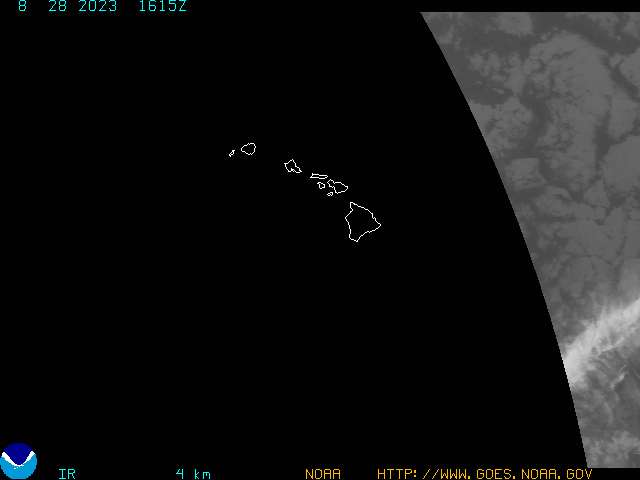
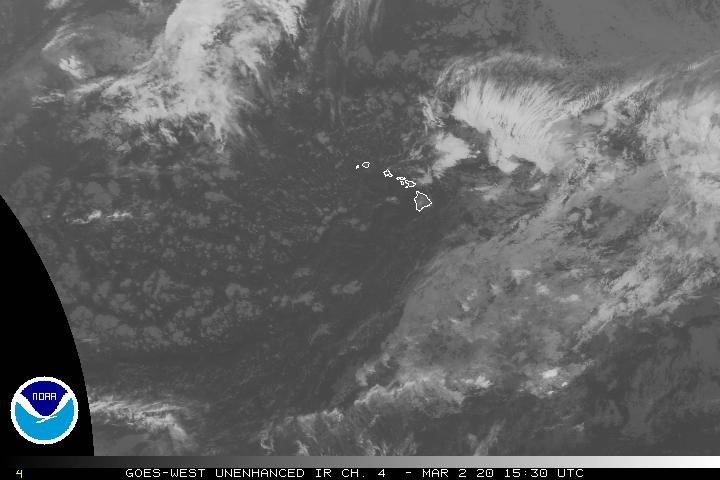
Satellite and Radar Images: To view the cloud conditions we have here in Hawaii, please use the following satellite links, starting off with the Infrared Satellite Image of the islands to see all the clouds around the state during the day and night. This next image is one that gives close images of the islands only during the daytime hours, and is referred to as a Close-up visible image. This next image shows a larger view of the Pacific…giving perspective to the wider ranging cloud patterns in the Pacific Ocean…out from the islands. To help you keep track of where any showers may be around the islands, here’s the latest animated radar image.
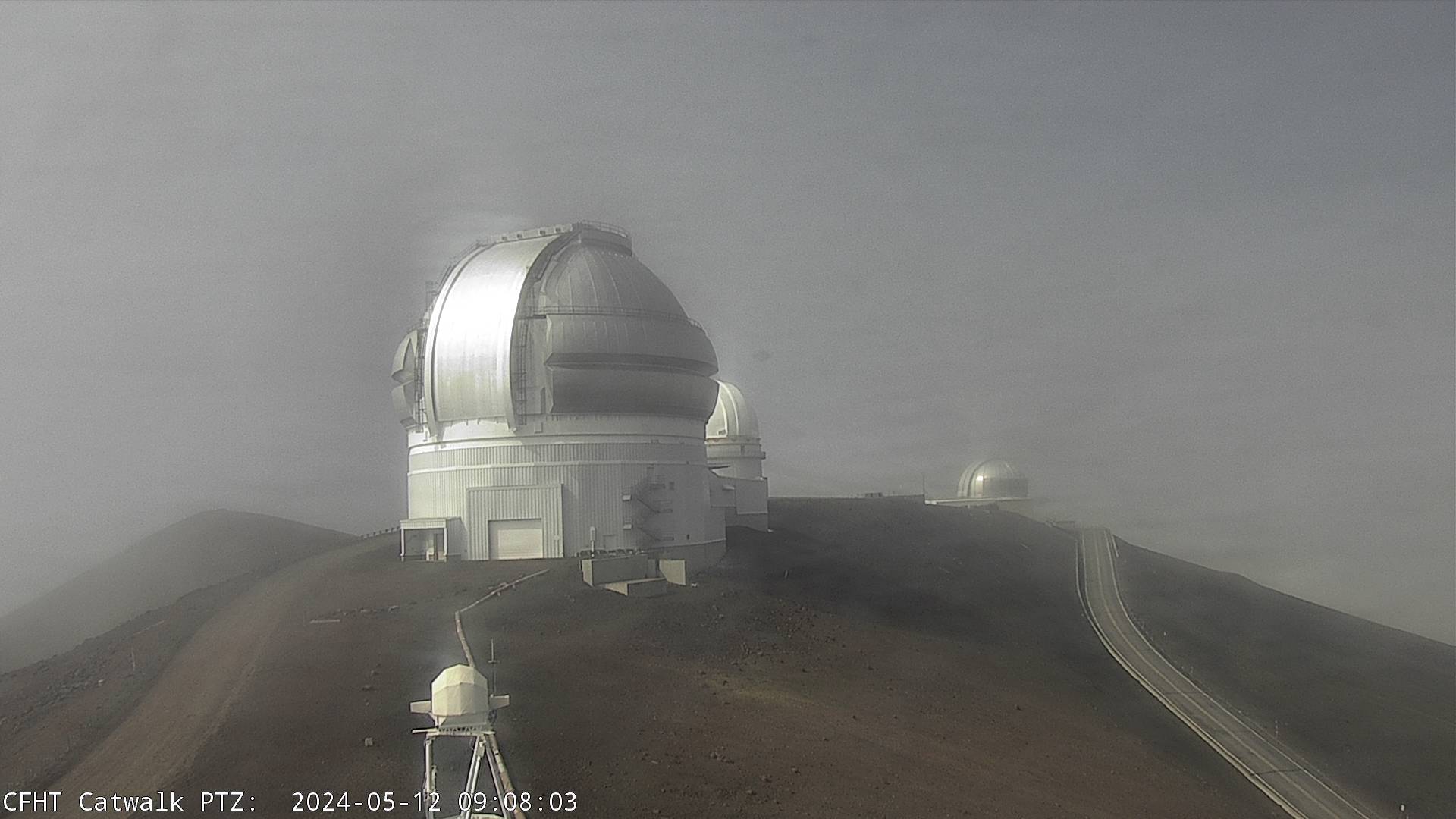
Hawaii’s Mountains – Here’s a link to the live webcam on the summit of near 14,000 foot Mauna Kea on the Big Island of Hawaii. The tallest peak on the island of Maui is the Haleakala Crater, which is near 10,000 feet in elevation. These two webcams are available during the daylight hours here in the islands…and when there’s a big moon rising just after sunset for an hour or two! Plus, during the nights and early mornings you will be able to see stars, and the sunrise too…depending upon cloud conditions.
Aloha Paragraphs
 A very relaxed beach scene…on the south shore of Maui
The trade winds will start a gradual tapering off in speed through the rest of the week. We’ll see moderately strong trade winds blowing across the entire state, although those windiest areas will find stronger and gustier conditions. A small craft wind advisory covers all the windward areas, plus the major channels between the islands. The computer forecast models show that the trade winds will continue through the rest of the week…into early next week.
As usual, under the influence of a trade wind weather pattern such as this, there will be a few showers falling along the windward sides…although not many now. The leeward sides will remain on the dry side as well, although the fast paced trade winds may carry a few stray showers over into those areas on the smaller islands. Computer models suggest that perhaps later this weekend, into next week, we may see increasing windward biased showers arriving.
Meanwhile, the south facing leeward beaches will continue to see medium surf breaking. This surf was generated more than a week ago, down near New Zealand, in the southern hemisphere. This surf is large enough, that the high surf advisory has been continued into Thursday. These waves will gradually lower through the rest of the week. Those folks heading to our resort filled leeward beaches, should use caution when going into the ocean.
It’s Thursday evening as I begin writing this last section of today’s narrative. The high clouds thinned in some parts of the island chain Wednesday, especially around the Big Island and Maui. The trade winds stayed on the gusty side of the wind spectrum, with some gusts surpassing the 40 mph mark in places. Thursday should show further clearing of the high clouds, and the start of a slightly lighter trade wind flow…although definitely remaing active. ~~~ We may find some changes occurring right after this coming weekend, as an upper level trough of low pressure moves into the area west of Hawaii, which could start a rather wet period along the windward sides. This would be good news, as we need to see some more wet trade wind weather, before we move into our dry summer season. ~~~ I’ll be back later in the day with more weather updates and details, and with a couple of new interesting news items later this morning as well. I hope you have a great Wednesday wherever you happen to be spending it! Aloha for now…Glenn.
Note: It snowed again atop the summit of Mauna Kea on the Big Island last night…it’s melting fast though!
Interesting: Climate change is having a greater and faster impact on the Arctic than previously thought, according to a new study by the global conservation organization WWF. The new report, called Arctic Climate Impact Science — An Update Since ACIA, represents the most wide-ranging reviews of arctic climate impact science since the Arctic Climate Impact Assessment (ACIA) was published in 2005. The new study found that change was occurring in all arctic systems, impacting on the atmosphere and oceans, sea ice and ice sheets, snow and permafrost, as well as species and populations, food webs, ecosystems and human societies. Melting of arctic sea ice and the Greenland Ice Sheet was found to be severely accelerated, now even prompting the expert scientists to discuss whether both may be close to their “tipping point” (the point where, because of climate change, natural systems may experience sudden, rapid and possibly irreversible change). “The magnitude of the physical and ecological changes in the Arctic creates an unprecedented challenge for governments, the corporate sector, community leaders and conservationists to create the conditions under which arctic natural systems have the best chance to adapt,” said Dr Martin Sommerkorn, one of the report’s authors and Senior Climate Change Adviser at WWF International’s Arctic Programme. “The debate can no longer focus only on creating protected areas and allowing arctic ecosystems to find their balance.”
Interesting2: Marine scientists studying the carcass of a rare colossal squid said Wednesday they had measured its eye at about 11 inches across — bigger than a dinner plate — making it the largest animal eye on Earth. One of the squid’s two eyes, with a lens as big as an orange, was found intact as the scientists examined the creature while it was slowly defrosted at New Zealand’s national museum, Te Papa Tongarewa. It has been preserved there since being caught in the RossSea off Antarctica‘s northern coast last year. “This is the only intact eye (of a colossal squid) that’s ever been found. It’s spectacular,” said Auckland University of Technology squid specialist Kat Bolstad, one of a team of international scientists brought in to examine the creature. “It’s the largest known eye in the animal kingdom,” Bolstad told The Associated Press. The squid is the biggest specimen ever caught of the rare and mysterious deep-water species Mesonychoteuthis hamiltoni, or colossal squid. When caught, it measured 26 feet long and weighed about 1,000 pounds, but scientists believe the species may grow as long as 46 feet.
Interesting3: Bison could make a big comeback all across North America over the next 100 years, a conservation group said today. Bison once numbered in the tens of millions across the continent, but these icons of the American West were wiped out by commercial hunting and habitat loss. By 1889, fewer than 1,100 individuals remained. 1n 1905, the American Bison Society formed at the current Bronx Zoo headquarters of the Wildlife Conservation Society (WCS) and began efforts to repopulate reserves on the Great Plains with animals from the zoo’s herd and other sources. Of the estimated 500,000 bison that exist today, only 20,000 are considered wild; the rest live on private ranches. "One hundred years ago, through our efforts and the efforts of others, the bison was saved from extinction," said WCS President and CEO Steven E. Sanderson. "We are now looking 100 years from now, because we believe there is an ecological future for the bison in the North American landscape."
Interesting4: Magician David Blaine set a new world record Wednesday for breath-holding: 17 minutes and 4 seconds. The feat was broadcast live during “The Oprah Winfrey Show” and the studio audience cheered as divers pulled Blaine from a water-filled sphere. He looked relaxed afterward and said the record was “a lifelong dream.” The previous record was 16 minutes and 32 seconds, set Feb. 10 by Switzerland‘s Peter Colat, according to Guinness World Records. Before he entered the sphere, Blaine inhaled pure oxygen through a mask to saturate his blood with oxygen and flush out carbon dioxide. Guinness says up to 30 minutes of so-called “oxygen hyperventilation” is allowed under their guidelines. Blaine took on a Zen-like appearance in the water tank as the minutes ticked, but Winfrey was anything but calm. She fidgeted in her chair, pursed her lips, placed her head in her hands, and kept seeking reassurance from the doctor at her side about the 35-year-old magician’s persistently high heart rate. “I’ll be glad when it’s over. I don’t like suspense,” she told the audience during a commercial break.
Posted by Glenn
No Comments
April 29-30 2008
Air Temperatures – The following maximum temperatures were recorded across the state of Hawaii Tuesday:
Lihue, Kauai – 80
Honolulu, Oahu – 86
Kaneohe, Oahu – 80
Kahului, Maui – 86
Hilo, Hawaii – 78
Kailua-Kona, Hawaii – 80
Air Temperatures ranged between these warmest and coolest spots near sea level at 4 p.m. Tuesday afternoon:
Barking Sands, Kauai – 83F
Molokai airport – 75
Precipitation Totals – The following numbers represent the largest precipitation totals (inches) during the last 24 hours on each of the major islands, as of Tuesday afternoon:
0.52 MOUNT WAIALEALE, KAUAI
0.07 MANOA VALLEY, OAHU
0.01 MOLOKAI
0.00 LANAI
0.00 KAHOOLAWE
0.17 WEST WAILUAIKI, MAUI
0.20 KAMUELA UPPER, BIG ISLAND
Weather Chart – Here’s the latest (automatically updated) weather map showing a 1033 millibar high pressure center far to the NNE of the state. This high will keep moderately strong trade winds blowing across our islands through Thursday…stronger and gusty in those windiest spots on Maui and the Big Island.
Satellite and Radar Images: To view the cloud conditions we have here in Hawaii, please use the following satellite links, starting off with the Infrared Satellite Image of the islands to see all the clouds around the state during the day and night. This next image is one that gives close images of the islands only during the daytime hours, and is referred to as a Close-up visible image. This next image shows a larger view of the Pacific…giving perspective to the wider ranging cloud patterns in the Pacific Ocean…out from the islands. To help you keep track of where any showers may be around the islands, here’s the latest animated radar image.
Hawaii’s Mountains – Here’s a link to the live webcam on the summit of near 14,000 foot Mauna Kea on the Big Island of Hawaii. The tallest peak on the island of Maui is the Haleakala Crater, which is near 10,000 feet in elevation. These two webcams are available during the daylight hours here in the islands…and when there’s a big moon rising just after sunset for an hour or two! Plus, during the nights and early mornings you will be able to see stars, and the sunrise too…depending upon cloud conditions.
Aloha Paragraphs
 Large surf breaking along Hawaii’s leeward beaches
The trade winds will be on the blustery side for the time being, tapering off some Friday into the weekend. We’ll see moderately strong trade winds blowing across the entire state now, with those usual windiest areas finding considerably stronger and gustier conditions. A small craft wind advisory has now been expanded to include all the windward areas, plus the major channels between the islands. The computer forecast models show that the trade winds will continue through the rest of the week.
There will be showers arriving over the islands at times, carried our way by the trade winds. These showers will be focused most intently along the windward coasts and slopes through most of this week. The leeward sides will remain on the dry side, although the fast paced trade winds may carry a few stray showers over into those areas on the smaller islands. High cirrus clouds will keep island skies quite cloudy for the time being…dimming and filtering our sunshine during the days.
The Hawaiian islands are having a difficult time breaking back into sunny weather. Last week, and through this past weekend, it was the thick volcanic haze, which muted our famous sunshine considerably. Now, as this looping satellite image shows, we have abundant high level cirrus clouds streaming across our skies…moving along in the high level winds aloft. This canopy of high clouds makes it difficult to see what kinds of lower level, shower bearing clouds, are being carried our way in the brisk trade wind flow. Looking at this looping radar image, it appears that the most generous of those are taking aim on the windward side of the Big Island…and Maui too.
Meanwhile, the south facing leeward beaches will continue to see large surf breaking. This surf was generated more than a week ago, down near New Zealand, in the southern hemisphere. This surf is large enough, that a high surf advisory has been issued by the NWS forecast office in Honolulu. These waves will be long lasting, continuing through most of the rest of this week…to the delight our local surfing community! Folks who aren’t used to breaking waves, along our resort filled leeward beaches, should use caution when going into the ocean.
It’s Tuesday evening as I begin writing this last section of today’s narrative.Tuesday wasn’t a banner day for sunshine, which is actually an understatement as it turns out! A serious layer of high clouds kept the sun under wraps all day. There may have been a few sneaky rays that snuck this this canopy of cirrus clouds, but they didn’t last long. Most areas saw dry weather, although if you had a chance to check out that looping radar image above, you saw that there was a line of showers moving through the Big Island and Maui end of the island chain. It will be touch and go in terms of the sunset this evening, in regards to whether the high clouds will be too thick to provide much of a colorful sunset? We may have a better chance of a pink or orange sunrise Wednesday morning. I’ll be back online with your next new weather narrative very early Wednesday. I hope you have a great Tuesday night until then! Aloha for now…Glenn.
Interesting: The world food crisis is hurting a lot of people, but global agribusiness firms, traders and speculators are raking in huge profits. Much of the news coverage of the world food crisis has focussed on riots in low-income countries, where workers and others cannot cope with skyrocketing costs of staple foods. But there is another side to the story: the big profits that are being made by huge food corporations and investors. Cargill, the world’s biggest grain trader, achieved an 86% increase in profits from commodity trading in the first quarter of this year. Bunge, another huge food trader, had a 77% increase in profits during the last quarter of last year. ADM, the second largest grain trader in the world, registered a 67% per cent increase in profits in 2007. Nor are retail giants taking the strain: profits at Tesco, the UK supermarket giant, rose by a record 11.8% last year. Other major retailers, such as France’s Carrefour and Wal-Mart of the US, say that food sales are the main sector sustaining their profit increases. Investment funds, running away from sliding stock markets and the credit crunch, are having a heyday on the commodity markets, driving prices out of reach for food importers like Bangladesh and the Philippines.
Interesting2: For most people the word "vacation" conjures images of relaxing in a tropical paradise, but for some animal lovers, their precious time off isn’t spent sipping margaritas. Fueled by a desire to make a difference, they’re using all, or part, of their vacation time to help improve the lives of homeless pets here and abroad. One of those people is Crystal Hall, an administrative assistant who lives in Calgary, Alberta. Hall’s last five vacations were spent at Best Friends Animal Sanctuary in Kanab, Utah, where she happily works eight-hour days filling food bowls, washing litter boxes and grooming cats. “I think I have a bit of a cat addiction,” she says with a laugh. “I just love them and can’t get enough of them. It just makes me happy to see them happy.” Hall isn’t alone. Each year, almost 5,000 volunteers make the journey to Best Friends, the nation’s largest no-kill shelter caring for abused and abandoned animals. Located in the heart of the Golden Circle of national parks, the refuge is a short drive to the Grand Canyon, Zion, Bryce Canyon and Lake Powell. Some people help for a few hours; others stay few days, said Barbara Williamson, a spokesperson for Best Friends. “Some even end up moving here permanently so they can contribute their labor of love to the sanctuary on a regular basis,” she said.
Posted by Glenn
No Comments
April 28-29 2008
Air Temperatures – The following maximum temperatures were recorded across the state of Hawaii Monday:
Lihue, Kauai – 81
Honolulu, Oahu – 87
Kaneohe, Oahu – 80
Kahului, Maui – 86
Hilo, Hawaii – 83
Kailua-Kona, Hawaii – 83
Air Temperatures ranged between these warmest and coolest spots near sea level at 4 p.m. Monday afternoon:
Honolulu, Oahu – 83F
Hilo, Hawaii – 77
Precipitation Totals – The following numbers represent the largest precipitation totals (inches) during the last 24 hours on each of the major islands, as of Monday afternoon:
0.97 MOHIHI CROSSING, KAUAI
0.04 POAMOHO 2, OAHU
0.00 MOLOKAI
0.02 LANAI
0.00 KAHOOLAWE
0.16 OHEO GULCH, MAUI
1.29 HONAUNAU, BIG ISLAND
Weather Chart – Here’s the latest (automatically updated) weather map showing a 1033 millibar high pressure center far to the NNE of the state. This high will keep moderately strong trade winds blowing across our islands through Wednesday…stronger and gusty in those windiest spots on Maui and the Big Island.
Satellite and Radar Images: To view the cloud conditions we have here in Hawaii, please use the following satellite links, starting off with the Infrared Satellite Image of the islands to see all the clouds around the state during the day and night. This next image is one that gives close images of the islands only during the daytime hours, and is referred to as a Close-up visible image. This next image shows a larger view of the Pacific…giving perspective to the wider ranging cloud patterns in the Pacific Ocean…out from the islands. To help you keep track of where any showers may be around the islands, here’s the latest animated radar image.
Hawaii’s Mountains – Here’s a link to the live webcam on the summit of near 14,000 foot Mauna Kea on the Big Island of Hawaii. The tallest peak on the island of Maui is the Haleakala Crater, which is near 10,000 feet in elevation. These two webcams are available during the daylight hours here in the islands…and when there’s a big moon rising just after sunset for an hour or two! Plus, during the nights and early mornings you will be able to see stars, and the sunrise too…depending upon cloud conditions.
Aloha Paragraphs
 A great beach on the south shore of Maui
Locally blustery trade winds will continue to blow into mid-week, then taper off a little. We’ll see light to moderately strong trade winds blowing across the entire state now, with those usual windiest areas finding considerably stronger and gustier conditions. A small craft wind advisory is now active in the waters around the Big Island and Maui. The computer forecast have been fluctuating on the wind conditions for the weekend, it now appears that light trade winds will continue…keeping the volcanic haze restricted to some parts of the Big Island.
The overlying atmosphere is relatively dry and stable now, which is limiting shower production. Whatever showers that do fall, will concentrating their efforts best along the windward coasts and slopes through most of the next week. The leeward sides will remain on the dry side, although the fast paced trade winds may carry a few stray showers over into those areas at times, only on the smaller islands however. High cirrus clouds will be on the increase soon, although they are high up in the atmosphere, and don’t drop rain.
It’s Monday evening as I begin writing this last section of today’s narrative. Monday was a pretty nice day, with the strong and gusty trade winds being the most notable weather feature. The strongest gusts, in those windiest areas, topped 40 mph…which is pretty impressive. At 4pm Monday afternoon, the winds were still gusting to 42 mph at Maalaea Bay here on Maui. Meanwhile, at higher levels of the atmosphere, icy cirrus clouds were still streaming across island skies. This looping satellite image shows these bright, white clouds moving along in association with the subtropical jet stream. The models show that this high canopy of clouds may increase further over the next couple of days. This will certainly dim and filter our sunshine…although on the positive side, provide nice sunset and sunrise colors! I’ll be back very early Tuesday morning with your next new weather narrative from paradise. I hope you have a great Monday night until then! Aloha for now…Glenn.
Interesting: Before humans began burning fossil fuels, there was an eons-long balance between carbon dioxide emissions and Earth’s ability to absorb them, but now the planet can’t keep up, scientists say. The finding, reported in the journal Nature Geoscience, relies on ancient Antarctic ice bubbles that contain air samples going back 610,000 years. Climate scientists for the last 25 years or so have suggested that some kind of natural mechanism regulates our planet’s temperature and the level of carbon dioxide in the atmosphere. Those skeptical about human influence on global warming point to this as the cause for recent climate change. This research is likely the first observable evidence for this natural mechanism. This mechanism, known as "feedback," has been thrown out of whack by a steep rise in carbon dioxide emissions from the burning of coal and petroleum for the last 200 years or so, said Richard Zeebe, a co-author of the report. "These feedbacks operate so slowly that they will not help us in terms of climate change … that we’re going to see in the next several hundred years," Zeebe said by telephone from the University of Hawaii. "Right now we have put the system entirely out of equilibrium." In the ancient past, excess carbon dioxide came mostly from volcanoes, which spewed very little of the chemical compared to what humans activities do now, but it still had to be addressed.
Interesting2: Dutch ecologist Roxina Soler and her colleagues have discovered that subterranean and above ground herbivorous insects can communicate with each other by using plants as telephones. Subterranean insects issue chemical warning signals via the leaves of the plant. This way, aboveground insects are alerted that the plant is already” occupied’. Aboveground, leaf-eating insects prefer plants that have not yet been occupied by subterranean root-eating insects. Subterranean insects emit chemical signals via the leaves of the plant, which warn the aboveground insects about their presence. This messaging enables spatially-separated insects to avoid each other, so that they do not unintentionally compete for the same plant. In recent years it has been discovered that different types of aboveground insects develop slowly if they feed on plants that also have subterranean residents and vice versa. It seems that a mechanism has developed via natural selection, which enables the subterranean and aboveground insects to detect each other. This avoids unnecessary competition.
Posted by Glenn
No Comments
April 27-28 2008
Air Temperatures – The following maximum temperatures were recorded across the state of Hawaii Sunday:
Lihue, Kauai – 81
Honolulu, Oahu – 88
Kaneohe, Oahu – 80
Kahului, Maui – 88
Hilo, Hawaii – 83
Kailua-Kona, Hawaii – 81
Air Temperatures ranged between these warmest and coolest spots near sea level at 5 p.m. Sunday evening:
Honolulu, Oahu – 84F
Hilo, Hawaii – 65
Precipitation Totals – The following numbers represent the largest precipitation totals (inches) during the last 24 hours on each of the major islands, as of Sunday afternoon:
0.23 MAKAHA RIDGE, KAUAI
0.68 POAMOHO, OAHU
0.00 MOLOKAI
0.02 LANAI
0.00 KAHOOLAWE
1.63 ULUPALAKUA, MAUI
0.62 PUU WAAWAA, BIG ISLAND
Weather Chart – Here’s the latest (automatically updated) weather map showing a high pressure center far to the NNE of the state. This high will keep moderately strong trade winds blowing across our islands through Tuesday.
Satellite and Radar Images: To view the cloud conditions we have here in Hawaii, please use the following satellite links, starting off with the Infrared Satellite Image of the islands to see all the clouds around the state during the day and night. This next image is one that gives close images of the islands only during the daytime hours, and is referred to as a Close-up visible image. This next image shows a larger view of the Pacific…giving perspective to the wider ranging cloud patterns in the Pacific Ocean…out from the islands. To help you keep track of where any showers may be around the islands, here’s the latest animated radar image.
Hawaii’s Mountains – Here’s a link to the live webcam on the summit of near 14,000 foot Mauna Kea on the Big Island of Hawaii. The tallest peak on the island of Maui is the Haleakala Crater, which is near 10,000 feet in elevation. These two webcams are available during the daylight hours here in the islands…and when there’s a big moon rising just after sunset for an hour or two! Plus, during the nights and early mornings you will be able to see stars, and the sunrise too…depending upon cloud conditions.
Aloha Paragraphs
 A special beach on the island of Kauai
The hazy atmosphere is clearing now, due to the strengthening trade winds, across all of the Hawaiian Islands. Our high pressure ridge is shifting further north, allowing the trade winds to get stronger through the next few days. This suggests that our winds will be able to ventilate away the long lasting volcanic haze. The computer models show that the trades, once they get fully established Monday into Tuesday, will last through the new work week ahead. The models continue to try and break down the trade winds by next weekend, but lets wait and see what they say over the next couple of days.
There were still a few heavy showers in the leeward areas, especially on Kauai and the Big Island, but most areas were quite dry Sunday. As the trade winds have the upper hand now, and the atmosphere is becoming more dry and stable, there won’t be very many showers falling. Whatever showers that do fall, will concentrating their efforts best along the windward coasts and slopes through most of the next week. The models, if they are right, would have us believe that next weekend could see some increase in showers, but again, lets give them another couple of days to make up their minds.
It’s Sunday evening as I begin writing this last section of today’s narrative. Despite the return of the trade winds this weekend, I just walked out on my weather deck here in Kula, Maui, and can still barely see the West Maui Mountains. The air visibilities are better, no doubt about it, although they are far from pristine! As you recall, yesterday there were extremely heavy showers here in Kula, accompanied by heavy duty thunderstorms. These rains flooded the area, and when I was out on my walk this morning, saw that all kinds of rocks, gravel and dirt had been washed across the roads.
I suggested to my neighbor that we take his pickup truck, and go scoop some of it up. This would help motorists, and also serve to replenish some of our own dirt road on this property…which had been washed downhill. It was a good little project, allowing me to do some physical work for a change, rather than my usual office related weather work. Sunday actually turned out to be a nice day here in upcountry Maui, with only a very short shower…the kind with big drops that plop down. The trade winds have reached up here, with my wind chimes actually making a little song for a change. I briefly drove down to Makawao to pick up some food, otherwise I didn’t leave the property at all this weekend. I wish I would have gone surfing, but I just couldn’t get myself to get in the car and drive anywhere.
~~~ It’s sunny here at around 6pm, with my wind chimes making a sweet little trade wind tune. This weekend I popped a bottle of champagne for some reason, and have been sipping on it. It’s a great bottle from Reims, France called Champagne Henriot, NV Brut Souverain. A blend of 60% Pinot Noir, and 40% Chardonnay. I will be getting another bottle at some point soon…as it is my favorite now. It wasn’t a special occasion in the traditional use of the word, but somehow, it just felt right to have a little bubbly! Whether you’re sippin’ Champagne or not, I trust that you’re enjoying yourself, wherever you happen to be spending time at the moment! I’ll be back very early Monday morning with your next new weather narrative from paradise…see you then! Aloha for now…Glenn.
Ahh spring….
Behold, my brothers, the spring has come: the earth has received the embraces of the sun and we shall soon see the results of that love! Every seed is awakened and so has all animal life. It is through this mysterious power that we too have our being and we therefore yield to our neighbors, even our animal neighbors, the same right as ourselves, to inhabit this land.
Tatanka Yotanka (Sioux Chief Sitting Bull) at the Powder River council in 1877
Posted by Glenn
[6] Comments
April 26-27 2008
Air Temperatures – The following maximum temperatures were recorded across the state of Hawaii Saturday:
Lihue, Kauai – 79
Honolulu, Oahu – 86
Kaneohe, Oahu – 80
Kahului, Maui – 86
Hilo, Hawaii – 83
Kailua-Kona, Hawaii – 83
Air Temperatures ranged between these warmest and coolest spots near sea level at 4 p.m. Saturday afternoon:
Kahului, Maui – 84F
Lihue, Kauai – 77
Precipitation Totals – The following numbers represent the largest precipitation totals (inches) during the last 24 hours on each of the major islands, as of Saturday afternoon:
1.17 MOUNT WAIALEALE, KAUAI
0.62 LULUKU, OAHU
0.0 MOLOKAI
0.10 LANAI
0.00 KAHOOLAWE
1.24 KULA, MAUI
2.00 PALI 2, BIG ISLAND
Weather Chart – Here’s the latest (automatically updated) weather map showing that the tail-end of a cold front, associated with a deep storm in the Gulf of Alaska, will be moving away. At the same time, we’ll find strengthening trade winds as a high pressure ridge to our north takes its place.
Satellite and Radar Images: To view the cloud conditions we have here in Hawaii, please use the following satellite links, starting off with the Infrared Satellite Image of the islands to see all the clouds around the state during the day and night. This next image is one that gives close images of the islands only during the daytime hours, and is referred to as a Close-up visible image. This next image shows a larger view of the Pacific…giving perspective to the wider ranging cloud patterns in the Pacific Ocean…out from the islands. To help you keep track of where any showers may be around the islands, here’s the latest animated radar image.
Hawaii’s Mountains – Here’s a link to the live webcam on the summit of near 14,000 foot Mauna Kea on the Big Island of Hawaii. The tallest peak on the island of Maui is the Haleakala Crater, which is near 10,000 feet in elevation. These two webcams are available during the daylight hours here in the islands…and when there’s a big moon rising just after sunset for an hour or two! Plus, during the nights and early mornings you will be able to see stars, and the sunrise too…depending upon cloud conditions.
Aloha Paragraphs
 The hazy sunset skies over Hawaii
The trade winds are slowly returning this weekend, gradually clearing the atmosphere of haze and all the extra humidity of late. Our high pressure ridge will ever so slowly shift northward, allowing the trade winds to ease back into the state from east. This suggests that our winds will be picking up, light at first, ventilating away the long lasting volcanic haze westward late in the weekend slowly. The computer models show that the trades, once they get well established, will last through the new week ahead.
As the trade winds arrive back into our Hawaiian Island weather picture, showers will move onto the windward sides. The last several days have seen a convective weather pattern, with clear mornings giving way to showery clouds over the interior areas during the afternoons. As the strengthening trade winds firm, so will the likelihood of showers passing their way along the windward coasts and slopes. The leeward sides of the islands will find dry weather in most cases…although the Kona slopes could see a few afternoon showers.
It’s Saturday evening as I begin writing this last section of today’s narrative. Saturday has been a transition day here in Hawaii, shifting from a light wind, hazy convective weather pattern…into the return of a long lasting trade wind episode. The trade winds certainly didn’t barrel back into our Hawaiian Island weather picture by any means, although they did show their face at last. Late Saturday afternoon the trade winds were gusting to 30 mph at times at Maalaea Bay here on Maui, which is a good sign of things to come. Despite the mid-day arrival of the trade winds, showers broke out from the ripe towering cumulus clouds upcountry again today, where thunderstorms and heavy rains, with localized flooding occurred in places. As the trade winds continue to firm, the bias for showers will reach back over to the windward sides of the islands starting Sunday.
~~~ I had the best intentions to go out today, although after washing my clothes, hanging them on the line, and having a leisurely breakfast, I got caught up. It wasn’t anything other than the way the weather was acting that stopped me from getting in my car! Clouds began gathering early, and did nothing but get thicker and thicker as the morning graded into the early afternoon hours. At that point I was committed to watching the show from my weather deck, and it certainly was some show to watch! The rains started gentle enough, although it didn’t take long before it was just pouring down. Then, and this is where it started to get really good, we had the most intense lightning and thunder. I rarely get to experience this kind of weather, so I was very happy that I had hung at home.
~~~ It’s early Saturday evening at the moment, and even with the return of the trade winds today, and the atmosphere clearing rainfall, it’s still exceptionally hazy out there. I still can’t see the West Maui Mountains, although I can now see the north shore slightly…where there are waves breaking on the reefs down there…and there’s the south shore peeking through the haze too. I’m still a little "worked-up" over the amazing thunderstorm activity that exploded over the Kula, Maui area earlier in the day…in what seemed like right over my house! Sunday should bring gradually clearing skies, at least we can hope so, as the trade winds help to clear our hazy skies then. I’ll be back early Sunday morning with your next new weather narrative, I hope you have a great Saturday night until then! Aloha, Glenn.
Ahh spring….
Behold, my brothers, the spring has come: the earth has received the embraces of the sun and we shall soon see the results of that love! Every seed is awakened and so has all animal life. It is through this mysterious power that we too have our being and we therefore yield to our neighbors, even our animal neighbors, the same right as ourselves, to inhabit this land.
Tatanka Yotanka (Sioux Chief Sitting Bull) at the Powder River council in 1877
Posted by Glenn
No Comments
April 25-26 2008
Air Temperatures – The following maximum temperatures were recorded across the state of Hawaii Friday:
Lihue, Kauai – 81
Honolulu, Oahu – 83
Kaneohe, Oahu – 80
Kahului, Maui – 84
Hilo, Hawaii – 84
Kailua-Kona, Hawaii – 84
Air Temperatures ranged between these warmest and coolest spots near sea level at 4 p.m. Friday afternoon:
Kailua-kona – 81F
Lihue, Kauai – 69
Precipitation Totals – The following numbers represent the largest precipitation totals (inches) during the last 24 hours on each of the major islands, as of Friday afternoon:
1.55 MOLOAA DAIRY, KAUAI
1.29 OLOMANA FIRE STATION, OAHU
0.51 MOLOKAI
0.01 LANAI
0.00 KAHOOLAWE
0.05 KULA, MAUI
0.10 WAIAKEA UKA, BIG ISLAND
Weather Chart – Here’s the latest (automatically updated) weather map showing a high pressure system located far to the NE of the islands, with its ridge in the process of moving north of Kauai. Our winds will remain light…becoming trade winds Saturday into Sunday.
Satellite and Radar Images: To view the cloud conditions we have here in Hawaii, please use the following satellite links, starting off with the Infrared Satellite Image of the islands to see all the clouds around the state during the day and night. This next image is one that gives close images of the islands only during the daytime hours, and is referred to as a Close-up visible image. This next image shows a larger view of the Pacific…giving perspective to the wider ranging cloud patterns in the Pacific Ocean…out from the islands. To help you keep track of where any showers may be around the islands, here’s the latest animated radar image.
Hawaii’s Mountains – Here’s a link to the live webcam on the summit of near 14,000 foot Mauna Kea on the Big Island of Hawaii. The tallest peak on the island of Maui is the Haleakala Crater, which is near 10,000 feet in elevation. These two webcams are available during the daylight hours here in the islands…and when there’s a big moon rising just after sunset for an hour or two! Plus, during the nights and early mornings you will be able to see stars, and the sunrise too…depending upon cloud conditions.
Aloha Paragraphs

 A different kind of surfer!
The trade winds will be taking over the controls now, kicking the light wind convective weather pattern out of Dodge. Our high pressure ridge will be bouncing northward this weekend, bringing back the refreshing trade winds. These refreshing tropical breezes will help to ventilate the volcanic haze away from the smaller islands…although the Big Island will remain hazy in places unfortunately. The strengthening trades are expected to remain active into the new week ahead.
The trade winds will bring back a few passing showers to the windward sides of the islands. The leeward sides will remain mostly dry, and without any intrusions of high clouds at the moment, we’ll find lots of warm sunshine beaming down. The emphasis for showers Friday was over and around the interior sections, but that will shift back over to the windward sides now into the new week ahead. Our days will be nice and balmy, with air temperatures at night seasonably cool.
It’s Friday evening as I begin writing this last section of today’s narrative. We’ve been locked into a stagnant air mass the last several days, which has kept warm and muggy weather over us…along with copious volcanic haze as well. This sultry reality will be taking a hike now, booted out by the easterly trade winds. This puts us back into a more normal weather pattern for the spring month of April. The long range computer forecast models suggest that we’ll see a long spell of these cooling trade winds unrolling well into the future.
~~~ Since it’s Friday, I’m going to see a new film this evening after work. This time around I’ll try out Shine a Light (2008)…starring Mick Jagger and Keith Richards, and the rest of the boys, of course. This is a documentary on the Rolling Stones’ concert at the Beacon Theatre in New York in 2006. I’ve always loved the Stones, haven’t you!? The film is directed by the famous producer Martin Scorsese. A movie reviewing website called rottentomatoes is giving Shine a Light a grade of 87 points out of a possible 100. I’m sure that I’ll be enjoying this film, and will certainly let you know what I think early Saturday morning, when I come back online with your next new weather narrative from paradise. Here’s the trailer for Shine a Light for your entertainment. I hope you have a great Friday night wherever you happen to be spending it! Aloha for now…Glenn.
Interesting: Earlier this week, on a spring day in April, John Stubblefield walked past the blue tanks of striped bass, Atlantic sea bream, and cobia stored inside a Baltimore, Maryland, laboratory. "In this tank, it’s spring in May. This tank it’s spring in September," he said. At the University of Maryland‘s Center for Marine Biotechnology, Stubblefield and his fellow researchers are not only altering nature, they are creating what may be the next generation of seafood. The experiment uses city-supplied water and a complex microbial filtration system to raise a few hundred fish completely indoors. Yonathan Zohar, the center’s director and the study’s leader, said it is the first indoor marine aquaculture system that can re-circulate nearly all of its water and expel zero waste. "I’m a strong believer that in 20 years from now, most seafood will be grown on land," Zohar said. "It can go to the Midwest, it can go into the inner city, it can go wherever." If Zohar’s team proves the system could become economically competitive with current marine fish farming techniques, Zohar says he may have found a sustainable answer to the world’s growing fishery crisis.
Interesting2: Human beings may have had a brush with extinction 70,000 years ago, an extensive genetic study suggests. The human population at that time was reduced to small isolated groups in Africa, apparently because of drought, according to an analysis released Thursday. The report notes that a separate study by researchers at StanfordUniversity estimated the number of early humans may have shrunk as low as 2,000 before numbers began to expand again in the early Stone Age. "This study illustrates the extraordinary power of genetics to reveal insights into some of the key events in our species’ history," Spencer Wells, National Geographic Society explorer in residence, said in a statement. "Tiny bands of early humans, forced apart by harsh environmental conditions, coming back from the brink to reunite and populate the world. Truly an epic drama, written in our DNA." Wells is director of the Genographic Project, launched in 2005 to study anthropology using genetics. The report was published in the American Journal of Human Genetics.
Interesting3: Elevated levels of sulfur dioxide pouring from Kilauea volcano Wednesday forced the evacuation of Hawaii Volcanoes National Park for the second time this month. About 2,000 people were forced to leave the park when a lack of wind kept the noxious gas from Halemaumau Crater lingering over the Big Island volcano, park spokeswoman Mardie Lane said. "Right now we have little to no wind," Lane said. The plume from the volcano’s main crater was lingering over the area rather than getting blown away by trade winds the way it had been earlier in the week. "When you step outside, definitely your eyes tear, you have that feeling that you’d like to cough or clear your throat," Lane said. A rare two-day park closure earlier this month was caused by a shift in wind direction that prevented the gas from being blown out to sea. "Our primary concern is for the health and safety of visitors and employees," said Joe Molhoek, the park’s incident commander. "We’re in close contact with the National Weather Service and look forward to favorable winds by week’s end."
Posted by Glenn
No Comments
April 24-25 2008
Air Temperatures – The following maximum temperatures were recorded across the state of Hawaii Thursday:
Lihue, Kauai – 82
Honolulu, Oahu – 84
Kaneohe, Oahu – 82
Kahului, Maui – 83
Hilo, Hawaii – 83
Kailua-Kona, Hawaii – 82
Air Temperatures ranged between these warmest and coolest spots near sea level at 4 p.m. Thursday afternoon:
Honolulu, Oahu – 82F
Hilo, Hawaii – 77
Precipitation Totals – The following numbers represent the largest precipitation totals (inches) during the last 24 hours on each of the major islands, as of Thursday afternoon:
0.03 MOLOAA DAIRY, KAUAI
0.01 WAIANAE VALLEY, OAHU
0.00 MOLOKAI
0.00 LANAI
0.00 KAHOOLAWE
0.02 PUKALANI, MAUI
0.13 WAIAKEA UKA, BIG ISLAND
Weather Chart – Here’s the latest (automatically updated) weather map showing a 1028 millibar high pressure system located far to the ENE of the islands Friday….with its ridge just north of Kauai. Our winds will remain light…gradually becoming trade winds later Saturday.
Satellite and Radar Images: To view the cloud conditions we have here in Hawaii, please use the following satellite links, starting off with the Infrared Satellite Image of the islands to see all the clouds around the state during the day and night. This next image is one that gives close images of the islands only during the daytime hours, and is referred to as a Close-up visible image. This next image shows a larger view of the Pacific…giving perspective to the wider ranging cloud patterns in the Pacific Ocean…out from the islands. To help you keep track of where any showers may be around the islands, here’s the latest animated radar image.
Hawaii’s Mountains – Here’s a link to the live webcam on the summit of near 14,000 foot Mauna Kea on the Big Island of Hawaii. The tallest peak on the island of Maui is the Haleakala Crater, which is near 10,000 feet in elevation. These two webcams are available during the daylight hours here in the islands…and when there’s a big moon rising just after sunset for an hour or two! Plus, during the nights and early mornings you will be able to see stars, and the sunrise too…depending upon cloud conditions.
Aloha Paragraphs

Black sand beach near Hana, Maui
Photo credit: flickr.com
The light wind pattern will remain in place through Friday, with strengthening trade winds on tap for the weekend. We see storminess in the middle latitudes pushing a high pressure ridge down close to the islands Thursday evening. When a high pressure ridge gets this close, the trade winds retreat to the area south of Hawaii. Looking at this latest weather map, we see the isobars (lines of equal air pressure) widely spaced around the Aloha state…and coming up from the southeast direction. This has made for an increasingly hazy environment for many areas from the Big Island up through Maui. Oahu and Kauai have been immune to this point, but they will see the haze arriving Friday. Light winds here in the tropics, will make our overlying atmosphere feel very warm and muggy during the days. The returning trade winds this weekend will ventilate the haze, and make our heat feel more bearable.
A weak cold front has pushed into the area near Kauai, although the rest of the state remains quite dry. The light winds have prompted a convective weather pattern, with days beginning generally clear, and slightly cooler than normal for this time of year. Daytime heating, with the lack of cloudiness during the morning hours, will get air currents rising. The moisture being carried upwards in these thermals will cool quickly into cumulus clouds during the late morning hours. These convective clouds will gather most effectively over and around the mountains, and by afternoon, the mountains will be covered up in most areas…although spreading over the coasts locally. These clouds will drop some showers, although not in any widespread way…perhaps most generously near Kauai, the island closest to the frontal cloud band. The upcountry areas will find the most generous showers falling. Skies will clear again after dark, with the process repeating itself through Friday into early Saturday. As the trade winds return later Saturday, the emphasis for showers will shift back over to the windward sides. Looking into next week, this windward bias for showers will continue, with favorably inclined weather prospects for the leeward sides of the islands.
It’s Thursday evening as I begin writing this last paragraph of today’s narrative. The light winds Thursday, with the addition of haze locally, gave island skies a milky look. As you can see by looking at this looping satellite image, the southern part of the state, and especially the Big Island, had to deal with high clouds streaming up from the deeper tropics on the high level jet stream level winds. It was so hazy here on Maui, that it was very difficult to see the Haleakala Crater, or even the West Maui Mountains, from the central valley! This haze will stick with us through Friday, and only begin to disperse as we move into the weekend. Where the sunshine was plentiful, the atmosphere felt very warm and humid today as well. ~~~ As you may know I had trouble with my website editor again this morning. My webmaster informed me that I needed to clear my cache, which eliminated the problem. Now I have to go home to my home computer, and hope that that solves the problem there. I trust that it will, and that early Friday morning I’ll be able to do my normal work, without any problems. Please forgive any inconvenience this may have caused. If I have the luck I need, Friday’s new narrative will come out on time as expected. I hope you have a great Thursday night until then. Aloha for now…Glenn.
Interesting: Tyrannosaurus rex just got a firm grip on the animal kingdom’s family tree, right next to chickens and ostriches. New analyses of soft tissue from a T.rex leg bone re-confirm that birds are dinosaurs’ closest living relatives. "We determined that T. rex, in fact, grouped with birds – ostrich and chicken – better than any other organism that we studied," said researcher John Asara of Beth Israel Deaconess Medical Center and Harvard Medical School. "We also show that it groups better with birds than [with] modern reptiles, such as alligators and green anole lizards." Scientists long suspected non-avian dinosaurs were most closely related to modern-day birds.
This idea initially rested largely on similarities between the outward appearances of bird and dinosaur skeletons. Later, further evidence on the close evolutionary relationships among birds and non-avian dinosaurs accumulated. The latest evidence comes from an ancient femur bone unearthed in 2003 by Jack Horner of the Museum of the Rockies in the Hell Creek Formation, a fossil-packed area that spans Montana, Wyoming and North and South Dakota. It seems some 68 million years ago, a teenage T. rex died and left behind a drumstick-shaped femur bone that today still contains intact soft tissue and the oldest preserved proteins discovered to date.
Interesting2: Human beings may have had a brush with extinction 70,000 years ago, an extensive genetic study suggests. The human population at that time was reduced to small isolated groups in Africa, apparently because of drought, according to an analysis released Thursday. The report notes that a separate study by researchers at StanfordUniversity estimated the number of early humans may have shrunk as low as 2,000 before numbers began to expand again in the early Stone Age. "This study illustrates the extraordinary power of genetics to reveal insights into some of the key events in our species’ history," Spencer Wells, National Geographic Society explorer in residence, said in a statement. "Tiny bands of early humans, forced apart by harsh environmental conditions, coming back from the brink to reunite and populate the world. Truly an epic drama, written in our DNA." Wells is director of the Genographic Project, launched in 2005 to study anthropology using genetics. The report was published in the American Journal of Human Genetics.
Interesting3: Elevated levels of sulfur dioxide pouring from Kilauea volcano Wednesday forced the evacuation of Hawaii Volcanoes National Park for the second time this month. About 2,000 people were forced to leave the park when a lack of wind kept the noxious gas from Halemaumau Crater lingering over the BigIsland volcano, park spokeswoman Mardie Lane said. "Right now we have little to no wind," Lane said. The plume from the volcano’s main crater was lingering over the area rather than getting blown away by trade winds the way it had been earlier in the week. "When you step outside, definitely your eyes tear, you have that feeling that you’d like to cough or clear your throat," Lane said. A rare two-day park closure earlier this month was caused by a shift in wind direction that prevented the gas from being blown out to sea. "Our primary concern is for the health and safety of visitors and employees," said Joe Molhoek, the park’s incident commander. "We’re in close contact with the National Weather Service and look forward to favorable winds by week’s end."
Posted by Glenn
No Comments
April 23-24 2008
Air Temperatures – The following maximum temperatures were recorded across the state of Hawaii Wednesday:
Lihue, Kauai – 79
Honolulu, Oahu – 84
Kaneohe, Oahu – 80
Kahului, Maui – 85
Hilo, Hawaii – 81
Kailua-Kona, Hawaii – 83
Air Temperatures ranged between these warmest and coolest spots near sea level at 10 a.m. Wednesday afternoon:
Kahului, Maui – 82F
Hilo, Hawaii – 76
Precipitation Totals – The following numbers represent the largest precipitation totals (inches) during the last 24 hours on each of the major islands, as of Wednesday afternoon:
0.01 MOLOAA DAIRY, KAUAI
0.00 OAHU
0.00 MOLOKAI
0.04 LANAI
0.00 KAHOOLAWE
0.16 KAHAKULOA, MAUI
0.21 HONOKAA, BIG ISLAND
Weather Chart – Here’s the latest (automatically updated) weather map showing a 1026 millibar high pressure system located to the ENE of the islands. Low pressure centers far north of Hawaii will weaken our local winds, turning then to the ESE to SE through Thursday.
Satellite and Radar Images: To view the cloud conditions we have here in Hawaii, please use the following satellite links, starting off with the Infrared Satellite Image of the islands to see all the clouds around the state during the day and night. This next image is one that gives close images of the islands only during the daytime hours, and is referred to as a Close-up visible image. This next image shows a larger view of the Pacific…giving perspective to the wider ranging cloud patterns in the Pacific Ocean…out from the islands. To help you keep track of where any showers may be around the islands, here’s the latest animated radar image.
Hawaii’s Mountains – Here’s a link to the live webcam on the summit of near 14,000 foot Mauna Kea on the Big Island of Hawaii. The tallest peak on the island of Maui is the Haleakala Crater, which is near 10,000 feet in elevation. These two webcams are available during the daylight hours here in the islands…and when there’s a big moon rising just after sunset for an hour or two! Plus, during the nights and early mornings you will be able to see stars, and the sunrise too…depending upon cloud conditions.
Aloha Paragraphs
 The beauty of waves framed by palm trees
Photo credit: MSW
The Hawaiian Islands will be slipping back into a light and variable wind pattern now, similar to the one we had last week about this time. The same dynamics are at play this time around, with storminess in the middle latitudes pushing a high pressure ridge down over or near the north of Kauai. When a high pressure ridge gets this close, our normal spring time trade winds falter quickly. Looking at this latest weather map, we see the isobars (lines of equal air pressure) widely spaced around the Aloha state. This implies light to very light winds in our area of the north central Pacific for the time being. The outlook continues to suggest that our low level winds will begin a gradual swing around to the southeast direction too. This is a recipe for an increasingly haze environment for many areas from the BigIsland up through Maui to Oahu…and perhaps even up the chain to Kauai? Light winds here in the tropics, will make our overlying atmosphere feel very warm and muggy during the days. The two relief valves are: the daytime sea breezes along the coasts, and the cloud cover that develops in the upcountry interior areas. The trade winds will return this weekend, bringing relief from the heat, humidity, and haze…which will extend into next week.
At the moment, the air mass over and around the islands is dry and stable. This is greatly limiting the rainfall capabilities of our local clouds. The light winds will prompt a convective weather pattern, with days beginning generally clear, and slightly cooler than normal for this time of year. Daytime heating, with the lack of cloudiness during the morning hours, will get air currents rising. The moisture being carried upwards in these thermals will cool quickly into cumulus clouds during the late morning hours. These convective clouds will gather most effectively over and around the mountains, and by afternoon, the mountains will be covered up in most areas. These clouds, if there was a lot of moisture around, and cold air aloft, would typically drop some serious showers. This time around though, there is neither, which will keep showers on the light side. Skies will clear again after dark, with the process repeating itself again the next day, through Friday into Saturday. As the trade winds return later Saturday, the emphasis for showers will shift back over to the windward sides. Looking into next week, this windward bias for showers will continue, with favorably inclined weather prospects for the leeward sides of the islands.
It’s early Wednesday evening as I begin writing this last paragraph of today’s narrative. I had trouble with my website editing tool early this morning. My webmaster was able to correct the problem, and was able to get some new updated weather information online to you later in the day. I apologize for the delay in the narrative, and hopefully things will smooth out now, and remain that way well into the future! ~~~ Wednesday was a good day, although the volcanic haze accumulated quickly during the afternoon. Each of the islands acted as a heating pad for the cauliflower type cumulus clouds, that stacked up over them today. It’s getting rather muggy out there too, although the nights and early morning hours will be slightly cooler than normal. ~~~ On another note, I know a lot of folks are complaining of high gasoline prices these days, with good reason for sure. Today, here in Kihei, Maui, I filled up my tank, with gas that was selling for $4.35 per gallon…that’s as high as I’ve ever paid in my life! I was just reading today that over 50% of the worlds population uses rice as their main food staple. The price of rice, since the first of this year, has risen an astonishing 68%! Wow, the times they are a changing, as was coined by Bob Dylan way back when. ~~~ Regardless of rising whatever, you can count on my being back with your next new weather narrative from high priced Hawaii very early Thursday morning, at least probably . Aloha for now…Glenn.
Interesting: Visitors to Alaska often marvel at the crisp, clear air. But the truth is, the skies above the Arctic Circle work like a giant lint trap during late winter and early spring, catching all sorts of pollutants swirling around the globe. In recent weeks, scientists have been going up in government research planes and taking samples of the Arctic haze in hopes of solving a mystery: Are the floating particles accelerating the unprecedented warming going on in the far north? While carbon dioxide and other greenhouse gases that trap the Earth’s heat are believed to be the chief cause of global warming, scientists suspect that airborne particles known as aerosols are also contributing to the Arctic meltdown.
To prove their suspicions, they are analyzing the haze, using mass spectroscopy and other technology to identify what is in it, where it came from and how it interacts with the clouds, the sunlight and the snow cover.
Their air samples have been found to contain dust from Asian deserts, salts that swell up moisture, particles from incomplete burning of organic material from forest and cooking fires, and all manner of nasties emitted by automobile tailpipes, factory smokestacks and power plants. Collectively, they are a United Nations of pollution. Through chemical analysis, the particles can be traced to their sources throughout Asia, Europe and North America. "The Arctic is a melting pot for mid-latitude pollution,” said Daniel Jacob, a Harvard scientist taking part in the research. "We have signatures of just about everything you can imagine flying around in the Arctic.”
Interesting2: Major greenhouse gases in the air are accumulating faster than in the past despite efforts to curtail their growth. Carbon dioxide concentration in the air increased by 2.4 parts per million last year, the U.S. National Oceanic and Atmospheric Administration reported Wednesday, and methane concentrations also rose rapidly. Concern has grown in recent years about these gases, with most atmospheric scientists concerned that the increasing accumulation is causing the earth’s temperature to rise, potentially disrupting climate and changing patterns of rainfall, drought and other storms. The Intergovernmental Panel on Climate Change has worked to detail the scientific bases of this problem and the Kyoto agreement sought to encourage countries to take steps to reduce their greenhouse emissions. Some countries, particularly in Europe, have taken steps to reduce emissions. But carbon dioxide emissions, primarily from burning fossil fuels such as coal, oil and gas have continued to increase.
Posted by Glenn
[2] Comments
April 22-23 2008
Air Temperatures – The following maximum temperatures were recorded across the state of Hawaii Tuesday:
Lihue, Kauai – 79
Honolulu, Oahu – 86
Kaneohe, Oahu – 80
Kahului, Maui – 84
Hilo, Hawaii – 80
Kailua-Kona, Hawaii – 83
Air Temperatures ranged between these warmest and coolest spots near sea level at 4 p.m. Tuesday afternoon:
Honolulu, Oahu – 85F
Lihue, Kauai – 77
Precipitation Totals – The following numbers represent the largest precipitation totals (inches) during the last 24 hours on each of the major islands, as of Tuesday afternoon:
0.12 MOUNT WAIALEALE, KAUAI
0.05 POAMOHO 2, OAHU
0.00 MOLOKAI
0.01 LANAI
0.00 KAHOOLAWE
0.17 WEST WAILUAIKI, MAUI
0.21 MOUNTAIN VIEW, BIG ISLAND
Weather Chart – Here’s the latest (automatically updated) weather map showing a 1025 millibar high pressure system located to the NE of the islands, the source of our trade winds now. Those trades will remain moderately strong, with locally stronger and gusty conditions in those windiest areas through Tuesday…becoming lighter Wednesday.
Satellite and Radar Images: To view the cloud conditions we have here in Hawaii, please use the following satellite links, starting off with the Infrared Satellite Image of the islands to see all the clouds around the state during the day and night. This next image is one that gives close images of the islands only during the daytime hours, and is referred to as a Close-up visible image. This next image shows a larger view of the Pacific…giving perspective to the wider ranging cloud patterns in the Pacific Ocean…out from the islands. To help you keep track of where any showers may be around the islands, here’s the latest animated radar image.
Hawaii’s Mountains – Here’s a link to the live webcam on the summit of near 14,000 foot Mauna Kea on the Big Island of Hawaii. The tallest peak on the island of Maui is the Haleakala Crater, which is near 10,000 feet in elevation. These two webcams are available during the daylight hours here in the islands…and when there’s a big moon rising just after sunset for an hour or two! Plus, during the nights and early mornings you will be able to see stars, and the sunrise too…depending upon cloud conditions.
Aloha Paragraphs
 Happy Earth Day
Photo credit:flickr.com
Our local trade winds got softer today, before relaxing more in strength Wednesday. The latest forecast continues to show that by later Wednesday, the trades will go on vacation, giving way to lighter winds into Friday. This will be caused by low pressure systems moving by to our north. Starting later Wednesday, this low will push our trade wind producing ridge of high pressure down near the islands for several days. This in turn will bring back a period of light winds, which are expected to have a southeast tendency. If this manifests as described by the models, those light breezes will carry volcanic haze up over much of the rest of the state from the Big Island. The lighter winds will allow urban haze to form over the islands as well. The high pressure ridge will bounce back northward this weekend, bringing back the trade winds into next week. These trade winds will help to ventilate the atmosphere, and become quite strong by next Monday.
The overlying atmosphere remains dry and stable, which will limit showers in most areas here in Hawaii. The bulk of these few showers will fall along the windward coasts and slopes. As usual, we’ll see afternoon clouds gathering over and around the mountains…with perhaps a few showers over the Kona slopes. Looking into the second half of the week, the light winds will cause a convective weather pattern for a short time, although with a distinct lack of moisture to work with, whatever afternoon clouds that develop, will be rather benign in terms of shower production in the upcountry interior areas. The returning trade winds will bring the bias for showers back over to the windward sides this weekend. The tail-end of a cold front may be carried our direction by the returning trade winds later this weekend into early next week…which could begin to moisten the windward sides then.
It’s Tuesday evening as I begin updating this last section of today’s narrative. As noted in the two paragraphs above, we have a few weather changes in store as we move through the rest of the work week. The first of which will be a faltering of the trade winds later Wednesday through Friday. The result of this will be the addition of localized haze, both of urban, and volcanic origins. The atmosphere will begin to feel rather muggy as well. Daytime temperatures will be slightly warmer than normal, while nights and early mornings will be slightly cooler than normal. Showers will be light at best, and generally limited to the uplands during the afternoon hours. The trade winds will return this weekend, to whisk away the haze, and bring back at least some incoming showers to the windward sides into early next week.
Today is Earth Day across the globe, a day to think of our home lovingly. Perhaps a day to renew our good thoughts of this round planet, that is trying to support all of us. There are more and more people trying to live together, and there are LOTS of us now! I for one declare my great love for the ground that I stand on, and the air that I breathe. Think about it, where would we be without it? It’s difficult to visualize how large this earth is, although it helps me to take it all in by looking at satellite imagery. It’s huge, but we need to think in terms of our small piece of it, where we live. We can take care of it as individuals, each in our own unique way. Recycling our trash properly, conserving water, driving a little less, just being nice to our neighbors…those kind of manageable tasks. Being nice to ourselves and others is a way of being grateful to our earth for taking care of us. It may sound a little airy fairy, although it takes being sensitive to get in touch with the vulnerable state of our planet earth. I for one declare that I will love the earth today, especially today, but I’ll even go further, and say, that everyday I will do my best to be a good planetary citizen!
~~~ Tuesday was another good day here in the islands, at least from a weather perspective. Winds have begun to turn ESE, and thus we’re starting to see volcanic haze coming up over Maui County from the Big Island already. Speaking of the Big Island, the northern fringe of a large area of high cirrus clouds rode up over that southernmost island today, helping to dim and filter the sunshine there. Here on Maui I could see the thick cirrus looming just to the south of the island during the day. Here’s a satellite image to show that stuff to the south and southeast. I expect the haze to increase, while the winds decrease over the next several days…with muggier conditions settling in during the days as well. I’ll be back very early Wednesday morning with your next new weather narrative. I hope you have a great Tuesday night wherever your place on Earth is today! Aloha for now…Glenn.
Interesting: Here’s a video showing the full Earth rising from the moon’s point of view
Posted by Glenn
1 Comment
April 21-22 2008
Air Temperatures – The following maximum temperatures were recorded across the state of Hawaii Monday:
Lihue, Kauai – 79
Honolulu, Oahu – 86
Kaneohe, Oahu – 81
Kahului, Maui – 86
Hilo, Hawaii – 81
Kailua-Kona, Hawaii – 83
Air Temperatures ranged between these warmest and coolest spots near sea level at 4 p.m. Monday afternoon:
Honolulu, Oahu – 83F
Molokai airport – 78
Precipitation Totals – The following numbers represent the largest precipitation totals (inches) during the last 24 hours on each of the major islands, as of Monday afternoon:
0.56 MOUNT WAIALEALE, KAUAI
0.39 POAMOHO 2, OAHU
0.06 MOLOKAI
0.00 LANAI
0.02 KAHOOLAWE
0.40 PUU KUKUI, MAUI
0.53 KEALAKEKUA, BIG ISLAND
Weather Chart – Here’s the latest (automatically updated) weather map showing a 1027 millibar high pressure system located to the NE of the islands, the source of our trade winds now. Those trades will remain moderately strong, with locally stronger and gusty conditions in those windiest areas through Tuesday…becoming lighter Wednesday.
Satellite and Radar Images: To view the cloud conditions we have here in Hawaii, please use the following satellite links, starting off with the Infrared Satellite Image of the islands to see all the clouds around the state during the day and night. This next image is one that gives close images of the islands only during the daytime hours, and is referred to as a Close-up visible image. This next image shows a larger view of the Pacific…giving perspective to the wider ranging cloud patterns in the Pacific Ocean…out from the islands. To help you keep track of where any showers may be around the islands, here’s the latest animated radar image.
Hawaii’s Mountains – Here’s a link to the live webcam on the summit of near 14,000 foot Mauna Kea on the Big Island of Hawaii. The tallest peak on the island of Maui is the Haleakala Crater, which is near 10,000 feet in elevation. These two webcams are available during the daylight hours here in the islands…and when there’s a big moon rising just after sunset for an hour or two! Plus, during the nights and early mornings you will be able to see stars, and the sunrise too…depending upon cloud conditions.
Aloha Paragraphs

Waterfall on the Big Island of Hawaii
Photo credit:flickr.com
Moderately strong trade winds will dominate our Hawaiian Island weather picture through Tuesday. The computer forecast models suggest that by Wednesday the trades will start breaking down, giving way to lighter winds into early Friday. This will be caused by a low pressure system moving by to our north. Starting later Wednesday, this low will push our trade wind producing ridge of high pressure down near the islands for a couple of days. This in turn will bring back a period of light winds, which if they swing around to the southeast direction…could carry volcanic haze up over Maui County from the Big Island. The lighter winds will allow urban haze to form over the island of Oahu. The high pressure ridge will bounce back northward later Friday, bringing back the atmospheric clearing trade winds during the weekend and beyond.
Whatever few showers that fall over the next couple of days, will be limited in coverage, and on the light side. The majority of these few showers will fall along the windward coasts and slopes. As usual, we’ll see afternoon clouds gathering over and around the mountains…with perhaps a few showers over the Kona slopes. Looking further ahead, during the second half of this new week, the light winds will cause a convective weather pattern for a short time, with most of the showers that fall then, occurring during the afternoons in the upcountry interior areas. The returning trade winds will bring the bias for showers back over to the windward sides later Friday into the weekend.
It’s Monday evening as I begin updating this last section of today’s narrative. This time of year, it’s more and more difficult to hold back the trade winds from blowing. We will see them blowing most of the time this week, although as noted in a paragraph above, there will be a couple of days when they falter. This short break from the trade winds will be short lived, as a low pressure system, later Wednesday through early Friday, moves by to our north…knocking the trade winds down. As is often the case, the trade winds will keep our air visibilities in good shape. As the trade winds give way to light and variable winds however, we often see haze developing, some of it of a volcanic origin if southeast breezes are blowing. It’s too early to know just how thick this haze may be Thursday into Friday, although we do know that whatever is still around, will be ventilated away by the returning trade winds later Friday into the weekend.
~~~ Monday was a great day here in Hawaii, with plentiful sunshine beaming down just about everywhere. All that sunshine gave a kick upwards to our local thermometers! The maximum temperature in both Kahului, Maui, and Honolulu, Oahu, reached a very warm 86F degrees. While I was in Kihei, right down near the beach, my car thermometer was reading 89F degrees, which felt more like summer than spring! Looking out the window here in Kihei, before I drive upcountry to Kula, skies are almost totally clear, with just a few clouds hugging the sides of the West Maui Mountains…and up on the Haleakala slopes. I expect a mostly clear night, with yet another gorgeous day on tap Tuesday. I’ll be back very early Tuesday morning with your next new weather narrative. I hope you have a great Monday night until then! Aloha for now…Glenn.
Interesting: JPL (NASA Jet Propulsion Laboratory) Earth Scientists Reflect on Earth Day – April 21, 2008
In commemoration of Earth Day on Tuesday, April 22, JPL Earth scientists were asked to reflect on the event, and what it means to them. Here are some of their responses:
"My father was a biologist who brought his family from Cuba to the United States. I still remember as a boy long walks with him on the beach as he pointed out the different organisms and the beauty of our planet. Those long walks instilled in me a love for understanding our planet, and more importantly, the desire to make sure we are good stewards of the precious gift we call planet Earth."
– Jorge Vazquez, PhysicalOceanographyDistributedActiveArchiveCenter task scientist
"At NASA, every day is Earth Day. After all our explorations of the universe, we are still awed by our own miracle planet and reminded daily that we have only one Earth. But we also see warning signs posted all over our home. Oceans are warming and rising, glaciers are retreating, our atmosphere carries pollution to all nations, forests are disappearing and our out-of-control population growth is crushing the environment. Yet Earth is a tough old gal, and we still control our collective future. Earth Day is a time for us to pause and consider how each of us, all of us, can work together as trustees of our home, Earth, to benefit our collective future."
– Bill Patzert, climatologist
"At the moment I am working with a number of JPL colleagues on the topic of global change and the role that JPL and NASA can play in this process. The considerable talent and expertise of the people I have the opportunity to work with in conjunction with their and JPL’s sincere intentions to contribute to this very important global problem make Earth Day particularly meaningful and going to ‘work’ extremely fun!"
– Duane Waliser, senior research scientist
"I study Earth science because I want to know: ‘What will the future bring?’"
– Tony Mannucci, Ionospheric and Atmospheric Remote Sensing Group
"NASA and international space agencies are collaborating to study the polar regions of Earth in ways that have never been done in the past. Observations gathered by satellites as well as field parties on the ground have shown that the vast expanses of ice in Greenland and Antarctica are melting away in response to climate warming. We are now putting all our efforts to be able to predict how ice will melt in the coming century because ice melt raises global sea level and the impact this will have on coastal populations will be significant–some populations will have to leave their homes and move inland."
– Eric Rignot, senior research scientist
"I have been working at JPL for 10 years, mainly on developing and using radar satellites to study vegetation all over the world. Radars allow us to measure vegetation changes and some characteristics of its structure, such as height and biomass (the amount of material in the forest). This enables measurement of the impact of climate change on vegetation. How do they contribute to the atmosphere (example: oxygen, carbon dioxide) and other life forms (human and animals) on Earth? Are forests destroyed? Can they survive climate change?"
– Marc Simard, senior scientist, radar systems
Next Page »












 Email Glenn James: