April 2008
Monthly Archive
Posted by Glenn
No Comments
April 20-21 2008
Air Temperatures – The following maximum temperatures were recorded across the state of Hawaii Sunday:
Lihue, Kauai – 78
Honolulu, Oahu – 85
Kaneohe, Oahu – 79
Kahului, Maui – 83
Hilo, Hawaii – 81
Kailua-Kona, Hawaii – 84
Air Temperatures ranged between these warmest and coolest spots near sea level at 5 p.m. Sunday evening:
Honolulu, Oahu – 80F
Molokai airport – 74
Precipitation Totals – The following numbers represent the largest precipitation totals (inches) during the last 24 hours on each of the major islands, as of Sunday afternoon:
0.85 MOUNT WAIALEALE, KAUAI
1.14 MANOA LYON ARBORETUM, OAHU
0.06 MOLOKAI
0.00 LANAI
0.02 KAHOOLAWE
2.29 PUU KUKUI, MAUI
1.44 GLENWOOD, BIG ISLAND
Weather Chart – Here’s the latest (automatically updated) weather map showing a 1027 millibar high pressure system located to the NE of the islands, the source of our trade winds now. Those trades will remain moderately strong, with locally stronger and gusty conditions in those windiest areas through Tuesday.
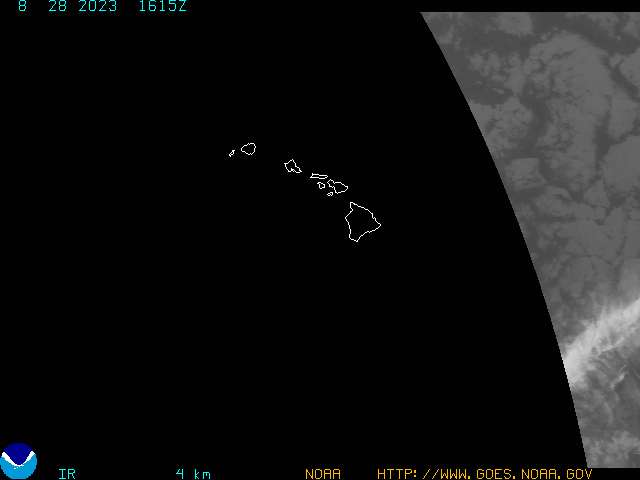
Satellite and Radar Images: To view the cloud conditions we have here in Hawaii, please use the following satellite links, starting off with the Infrared Satellite Image of the islands to see all the clouds around the state during the day and night. This next image is one that gives close images of the islands only during the daytime hours, and is referred to as a Close-up visible image. This next image shows a larger view of the Pacific…giving perspective to the wider ranging cloud patterns in the Pacific Ocean…out from the islands. To help you keep track of where any showers may be around the islands, here’s the latest animated radar image.
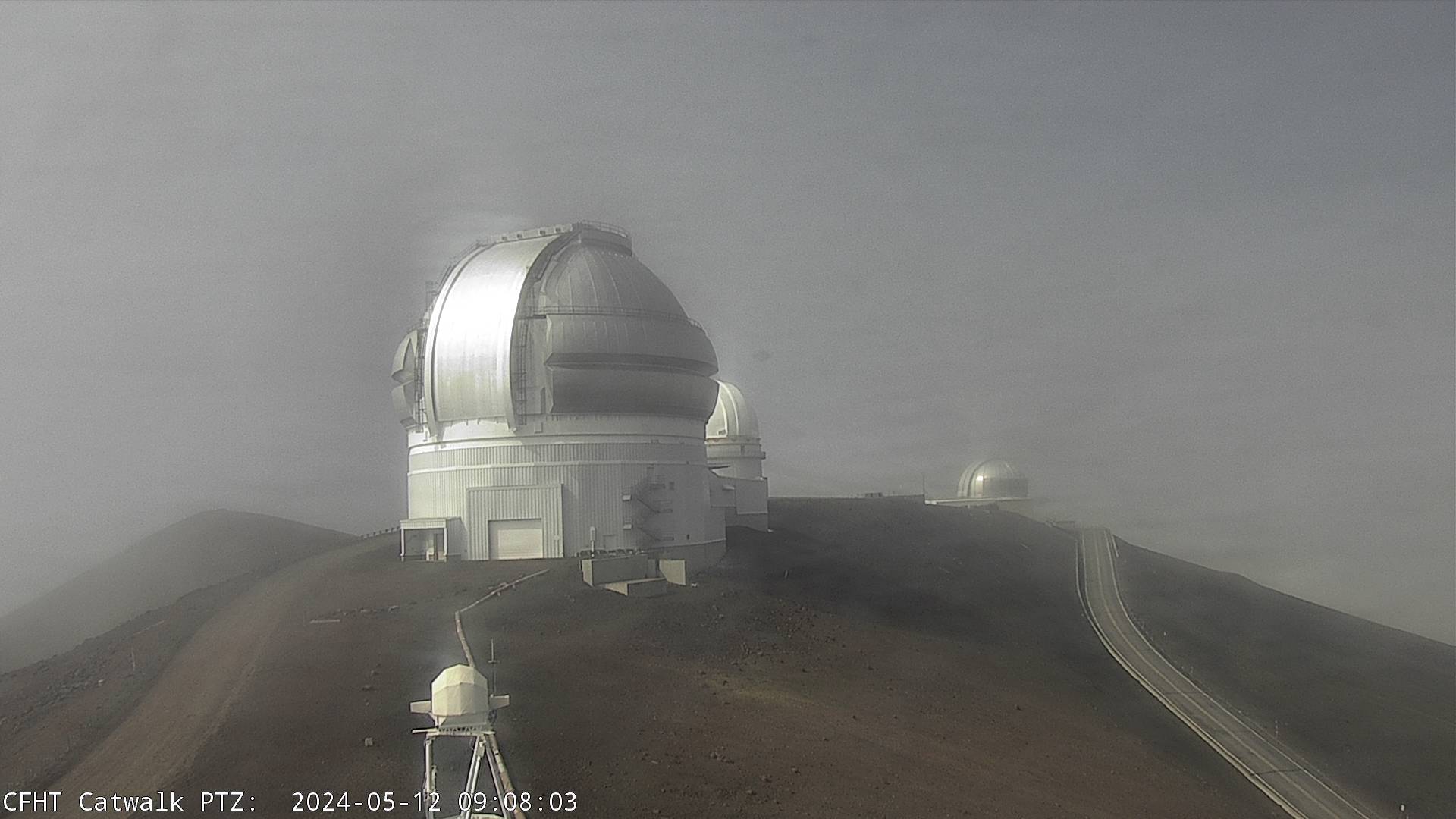
Hawaii’s Mountains – Here’s a link to the live webcam on the summit of near 14,000 foot Mauna Kea on the Big Island of Hawaii. The tallest peak on the island of Maui is the Haleakala Crater, which is near 10,000 feet in elevation. These two webcams are available during the daylight hours here in the islands…and when there’s a big moon rising just after sunset for an hour or two! Plus, during the nights and early mornings you will be able to see stars, and the sunrise too…depending upon cloud conditions.
Aloha Paragraphs
 Nice waves breaking at our local beaches now
Photo credit:flickr.com
Locally gusty trade winds will continue, strongest during the afternoon hours as usual. The long range computer forecast models suggest that by this coming Wednesday, the trades will break down. This will be caused by a deep low pressure system moving by to our north. This low will have an associated cold front, which will approach the islands, but not make it all the way down into our area. During the second half of the week, this low and front will keep our ridge of high pressure down over the islands for several days. This in turn will bring back a period of light winds, which will likely will swing around to the southeast direction…carrying volcanic haze up over the Aloha state from the Big Island.
The trade winds will carry a few showers our way, although the leeward sides will remain generally sunny to partly cloudy during the days. The majority of these showers will fall along the windward coasts and slopes. There is good chance that afternoon clouds will gather over and around the mountains…as they did Saturday. The leeward slopes on the Big Island had a couple of thunderstorms, which may flare-up again this afternoon. Looking further ahead, during the second half of the new week, the light winds will cause a convective weather pattern, with most of the showers that fall, occurring during the afternoons in the upcountry interior areas.
It’s Sunday evening as I begin updating this last section of today’s narrative. Today was very near a repeat performance of Saturday, at least in terms of the weather. Many areas started off with clear skies, although clouds increased as the day wore on. The trade winds, as noted above, will still be on the breezy side, although not strong enough to trigger small craft wind advisories in our coastal waters now. You may have noticed in the paragraphs above, that our local trade winds will be faltering again by the middle of the new week. This is not great news, if you are one of those folks who have respiratory problems due to the volcanic haze that gathers over our islands. This last week we had just such conditions, and the light southeast winds may bring up that vog over us again starting Wednesday.
~~~ I got up very early Sunday morning, actually at 415am, the same time I do during the weekdays. I didn’t mind however, as it was for a good cause. I took the drive over to the Lahaina side, for a surfing excursion. I paddled out just as the warm sunshine was hitting the water, just to the south of Lahaina town here on Maui. There were only two guys out, and I knew one of them. Later more folks paddled out, but it never really got crowded. I must say that I got many thank you comments, for the surf page that I produce on this website. The tide got very low, and the water was clear enough, that I could see just how close the reef was just below my feet. My surfboard only hit the reef slightly once, when I got stuck inside, after riding a nice wave towards shore. I had some concern about my arms, and paddling, as I’ve been healing my shoulders from a skateboarding accident I had last year. I’m delighted to say that my upper arms were stiff, but they stretched out as I was out there paddling for waves, it is with relief that I now know I can go surfing more…like next weekend I hope!
~~~ I’m about ready to go down stairs from my Kula, Maui weather tower, to make dinner. I’ll make a nice red pasta sauce, and then just cook spaghetti each night during the week. I’ll sauteed three large portobello mushrooms, an onion, garlic, a couple of zucchini’s, along with a hot green pepper in extra virgin olive oil…then throw in a can of organic Muir Glen diced tomatoes. As I’ve mentioned many times here, I love having a ready made sauce, which I’ll add the sauce, and then grate some nice cheese over the plating each work night. I hope you have a great Sunday night! I’ll meet you here very early Monday morning with your next weather narrative from paradise. Aloha for now…Glenn.
In celebration of Earth Day weekend: If the Earth were only a few feet in diameter…floating a few feet above a field somewhere, people would come from everywhere to marvel at it. People would walk around it, marveling at its big pools of water, or little pools and the water flowing between the pools. People would marvel at the bumps on it, and the holes in it, and they would marvel at the very thin layer of gas surrounding it and the water suspended in the gas. The people would marvel at the creatures walking around the surface of the ball, and at the creatures in the water.
The people would declare it as sacred because it was the only one, and they would protect it so that it would not be hurt. The ball would be the greatest wonder known, and people would come to pray to it, to be healed, to gain knowledge, to know beauty and to wonder how it could be. People would love it, and defend it with their lives because they would somehow know that their lives, their own roundness, could be nothing without it. If the Earth were only a few feet in diameter.
Posted by Glenn
1 Comment
April 19-20 2008
Air Temperatures – The following maximum temperatures were recorded across the state of Hawaii Saturday:
Lihue, Kauai – 80
Honolulu, Oahu – 86
Kaneohe, Oahu – 80
Kahului, Maui – 85
Hilo, Hawaii – 76
Kailua-Kona, Hawaii – 83
Air Temperatures ranged between these warmest and coolest spots near sea level at 4 p.m. Saturday afternoon:
Honolulu, Oahu – 83F
Hilo, Hawaii – 74
Precipitation Totals – The following numbers represent the largest precipitation totals (inches) during the last 24 hours on each of the major islands, as of Saturday afternoon:
0.05 MOLOAA DAIRY, KAUAI
0.30 PALISADES, OAHU
0.05 MOLOKAI
0.00 LANAI
0.00 KAHOOLAWE
0.24 PUU KUKUI, MAUI
0.72 WAIAKEA UKA, BIG ISLAND
Weather Chart – Here’s the latest (automatically updated) weather map showing high pressure systems to the NE and NW. Our trade winds will remain moderately strong, although locally stronger and gusty Sunday and Monday.
Satellite and Radar Images: To view the cloud conditions we have here in Hawaii, please use the following satellite links, starting off with the Infrared Satellite Image of the islands to see all the clouds around the state during the day and night. This next image is one that gives close images of the islands only during the daytime hours, and is referred to as a Close-up visible image. This next image shows a larger view of the Pacific…giving perspective to the wider ranging cloud patterns in the Pacific Ocean…out from the islands. To help you keep track of where any showers may be around the islands, here’s the latest animated radar image.
Hawaii’s Mountains – Here’s a link to the live webcam on the summit of near 14,000 foot Mauna Kea on the Big Island of Hawaii. The tallest peak on the island of Maui is the Haleakala Crater, which is near 10,000 feet in elevation. These two webcams are available during the daylight hours here in the islands…and when there’s a big moon rising just after sunset for an hour or two! Plus, during the nights and early mornings you will be able to see stars, and the sunrise too…depending upon cloud conditions.
Aloha Paragraphs
 Tropical full moon
Artist:James Coleman
Moderately strong trade winds, now active across the entire state of Hawaii…will continue into the new week ahead. This is good news, as the hazy and muggy weather of this last week, continue to be blown away. Skies should show improved clarity, with less relative humidity in general. The long range computer forecast models suggest that by next Wednesday, the trades will relax a little in strength. Those models go on to indicate go on to show that the slightly lighter trade winds will last only a few days…with stronger trade winds returning Friday into next weekend.
The trade winds will carry a few showers to our windward sides, leaving the leeward sides sunny to partly cloudy during the days. This looping satellite imagery shows high and middle level clouds looming to the south, minding its manners down there for the time being. Otherwise, most of the clouds locally will occur along the windward sides…where a few showers will spill along those coasts and slopes. The overlying atmosphere is fairly dry and stable now, which will limit shower production, even in regards to those stratocumulus and cumulus clouds being carried our way on the breezy trade winds.
It’s Saturday evening as I begin updating this last section of today’s narrative. Saturday was a delightful day, that is if you don’t mind a bit of gusty trade winds blowing…and some misty showers falling along the windward sides. The leeward areas basked in warm sunshine in many areas, where it was generally less windy than elsewhere. Clouds gathered, as usual, around the mountains, but didn’t drop much precipitation. I see little change for Sunday, which will be another nice day as well…carrying forth right on into the new week ahead.
~~~ You may have noticed the growing size of the moon lately? Well, if not, I’m pretty sure you will tonight. The April full moon occurs Saturday night, actually, the official time of full moon is early Sunday morning at 12:25am here in Hawaii. This moon will light the way for whatever night hikes that you might have planned, or at least a walk on some sandy beach perhaps.
~~~ I saw the new film Friday night called The Forbidden Kingdom (2008), starring Jackie Chan, Jet Li, among others. It’s about an American teenager who is obsessed with Hong Kong cinema and kung-fu classics makes an extraordinary discovery in a Chinatown pawnshop: the legendary stick weapon of the Chinese sage and warrior, the Monkey King. With the lost relic in hand, the teenager unexpectedly finds himself traveling back to ancient China to join a crew of warriors from martial arts lore on a dangerous quest to free the imprisoned Monkey King. The Maui Megaplex used its largest theater to show this film, and it was packed. The local population here love this kind of film, and I noticed when walking out of the theater afterwards, that I was the only white guy walking among all brown skin folks! This film was just about what I had expected, although it had a funny edge that kept coming out, with lots of laughs along the way. Jet Li is a pretty serious guy, although with Jackie Chan involved, there’s always some aspect of comedy. I have to admit, as is often the case, I had a pretty good crush going on over the two leading ladies in this Kung-fu movie! Here’s the trailer, see what you think.
~~~ I did little projects around the house today, which was pleasant. I have my surfboard strapped to the racks on the top of my car. I’ll get up early Sunday morning, update this website, have a little breakfast and coffee, and then take the drive over to the Lahaina side for a long awaited surf session. I have been healing my shoulders from a skateboarding accident I had last year, and am finally feeling strong enough to get out there and paddle my surfboard into some nice south swell waves. I may be a little rusty in my riding, but the truth is that surfing, once you know how, is like riding a bike, you never forget. I’ll meet you here early in the morning for more updates on this webpage, I hope you have a great full moon Saturday night until then! Aloha for now…Glenn
In celebration of Earth Day weekend: If the Earth were only a few feet in diameter…floating a few feet above a field somewhere, people would come from everywhere to marvel at it. People would walk around it, marveling at its big pools of water, or little pools and the water flowing between the pools. People would marvel at the bumps on it, and the holes in it, and they would marvel at the very thin layer of gas surrounding it and the water suspended in the gas. The people would marvel at the creatures walking around the surface of the ball, and at the creatures in the water.
The people would declare it as sacred because it was the only one, and they would protect it so that it would not be hurt. The ball would be the greatest wonder known, and people would come to pray to it, to be healed, to gain knowledge, to know beauty and to wonder how it could be. People would love it, and defend it with their lives because they would somehow know that their lives, their own roundness, could be nothing without it. If the Earth were only a few feet in diameter.
Posted by Glenn
[2] Comments
April 18-19 2008
Air Temperatures – The following maximum temperatures were recorded across the state of Hawaii Friday:
Lihue, Kauai – 80
Honolulu, Oahu – 87
Kaneohe, Oahu – 81
Kahului, Maui – 85
Hilo, Hawaii – 83
Kailua-Kona, Hawaii – 83
Air Temperatures ranged between these warmest and coolest spots near sea level at 4 p.m. Friday morning:
Honolulu, Oahu – 85F
Molokai airport – 77
Precipitation Totals – The following numbers represent the largest precipitation totals (inches) during the last 24 hours on each of the major islands, as of Friday afternoon:
0.16 MOUNT WAIALEALE, KAUAI
0.53 OLOMANA FIRE STATION, OAHU
0.02 MOLOKAI
0.11 LANAI
0.00 KAHOOLAWE
0.12 PUU KUKUI, MAUI
0.04 HILO AIRPORT, BIG ISLAND
Weather Chart – Here’s the latest (automatically updated) weather map showing a low pressure system moving away to the north. This is allowing high pressure to establish itself to the NE and NW. Our trade winds will picking up strength through the weekend.
Satellite and Radar Images: To view the cloud conditions we have here in Hawaii, please use the following satellite links, starting off with the Infrared Satellite Image of the islands to see all the clouds around the state during the day and night. This next image is one that gives close images of the islands only during the daytime hours, and is referred to as a Close-up visible image. This next image shows a larger view of the Pacific…giving perspective to the wider ranging cloud patterns in the Pacific Ocean…out from the islands. To help you keep track of where any showers may be around the islands, here’s the latest animated radar image.
Hawaii’s Mountains – Here’s a link to the live webcam on the summit of near 14,000 foot Mauna Kea on the Big Island of Hawaii. The tallest peak on the island of Maui is the Haleakala Crater, which is near 10,000 feet in elevation. These two webcams are available during the daylight hours here in the islands…and when there’s a big moon rising just after sunset for an hour or two! Plus, during the nights and early mornings you will be able to see stars, and the sunrise too…depending upon cloud conditions.
Aloha Paragraphs
 Dolphins in Hawaiian waters
Photo Credit: flickr.com
The trade winds came charging back into Hawaiian waters Friday! A long lasting low pressure system, to the north of the islands, finally moved northward. This in turn allowed the return of what started out as light trade winds…which increased quickly during the day. The thick volcanic haze of late, and the muggy air too, are quickly leaving…as the trade winds scrub the air clean. These moderately strong trade winds will continue this weekend, and into the new week ahead. The long range computer forecast models suggest that by next Wednesday, they will relax in strength for several days.
The returning trade winds will provide good weather conditions well into the future. As is always the case, or at least almost always, we’ll see the return of a few showers to the north and east facing windward sides. The south and west sides, referred to as leeward, will remain mostly dry and sunny during the days. This looping satellite imagery shows high cirrus clouds looming to the west and southwest, so that we may see that high level moisture arriving, carried on the upper winds aloft…eventually. Otherwise, most of the clouds will occur along the windward sides…where a few showers will spill along those coasts and slopes.
It’s Friday evening as I begin updating this last section of today’s narrative. Friday was a transition day, taking us out of the light winds, muggy and hazy weather conditions…back into a freshening trade wind weather pattern. Most areas of the state have had to put up with hazy conditions, caused by the volcanic emissions from the Big Island, carried up the island chain on the southeast wind flow. We started the day off in a voggy way (vog is what we call volcanic haze in Hawaii), but relief came on heels of the stiffening trade winds. It took most of the day, but the vog is rapidly thinning, and will continue to do so into the weekend.
~~~ You may have noticed the growing size of the moon lately? Well, if not, I’m pretty sure you will over the next couple of nights. The April full moon occurs Saturday night, and will be reflecting all kinds of sunshine after dark!
~~~ I had a hard time trying to decide which film to see this evening, as there are so many good ones to chose from. I finally picked the new film called The Forbidden Kingdom (2008), starring Jackie Chan, Jet Li, among others. An American teenager who is obsessed with Hong Kong cinema and kung-fu classics makes an extraordinary discovery in a Chinatown pawnshop: the legendary stick weapon of the Chinese sage and warrior, the Monkey King. With the lost relic in hand, the teenager unexpectedly finds himself traveling back to ancient China to join a crew of warriors from martial arts lore on a dangerous quest to free the imprisoned Monkey King. I love this kind of action flick, and am looking forward to seeing it! Here’s the trailer for this flim, see what you think. I’ll let you know what I thought early Saturday morning when I’m here with your next new weather narrative from paradise then. Aloha for now…Glenn.
Interesting: The first typhoon to threaten China this year churned toward the southern island province of Hainan on Friday, forcing about 120,000 people to evacuate fish farms and low-lying areas, forecasters and media said. Fifty-six fishermen were reported missing. Typhoon Neoguri was expected to sweep over Hainan’s northeastern coast on Friday night or early Saturday, lashing the city of Wanning or Wenchang, the nation’s meteorological observatory said. The last time a typhoon threatened China so early in the season was before 1949, Chen Lei, a flood relief official, was quoted as saying by the state-run Xinhua News Agency. Neoguri, which means "raccoon" in Korean, was packing winds of up to 75 miles per hour as it swirled across the South Sea and approached Hainan, famous for its resorts, beaches and tropical fruit orchards, forecasters said. About 21,800 fishing boats with 80,000 crew sought shelter in ports or reefs in Hainan, and 20,000 more sailed to safer waters in nearby Guangdong province, Xinhua said.
Interesting2: Scientists studying the icy depths of the sea around Antarctica have detected changes in salinity that could have profound effects on the world’s climate and ocean currents. The scientists returned to the southern Australian city of Hobart on Thursday after a one-month voyage studying the Southern Ocean to see how it is changing and what those changes might mean for global climate patterns. Voyage leader Steve Rintoul said his team found that salty, dense water that sinks near the edge of Antarctica to the bottom of the ocean about 5 km (3 miles) down was becoming fresher and more buoyant. So-called Antarctic bottom water helps power the great ocean conveyor belt, a system of currents spanning the Southern, Pacific, Indian and Atlantic Oceans that shifts heat around the globe. "The main reason we’re paying attention to this is because it is one of the switches in the climate system and we need to know if we are about to flip that switch or not," said Rintoul of Australia’s government-backed research arm the CSIRO. "If that freshening trend continues for long enough, eventually the water near Antarctica would be too light, too buoyant to sink and that limb of the global-scale circulation would shut down," he said on Friday.
Interesting3: Just as canaries help miners monitor underground gases, marine turtles are emerging as excellent indicators of the effects of climate change. “Turtles are a really good way to study climate change because they depend on healthy beaches as well as mangroves, sea grass beds, coral reefs and deep oceane cosystems to live”, said Dr. Lucy Hawkes, coordinator of an initiative to develop adaptation strategies for climate change impacts to turtles. As part of the initiative, WWF launched a new website today, Adaptation to Climate Change in Marine Turtles (ACT). “Understanding of how climate change may affect the beaches, the reef and the open ocean will not only benefit endangered sea turtle populations, but also the millions of people who live along the coastlines of the world and depend upon marine resources and environemental services.” The public, educators, conservationists and scientists will be able to share information and projects to try to gain a better picture of how climate change will affect turtles and what might be done to combat the impacts.
Interesting4: Full moons are said to be behind many strange things, but here’s one you didn’t know about: At full moon, our favorite satellite (the moon) is whipped by Earth’s magnetotail, causing lunar dust storms and discharges of static electricity. This new finding, announced this week by NASA, is important to future lunar explorers: Astronauts may find themselves "crackling with electricity like a sock pulled out of a hot dryer," according to an agency statement. The effect on the moon was first noticed in 1968, when NASA’s Surveyor 7 lander photographed a strange glow on the horizon after dark. Nobody knew what it was. Now scientists think it was sunlight scattered by electrically charged moon dust floating just above the surface. That fits with data from NASA’s Lunar Prospector, which orbited the moon in 1998-99. During some crossings of the magnetotail, the spacecraft recorded big changes in the lunar night-side voltage.
Posted by Glenn
1 Comment
April 17-18 2008
Air Temperatures – The following maximum temperatures were recorded across the state of Hawaii Thursday:
Lihue, Kauai – 77
Honolulu, Oahu – 80
Kaneohe, Oahu – 80
Kahului, Maui – 83
Hilo, Hawaii – 81
Kailua-Kona, Hawaii – 84
Air Temperatures ranged between these warmest and coolest spots near sea level at 4 p.m. Thursday afternoon:
Kailua-kona – 82F
Barking Sands, Kauai – 76
Precipitation Totals – The following numbers represent the largest precipitation totals (inches) during the last 24 hours on each of the major islands, as of Thursday afternoon:
1.94 PORT ALLEN, KAUAI
0.35 WHEELER FIELD, OAHU
0.21 MOLOKAI
0.10 LANAI
0.00 KAHOOLAWE
0.01 ULUPALAKUA, MAUI
0.09 PAHOA, BIG ISLAND
Weather Chart – Here’s the latest (automatically updated) weather map showing a 999 millibar low pressure system to our NNW. This low will be moving away now, with high pressure establishing itself to the NE and NW. Our recent light SE winds will gradually become trade winds into Saturday.
Satellite and Radar Images: To view the cloud conditions we have here in Hawaii, please use the following satellite links, starting off with the Infrared Satellite Image of the islands to see all the clouds around the state during the day and night. This next image is one that gives close images of the islands only during the daytime hours, and is referred to as a Close-up visible image. This next image shows a larger view of the Pacific…giving perspective to the wider ranging cloud patterns in the Pacific Ocean…out from the islands. To help you keep track of where any showers may be around the islands, here’s the latest animated radar image.
Hawaii’s Mountains – Here’s a link to the live webcam on the summit of near 14,000 foot Mauna Kea on the Big Island of Hawaii. The tallest peak on the island of Maui is the Haleakala Crater, which is near 10,000 feet in elevation. These two webcams are available during the daylight hours here in the islands…and when there’s a big moon rising just after sunset for an hour or two! Plus, during the nights and early mornings you will be able to see stars, and the sunrise too…depending upon cloud conditions.
Aloha Paragraphs
 White sand and blue water of windward Oahu
Photo Credit: flickr.com
A low pressure system in our area will keep our winds light today, with returning trade winds Friday. Our normal trade winds have veered around to the southeast and south-southeast recently…due to the close proximity of the low to the northwest of Kauai. These lighter winds have kept somewhat muggy conditions in place, with daytime temperatures feeling very warm near the beaches, especially in those areas out from under cloud cover. The SE winds have carried volcanic haze up from the Big Island to other parts of the state as well. The trade winds will rebound later Friday, and remain active through the weekend…continuing on into next week.
The Kauai end of the island chain saw the most showers Thursday…due to its closeness to the low pressure system. Generally though, we saw an increase in afternoon convective clouds, but not very many showers over the islands from Oahu down through the Big Island. Satellite imagery showed some towering cumulus clouds, and thunderstorms forming near Kauai Thursday morning, which was evidence of the cold air aloft associated with the dynamic low pressure area. As this low pressure area remains quite close through Thursday, there will be the chance of showers breaking out. As this weather feature moves away Friday, our local air mass will lose its shower aspects.
It’s Thursday evening as I begin updating this last section of today’s narrative. The low pressure system, mentioned above, will be moving out of our area later Friday. This in turn will allow the refreshing trade winds to return into the weekend. These light to moderately strong trade winds will help to clear the humid air, with more comfortable conditions returning then. There will continue to be some volcanic haze in places, although most concentrated down on the Big Island as usual. As there are two volcanic emission points now, it is difficult for that southernmost island to escape the dreaded vog these days. The computer forecast models suggest that the trade winds will carry on right into next week, with generally fair weather forecast then statewide.
Thursday was a pretty good day, although most islands saw sun dimming and filtering high clouds above, and muggy and hazy air conditions below. The heaviest showers were restricted to the island of Kauai, with just a few light to moderate afternoon showers elsewhere. It looks like Friday will see the return of the trade winds, which will become even better established this weekend. This new air flow will ventilate the haze away in most areas, or at least begin to do that from Kauai down through Maui. At the same time, we should see the return of a few windward biased showers as well. This weekend looks like a nice one, with favorable weather conditions continuing right on into next week.
I’ll be back again very early Friday morning with your next new weather narrative. I hope you have a great Thursday night wherever you happen to be spending it! Aloha for now…Glenn.
Interesting: A thick layer of yellow dust blanketed houses and cars in the Iraqi capital Thursday as a heavy sandstorm over central Iraq sent dozens of residents to hospitals with breathing difficulties. The spring storm, one of the worst in years, forced the closure of the Baghdad International Airport. It also appeared to hamper military flights. None of the helicopter patrols that regularly roar over the city of 6 million people seemed to be airborne. Many shops in the city were closed, and only a few cars were seen on the deserted streets. AP Television News footage also showed Iraqi traffic policemen wearing masks over their mouths as protection from the dust whipped up by the hot winds.
Interesting2: Planet Earth continues to run a fever. Last month was the warmest March on record over land surfaces of the world and the second warmest overall worldwide. For the United States, however, it was just an average March, the National Oceanic and Atmospheric Administration reported Thursday.NOAA’s National Climatic Data Center said high temperatures over much of Asia pulled the worldwide land temperature up to an average of 40.8 degrees, 3.2 degrees warmer than the average in the 20th century. While Asia had its greatest January snow cover this year, warm March readings caused a rapid melt and March snow cover on the continent was a record low. Global ocean temperatures were the 13th warmest on record, with a weakening of the La Nina conditions that cool the tropical Pacific Ocean. Overall land and sea surface temperatures for the world were second highest in 129 years of record keeping, trailing only 2002, the agency said. Warming conditions in recent decades have continued to raise concern about global climate change, which many weather and climate experts believe is related to gases released into the atmosphere by industrial and transportation processes. The climate center said that for the 48 contiguous United States it was about average, ranking as the 63rd warmest March in 113 years of record keeping.
Interesting3: Major floods striking America’s heartland this week offer a preview of the spring seasonal outlook, according to NOAA’s National Weather Service. Several factors will contribute to above-average flood conditions, including record rainfall in some states and snow packs, which are melting and causing rivers and streams to crest over their banks. This week, more than 250 communities in a dozen states are experiencing flood conditions. The science supporting NOAA’s short-term forecasts allows for a high level of certainty. National Weather Service forecasters highlighted potential for the current major flood event a week in advance and began working with emergency managers to prepare local communities for the impending danger. “We expect rains and melting snow to bring more flooding this spring,” said Vickie Nadolski, deputy director of NOAA’sNational Weather Service. “Americans should be on high alert to flood conditions in your communities. Arm yourselves with information about how to stay safe during a flood and do not attempt to drive on flooded roadways — remember to always turn around, don’t drown.”
Interesting4: Hurricanes in some areas, including the North Atlantic, are likely to become more intense as a result of global warming even though the number of such storms worldwide may decline, according to a new study by MIT researchers.
Kerry Emanuel, the lead author of the new study, wrote a paper in 2005 reporting an apparent link between a warming climate and an increase in hurricane intensity. That paper attracted worldwide attention because it was published in Nature just three weeks before Hurricane Katrina slammed into New Orleans.
Emanuel, a professor of atmospheric science in MIT’s Department of Earth, Atmospheric and Planetary Sciences, says the new research provides an independent validation of the earlier results, using a completely different approach. The paper was co-authored by postdoctoral fellow Ragoth Sundararajan and graduate student John Williams and appeared last week in the Bulletin of the American Meteorological Society.
While the earlier study was based entirely on historical records of past hurricanes, showing nearly a doubling in the intensity of Atlantic storms over the last 30 years, the new work is purely theoretical. It made use of a new technique to add finer-scale detail to computer simulations called Global Circulation Models, which are the basis for most projections of future climate change.
Interesting5: The jet stream — America‘s stormy weather maker — is creeping northward and weakening, new research shows. That potentially means less rain in the already dry South and Southwest and more storms in the North. And it could also translate into more and stronger hurricanes since the jet stream suppresses their formation. The study’s authors said they have to do more research to pinpoint specific consequences. From 1979 to 2001, the Northern Hemisphere’s jet stream moved northward on average at a rate of about 1.25 miles a year, according to the paper published Friday in the journal Geophysical Research Letters.
The authors suspect global warming is the cause, but have yet to prove it. The jet stream is a high-speed, constantly shifting river of air about 30,000 feet above the ground that guides storm systems and cool air around the globe. And when it moves away from a region, high pressure and clear skies predominate. Two other jet streams in the Southern Hemisphere are also shifting poleward, the study found. The northern jet stream "is the dominant thing that creates weather systems for the United States,” said study co-author Ken Caldeira, a climate scientist at the Carnegie Institution of Washington in Stanford, Calif. "Bascially look south of where you are and that’s probably a good guess of what your weather may be like in a few decades.”
The study looked at the average location of the constantly moving jet stream and found that when looked at over decades, it has shifted northward. The study’s authors and other scientists suggest that the widening of the Earth’s tropical belt — a development documented last year — is pushing the three jet streams toward the poles.
Climate models have long predicted that with global warming, the world’s jet streams would move that way, so it makes sense to think that’s what happening, Caldeira said. However, proving it is a rigorous process, using complex computer models to factor in all sorts of possibilities. That has not been done yet.
A rate of 1.25 miles a year "doesn’t sound like much, but that works out to about 18 feet per day,” Caldeira said. "If you think about climate zones shifting northward at this rate, you can imagine squirrels keeping up. But what are oak trees going to do?
Posted by Glenn
[4] Comments
April 16-17 2008
Air Temperatures – The following maximum temperatures were recorded across the state of Hawaii Wednesday:
Lihue, Kauai – 81
Honolulu, Oahu – 82
Kaneohe, Oahu – 81
Kahului, Maui – 87
Hilo, Hawaii – 81
Kailua-Kona, Hawaii – 83
Air Temperatures ranged between these warmest and coolest spots near sea level at 4 p.m. Wednesday afternoon:
Kahului, Maui – 83F
Molokai airport – 74
Precipitation Totals – The following numbers represent the largest precipitation totals (inches) during the last 24 hours on each of the major islands, as of Wednesday afternoon:
2.55 MOUNT WAIALEALE, KAUAI
1.03 POAMOHO 2, OAHU
0.00 MOLOKAI
0.00 LANAI
0.00 KAHOOLAWE
0.09 OHEO GULCH, MAUI
0.23 MOUNTAIN VIEW, BIG ISLAND
Weather Chart – Here’s the latest (automatically updated) weather map showing a 1038 millibar high pressure system located far to the north-northeast of Hawaii Thursday. Meanwhile, we have a 1012 millibar low pressure system, with its associated trough/cold front to our NNW. Our local winds will be light from the southeast, and SSE…gradually becoming more easterly later Friday.
Satellite and Radar Images: To view the cloud conditions we have here in Hawaii, please use the following satellite links, starting off with the Infrared Satellite Image of the islands to see all the clouds around the state during the day and night. This next image is one that gives close images of the islands only during the daytime hours, and is referred to as a Close-up visible image. This next image shows a larger view of the Pacific…giving perspective to the wider ranging cloud patterns in the Pacific Ocean…out from the islands. To help you keep track of where any showers may be around the islands, here’s the latest animated radar image.
Hawaii’s Mountains – Here’s a link to the live webcam on the summit of near 14,000 foot Mauna Kea on the Big Island of Hawaii. The tallest peak on the island of Maui is the Haleakala Crater, which is near 10,000 feet in elevation. These two webcams are available during the daylight hours here in the islands…and when there’s a big moon rising just after sunset for an hour or two! Plus, during the nights and early mornings you will be able to see stars, and the sunrise too…depending upon cloud conditions.
Aloha Paragraphs
 Soaking rays on the beach in Hawaii…now that’s brown!
Photo Credit: flickr.com
Deepening low pressure to the northwest of Hawaii have helped to weaken our winds, and add some instability to our overlying atmosphere. Weather charts show a 1038 millibar high pressure system far northeast of Hawaii Wednesday night. Our trade winds have veered around to the southeast statewide. Winds from this compass point carry volcanic haze (called vog here in the Hawaii), from the vents on the Big Island, on up over other islands. The trade winds should recover later Friday or Saturday everywhere, and remain active through the weekend…strengthening early next week.
The area of low pressure to the northwest will make our weather a bit more shower prone. As the winds slow down starting now, we’ll see some increase in afternoon convective showers over all the Islands. Satellite imagery shows some towering cumulus clouds, and thunderstorms forming just to the west and north of Kauai now, which is evidence of the cold air aloft associated with the dynamic low pressure area. As this low pressure area remains quite close through Thursday into early Friday, there will be the chance of showers popping up…especially near Kauai and Oahu.
It’s Wednesday evening as I begin updating this last section of today’s narrative. If you had a chance to read the paragraphs above, you’ll know we have some weather changes in store over the next several days. The most notable of these will occur over and around Kauai and Oahu, with humid weather in store, and a good chance of showers. Here’s a looping satellite image to keep track of that developing low pressure system to the NW of Kauai. Meanwhile, on the eastern side of the chain, the islands of Maui County, and the Big Island, being further away from the low pressure area, may be less affected. The winds statewide however will be lighter, with daytime heating setting off some rather extensive afternoon cloudiness over and around the mountains. There may be some showers in the upcountry areas, a few of which will likely be rather generous around Kauai and Oahu.
The light winds will make our air mass feel rather warm and muggy during the days…hazy too. It certainly felt that way at Kahului, Maui, where the Wednesday afternoon high temperaure reached 87F degrees. That temperature fell three degrees short of the record for the date however, which was a hot 90F degrees back in 1952. Air temperatures overnight will be slightly cooler than normal…dipping into the 60F’s at sea level, cooler than that in the upcountry areas.. As the trade winds return later Friday or by Saturday, we’ll see a more normal trade wind weather pattern returning…continuing on into next week.
~~~ I’ll be back very early Thursday morning with your next new weather narrative from paradise. I hope you enjoy your Wednesday night wherever you happen to be spending it! Aloha for now…Glenn.
Interesting: Countries around the Mediterranean are unprepared to deal with tsunamis occurring in the region, geoscientists said in Vienna on Wednesday. Any region surrounding the Mediterranean sea, among them popular tourist destinations in Italy, Spain or Greece, could be hit by a tsunami within a few minutes, but warning systems are not in place, Stefano Tinti of Italy‘s University of Bologna warned. "If a tsunami hits, there is no safe place in the Mediterranean," Tinti said. While Mediterranean countries have scientific centres observing earthquakes, these lacked equipment and authority to serve as national warning centres, Tinti said. Large tsunamis, monster waves like the one which hit Indonesia, Thailand and India on December 26, 2004, are rare events in and around the Mediterranean but a danger that cannot be ignored. In 1755 for example, a massive wave destroyed Portugal‘s capital Lisbon. Tsunamis occur due to several reasons – seismic origins like earthquakes, volcanic activities or landslides under the sea being the most frequent. A local tsunami, defined in the Mediterranean as hitting within a 100-kilometre distance from the source, can reach coasts and islands within minutes, making speed essential for warning systems, scientists said. "Most fatalities are related to local tsunamis," Tinti told journalists at the annual meeting of the European Geosciences Union (EGU) taking place in Vienna this week. A seaquake off Algeria for example created a small tsunami which reached Algeria‘s coast within 15 minutes. About 40 minutes later, waves were hitting Spain‘s Baleares and 60 minutes later southern France.
Interesting2: The world’s oldest living tree, a spruce that is 9,550 years old, has been discovered in Sweden, researchers at Umea University said Wednesday. The ancient spruce was discovered on a mountain range in the province of Dalarna, north-west of Stockholm and has reversed previous assumptions that the spruce tree arrived relatively recently to Sweden. "Our results have shown the complete opposite, that the spruce is one of the oldest known trees in the mountain range," said Leif Kullman, Professor of Physical Geography at Umea University, 660 kilometres north of Stockholm. Researchers found four "generations" of spruces in Dalarna. Using Carbon-14 dating at a laboratory in Miami in the US, they were able to establish that the four trees were aged 375, 5,660, 9,000 and 9,550 years, respectively. Spruces can multiply with root penetrating branches, so they can produce exact copies or clones, the researchers said, noting that the oldest tree had the same genetic material as wood found at the site. North American pine trees have previously been believed to hold the age record of 4,000 to 5,000 years. Kullman said research on spruces may also provide knowledge about climate change.
Posted by Glenn
No Comments
April 16-17 2008
Air Temperatures – The following maximum temperatures were recorded across the state of Hawaii Tuesday:
Lihue, Kauai – 80
Honolulu, Oahu – 85
Kaneohe, Oahu – 79
Kahului, Maui – 84
Hilo, Hawaii – 76
Kailua-Kona, Hawaii – 83
Air Temperatures ranged between these warmest and coolest spots near sea level at 4 a.m. Wednesday morning:
Kailua-kona – 75F
Kahului, Maui – 65
Precipitation Totals – The following numbers represent the largest precipitation totals (inches) during the last 24 hours on each of the major islands, as of Wednesday morning:
2.49 MOUNT WAIALEALE, KAUAI
1.02 POAMOHO 2, OAHU
0.00 MOLOKAI
0.00 LANAI
0.00 KAHOOLAWE
0.28 WEST WAILUAIKI, MAUI
1.01 GLENWOOD, BIG ISLAND
Weather Chart – Here’s the latest (automatically updated) weather map showing a weakening 1036 millibar high pressure system located far to the north-northeast of Hawaii Wednesday. As this high pressure cell moves eastward, and low pressure develops to the west and northwest of Kauai, our winds will be lighter from the southeast to east for the time being.
Satellite and Radar Images: To view the cloud conditions we have here in Hawaii, please use the following satellite links, starting off with the Infrared Satellite Image of the islands to see all the clouds around the state during the day and night. This next image is one that gives close images of the islands only during the daytime hours, and is referred to as a Close-up visible image. This next image shows a larger view of the Pacific…giving perspective to the wider ranging cloud patterns in the Pacific Ocean…out from the islands. To help you keep track of where any showers may be around the islands, here’s the latest animated radar image.
Hawaii’s Mountains – Here’s a link to the live webcam on the summit of near 14,000 foot Mauna Kea on the Big Island of Hawaii. The tallest peak on the island of Maui is the Haleakala Crater, which is near 10,000 feet in elevation. These two webcams are available during the daylight hours here in the islands…and when there’s a big moon rising just after sunset for an hour or two! Plus, during the nights and early mornings you will be able to see stars, and the sunrise too…depending upon cloud conditions.
Aloha Paragraphs
 Nice South swell along our leeward beaches now!
Photo Credit: flickr.com
Deepening low pressure to the northwest of Hawaii will help to weaken our winds, and add some instability to our overlying atmosphere. Weather charts show a 1036 millibar high pressure system northeast of Hawaii Wednesday. This high pressure cell will continue to lose strength, while moving eastward…contributing to our lighter wind speeds as well. Computer forecast models suggest that our trade winds will veer around to the southeast on the Kauai end of the chain Wednesday into Friday. The winds will remain from the easterly or ESE direction on the Big Island and Maui. The trade winds should recover later Friday or Saturday everywhere, and remain active through the weekend…strengthening early next week.
The area of low pressure to the northwest will make our weather a bit more shower prone. As the winds slow down starting Wednesday, we’ll see some increase in afternoon convective showers near Kauai and Oahu. The Big Island end of the chain should remain in a trade wind flow, with windward biased showers continuing at times…although could begin to see some afternoon showers over the interiors if the winds slow down enough there too. Satellite imagery shows some towering cumulus clouds, and thunderstorms forming fairly near Kauai now, which is evidence of the cold air aloft associated with the dynamic low pressure area.
It’s Wednesday morning as I begin writing this last section of today’s narrative. If you had a chance to read the paragraphs above, you’ll know we have some weather changes in store over the next several days. The most notable of these will occur over and around Kauai and Oahu, with humid weather in store, and a good chance of showers. Here’s a looping satellite image to keep track of that developing low pressure system to the NW of Kauai. Meanwhile, on the eastern side of the chain, the islands of Maui County, and the Big Island, being further away from the low pressure area, will be less affected. The winds statewide however will be lighter, with the chance that daytime heating may set off some rather extensive afternoon cloudiness over and around the mountains. There may be some showers in the upcountry areas, a few of which will likely be rather generous around Kauai and Oahu. As the trade winds return later Friday or by Saturday, we’ll see a more normal trade wind weather pattern returning…continuing on into next week.
~~~ I’ll be back later in the day Wednesday, with more weather details and updates, and a new crop of those interesting news items listed below. I hope you enjoy your Wednesday wherever you happen to be spending it! Aloha for now…Glenn.
Interesting: Sea levels could rise by up to 4.9 feet by the end of this century, according to a new scientific analysis. This is substantially more than the Intergovernmental Panel on Climate Change (IPCC) forecast in last year’s landmark assessment of climate science. Sea level rise of this magnitude would have major impacts on low-lying countries such as Bangladesh. The findings were presented at a major science conference in Vienna. The research group is not the first to suggest that the IPCC’s forecast of an average rise in global sea levels of 14 inches by 2100 is too conservative. The IPCC was unable to include the contribution from "accelerated" melting of polar ice sheets as water temperatures warm because the processes involved were not yet understood. The new analysis comes from a UK/Finnish team which has built a computer model linking temperatures to sea levels for the last two millennia.
Interesting2: A United Nations-sponsored report has warned that modern farming practices and rules must change in response to rising food prices. "Business as usual is no longer an option", says the report, as extra food costs threaten to plunge millions more people into poverty. The study, published by Unesco in Paris, calls for more emphasis on protecting natural resources. More natural and ecological farming techniques should be used, it says. These should include reducing the distance between production and the consumer. The report is the result of three years of work involving scientists and other experts, as well as governments of developed and developing countries. The authors conclude that progress in agriculture has reaped very unequal benefits – and that it has come at a high social and environmental cost. Unesco notes the ”considerable influence” of big transnational corporations in North America and Europe. By contrast, Latin America and the Caribbean are largely dependent on imported food. The UN body describes the need for action as urgent, warning that staple food prices are likely to continue to rise because of increased demand from countries like China and India, and the alternative use of maize and soya beans for biofuels. The report says more than a third of the world’s most deteriorated land has been caused by farming.
Interesting3: The Colombian authorities have declared a state of red alert after a volcano erupted 240 km (149 miles) southwest of the capital, Bogota. The Nevado de Huila, the country’s third highest peak, began to belch smoke and ash late on Monday night. Thousands of people living in the shadow of the volcano are being evacuated, as emergency services seek halls and schools to use as shelters. The volcano became active again in after lying dormant for centuries.Experts are trying to assess whether the eruption is likely to get worse or stabilise. Since 1985, Colombia has treated the rumblings of volcanoes with dread and respect, says the BBC’s Jeremy McDermott in Colombia. In that year the Nevado del Ruiz volcano erupted in the western province of Caldas, with lava swallowing up the town of Armero and its 25,000 inhabitants.
Interesting4: China has already overtaken the US as the world’s "biggest polluter", a report to be published next month says. The research suggests the country’s greenhouse gas emissions have been underestimated, and probably passed those of the US in 2006-2007. The University of California team will report their work in the Journal of Environment Economics and Management. They warn that unchecked future growth will dwarf any emissions cuts made by rich nations under the Kyoto Protocol.The team admit there is some uncertainty over the date when China may have become the biggest emitter of CO2, as their analysis is based on 2004 data. Until now it has been generally believed that the US remains "Polluter Number One".
Interesting5: Construction will halt, heavy industries will close, and even spray painting will stop in order to clean Beijing’s polluted air for the Olympics — an issue that suddenly has taken a back seat to political protests. An aggressive plan to temporarily shutter belching steel and chemical plants, cut back emissions by 30 percent at 19 heavy-polluting companies and stop excavation and pouring of concrete at hundreds of sites around the city was explained Monday by the city’s Environmental Protection Bureau. “From the suggestions of experts we think that we need to take these measures to guarantee the air quality of Beijing,” said Du Shaozhong, the bureau’s deputy director. The measures are severe and will be in effect officially for two months — July 20-Sept. 20 — although reports a few months ago suggest some production cutbacks may come even sooner.Officials also are expected to ban about half of Beijing’s 3.3 million vehicles for the Aug. 8-24 Olympics. Du said specific details would be announced later.
Interesting6: Coral is again flourishing in the crater left by the largest nuclear weapon ever detonated by the United States, 54 years after the blast on Bikini Atoll, marine scientists said on Tuesday. A team of research divers visited Bravo crater, ground zero for the test of a thermonuclear weapon in the remote Marshall Islands on March 1, 1954, and found large numbers of fish and coral growing, although some species appeared locally extinct. "I didn’t know what to expect, some kind of moonscape perhaps. But it was incredible," Zoe Richards, from Australia‘s James Cook University, told Reuters about the team’s trip to the atoll in the south Pacific. "We saw communities not too far from any coral reef, with plenty of fish, corals and action going on, some really striking individual colonies," she said. The 15 mega-tonne hydrogen bomb was 1,000 times more powerful than the blast which destroyed Hiroshima, vaporizing islands with temperatures hitting 99,000 degrees Fahrenheit, and shaking islands even up to 124 miles away. The resulting 4 mile-wide fireball left a crater 1 mile across and 80 yards deep, while the mushroom cloud rose 62 miles over theSouth Pacific and radioactive fallout reached Australia and Japan.
Posted by Glenn
[2] Comments
April 14-15 2008
Air Temperatures – The following maximum temperatures were recorded across the state of Hawaii Monday:
Lihue, Kauai – 80
Honolulu, Oahu – 85
Kaneohe, Oahu – 80
Kahului, Maui – 83
Hilo, Hawaii – 81
Kailua-Kona, Hawaii – 79
Temperatures ranged between these warmest and coolest spots near sea level at 4 p.m. Monday afternoon:
Honolulu, Oahu – 83F
Hilo, Hawaii – 76
Precipitation Totals – The following numbers represent the largest precipitation totals (inches) during the last 24 hours on each of the major islands, as of Monday afternoon:
0.78 MOUNT WAIALEALE, KAUAI
0.43 KOOLAU RANGE, OAHU
0.01 MOLOKAI
0.00 LANAI
0.03 KAHOOLAWE
0.73 WEST WAILUAIKI, MAUI
0.55 GLENWOOD, BIG ISLAND
Weather Chart – Here’s the latest (automatically updated) weather map showing a 1043 millibar high pressure system is located far to the north of Hawaii Tuesday. As this high pressure cell moves eastward, and low pressure develops to the west of Kauai, our winds will gradually be on the downward trend in strength.
Satellite and Radar Images: To view the cloud conditions we have here in Hawaii, please use the following satellite links, starting off with the Infrared Satellite Image of the islands to see all the clouds around the state during the day and night. This next image is one that gives close images of the islands only during the daytime hours, and is referred to as a Close-up visible image. This next image shows a larger view of the Pacific…giving perspective to the wider ranging cloud patterns in the Pacific Ocean…out from the islands. To help you keep track of where any showers may be around the islands, here’s the latest animated radar image.
Hawaii’s Mountains – Here’s a link to the live webcam on the summit of near 14,000 foot Mauna Kea on the Big Island of Hawaii. The tallest peak on the island of Maui is the Haleakala Crater, which is near 10,000 feet in elevation. These two webcams are available during the daylight hours here in the islands…and when there’s a big moon rising just after sunset for an hour or two! Plus, during the nights and early mornings you will be able to see stars, and the sunrise too…depending upon cloud conditions.
Aloha Paragraphs
 Hanalei Bay on Kauai
Photo Credit: flickr.com
The trade winds will start to get lighter Tuesday for a couple of days. Weather charts still show an exceptionally strong 1045 millibar high pressure system north of Hawaii Monday evening. This dynamic high pressure cell will begin to lose strength soon, with a corresponding softening of our local wind speeds. Small craft wind advisories remain up in all of our coast waters for the time being. The computer forecast models suggest that these trade winds will begin to ease up Tuesday, and veer around to the southeast or even south on the Kauai end of the chain for a couple of days. The trade winds will remain from the easterly direction on the Big Island and Maui.
The lighter trade winds will still be able to carry passing showers onto our windward coasts and slopes at times. Showers being carried in our direction by the trade winds, which will fall most often along the windward sides, although may be carried over into some leeward spots on the smaller islands tonight. As the winds slow down Tuesday into Wednesday, we’ll see some increase in afternoon convective showers near Kauai. The Big Island end of the chain should remain in a trade wind flow, with windward biased showers continuing in an off and on manner.
It’s Monday evening as I begin updating this last section of today’s narrative. As noted above, we continue to have a 1045 millibar high pressure system far to the north of the islands. This high pressure cell is dominating the area from just west of the International Dateline, across all of the central north Pacific, including northward into the Gulf of Alaska…and on over into the east Pacific into the west coast and Baja, California.
The trade winds remained locally strong Monday, with the top numbers a fairly impressive 42 mph at Kahooolawe, and 44 mph at South Point, on the Big Island. As noted above, starting Tuesday our winds will relax some, due to the presence of low pressure to the northwest of Hawaii. This low will cause southeast or even south winds to develop on Kauai, and perhaps on Oahu too…prompting somewhat heavier upcountry convective showers, especially during the afternoon hours into Thursday. Meanwhile, further away from the low to the east, the Big Island, and Maui County will remain in the trade wind flow, with continued windward focused shower activity.
As the low pressure system, both aloft and at the surface develops further over the next couple of days, we’ll see heavy showers or even thunderstorms flairing-up over the ocean west of Kauai and Niihau. These heavy rain producers shouldn’t extend over to the Hawaiian Islands however, although the tops of those cumulonimbus clouds, called cirrus, will likely get carried over the islands by the upper winds aloft. This should prompt nice sunrise and sunset colors at times.
I’ll be back very early Tuesday morning with your next new weather narrative. I hope you have a good Monday night wherever you happen to be spending it! Aloha for now…Glenn.
Interesting: One of the most influential scientists behind the theory that global warming has intensified recent hurricane activity says he will reconsider his stand. The hurricane expert, Kerry Emanuel of the Massachusetts Institute of Technology, unveiled a novel technique for predicting future hurricane activity this week. The new work suggests that, even in a dramatically warming world, hurricane frequency and intensity may not substantially rise during the next two centuries.The research, appearing in the March issue of Bulletin of the American Meteorological Society, is all the more remarkable coming from Emanuel, a highly visible leader in his field and long an ardent proponent of a link between global warming and much stronger hurricanes. His changing views could influence other scientists.
Interesting2: When a meteorite struck Earth before humans were around to watch, did it still make a "splat"? Although it’s too late to witness the many pummeling’s our planet has already seen, scientists are still finding the humongous holes left here by long ago impacting space rocks. At last count, there were more than 170 known impact craters on our planet, according to the Earth Impact Database maintained by the University of New Brunswick in Canada. These puncture wounds are littered over every continent, as well as the seafloor. There would be countless more if it weren’t for Earth’s constant remodeling. Plates shift, mountains form, volcanoes erupt and erosion washes over the planet’s surface, continually hiding the evidence of most craters. "If there was no erosion or tectonic activity, we would look like the moon," said Lucy Thompson, a geologist at the University of New Brunswick. "The moon is just pockmarked with impact craters."
Interesting3: Spring’s bloom may not smell so sweet anymore, as pollutants from power plants and automobiles destroy flowers’ aromas, a new study suggests. The finding could help explain why some pollinators, particularly bees, are declining in certain parts of the world. Researchers at the University of Virginia created a mathematical model of how the scents of flowers travel with the wind. The scent molecules produced by the flowers readily bond with pollutants such as ozone, which destroys the aromas they produce. So instead of wafting for long distances with the wind, the flowery scents are chemically altered. Essentially, the flowers no longer smell like flowers. "The scent molecules produced by flowers in a less polluted environment, such as in the 1800s, could travel for roughly 1,000 to 1,200 meters [3,300 to 4,000 feet]; but in today’s polluted environment downwind of major cities, they may travel only 200 to 300 meters [650 to 980 feet]," said study team member Jose D. Fuentes. With flowers no longer advertising their presence over as large an area, pollinators are forced to search farther and longer to pick up the hint of their scent. They may also have to rely more on their sight than what they smell.
Interesting4: Hoping to ease the parking problems that plague drivers in many cities around the world, San Francisco is to test a high tech parking system that will change meter prices on the fly, and give drivers the ability to check availability on their cell phones. The 23-million-dollar demonstration project will cover 6,425 curbside spaces regulated by parking meters – about 25 per cent of the city’s total stock – and 11,677 spaces in city-managed lots and garages, the San Francisco Chronicle reported Monday. City officials hope to start the test program in September and operate it for at least a year. The agency’s governing board is expected to give the go-ahead at its meeting Tuesday. The plan is for city officials to micromanage the parking supply to reduce the time it takes motorists to find parking sports and at the same time generate more revenue. Sensors would be embedded in the asphalt to keep track of when a parking spot is empty. Parking rates would be adjusted based on time of day, day of week and duration of stay. People would be able to pay not just with coins, but with credit cards, prepaid debit cards and even by cell phone. If a meter is set to expire, a text message could be sent to the driver. More time could be purchased remotely. People also would be able to check parking availability before arriving at their destination via the Internet and cell phone. "The idea is to give people more choice, more convenience and to reduce congestion," said Mayor Gavin Newsom.
Interesting 5: A major earthquake measuring 6.7 or more is 99 per cent likely to hit California within the next 30 years, scientists said Monday in releasing the first official forecast of statewide earthquake probabilities. The report by a team of federal and state earthquake scientists said that a much more damaging quake of magnitude of 7.5 or greater is at least 46 per cent likely to hit within the same period. The 6.7 magnitude Northridge quake of 1994 killed 60 people, left 20,000 homeless and damaged more than 40,000 buildings. The study "basically guarantees it’s going to happen" again by 2037, said Ned Field, a geophysicist with the US Geological Survey in Pasadena and lead author of the report. The quake’s precise time and location is not known. The scientists said that they hoped their findings would jolt awareness about the dangers facing California. "In our two major metropolitan areas where odds are high that a large quake is coming, people think a lot about quakes whenever even a smaller one shakes, … but 10 days later most folks forget them, and they shouldn’t," said David Schwartz, an earthquake geologist at the US Geological Survey. The scientists used new analytical tools and computer programs to arrive at their new forecasts of earthquake magnitudes and the faults they may rupture. By their calculations, the probability that a 6.7 magnitude quake will hit on any one of the faults in the San Francisco Bay area is now set at 63 per cent, only slightly higher than the 62 per cent estimated in 2003.
Posted by Glenn
1 Comment
April 13-14 2008
Air Temperatures – The following maximum temperatures were recorded across the state of Hawaii Sunday:
Lihue, Kauai – 80
Honolulu, Oahu – 84
Kaneohe, Oahu – 77
Kahului, Maui – 81
Hilo, Hawaii – 82
Kailua-Kona, Hawaii – 82
Temperatures ranged between these warmest and coolest spots near sea level at 4 p.m. Sunday afternoon:
Barking Sands, Kauai – 84F
Lihue, Kauai – 76
Precipitation Totals – The following numbers represent the largest precipitation totals (inches) during the last 24 hours on each of the major islands, as of Sunday afternoon:
0.35 MOUNT WAIALEALE, KAUAI
0.18 KOOLAU RANGE, OAHU
0.17 MOLOKAI
0.00 LANAI
0.03 KAHOOLAWE
1.46 PUU KUKUI, MAUI
0.18 KEALAKEKUA, BIG ISLAND
Weather Chart – Here’s the latest (automatically updated) weather map showing a 1045 millibar high pressure system is located far to the north of Hawaii Monday, with the weak tail-end of a cold front just north of the islands. The winds will remain locally strong and gusty from the trade wind direction…becoming a little lighter Tuesday.
Satellite and Radar Images: To view the cloud conditions we have here in Hawaii, please use the following satellite links, starting off with the Infrared Satellite Image of the islands to see all the clouds around the state during the day and night. This next image is one that gives close images of the islands only during the daytime hours, and is referred to as a Close-up visible image. This next image shows a larger view of the Pacific…giving perspective to the wider ranging cloud patterns in the Pacific Ocean…out from the islands. To help you keep track of where any showers may be around the islands, here’s the latest animated radar image.
Hawaii’s Mountains – Here’s a link to the live webcam on the summit of near 14,000 foot Mauna Kea on the Big Island of Hawaii. The tallest peak on the island of Maui is the Haleakala Crater, which is near 10,000 feet in elevation. These two webcams are available during the daylight hours here in the islands…and when there’s a big moon rising just after sunset for an hour or two! Plus, during the nights and early mornings you will be able to see stars, and the sunrise too…depending upon cloud conditions.
Aloha Paragraphs
 Hula hooping at the beach
Photo Credit: flickr.com
The trade winds will remain locally strong and gusty through Monday. Weather charts show an exceptionally strong 1045 millibar high pressure system north of Hawaii now. This huge high pressure cell will keep our trade winds quite strong and gusty. Small craft wind advisories remain up in almost all of our coast waters. There are even gale warnings in the offshore waters Sunday evening. The computer forecast models suggest that these trade winds will remain active into the new week ahead…although becoming much lighter from the southeast by mid-week.
The blustery trade winds will carry passing showers onto our windward coasts and slopes. Weather maps show the tail-end of a cold front just to the north of Hawaii Sunday evening, more or less paralleling the windward sides of all the islands. Showers being carried in our direction by the trade winds, which will fall most often along the windward sides, although may be carried over into some leeward spots on the smaller islands. As the winds slow down later Tuesday into Wednesday, we see some increase in afternoon convective showers…along with more volcanic haze locally.
It’s Sunday evening as I begin updating this last section of today’s narrative. As described above, we’re going to be experiencing lots of trade winds now, although by later Tuesday and Wednesday, they will be quickly getting lighter. As the winds become lighter, they will veer around to the southeast, which will help to pull up more of that volcanic haze into some parts of the state. Meanwhile, a long lasting trough of low pressure to the west of the state, may send more high cirrus clouds our way as well…providing nice sunset and sunrise colors.
~~~ Sunday was a decent day, although the windward sides had off and on passing showers brought in by the gusty trade winds…in many case more on than off! This weather map, shows a rare 1045 millibar high pressure system for to the north of the islands. This high pressure cell is dominating the area from just west of the International Dateline, across all of the central north Pacific, on over into the east Pacific…on into the west coasta and Baja, California. It’s very unusual to see such a strong high pressure system, and if it weren’t for the frontal boundary just to our north, our local winds would be even more blustery than they already are. The windiest areas across the state Sunday afternoon had winds gusting well into the 30+ mph range, with Maalaea Bay on Maui, topping the 40 mph mark!
I’ll be back very early Monday morning with your next new weather narrative from paradise. I hope you enjoy your Sunday night until then, wherever you happen to be spending it! Aloha for now…Glenn.
Posted by Glenn
No Comments
April 12-13 2008
Air Temperatures – The following maximum temperatures were recorded across the state of Hawaii Saturday:
Lihue, Kauai – 80
Honolulu, Oahu – 85
Kaneohe, Oahu – 80
Kahului, Maui – 81
Hilo, Hawaii – 82
Kailua-Kona, Hawaii – 82
Temperatures ranged between these warmest and coolest spots near sea level at 5 p.m. Saturday evening:
Honolulu, Oahu – 81F
Hilo, Hawaii – 75
Precipitation Totals – The following numbers represent the largest precipitation totals (inches) during the last 24 hours on each of the major islands, as of Saturday afternoon:
2.41 MOUNT WAIALEALE, KAUAI
0.97 OAHU FOREST NWR, OAHU
0.15 MOLOKAI
0.18 LANAI
0.00 KAHOOLAWE
2.04 PUU KUKUI, MAUI
0.47 PAHOA, BIG ISLAND
Weather Chart – Here’s the latest (automatically updated) weather map showing a 1040 millibar high pressure system is located far to the north-northwest of Hawaii Sunday night, with the weak tail-end of a cold front just north of Kauai. The winds will remain locally strong and gusty from the trade wind direction through the weekend into Monday.
Satellite and Radar Images: To view the cloud conditions we have here in Hawaii, please use the following satellite links, starting off with the Infrared Satellite Image of the islands to see all the clouds around the state during the day and night. This next image is one that gives close images of the islands only during the daytime hours, and is referred to as a Close-up visible image. This next image shows a larger view of the Pacific…giving perspective to the wider ranging cloud patterns in the Pacific Ocean…out from the islands. To help you keep track of where any showers may be around the islands, here’s the latest animated radar image.
Hawaii’s Mountains – Here’s a link to the live webcam on the summit of near 14,000 foot Mauna Kea on the Big Island of Hawaii. The tallest peak on the island of Maui is the Haleakala Crater, which is near 10,000 feet in elevation. These two webcams are available during the daylight hours here in the islands…and when there’s a big moon rising just after sunset for an hour or two! Plus, during the nights and early mornings you will be able to see stars, and the sunrise too…depending upon cloud conditions.
Aloha Paragraphs
 The famous road to Hana, Maui
Photo Credit: flickr.com
The trade winds will be rather strong and gusty this weekend. Weather charts show an unusually robust 1040 millibar high pressure system moving into the area north of Hawaii now. As this big high pressure cell gets into position, our trade winds will become quite strong and gusty. Small craft wind advisories have already been hoisted in some areas, which will be extended over more of our marine waters this weekend. There are even gale warnings in the offshore waters Saturday night. The computer forecast models suggest that these trade winds will remain active into the new week ahead…although becoming much lighter and from the southeast by mid-week.
The blustery trade winds will carry passing showers onto our windward coasts and slopes. Weather maps show the tail-end of a cold front just to the north of Kauai Saturday night, which will be pushed in our direction by the strengthening trade winds. As this frontal cloud band stalls just north of Kauai, it will provide some of the moisture for the windward showers to all the islands. These showers may be locally quite generous at times, lasting into the new week.
It’s Saturday evening as I begin updating this last section of today’s narrative. As described above, we’re going to be seeing a lot of the trade winds now, although by Tuesday and Wednesday, they will be quickly getting lighter. As the winds become lighter, they will veer around to the southeast, which will help to pull up more of that volcanic haze into some parts of the state. Meanwhile, the high cirrus clouds that have kept our famous Hawaiian sunshine to a minimum lately, took a break most of Saturday. As this looping satellite image shows however, it looks like we have another batch of it that will soon be moving moving over most of the state soon.
At lower levels of the atmosphere, down here where the gusty trade winds are blowing, they will carry showery clouds our way. The bulk of this moisture will fall along the windward sides, although a few stray showers will likely find their way over to the leeward sides in places on the smaller islands.
~~~ I went to see a new film Friday evening, called Street Kings (2008), starring Keanu Reeves and Forest Whitaker, among others. In Street Kings, a police thriller directed by David Ayer, Keanu Reeves plays Tom Ludlow, a veteran LAPD Vice Detective. Ludlow sets out on a quest to discover the killers of his former partner. Academy Award winner Forest Whitaker plays Captain Wander, Ludlow’s supervisor, whose duties include keeping him within the confines of the law and out of the clutches of Internal Affairs. Ludlow teams up with a young Robbery Homicide Detective to track his former partners killers through the diverse communities of Los Angeles. Their determination pays off when the two Detectives track down the murderers and confront them in an attempt to bring them to justice.
I must admit that I was a little nervous about seeing this film, due to the violence that the trailers were showing. When I got into the theater though, and saw that it was pretty full, and that I wasn’t going to be sitting there alone watching this stuff, I felt reassured. As it turned out, there was certainly lots of "shoot em up" going on, but nothing that that was over the top for me. I actually enjoyed watching all the bad guy, and bad cop action. I’ve always enjoyed Keanu Reeves, after really liking him in the Matrix series of films. I would have to give a good solid B grade to this film, and could recommend it to those of you who like this kind of police and gangster stuff.
Saturday was a pretty decent day, with most of the incoming showers, as expected, landing along the windward sides of the islands. I’m up here in Kula, Maui this evening, and it’s quite cloudy, although on the warm side…with a few ever so light sprinkles falling at times. I’m sipping on a shot of high grade vodka at the moment, mixed with a Blue Sky lemon lime soda in a cobalt blue glass. I had to have a little vodka after seeing Keanu Reeves, drinking so much of it in the film I saw last night! It does taste good, and seemed like a fun thing to do on this Saturday evening.
Sunday I have to take the drive to Kihei in the morning, to the Pacific Disaster Center, my regular day job. We have a high level delegation visiting from the Philippine Islands, which my part will to give a rather extensive weather briefing. Before I leave for the drive however, Ill be back with another new weather narrative from paradise. I hope you have a great Saturday night until then! Aloha for now…Glenn.
Posted by Glenn
No Comments
April 11-12 2008
Air Temperatures – The following maximum temperatures were recorded across the state of Hawaii Friday:
Lihue, Kauai – 80
Honolulu, Oahu – 82
Kaneohe, Oahu – 78
Kahului, Maui – 80
Hilo, Hawaii – 83
Kailua-Kona, Hawaii – 79
Temperatures ranged between these warmest and coolest spots near sea level at 4 p.m. Friday afternoon:
Honolulu, Oahu – 83F
Hilo, Hawaii – 77
Precipitation Totals – The following numbers represent the largest precipitation totals (inches) during the last 24 hours on each of the major islands, as of Friday afternoon:
2.16 PRINCEVILLE AIRPORT, KAUAI
0.08 PUNALUU PUMP, OAHU
0.01 MOLOKAI
0.00 LANAI
0.01 KAHOOLAWE
0.47 ULUPALAKUA, MAUI
0.26 WAIAKEA UKA, BIG ISLAND
Weather Chart – Here’s the latest (automatically updated) weather map showing a 1038 millibar high pressure system is located far to the north-northwest of Hawaii, with the weak tail-end of a cold front just north of Kauai. The winds will pick up in strength from the trade wind direction through the weekend.
Satellite and Radar Images: To view the cloud conditions we have here in Hawaii, please use the following satellite links, starting off with the Infrared Satellite Image of the islands to see all the clouds around the state during the day and night. This next image is one that gives close images of the islands only during the daytime hours, and is referred to as a Close-up visible image. This next image shows a larger view of the Pacific…giving perspective to the wider ranging cloud patterns in the Pacific Ocean…out from the islands. To help you keep track of where any showers may be around the islands, here’s the latest animated radar image.
Hawaii’s Mountains – Here’s a link to the live webcam on the summit of near 14,000 foot Mauna Kea on the Big Island of Hawaii. The tallest peak on the island of Maui is the Haleakala Crater, which is near 10,000 feet in elevation. These two webcams are available during the daylight hours here in the islands…and when there’s a big moon rising just after sunset for an hour or two! Plus, during the nights and early mornings you will be able to see stars, and the sunrise too…depending upon cloud conditions.
Aloha Paragraphs
 Waterfall in the mountains of Kauai
Photo Credit: flickr.com
Stronger and gusty trade winds will present themselves this weekend across all the islands. Weather charts show an unusually robust high pressure system moving into the area north of Hawaii now. As this big high pressure cell gets into position, our trade winds will become quite strong and gusty. Small craft wind advisories have already been hoisted in some areas, which will extend over more of our marine waters this weekend.The computer forecast models suggest that these trade winds will remain active into the new week ahead.
The strengthening trade winds will carry passing showers onto our windward coasts and slopes. Weather maps show a cold front to the northwest of Kauai Friday evening, which will be pushed in our direction by the strengthening trade winds. As we move into the weekend, this frontal cloud band will move into the area somewhere just north of Kauai, which will provide windward showers to all the islands. These showers may be locally quite generous at times, lasting into next week.
It’s Friday evening as I begin updating this last section of today’s narrative. As described above, we’re going to be seeing a lot of the trade winds now, lasting well into the future. This is common during the spring months here in the islands. The one unusual aspect to this will occur over the weekend, when we see the rare appearance of such a strong high pressure system to our north. The actual numbers may not mean all that much to most of us, although those folks in the meteorology field will find the 1044 millibar rating very impressive. Normally a high pressure system like this would provide very strong and gusty trade winds to Hawaii. This time around though, with the tail-end of a cold front positioned just north of Kauai, it will help to shield us from what would otherwise be exceptionally blustery winds.
Meanwhile, the high cirrus clouds that have kept our famous Hawaiian sunshine to a minimum lately, is thinning to some extent. Here’s a looping satellite image, which shows that we still have more of that high level moisture being pulled up over Hawaii by the strong winds aloft. It looks like the thickest part of this veil of cirrus clouds may be done with us though.
At lower levels of the atmosphere, down here where the trade winds are blowing, they will carry showery clouds to our windward sides. This hasn’t started in any significant way just yet, although once the aforementioned cloud band to our north and northwest, drops further south…its moisture will make our trade winds at least somewhat wetter. The bulk of this moisture will fall along the windward sides, although a few stray showers will likely find their way over to the leeward sides in places on the smaller islands.
~~~ We’re having a difficult time getting rid of the prolonged period of sun dimming high cloudiness. Friday saw some clearing at times, although just when it seemed like they would be gone, another broad area of cirrus slid between us and the sun.
I’m about ready to leave Kihei, taking the drive over to Kahului, Maui. I have plans to see a new film this evening, called Street Kings (2008), starring Keanu Reeves and Forest Whitaker, among others. In Street Kings, a police thriller directed by David Ayer, Keanu Reeves plays Tom Ludlow, a veteran LAPD Vice Detective. Ludlow sets out on a quest to discover the killers of his former partner. Academy Award winner Forest Whitaker plays Captain Wander, Ludlow’s supervisor, whose duties include keeping him within the confines of the law and out of the clutches of Internal Affairs. Ludlow teams up with a young Robbery Homicide Detective to track Washington’s killers through the diverse communities of Los Angeles. Their determination pays off when the two Detectives track down Washington’s murderers and confront them in an attempt to bring them to justice.
My understanding is that this film can easily be described as an ultra-violent flick. I must admit, after seeing the trailer, I’m intimidated by this aspect of this bad cop film! Speaking of trailers, I’d prefer to not put a link to it, as the subject matter is just too intense for the general public! Street Kings is being called a drama, thiller and crime/gangster film. I’ll let you know what I think, and how shocked I was, when I return early Saturday morning with your next new weather narrative then. Aloha for now…Glenn.
Interesting: U.S. West Coast fisheries managers recommended on Thursday to halt virtually all commercial and sport salmon fishing in coastal waters off California and most of Oregon to preserve collapsing Chinook salmon stocks. The Pacific Fishery Management Council recommended what would be the strictest limits ever imposed on salmon fishing on the West Coast following a sharp decline on California‘s Sacramento River Chinook salmon run, typically one of the region’s most abundant runs. "This is a disaster for West Coast salmon fisheries," said Don Hansen, chairman of the Pacific Fishery Management Council, in a statement. The recommendations for salmon fishing along the 700 mile coastline included a tiny catch quota of 9,000 hatchery coho salmon in central Oregon. It will be forwarded to the National Marine Fisheries Service for approval by May 1.
Interesting2: Scrubbing the tub and other forms of housework may clean your house and boost your mood. In fact, as little as 20 minutes of any kind of physical activity a week helped mental health, although the more vigorous the activity, the greater the benefit, said the authors of a study published online Thursday in the British Journal of Sports Medicine. "There’s such a pervasive feeling in this country that, if there’s a problem, there’s always a pill to fix it," said Dr. Suzanne Steinbaum, director of Women and Heart Disease at Lenox Hill Hospital in New York City. "This study is just reminding us that it doesn’t take much to actually have an effect even on your mood." The physical benefits of exercise are well known: It reduces the risk of heart disease, type 2 diabetes, high blood pressure and even some cancers, among other things. The mental benefits are less clear, although exercise is thought to improve blood flow and reduce inflammation, which have been related to depression and dementia. Exercise might also improve mood by reducing stress levels.
Interesting3: The gas-spouting vent inside Halemaumau Crater (on the Big Island) blew up again recently, sending hot rocks and pieces of natural glass melting through plastic containers placed to collect volcanic ash, the Hawaiian Volcano Observatory noted. A previous explosion on March 19 widened and opened a vent that was already releasing up to 2,500 metric tons of sulfur dioxide. "Based on field observations, the explosion ejected considerably less rocky material than the March 19 event," the observatory said. The Wednesday explosion was "considerably smaller," it said. But the effects were still noticed in distant Pahala. "Hawaii County Civil Defense received reports of ash fall in Pahala, suggesting that tiny fragments of rock pulverized by the explosion were carried downwind at least 19 miles," the observatory said. The explosion took place at 11:08 p.m. When morning arrived, scientists discovered that the debris included "volcanic glass shards" blasted 230 feet up from near the bottom of the crater. Another find was a rock blasted from the crater pit about 8 by 8 by 14 inches, they said. The blast blew away a rock ledge that separated the vent from the crater floor, enlarging the vent by as much as 30 feet. The growing size of the vent has scientists watching for an full-scale eruption of lava, although only spatters of molten rock have so far been seen.
Interesting4: China is preparing an arsenal of rockets and aircraft to protect the Olympics opening ceremony from rain, hoping to disperse clouds before they can drench dignitaries at the roofless "bird’s nest" stadium. Officials believe there is a 47 percent probability of rain during the August 8 opening ceremony and a 6 percent chance of a heavy downpour and will try to drain humidity from clouds before they reach Beijing. More than 100 staff at 21 stations surrounding the city will have 10 minutes’ notice to fire rockets or cannons containing silver iodide at approaching clouds in the hope of making them rain before they reach the stadium. Three aircraft will also be on stand-by to drop catalysts to unleash rain from the clouds. "We’ve worked with neighboring provinces on a contingency plan for rainstorm and other weather risks during the ceremonies," said Wang Yubin, the deputy chief of China‘s meteorological service assigned to the Olympics. The government has spent $500,000 to build up Beijing‘s cloud seeding capacities over the last five years and authorities will conduct practice runs in June and July.
« Previous Page — Next Page »












 Email Glenn James: