











July 19-20, 2010
Air Temperatures – The following maximum temperatures were recorded across the state of Hawaii Monday afternoon:
Lihue, Kauai – 83
Honolulu, Oahu – 85
Kaneohe, Oahu – 83
Kaunakakai, Molokai – 85
Kahului, Maui – 87
Hilo, Hawaii – 83
Kailua-kona – 84
Air Temperatures ranged between these warmest and coolest spots near sea level – and on the highest mountain tops too…as of 4pm Monday afternoon:
Kahului, Maui – 84
Princeville, Kauai – 79
Haleakala Crater – 50 (near 10,000 feet on Maui)
Mauna Kea summit – 43 (near 14,000 feet on the Big Island)
Precipitation Totals – The following numbers represent the largest precipitation totals (inches) during the last 24 hours on each of the major islands, as of Monday afternoon:
0.73 Mount Waialeale, Kauai
0.64 Oahu Forest NWR, Oahu
0.50 Molokai
0.00 Lanai
0.00 Kahoolawe
1.01 Puu Kukui, Maui
0.32 Honaunau, Big Island
Marine Winds – Here’s the latest (automatically updated) weather map showing a strong 1038 millibar high pressure system far to the north of the islands. Our local trade winds remain active through Tuesday and Wednesday.
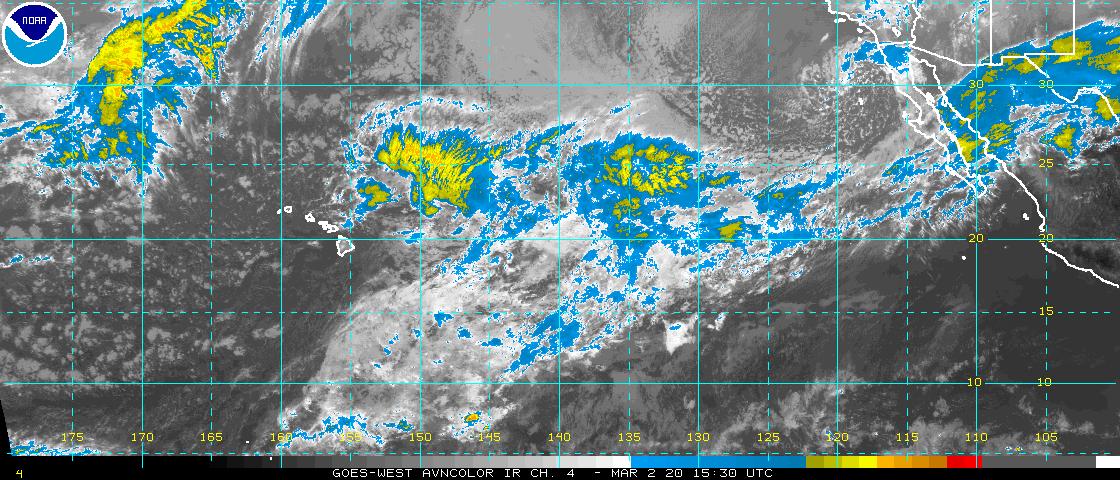
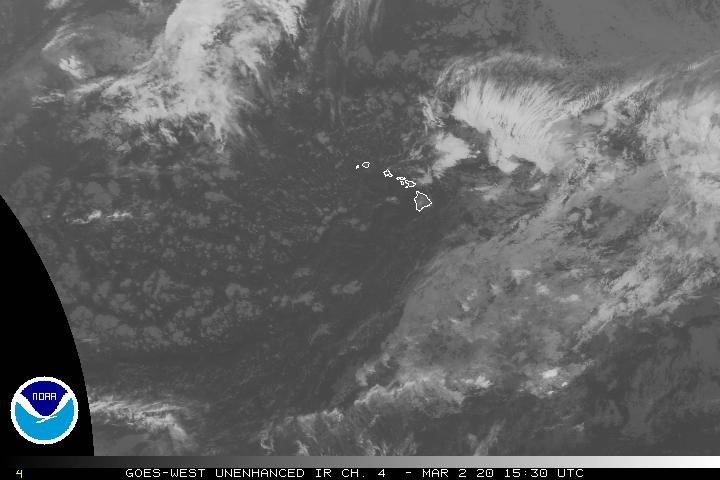
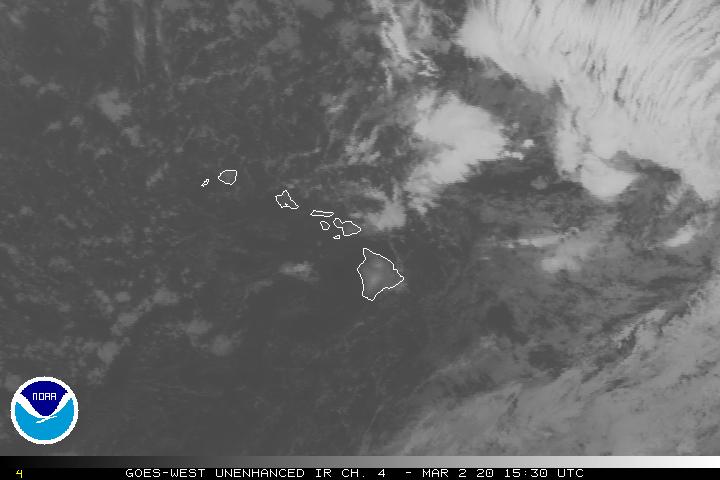
Satellite and Radar Images: To view the cloud conditions we have here in Hawaii, please use the following satellite links, starting off with this Infrared Satellite Image of the islands to see all the clouds around during the day and night. This next image is one that gives close images of the islands only during the daytime hours, and is referred to as a Close-up visible image. This next image shows a larger view of the Pacific…giving perspective to the wider ranging cloud patterns in the Pacific Ocean. Finally, here’s a Looping IR satellite image, making viewable the clouds around the islands 24 hours a day. To help you keep track of where any showers may be around the islands, here’s the latest animated radar image.
Hawaii’s Mountains – Here’s a link to the live webcam on the summit of near 14,000 foot Mauna Kea on the Big Island of Hawaii. The tallest peak on the island of Maui is the Haleakala Crater, which is near 10,000 feet in elevation. These two webcams are available during the daylight hours here in the islands…and when there’s a big moon rising just after sunset for an hour or two! Plus, during the nights and early mornings you will be able to see stars, and the sunrise too…depending upon weather conditions.
Tropical Cyclone activity in the eastern and central Pacific – Here’s the latest weather information coming out of the National Hurricane Center, covering the eastern north Pacific. You can find the latest tropical cyclone information for the central north Pacific (where Hawaii is located) by clicking on this link to the Central Pacific Hurricane Center. Here’s a tracking map covering both the eastern and central Pacific Ocean. A satellite image, which shows the entire ocean area between Hawaii and the Mexican coast…can be found here. Of course, as we know, our hurricane season won’t begin again until June 1st here in the central Pacific.
Aloha Paragraphs
Hana, Maui…Bamboo Forest
Photo credit: Danielle Meyer
Despite the models suggestion that the trade winds would ease up today, they didn’t really do much of that…probably having reached their minimum now. We find a strong 1038 millibar high pressure system far to the north of the islands Monday night. This weather map shows this hefty high pressure cell up around 45 degrees north latitude. The models go on to suggest, that our local trade wind speeds will edge up a notch or two during the second half of this week…after Wednesday or so. There are no small craft wind advisory flags flapping in the moderately strong breezes at this time, although if the trades do accelerate as expected later this week, they will go up around those windiest waters in Maui County and the Big Island.
Saturday was somewhat of a rainy day here in Hawaii, Sunday was drier, and now again on Monday…we saw more showers moving over some areas of the state of Hawaii. Most of the showers now look like they will be taking aim on the area between Maui and Oahu, at least in their most generous form. If we check out this IR satellite image, we see a bulge in the Inter-tropical convergence zone to our south. There are numerous thunderstorm cells firing-off down there, with some high cirrus trying to move northeast too. At the same time, we see an area of showery looking clouds extending northward from this bulge…to the east of the state. We can see this area of north-south oriented clouds using this
It’s Monday evening as I begin writing this last section of today’s narrative update. As noted above, our trade winds will continue to blow this week, with the normal variations in speed as we go forward. The satellite imagery above, shows no end to the windward biased shower clouds upstream of the islands. As a trough of low pressure moves by to our south, an upper air feature, it may force additional moisture our way. This would be focused most intently along the windward sides, as the trade winds continue to blow. There could be a few showers being carried over to the leeward sides, on the smaller islands at times too. All things considered, our weather conditions will be somewhat wetter than usual, at least compared to climatology for this summer month of July. ~~~ Here in Kihei, Maui, before I leave for the drive back upcountry to Kula, it’s breezy, with some showers around the edges too. I expect more showers to arrive overnight, although less so for the Big Island…at least temporarily. Those showers further to the east will reach us perhaps by Tuesday afternoon, and hopefully rain down on us into Wednesday morning. We can certainly use the rainfall, no doubt about that! I’ll be back early Tuesday morning with your next new weather narrative from paradise, I hope you have a great Monday night until then! Aloha for now…Glenn.
Extra: I find it interesting that in Barrow, Alaska, at 4pm Monday afternoon…it was lightly snowing!
Interesting: Lava from Kilauea volcano has forced the evacuation of a Big Island couple and their dogs. They fled Sunday as the molten rock surrounded their two-story house in Kalapana, coming to within 100 yards of the structure. Hawaii County Civil Defense Director Quince Mento says the lava is cooling, but more destructive lava was moving closer.
Mento says four other houses in the area aren’t immediately threatened. On Saturday, lava crossed Kalapana’s access road and enveloped the intersection of Highways 130 and 137. Lava also hit Highway 130 in May. The town of Kalapana was overrun by lava in 1990, seven years after the current eruption of Kilauea began.
Interesting2: Authorities in northeastern China have mobilized 1000 vessels to help clean up an oil spill in the Yellow Sea caused by a weekend pipeline explosion and fire. Dozens of oil-skimming vessels were working to remove the slick off the port city of Dalian following Friday night’s accident which spilled an estimated 1500 tons of crude into the sea, press reports said.
Another 1000 local fishing vessels have been ordered to aid the clean-up operation, the Dalian government said in a statement on its website. Authorities predicted the clean-up would take 10 days. The spill, which initially covered 50 square kilometers had been reduced to 45 sq km as of today, the official China Central Television reported on its news website.
The Dalian government said the last remnants of the fire had finally been put out and it declared a "decisive victory" against the spill, but did not explicitly say whether the spill had been completely halted. Two pipelines exploded at an oil storage depot belonging to China National Petroleum Corp near Dalian’s Xingang harbor in Liaoning province, triggering a spectacular blaze that burned throughout the weekend.
No deaths or injuries have been reported. CNPC is the country’s biggest oil company. Media reports quoted Dalian authorities saying investigators were still trying to determine the cause of the accident, which occurred after a Libyan-flagged tanker discharged its load at the port. The tanker made it away from the oil storage facility safely, reports said.
Interesting3: Soaring temperatures across large swathes of Russia have destroyed nearly 10 million hectares of crops and prompted a state of emergency to be declared in 17 regions. On Friday the state-run Moscow region weather bureau said it expected the heat wave, which has gripped the country since late June and is estimated to have already cost the agricultural sector about $1 billion, to continue into next week.
Saturday could see temperatures in Moscow hit 37 Celsius (98.6 Fahrenheit), which would break the previous record of 36.6C. set in 1936. "It looks like tomorrow could just break the record," the weather bureau’s Moscow head Yelena Timakina said. The high temperatures and tinder dry land have exacerbated the problem of forest fires. Billowing smoke and orange flames encircle Moscow as peat and forest fires resist attempts to extinguish them.
A state of emergency due to what the grain lobby says is the country’s worst drought in 130 years, has now been imposed in 17 Russian regions, up from 16 earlier this week. The area affected sprawls from the southern Urals and central European Russia to the Volga, the Agriculture Ministry said in a statement on Friday.
A state of emergency might be declared in a further two regions. As of Thursday crops on a combined area of 9.6 million hectares have been destroyed. This comprises some 12 percent of all lands sown to crops in Russia, or a territory roughly the size of Hungary.
Interesting4: Calmer winds helped firefighters make progress Monday on a wildfire that has burned about 15 square miles in central Washington state. The fire was about 15% contained, "and if the weather cooperates they’ll have much more contained today," said Christy Boisselle, a spokeswoman for West Valley Fire and Rescue. Easing winds allowed bulldozers to build lines that pinched the fire into an area behind a gravel pit.
Monday’s forecast high in the area is near 90 degrees, but winds of no more than 6 mph were expected. On Sunday, stronger winds pushed the fire so fast that it overran one of the department’s fire trucks. Three firefighters escaped with minor injuries such as sprains and singed hair.
The blaze started in grass and brush about 10 miles west of Yakima, sending smoke over the city of 71,000 and the Yakima Valley, which is known for its tree fruit, wine grapes and hops. The fire burned into several orchards, which acted as a buffer, helping firefighters.
West Valley Fire and Rescue Chief Dave Leitch said about 100 firefighters from across the state helped the roughly 200 mostly volunteer and local firefighters who responded. The cause remained unknown. Leitch said the fire started near a creek in farmland, not near a house or campground.
 Email Glenn James: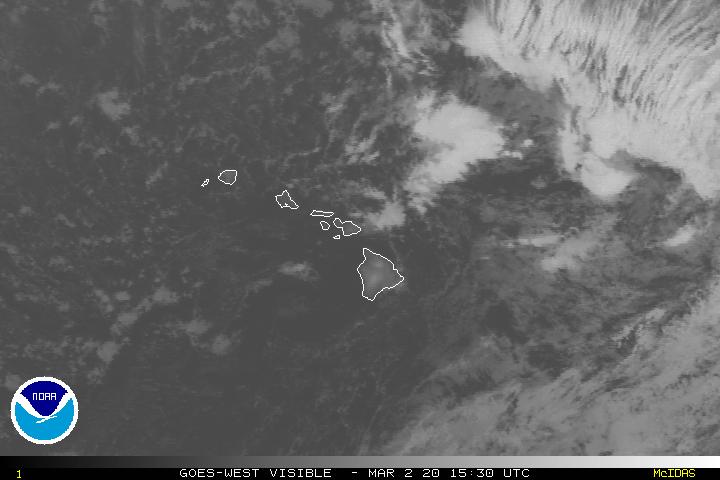


Jay Says:
We had an inch of rain over Friday/Saturday, and another inch today here in Ulupalakua – according to the unscientific glass beaker/collector in the garden…thank heavens!~~~Thank Heavens indeed, you folks needed that water in those pastures up there! Thanks for letting us know the good news! Aloha, Glenn