











May 5-6, 2009
Air Temperatures – The following maximum temperatures were recorded across the state of Hawaii Tuesday afternoon:
Lihue, Kauai – 80
Honolulu, Oahu – 86
Kaneohe, Oahu – 80
Kahului, Maui – 86
Hilo, Hawaii – 83
Kailua-kona – 85
Air Temperatures ranged between these warmest and coolest spots near sea level – and on the highest mountains…at 4 p.m. Tuesday afternoon:
Honolulu, Oahu – 83F
Kapalua, Maui – 79
Haleakala Crater – 55 (near 10,000 feet on Maui)
Mauna Kea summit – 45 (near 14,000 feet on the Big Island)
Precipitation Totals – The following numbers represent the largest precipitation totals (inches) during the last 24 hours on each of the major islands, as of Tuesday afternoon:
0.03 Moloaa Dairy, Kauai
0.03 Waimanalo, Oahu
0.00 Molokai
0.00 Lanai
0.00 Kahoolawe
0.01 Ulupalakua, Maui
0.01 Kamuela Upper, Big Island
Weather Chart – Here’s the latest (automatically updated) weather map shows a 1026 millibar high pressure system located far to the ENE of the islands now. This high will remain weak, and with its associated ridge extending WSW, positioned between Kauai and Oahu, it will keep our winds generally light southeasterlies through Thursday…with daytime onshore sea breezes.
Satellite and Radar Images: To view the cloud conditions we have here in Hawaii, please use the following satellite links, starting off with the Infrared Satellite Image of the islands to see all the clouds around the state during the day and night. This next image is one that gives close images of the islands only during the daytime hours, and is referred to as a Close-up visible image. This next image shows a larger view of the Pacific…giving perspective to the wider ranging cloud patterns in the Pacific Ocean. Finally, here’s a looping IR satellite image, making viewable the clouds around the islands 24 hours a day. To help you keep track of where any showers may be around the islands, here’s the latest animated radar image.
Hawaii’s Mountains – Here’s a link to the live webcam on the summit of near 14,000 foot Mauna Kea on the Big Island of Hawaii. The tallest peak on the island of Maui is the Haleakala Crater, which is near 10,000 feet in elevation. These two webcams are available during the daylight hours here in the islands…and when there’s a big moon rising just after sunset for an hour or two! Plus, during the nights and early mornings you will be able to see stars, and the sunrise too…depending upon weather conditions.
Aloha Paragraphs
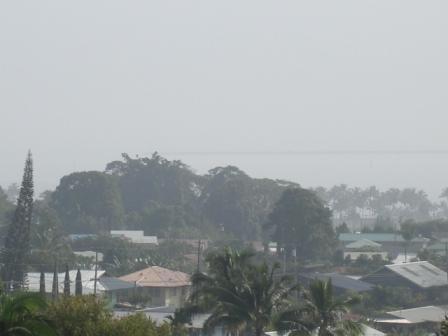
When volcanic haze gets into Hilo…on the Big Island
Light southeast breezes over the ocean, with daytime sea breezes, and offshore land breezes at night…through most of the rest of this week. The latest forecasts show the return of trade winds not until early next week. If this turns out to be true, our light winds, dry weather, and hazy conditions will persist through the rest of this week. Our high pressure ridge is just to the north of Kauai, as shown on this weather map. If it moves just a little further northward, we would see light trade winds picking up on the Big island and Maui.
The close proximity of the high pressure ridge will not only keep our winds light, but our overlying atmosphere rather dry. We will find clear to partly cloudy mornings, which will give way to cloudy afternoons locally. The air mass over our islands is dry and stable, which will continue to greatly limit any showers from falling. Whatever few showers that do manage to fall, will end up over and around the mountains…during the afternoon hours generally. This looping radar image demonstrates just how few showers are falling here in the central north Pacific.
The orientation of our local winds, at least over the offshore waters, is from the southeast, which carries volcanic haze from the Big Island…to the other islands. The source of this vog is the volcanic vents on the Big Island. This will keep our atmosphere hazy through much of the rest of this week. It will take the returning trade winds to ventilate this haze away. The daytime heating, coupled with the light winds, will generate lots of afternoon clouds…and a generally more sultry reality than we’re used to seeing during the spring month of Maui.
It’s early Tuesday evening as I begin writing this last section of today’s weather narrative. Looking out the window here in Kihei, Maui, before I take the drive upcountry to Kula, it looks about the same as it did Monday evening at the same time. The sea breeze is blowing, which looks similar to when the trade winds are active…except it’s hazy out there. ~~~ Actually, as it turned out, I found during my drive home, it was less hazy than I thought it was. It appears that the high pressure ridge may have gotten just far enougn north, that we are finding light trade winds blowing locally. These light trade winds seem to be clearing the air quite a bit now…the question becomes, will they continue? ~~~ Ok, that’s about it for this Maui weatherman, nothing more to say today, but I’ll be back with you again early Wednesday morning. I’ll be up early preparing the next new weather narrative, hope to meet you here then! Aloha for now…Glenn.
Interesting: The grey wolf was Monday taken off the U.S. list of endangered species, making a comeback 35 years after it virtually disappeared and can now be hunted in most states, officials said. "We have recovered a wolf population," said Ed Bangs, wolf recovery coordinator for the U.S. Fish and Wildlife service, based in Montana. "The populations are viable, they are in great shape, they have extreme genetic diversity and so the endangered species act did its job to bring wolves back."
The grey wolf was placed on the endangered list in 1974 after the animals were almost eliminated in many U.S. states. But thanks to conservation efforts its numbers now reach some 4,000 in the Great Lakes region, which includes Michigan, Minnesota and Wisconsin, and there are more than 1,300 in the Rocky Mountain states of Idaho and Montana. There are also between 8,000 and 11,000 grey wolves in Alaska.
Interesting2: Scientists who have just returned from an expedition to an erupting undersea volcano near the Island of Guam report that the volcano appears to be continuously active, has grown considerably in size during the past three years, and its activity supports a unique biological community thriving despite the eruptions. An international science team on the expedition captured dramatic new information about the eruptive activity of NW Rota-1. "This research allows us, for the first time, to study undersea volcanoes in detail and close up," said Barbara Ransom, program director in NSF’s Division of Ocean Sciences, which funded the research.
"NW Rota-1 remains the only place on Earth where a deep submarine volcano has ever been directly observed while erupting." Scientists first observed eruptions at NW Rota-1 in 2004 and again in 2006, said Bill Chadwick, an Oregon State University (OSU) volcanologist and chief investigator on the expedition. This time, however, they discovered that the volcano had built a new cone 40 meters high and 300 meters wide.
"That’s as tall as a 12-story building and as wide as a full city block," Chadwick said. "As the cone has grown, we’ve seen a significant increase in the population of animals that lives atop the volcano. We’re trying to determine if there is a direct connection between the increase in the volcanic activity and that population increase."
Animals in this unusual ecosystem include shrimp, crab, limpets and barnacles, some of which are new species. "They’re specially adapted to their environment," said Chadwick, "and are thriving in harsh chemical conditions that would be toxic to normal marine life.
Interesting3: California will pay more and companies pay less to clean up a polluted San Joaquin Valley site under a closely watched Supreme Court decision Monday. Capping an excruciatingly long legal battle, the court by an 8-1 margin limited the liability of two major railroads for chemical spills in the Kern County town of Arvin.
The court also absolved Shell of liability for the Arvin site, in a ruling could help restrict corporate liability in other future pollution cases as well. "It’s a hugely significant case," said Baker & Botts’ attorney Daniel Steinway, who wrote a legal brief on behalf of the National Association of Manufacturers and other business groups. "It will have enormous financial consequences for industry."
Interesting4: The EPA next week will convene an Agricultural Air Quality Task Force this week in the town that, according to a new study by the American Lung Association, is among the 10 most-polluted cities in the nation. The Task Force will look into ways that farm operations can minimize air pollution and toxic emissions — including how to use funding from a $10.9 million assistance package to help achieve those goals.
"This is a pivotal time for agriculture and air quality," says Ed Burton, State Conservationist of the USDA’s Natural Resources Conservation Service in California. "The focus on energy and climate is creating more challenges — and more opportunities — for agriculture than ever before. At this meeting we will address technical issues associated with agriculture and forestry."
Interesting5: Motorway-sized troughs and channels carved into Antarctica’s continental shelves by glaciers thousands of years ago could help scientists to predict future sea-level rise according to a report in the journal Geology this month (May). Using sonar technology from onboard ships, scientists from British Antarctic Survey (BAS) and the German Alfred Wegener Institute (AWI) captured the most extensive, continuous set of images of the seafloor around the Amundsen Sea embayment ever taken.
This region is a major drain point of the West Antarctic Ice Sheet (WAIS) and considered by some scientists to be the most likely site for the initiation of major ice sheet collapse. The sonar images reveal an ‘imprint’ of the Antarctic ice sheet as it was at the end of the last ice age around 10 thousand years ago. The extent of ice covering the continent was much larger than it is today.
The seabed troughs and channels that are now exposed provide new clues about the speed and flow of the ice sheet. They indicate that the controlling mechanisms that move ice towards the coast and into the sea are more complex than previously thought.
Interesting6: The European Parliament voted to ban European Union imports of seal products on Tuesday, a step Canada and Norway have said they will challenge in the world’s top trade court. "This is what the citizens of Europe want," Arlene McCarthy, the British socialist who chairs parliament’s internal market committee, told reporters.
The 15 seal species now hunted are not endangered but European politicians demanded action after finding what they said was evidence that many are skinned while still conscious. EU lawmakers dismissed a possible challenge as "blustering and threats" and said the ban could withstand any challenge at the World Trade Organization.
Interesting7: If the overall water resources in river basins were acknowledged and managed better, future food crises could be significantly reduced, say researchers from Stockholm Resilience Centre at Stockholm University, Stockholm Environment Institute and Potsdam Institute for Climate Impact Research. The challenge of meeting future water needs under the impacts of climate change and rapidly growing human demands for water may be less bleak than widely portrayed.
An analysis by a team of Swedish and German scientists quantifies for the first time the opportunities of effectively using both “green” and “blue” water to adapt to climate change and to feed the future world population. The study was recently published in the journal Water Resources Research. The current approach to water management considers only blue water that is river discharge and groundwater.
According to the researchers, this limits the options to deal with increasing water scarcity and water risks induced by climate change. Under those conditions, over three billion of the current world populations are estimated to suffer from severe water scarcity. The new analysis which additionally accounts for green water, that is water in the soil that stems directly from rainfall, suggests that the actual number is under one billion.
It also shows that wise water management can lift billions out of water poverty. “This opens a new area of investments for climate adaptation and a window to achieve a much needed new green revolution in poor countries in the world.
Our analysis shows that many water-short countries are able to produce enough food for their populations if green water is considered and managed well,” the researchers report. Their article, entitled “Future water availability for global food production: The potential of green water for increasing resilience to global change”, changes fundamentally the conventional bleak estimations for future water scarcity in the world.
 Email Glenn James: