July 14-15, 2010
Air Temperatures – The following maximum temperatures were recorded across the state of Hawaii Wednesday afternoon:
Lihue, Kauai – 84
Honolulu, Oahu – 86
Kaneohe, Oahu – 83
Kaunakakai, Molokai – 84
Kahului, Maui – 87
Hilo, Hawaii – 83
Kailua-kona – 80
Air Temperatures ranged between these warmest and coolest spots near sea level – and on the highest mountain tops too…as of 5pm Wednesday evening:
Honolulu, Oahu – 84
Lihue, Kauai – 79
Haleakala Crater – 64 (near 10,000 feet on Maui)
Mauna Kea summit – 50 (near 14,000 feet on the Big Island)
Precipitation Totals – The following numbers represent the largest precipitation totals (inches) during the last 24 hours on each of the major islands, as of Wednesday afternoon:
0.23 Puu Opae, Kauai
1.43 Maunawili, Oahu
0.02 Molokai
0.00 Lanai
0.00 Kahoolawe
0.19 West Wailuaiki, Maui
0.71 Kealakekua, Big Island
Marine Winds – Here’s the latest (automatically updated) weather map showing a 1035 millibar high pressure cell far to the northeast, which will keep the trade winds blowing…increasing in strength through Friday.
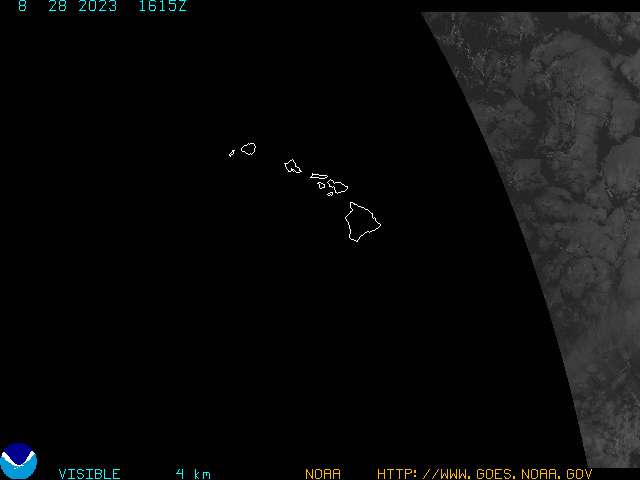
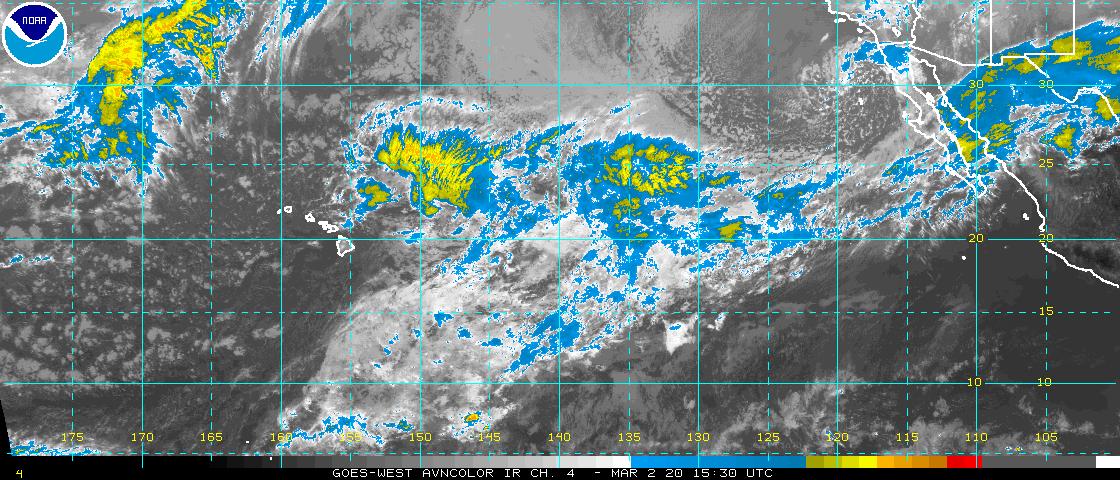
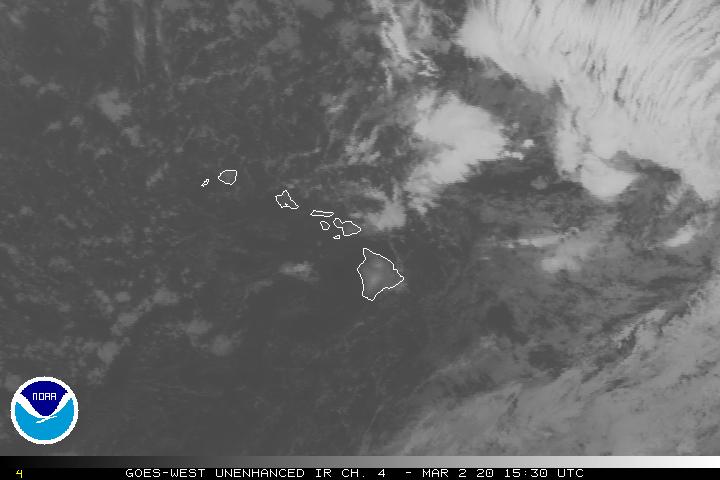
Satellite and Radar Images: To view the cloud conditions we have here in Hawaii, please use the following satellite links, starting off with this Infrared Satellite Image of the islands to see all the clouds around during the day and night. This next image is one that gives close images of the islands only during the daytime hours, and is referred to as a Close-up visible image. This next image shows a larger view of the Pacific…giving perspective to the wider ranging cloud patterns in the Pacific Ocean. Finally, here’s a Looping IR satellite image, making viewable the clouds around the islands 24 hours a day. To help you keep track of where any showers may be around the islands, here’s the latest animated radar image.
Hawaii’s Mountains – Here’s a link to the live webcam on the summit of near 14,000 foot Mauna Kea on the Big Island of Hawaii. The tallest peak on the island of Maui is the Haleakala Crater, which is near 10,000 feet in elevation. These two webcams are available during the daylight hours here in the islands…and when there’s a big moon rising just after sunset for an hour or two! Plus, during the nights and early mornings you will be able to see stars, and the sunrise too…depending upon weather conditions.
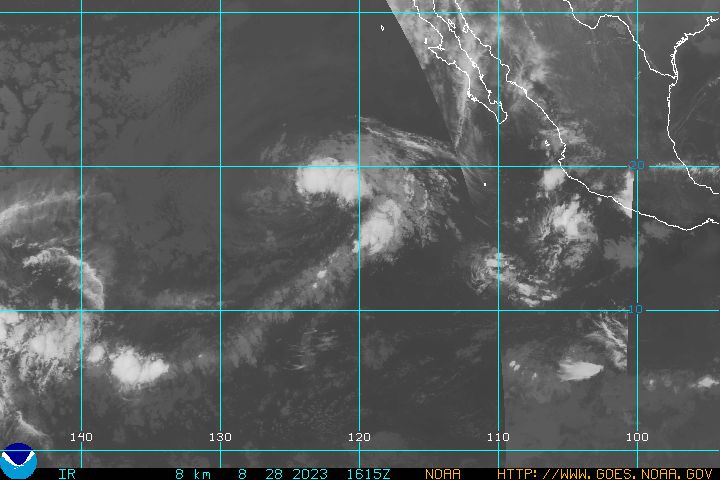
Tropical Cyclone activity in the eastern and central Pacific – Here’s the latest weather information coming out of the National Hurricane Center, covering the eastern north Pacific. You can find the latest tropical cyclone information for the central north Pacific (where Hawaii is located) by clicking on this link to the Central Pacific Hurricane Center. Here’s a tracking map covering both the eastern and central Pacific Ocean. A satellite image, which shows the entire ocean area between Hawaii and the Mexican coast…can be found here. Of course, as we know, our hurricane season won’t begin again until June 1st here in the central Pacific.
Aloha Paragraphs

Meals are such a pleasure in the islands!
The trade winds have been lighter than normal the last couple of days, although have increased some today, a day or so earlier than the computer models had suggested. The trade winds weren’t all that strong Wednesday, although they are quite a bit stronger than they were so far this week. These trade winds will be increasing further as we move through the next couple of days…into the weekend. They should settle into the moderately strong category, and become strong enough to trigger small craft advisories in those windiest areas around Maui and the
Satellite and radar both showed that we found increased cloud cover last night, although with a continued fairly dry atmosphere…warm sunshine took over Wednesday. Typically, the trade winds bring us most of the showers that we find in the May through early October time frame. There are other variations on this theme, but covers the bulk of precipitation that we find here in the islands. Looking ahead, we could see some off and on increases in showers over the next couple of days. Although, without any rainfall enhancing upper level troughs in the area, showers shouldn’t become all that abundant…and concentrate their efforts most effectively along the windward coasts and slopes. Using this satellite image, we see several clumps of clouds upstream to the east through north, which may drop some showers at times, especially during the night time hours.
Tropical cyclone 06E has begun churning the waters of the east Pacific…offshore from Mexico. This 6th storm of the 2010 hurricane season is expected to become a tropical storm soon, taking on the name Estelle. Here’s a track map, which shows the storm in relation to the Hawaiian Islands. There is no worry for the Hawaiian Islands, as this storm will dissipate far to our east. Here’s a satellite image of this area close to Mexico.
It’s Wednesday evening as I begin writing this last section of today’s narrative update. As noted above, our winds are starting to blow stronger now, and will get even a bit stronger soon. As we move through the next day or two, we’ll see a trend toward stronger winds, with showers becoming more common along our windward sides. Other than that, it looks like we’re moving into a fairly typical mid-summer trade wind weather pattern. ~~~ Here in Kihei, Maui this evening, before I take the drive back upcountry to Kula, it’s mostly clear, and the trade winds are blowing at a pretty good clip. I’ll be back with you again early Thursday morning, when I’ll have your next new weather narrative ready for the reading. As I mentioned last evening about this time, at around 750pm, there is the most beautiful planetary configuration in the west horizon. The crescent moon this time is just to the left of Venus, making for a special sight in tonights sky. I hope you have a great Wednesday night until then! Aloha for now…Glenn.
Extra: UFO seen over Chinese airport – July 9, 2010
Interesting: Name a drink that can make you more alert for late-night studying, prevent you from fainting after giving blood, and even promote a teensy bit of weight loss. Chances are you didn’t say water. But that’s the right answer. Researchers at Vanderbilt University Medical Center have shown that ordinary water — without any additives — does more than just quench thirst. It has some other unexpected, physiological effects. It increases the activity of the sympathetic — fight or flight — nervous system, which raises alertness, blood pressure and energy expenditure.
David Robertson, M.D., and colleagues first observed water’s curious ability to increase blood pressure about 10 years ago, in patients who had lost their baroreflexes — the system that keeps blood pressure within a normal range. The observation came as a complete surprise, said Robertson, professor of Medicine, Pharmacology and Neurology. "We had to unlearn the idea that water had no effect on blood pressure, which is what all medical students had been told until the last couple of years."
Although water does not significantly raise blood pressure in healthy young subjects with intact baroreflexes, the investigators found that it does increase sympathetic nervous system activity and constrict blood vessels (which prevents pooling of blood in the extremities). These findings prompted the American Red Cross to conduct a study of water drinking as a method for reducing fainting responses. The study found that drinking 16 ounces of water before blood donation reduced the fainting response by 20 percent.
"This response to water may turn out to be very important for retaining blood donors," Robertson said. "If you pass out after giving blood, you pretty much never give blood again. If we can reduce fainting by 20 percent, we can reduce the unpleasantness of passing out and really bolster the number of people who can continue to be blood donors." Julia McHugh, a student in Vanderbilt University School of Medicine’s Medical Scientist Training Program, tackled the questions of where water is acting, and how, in a series of studies in mice. The team’s latest findings are reported in the June issue of the journal Hypertension.
Interesting2: Severe heat, made worse in areas by drought, has already gripped a wide swath of the Russian heartland since the first of summer, and prospects are for even more of the abnormal heat. Health, water supply and crops have all taken a hit in many areas. A heat wave hit the city with temperatures going higher than 86F.
Average temperatures for the summer so far have been at least 10F above normal between the western borders and the Ural Mountains. Moscow, for instance, has tallied more than 10F above normal has of July 13. In Saint Petersburg, the average temperature since the start of summer has been almost 12F above normal. Readings as high as 92F in Moscow and 90F in Saint Petersburg have broken records.
Other regions have fared worse. Regions between Moscow and the Caucasus region have reached 95 F and, along the lower Volga River, even as high as 105 F, during July with more such heat forecast for the coming days. Normally scanty, early summer rain in southern Russia has fallen even further short of usual. Some bigger cities weathering the highest temperatures are Lipetsk, Tambov, Ryazan, Kursk and Voronezh.
The Russian Prime Minister has spoken the words "disaster" and "drought" in describing the situation. Government health officials have called on people to take an afternoon break, or siesta, to limit strenuous work and sun exposure during the hottest part of the day. Already, health effects have included heat stroke and severe sunburn as well as the compounding of effects from such conditions as diabetes and heart problems.
The Russian Army has even halted, temporarily, the use of incendiary ammunition in training exercises. It also relaxed the dress code for soldiers to lessen the heat discomfort. Crop losses have mounted across what is one of the world’s top breadbaskets, an agricultural belt that yielded a 97-million metric ton grain harvest in 2009.
One spokesman for Russian agriculture has stated that drought, made worse by the heat, has laid waste to 9 million out of 48 million hectares of planted land. Little relief is in sight. For the next seven days, for instance, average temperatures will be 5F to 10F above normal over nearly all of European Russia with temperatures likely to hold well above normal during the following week. At least one week of below normal, even zero, rainfall is also in the offing over a vast area.
 Email Glenn James: