April 6-7, 2009
Air Temperatures – The following maximum temperatures were recorded across the state of Hawaii Monday afternoon:
Lihue, Kauai – 74
Honolulu, Oahu – 82
Kaneohe, Oahu – 77
Kahului, Maui – 79
Hilo, Hawaii – 76
Kailua-kona – 81
Air Temperatures ranged between these warmest and coolest spots near sea level – and on the highest mountains…at 4 p.m. Monday afternoon:
Kailua-kona – 79F
Lihue, Kauai – 70
Haleakala Crater – 45 (near 10,000 feet on Maui)
Mauna Kea summit – 32 (near 14,000 feet on the Big Island)
Precipitation Totals – The following numbers represent the largest precipitation totals (inches) during the last 24 hours on each of the major islands, as of Monday afternoon:
2.15 Hanalei River, Kauai
1.28 Manoa Lyon Arboretum, Oahu
0.04 Molokai
0.00 Lanai
0.00 Kahoolawe
0.76 Puu Kukui, Maui
0.14 Mountain View, Big Island
Weather Chart – Here’s the latest (automatically updated) weather map showing a 1031 millibar high pressure system more or less to the north the islands. This high pressure cell will keep our trade winds moderately strong, to locally strong and gusty Tuesday and Wednesday…lighter in those more protected places.
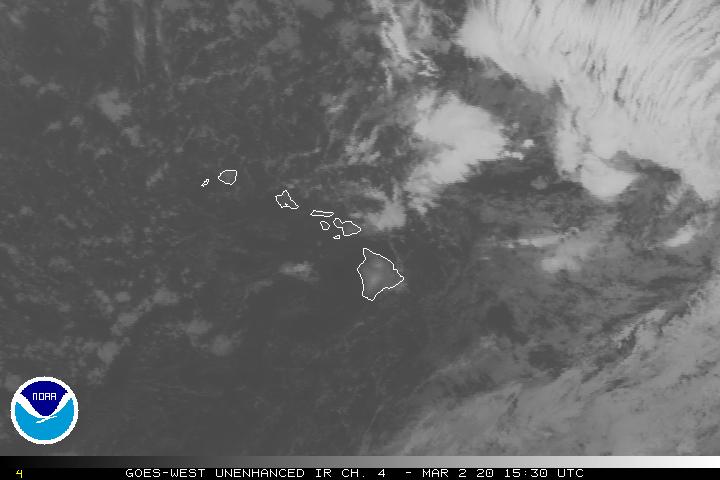
Satellite and Radar Images: To view the cloud conditions we have here in Hawaii, please use the following satellite links, starting off with the Infrared Satellite Image of the islands to see all the clouds around the state during the day and night. This next image is one that gives close images of the islands only during the daytime hours, and is referred to as a Close-up visible image. This next image shows a larger view of the Pacific…giving perspective to the wider ranging cloud patterns in the Pacific Ocean. Finally, here’s a looping IR satellite image, making viewable the clouds around the islands 24 hours a day. To help you keep track of where any showers may be around the islands, here’s the latest animated radar image.
Hawaii’s Mountains – Here’s a link to the live webcam on the summit of near 14,000 foot Mauna Kea on the Big Island of Hawaii. The tallest peak on the island of Maui is the Haleakala Crater, which is near 10,000 feet in elevation. These two webcams are available during the daylight hours here in the islands…and when there’s a big moon rising just after sunset for an hour or two! Plus, during the nights and early mornings you will be able to see stars, and the sunrise too…depending upon weather conditions.
Aloha Paragraphs

Hawaiian beach campfire
Art credit: Cruiser Art Gallery
Gusty trade winds will remain in force through Thursday or Friday…then ease up and become much lighter from the southeast this weekend. The source of blustery trade winds Monday night is a 1033 millibar high pressure system that is located to the north of the Hawaiian Islands…as shown on this weather map. These winds will fluctuate some, in terms of strength and direction, although the NWS forecast office in Honolulu is keeping the small craft wind advisory flags up across all of our marine coastal and channel waters. Speaking of the ocean, we’ll have lots of waves breaking along all shores of our Hawaiian Islands through the next several days.
The windward sides will see most of whatever showers that fall through the work week, a few could be locally heavy…then more widespread showers this weekend. Clear to partly cloudy skies will persist Monday night, with cloudy periods at times. Looking at this satellite image, we continue to see somewhat cloudier skies than normal. We’ll hold off from seeing those sunshine filtering high clouds, at least through the day Tuesday, after which they will come sliding back our way by mid-week…and stick around for several days at least. It would be a good idea to get out there and do your suntanning now, before we lose our sunny weather thereafter.
As I did this morning, I want to go over again what we can expect as we move through the rest of this week. As noted above we will have the trade winds blowing throughout, at least through Friday. As we move into the second half of the week, we will see some changes occurring. The computer models are now in good agreement…that we will see some increase in clouds and showers starting Friday into the weekend. This may become somewhat widespread, perhaps most frequently and most generously during the afternoon hours…in the upcountry areas. If the winds turn southeast, we would also see an increase in volcanic haze too.
It’s early Monday evening as I begin writing this last paragraph of today’s weather narrative. Most of this week will be just fine, that is if you don’t mind the gusty trade winds, and the addition of our sun dimming cirrus clouds by Wednesday or so. There will be lots of waves breaking, on all our beaches through the next several days, which will be a treat for our local wave riders! As we get into the Friday, Saturday and Sunday time frame, we could see lighter winds, hazy skies, and those more frequent upcountry showers. We will still need to fine tune this prospect, as often during the transition month of April, things can sometimes be less predictable than at other times. I will monitor this situation closely, and have more to say about it early Tuesday morning. ~~~ Looking out the window here in Kihei, just before I take the drive back upcountry, it’s what I would call partly cloudy. The trade winds are blowing, as they did all day. The strongest gust early in the afternoon that I saw, was a muscular 53 mph gust down at the Upolu airport on the Big Island of Hawaii. At around 530pm there was still a 47 mph gust down at that airport, which is pretty late in the day for such a robust observation! ~~~ When I get home, I’ll go see if my neighbors want to take a walk, or I’ll just hit the road alone, either way is ok. I hope you have a great Monday night, and trust that you will check back in on Tuesday, if you have some interest in getting the latest scoop on what’s coming our way here in Hawaii! Aloha for now…Glenn.
Interesting: In the summer of 2007, a large portion of Arctic Sea ice – about 40 per cent – simply vanished. That wasn’t supposed to happen, at least not yet. As recent as 2004, scientists had predicted it would take another 50 to 100 years for that much ice to melt. Yet here it was happening today. It raised the question: Had global warming suddenly pressed the gas pedal to the floor? If so, the world was in for quite a climate ride – dramatic, jarring changes in climate much sooner than expected. Climate scientists were deeply worried.
"It really caught the scientific community by surprise," Professor James Ford, a McGill University geographer and Arctic expert recalled. "The Arctic system is close to crossing the threshold beyond which we will get dramatic changes in climate." The sudden mass melting brought an earlier ice event into new perspective.
In 2005, scientists at the Canadian Ice Service, the nation’s leading ice specialists, were examining satellite images when they noticed that the Ayles Ice Shelf, which is about as big as the island of Montreal, had suddenly broken free from the top of Ellesmere Island and floated away. Vincent Warwick, an Arctic expert at Université Laval, said at the time: "This is a dramatic and disturbing event.
It shows that we are losing remarkable features of the Canadian North that have been in place for many thousands of years. We are crossing climate thresholds, and these may signal the onset of accelerated change ahead." The ice melt of 2007 seemed to confirm Warwick’s fears. Reports since then claim the Arctic ice could be gone by 2013.
Interesting2: An ice bridge which had apparently held a vast Antarctic ice shelf in place during recorded history shattered on Saturday and could herald a wider collapse linked to global warming, a leading scientist said. "It’s amazing how the ice has ruptured. Two days ago it was intact," David Vaughan, a glaciologist with the British Antarctic Survey, told Reuters of a satellite image of the Wilkins Ice Shelf on the Antarctic Peninsula. The satellite picture, from the European Space Agency (ESA), showed that a 40 km (25 mile) long strip of ice believed to pin the Wilkins Ice Shelf in place had splintered at its narrowest point, about 500 meters wide.
"We’ve waited a long time to see this," he said. The Wilkins, now the size of Jamaica or the U.S. state of Connecticut, is one of 10 shelves to have shrunk or collapsed in recent years on the Antarctic Peninsula, where temperatures have risen in recent decades apparently because of global warming. The ESA picture showed a jumble of huge flat-topped icebergs in the sea where the ice bridge had been on Friday, pinning the Wilkins to the coast and running northwest to Charcot Island.
"Charcot Island will be a real island for the first time in history," Vaughan said. Vaughan, who landed on the flat-topped ice bridge on the Wilkins in January in a ski-equipped plane with other scientists and two Reuters reporters, said change in Antarctica was rarely so dramatic. It was the first — and last — visit to the area.
The loss of the ice bridge, jutting about 20 meters out of the water and which was almost 100 km wide in 1950, may now allow ocean currents to wash away far more of the Wilkins shelf. "My feeling is that we will lose more of the ice, but there will be a remnant to the south," said Vaughan.
Ice shelves float on the water, formed by ice spilling off Antarctica, and can be hundreds of meters thick. Nine other shelves have receded or collapsed around the Antarctic Peninsula in the past 50 years, often abruptly like the Larsen A in 1995 or the Larsen B in 2002 further north.
Interesting3: Saturn’s largest moon, Titan, may have a subterranean ocean of hydrocarbons and some topsy-turvy topography in which the summits of its mountains lie lower than its average surface elevation, according to new research. Titan is also more squashed in its overall shape—like a rubber ball pressed down by a foot—than researchers had expected, said Howard Zebker, a Stanford geophysicist and electrical engineer involved in the work.
The new findings may help explain the presence of large lakes of hydrocarbons at both of Titan’s poles, which have been puzzling researchers since being discovered in 2007. "Since the poles are squished in with respect to the equator, if there is a hydrocarbon ‘water table’ that is more or less spherical in shape, then the poles would be closer down to that water table and depressions at the poles would fill up with liquid," Zebker said. The shape of the water table would be controlled by the gravitational field of Titan, which is still not fully understood.
Interesting4: The Empire State Building, New York’s 1931 signature skyscraper, is undergoing a $20 million environmental efficiency makeover to compete in the 21st century. The project, which includes building an on-site facility to remake all 6,500 windows in the 102-story tower, aims to cut energy use almost 40 percent, said Ray Quartararo, director of development and project management for renovation supervisor Jones Lang LaSalle Inc.
"We’re trying to do something that is very new," said Anthony Malkin, whose family owns the building. "By proving that this works, we empower people to argue that this is what should be done, and possibly not by option. Maybe this is something that should be required to be done."
Buildings account for 72 percent of the nation’s electricity consumption and emit 38 percent of its manmade carbon dioxide, according to the U.S. Green Building Council, a Washington-based organization that rates properties for their effect on the environment.
Empire State Building tenants will save on heating and air conditioning bills after the renovation, Quartararo said. His team is pushing for an "Energy Star" rating of 90 from the U.S. Environmental Protection Agency, meaning a building is more energy efficient than 90 percent of offices. Wien & Malkin LLC, the company that indirectly owns the tower, also plans to seek a "gold" rating for Leadership in Energy and Environmental Design (LEED) from the Green Building Council.
Interesting5: All farming depends on the weather, but few foods are more dependent on a specific climate than maple syrup. After all, for the sugar maple’s sap to run at all requires cooperative weather — freezing nights followed by warmer days. But thanks to the build-up of invisible greenhouse gases in the atmosphere, those temperature swings don’t happen as reliably.
At risk is an American tradition that stretches back even before Europeans discovered the "New World." "Weather controls it all," says Marty Fitzgerald, a fifth-generation sugar maker in upstate New York. And, in recent years, the weather has been weird.
Extracting sap from maple trees — the business of maple sugaring — employs everything from little tin funnels and hanging pails to plastic spigots and light blue tubing that turn the forest into a spider’s web of tripwires, often at chest height. Sugar makers collect the sap any number of ways: hustling a pail down the mountainside to the sugar shack, using gravity to deposit it in the holding tanks, even vacuum pumping the sap downhill.
At the Carney sugarbush — the term of art for a stand of maple trees — in upstate New York, Rick Bartlett splits the difference. While 700 hundred trees bear 1,000 or so metal taps and buckets, centralized collecting bins — plastic garbage cans — connected by tubing dot the mountainside and feed into a 300 gallon collector near the sugar shack where the sap is boiled into syrup by Fitzgerald. It takes a mature tree — 40 to 50 years old — to produce maple syrup safely.
By that age, the sugar maple has reached a diameter of roughly 10 inches and, according to the standard Ontario tapping rule, can handle one tap. For every five inches in diameter the tree grows after that, the rule says, it can handle one more tap. Even with tubing, only a high price or a deep love can justify all the labor involved.
Given that an average maple will produce sap with a sugar content of just two percent — sap right out of the bucket often tastes more metallic than sweet — Bartlett must collect more than 40 gallons of sap to create just one gallon of syrup.
Interesting6: A growing number of states are moving to require home builders to offer solar electricity and hot-water systems in new homes, right alongside more traditional options such as fancy kitchen countertops and special window treatments. "It’s just like the granite countertop upgrade or the two-car garage or the larger closet — these are options the homeowner can choose to purchase," said Jeff Lyng, the renewable energy program manager for Colorado Gov. Bill Ritter’s Energy Office.
In Colorado, lawmakers are considering a bill that would require builders to offer a range of options, from pre-wiring the home for solar power to full installation of a solar system. The legislation would also require builders to tell buyers they can roll the cost of the system into their mortgage, reducing up-front costs, Lyng said. The Colorado proposal has passed in the state House and awaits Senate consideration. Ritter, a Democrat who had solar panels installed at the Governor’s Mansion in Denver several years ago, said he plans to sign the bill.
Interesting7: Trees and plants are growing bigger and faster in response to the billions of tons of carbon dioxide released into the atmosphere by humans, scientists have found. The increased growth has been discovered in a variety of flora, ranging from tropical rainforests to British sugar beet crops. It means they are soaking up at least some of the CO2 that would otherwise be accelerating the rate of climate change. It also suggests the potential for higher crop yields.
Some researchers believe the phenomenon is strong enough to buy humanity some extra years in which to try to reverse the growth of greenhouse gas emissions. However, few dispute that this will provide anything more than a temporary reprieve. "There is no doubt that the enrichment of the air with CO2 is increasing plant growth rates in many areas," said Professor Martin Parry, head of plant science at Rothamsted Research, Britain’s leading crop institute.
“The problem is that humans are releasing so much that plants can remove only a fraction of it.” CO2 Plants survive by extracting CO2 from the air and using sunlight to convert it into proteins and sugars. Since 1750 the concentration in the air has risen from of CO2 278 parts per million (ppm) to more than 380ppm, making it easier for plants to acquire the CO2 needed for rapid growth. One of the most convincing confirmations of this trend, recently published in the science journal Nature, came from a team at Leeds University.
Simon Lewis, a fellow of the Royal Society, led the study that measured the girth of 70,000 trees across 10 African countries and compared them with similar records made four decades ago. "On average, the trees were getting bigger faster," Lewis said. He found that each hectare of African forest was trapping an extra 0.6 tons of CO2 a year compared with the 1960s. If this is replicated across the world’s tropical rainforests they would be removing nearly 5 billion tons of CO2 a year from the atmosphere. Humans, however, generate about 50 billion tons of the gas each year.
Scientists have been looking for a similar impact on crop yields and have carried out experiments where plants growing in the open are exposed to extra CO2 released upwind of the site. The experiments generally suggest that raised CO2 levels, similar to those predicted for the middle of this century, would boost the yields of main-stream crops, such as maize, rice and soy, by about 13%. Some niche crops, such as lavender, would similarly benefit.
Interesting8: Dennis Jobin used to cringe when he flushed the toilet in his Phoenix home. To Jobin, it sounded like dollars going down the drain when the old toilet flushed three times with a single pull of the handle. "I run maintenance at a school, so I’m very aware of the cost of water," Jobin says. "Around the house, I’m constantly checking for leaks. But the one thing that has baffled me has been that toilet."
The Environmental Protection Agency estimates that more than 1.25 trillion gallons of water — equivalent to the annual water use of Los Angeles, Chicago and Miami combined — leak from U.S. homes each year. According to the EPA, toilets account for nearly 30% of indoor water consumption in American homes.
Old, inefficient toilets are responsible for the majority of the water wasted — 200 gallons a day each in some cases. Often such leaks can be stopped by simply replacing the flapper, the piece of rubber that seals water into the tank and allows it to leave when you flush.
The flapper can deteriorate with age or develop mineral buildup, failing to provide a tight seal in the toilet tank. Outside the home, it is important to check spigots and irrigation systems for leaks as well, and repairs can sometimes be as small as replacing a washer. Making simple fixes can save 10% on a residential water bill. According to the U.S. Government Accountability Office, 36 states anticipate water shortages over the next five years.
 Email Glenn James: