April 5-6, 2009
Air Temperatures – The following maximum temperatures were recorded across the state of Hawaii Sunday afternoon:
Lihue, Kauai – 75
Honolulu, Oahu – 81
Kaneohe, Oahu – 76
Kahului, Maui – 77
Hilo, Hawaii – 76
Kailua-kona – 79
Air Temperatures ranged between these warmest and coolest spots near sea level – and on the highest mountains…at 4 p.m. Sunday afternoon:
Barking Sands, Kauai – 80F
Molokai airport – 70
Haleakala Crater – 43 (near 10,000 feet on Maui)
Mauna Kea summit – 32 (near 14,000 feet on the Big Island)
Precipitation Totals – The following numbers represent the largest precipitation totals (inches) during the last 24 hours on each of the major islands, as of Sunday afternoon:
0.64 Mount Waialaele, Kauai
0.15 South Fork Kaukonahua, Oahu
0.00 Molokai
0.00 Lanai
0.00 Kahoolawe
0.54 Puu Kukui, Maui
0.38 Glenwood, Big Island
Weather Chart – Here’s the latest (automatically updated) weather map showing a 1034 millibar high pressure system to the north the islands. This high pressure cell is well place to keep our trade winds moderately strong, to locally strong and gusty Sunday and Monday…lighter in those more protected places.
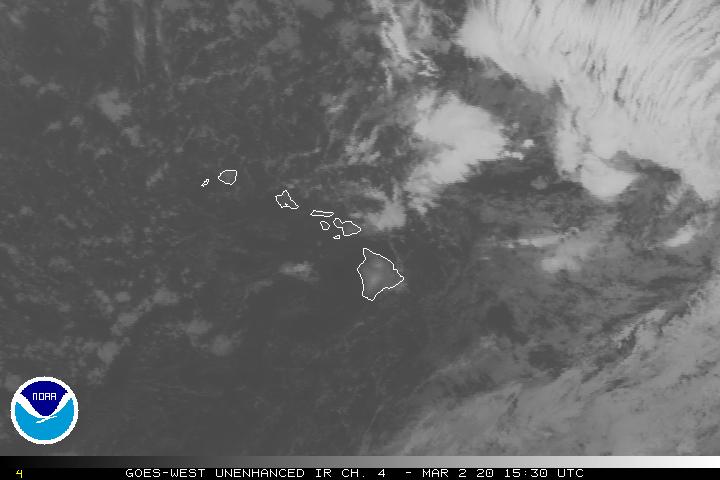
Satellite and Radar Images: To view the cloud conditions we have here in Hawaii, please use the following satellite links, starting off with the Infrared Satellite Image of the islands to see all the clouds around the state during the day and night. This next image is one that gives close images of the islands only during the daytime hours, and is referred to as a Close-up visible image. This next image shows a larger view of the Pacific…giving perspective to the wider ranging cloud patterns in the Pacific Ocean. Finally, here’s a looping IR satellite image, making viewable the clouds around the islands 24 hours a day. To help you keep track of where any showers may be around the islands, here’s the latest animated radar image.
Hawaii’s Mountains – Here’s a link to the live webcam on the summit of near 14,000 foot Mauna Kea on the Big Island of Hawaii. The tallest peak on the island of Maui is the Haleakala Crater, which is near 10,000 feet in elevation. These two webcams are available during the daylight hours here in the islands…and when there’s a big moon rising just after sunset for an hour or two! Plus, during the nights and early mornings you will be able to see stars, and the sunrise too…depending upon weather conditions.
Aloha Paragraphs

Lava flowing into the sea…Big Island
Photo Credit: Google.com
The trade winds will continue to blow across our tropical latitudes through the upcoming work week…although my final subside by next weekend. The source of these blustery trade winds is a 1033 millibar high pressure system that is located to the north of the Hawaiian Islands Sunday evening…as shown on this weather map. These winds will fluctuate some, in terms of strength, but continue to blow generally in a manner that will keep small craft wind advisory flags up in those windiest areas around the state.
There’s just a few showers expected along the windward sides Sunday night…although they may increase some Monday and Tuesday. Partly cloudy skies will persist Sunday night, with cloudy periods at times. Looking at this satellite image, we finally see the back edge of the high cirrus clouds approaching from the west. We should see, at least the leeward sides will see…more sunshine Monday. At lower levels, there will be the usual passing showers, as noted above, along our windward sides generally.
Sunday continued to be quite a cloudy day, with a fairly major canopy of high clouds overhead. If we look at this looping satellite image, we can see them sweeping up over us from the deeper tropics. These high clouds kept the sunshine muted to varying degrees, with some sun slipping through over Kauai and Oahu during the late afternoon hours. We should see some relief from the high cloudiness over the next couple of days, although the models suggest that we will see another rather extensive intrusion of high cirrus starting around mid-week.
It’s late Sunday afternoon as I writing this last long paragraph of today’s weather narrative for. The air temperature here in Kula was 63.7F degrees at around 430pm. We may see a nice sunset this evening, as there are still lots of high clouds streaming by. There are some lower level clouds too, but actually not many showers fell during the day. As I noted above, we should see more sunshine Monday and Tuesday, during the days, especially along those south and west facing leeward beaches. ~~~ I had good luck this morning at the Orchid sale in Haiku, where I picked up four nice small plants, which not only had some pretty flowers, but several new sprays, which will give me lovely flowers well into the future. I also had some good luck in being more friendly while I was Paia shopping afterwards. I ran into several friends in the health food store, and then out on Baldwin Ave. while I was getting ready to drive back up to Kula. As I’ve mentioned here before, I have a bit of a shy streak in me, so it was good that I spoke with many folks today. I enjoy communicating, but sometimes just don’t have what it takes to strike up a conversation. I was sort of hoping to run into a lady to talk to, but in all the various cases, it was men that I conversed with. It always turns out to be fine whoever I talk to, as it always feels good somehow! ~~~ I made a nice meal this afternoon, a nice red sauce pasta, and bbq’d some nice organic chicken breasts as well. I’ll plate those together each evening during the upcoming week, which makes it pretty easy after a long work day. ~~~ I’ll be back online again early Monday morning, as I’m already looking forward to launching off into a new week. I hope you have a great Sunday night wherever you happen to be resting your head, and that comes with a friendly invititation to join me here again on Monday! Aloha for now…Glenn.
Interesting: Norma Wooley checked into Loyola University Hospital on a recent Monday morning for brain surgery to repair a life-threatening aneurysm. She went home on Tuesday, cured of the slurred speech, drooping face and worst headache of her life. Dr. John Whapham used a less-invasive technique that’s becoming increasingly common in brain surgery. The Loyola University Health System neurologist inserted a catheter (thin tube) in an artery in Wooley’s leg and guided it up to her brain. The catheter released tiny platinum coils into the bulging aneurysm, effectively sealing it off.
"She went home the next morning with a Band Aid on her leg," Whapham said. Whapham, 36, is part of a new generation of neurologists who are using catheters to repair aneurysms, open clogged arteries, extract blood clots and repair blood vessel malformations in the brain. He also opens blocked carotid arteries in the neck. The catheter technique is much less invasive and risky than traditional brain surgery, which involves cutting a large opening in the skull.
Catheter technology, originally developed for heart surgery, has been modified for narrower and more challenging blood vessels in the brain. "There has been a huge evolution in devices over the last five years," Whapham said. Whapham is an assistant professor in the Departments of Neurology and Neurological Surgery, Loyola University Chicago Stritch School of Medicine.
Interesting2: Scientists have pinned down the constituent of olive oil that gives greatest protection from heart attack and stroke. In a study of the major antioxidants in olive oil, Portuguese researchers showed that one, DHPEA-EDA, protects red blood cells from damage more than any other part of olive oil. "These findings provide the scientific basis for the clear health benefits that have been seen in people who have olive oil in their diet," says lead researcher Fatima Paiva-Martins, who works at the University of Porto.
Heart disease is caused partly by reactive oxygen, including free radicals, acting on LDL or "bad" cholesterol and resulting in hardening of the arteries. Red blood cells are particularly susceptible to oxidative damage because they are the body’s oxygen carriers.
In the study, published in Molecular Nutrition & Food Research, Paiva-Martins and colleagues compared the effects of four related polyphenolic compounds on red blood cells subjected to oxidative stress by a known free radical generating chemical.
DHPEA-EDA was the most effective and protected red blood cells even at low concentrations. The researchers say the study provides the first evidence that this compound is the major source of the health benefit associated with virgin olive oils, which contain increased levels of DHPEA-EDA compared to other oils.
In virgin olive oils, DHPEA-EDA may make up as much as half the total antioxidant component of the oil. Paiva-Martins says the findings could lead to the production of "functional" olive oils specifically designed to reduce the risk of heart disease.
Interesting3: Six out of every 10 university students, regardless their field of study, present symptoms of anxiety when it comes to dealing with mathematics, according to a research work carried out at the University of Granada in Spain. In addition, there are significant differences between men and women, with men suffering less anxiety when it comes to dealing with mathematical tasks (47% of men versus 62% of women).
The research has been carried out by professors Patricia Pérez-Tyteca, Enrique Castro, Isidoro Segovia, Encarnación Castro and Francisco Fernández, of the department of Didactics of Mathematics of the UGR, and Francisco Cano, of the department of Evolutionary and Education Psychology.
This study was carried out in a sample consisting of 885 first-year students from 23 different degrees given at the UGR which include the subject of mathematics, both compulsory and core. The sample included four of the five university fields of study: Health Sciences, Experimental Sciences, Technical Education and Social Sciences.
Interesting4: Is today’s academic and corporate culture stifling science’s risk-takers and stopping disruptive, revolutionary science from coming to the fore? In April’s Physics World the science writer Mark Buchanan looks at those who have shifted scientific paradigms and asks what we can do to make sure that those who have the potential to change our outlook on the world also have the opportunity to do so.
When Max Planck accidentally discovered quantum theory, he kick-started the most significant scientific revolution of the 20th century; his colleague, Wilhelm Röntgen’s experiments with cathode rays led inadvertently to the discovery of X-rays, which ultimately revolutionised modern medical practice; and US physicists at Bell Labs, Arno Penzias and Robert Wilson, detected cosmic wave background radiation — the echo of the Big Bang — when trying to get rid of the annoying noise being picked up by their microwave receiver.
Would today’s physicists, plagued by the publish-or-perish ethic, have the same freedom to explore their findings? Buchanan offers a selection of different perspectives in the article. He looks, for example, at suggestions that scientists themselves could take a financial risk in speculative research depending on whether they do or do not think it will pay off, as well as proposals – through, say, 10-year fellowships – that allow scientists to pursue really "hard", long-standing problems without the pressure for rapid results.
Interesting5: Dust trapped deep in Antarctic ice sheets is helping scientists unravel details of past climate change. Researchers have found that dust blown south to Antarctica from the windy plains of Patagonia – and deposited in the ice periodically over 80,000 years – provides vital information about glacier activity. Scientists hope the findings will help them to better understand how the global climate has changed during the past ice age, and so help predict environmental changes in the future.
The study indicates that the ebb and flow of glaciers in the Chilean and Argentinian region is a rich source of information about past climates – which had not until now been fully appreciated by scientists. The study, carried out by the Universities of Edinburgh, Stirling and Lille, shows that the very coldest periods of the last ice age correspond with the dustiest periods in Antarctica’s past. During these times, glaciers in Patagonia were at their biggest and released their melt water, containing dust particles, on to barren windy plains, from where dust was blown to Antarctica.
When the glaciers retreated even slightly, their melt water ran into lakes at the edge of the ice, which trapped the dust, so that fewer particles were blown across the ocean to Antarctica. Dust from the ice cores was analysed and found to be a close match with mud of the same age in the Magellan Straits, showing that most of the dust originated in this region. The study was supported by the Natural Environment Research Council. The findings were published in Nature Geoscience.
Interesting6: Cell phone users don’t have it easy – many enter far more letters than numbers into their gadgets, but most phones still make you do so using a number pad. Meanwhile, the designers of smart phones seem determined to make touch screen keyboards the norm before they have been fully perfected.
Although touch screens are growing in popularity with designers, tapping at images of buttons on a small, slippery surface does not provide a good user experience. Figuring out better ways to input text on touch screens is important for more than just phones too, as they become common in other places like desktop computers, gaming devices and coffee tables.
Recently some more innovative ideas have shown where the future of mobile touch-screen text input may lie. One that launched recently is Shapewriter – already available for the iPhone and soon on other devices. It does away with the backwards-looking concept of pecking at images of keys on a glossy surface.
A qwerty layout is still shown, but the user draws over it to link up the letters of a word they wish to write. The company behind Shapewriter says it has evidence this can be significantly faster than even a conventional touch keyboard – although at first glance, the shapes you draw even for relatively simple words seem elaborate.
Another approach is to use a phone’s vibrate function to give an uncannily real illusion of using physical buttons. Stephen Brewster’s team at the University of Glasgow, UK, achieve the illusion with split-second pulses of vibrations chosen to provide sensations that feel like pressing a button, or shifting from key to key. Next week at the Computer Human Interaction 2009 conference in Boston, Massachusetts, the team will present results of user tests on a Nokia N800 Internet Tablet equipped with the technology.
The system uses the feedback to allow you to press harder on the screen for uppercase letters. Ultimately, though entering text may stop being a physical task. We reported last year on the first "voiceless phone call", placed using a neckband that makes it possible for someone to think words and have a computer read or type them out. The device detects and translates nerve signals sent by the brain to the vocal cords when we merely think about speaking a sound.
 Email Glenn James: