











July 9-10, 2010
Air Temperatures – The following maximum temperatures were recorded across the state of Hawaii Friday afternoon:
Lihue, Kauai – 84
Honolulu, Oahu – 85
Kaneohe, Oahu – 83
Kaunakakai, Molokai – 83
Kahului, Maui – 86
Hilo, Hawaii – 82
Kailua-kona – 84
Air Temperatures ranged between these warmest and coolest spots near sea level – and on the highest mountain tops too…as of 5pm Friday evening:
Barking Sands, Kauai – 85
Molokai airport – 78
Haleakala Crater – missing (near 10,000 feet on Maui)
Mauna Kea summit – 45 (near 14,000 feet on the Big Island)
Precipitation Totals – The following numbers represent the largest precipitation totals (inches) during the last 24 hours on each of the major islands, as of Friday afternoon:
1.02 Mount Waialeale, Kauai
0.97 Manoa Lyon Arboretum, Oahu
0.08 Molokai
0.00 Lanai
0.00 Kahoolawe
0.62 Puu Kukui, Maui
0.60 Kawainui Stream, Big Island
Marine Winds – Here’s the latest (automatically updated) weather map showing a 1030 millibar high pressure cell to the northeast, moving slowly westward…which will prompt strengthening trade winds this weekend.
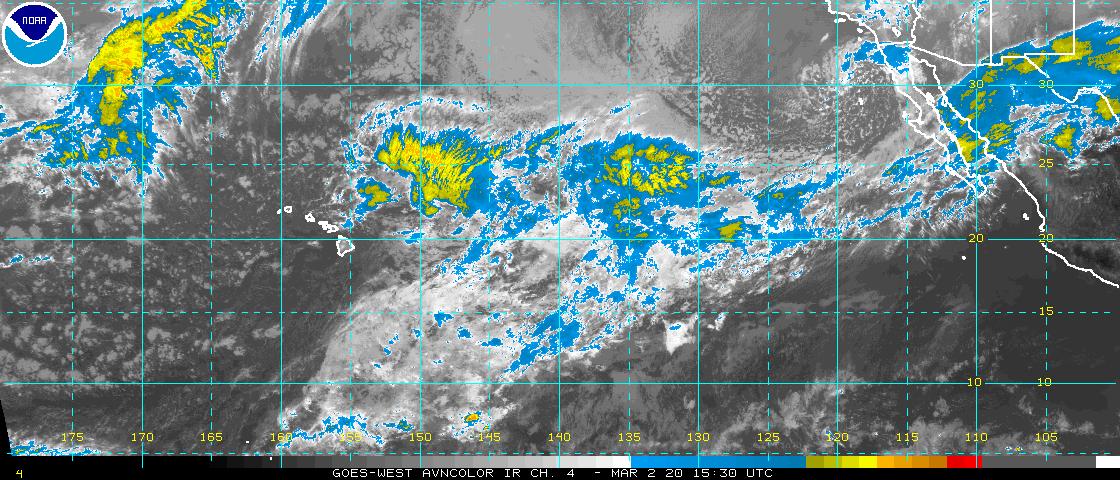
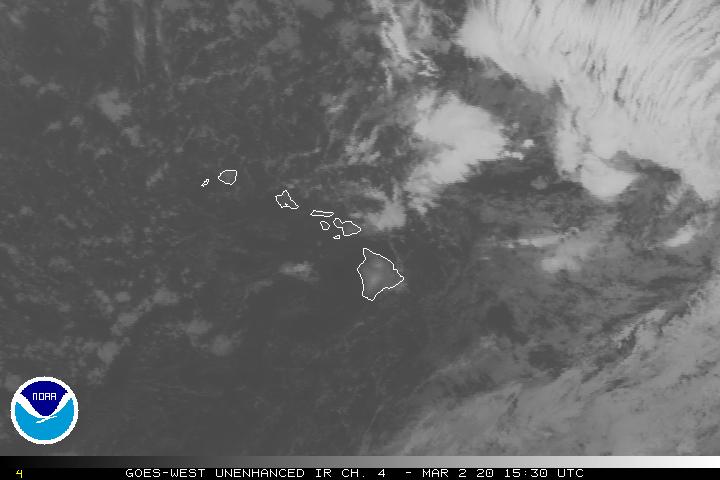
Satellite and Radar Images: To view the cloud conditions we have here in Hawaii, please use the following satellite links, starting off with this Infrared Satellite Image of the islands to see all the clouds around during the day and night. This next image is one that gives close images of the islands only during the daytime hours, and is referred to as a Close-up visible image. This next image shows a larger view of the Pacific…giving perspective to the wider ranging cloud patterns in the Pacific Ocean. Finally, here’s a Looping IR satellite image, making viewable the clouds around the islands 24 hours a day. To help you keep track of where any showers may be around the islands, here’s the latest animated radar image.
Hawaii’s Mountains – Here’s a link to the live webcam on the summit of near 14,000 foot Mauna Kea on the Big Island of Hawaii. The tallest peak on the island of Maui is the Haleakala Crater, which is near 10,000 feet in elevation. These two webcams are available during the daylight hours here in the islands…and when there’s a big moon rising just after sunset for an hour or two! Plus, during the nights and early mornings you will be able to see stars, and the sunrise too…depending upon weather conditions.
Tropical Cyclone activity in the eastern and central Pacific – Here’s the latest weather information coming out of the National Hurricane Center, covering the eastern north Pacific. You can find the latest tropical cyclone information for the central north Pacific (where Hawaii is located) by clicking on this link to the Central Pacific Hurricane Center. Here’s a tracking map covering both the eastern and central Pacific Ocean. A satellite image, which shows the entire ocean area between Hawaii and the Mexican coast…can be found here. Of course, as we know, our hurricane season won’t begin again until June 1st here in the central Pacific.
Aloha Paragraphs
![[IMG_6256A+copy.jpg]](http://3.bp.blogspot.com/_TWvs1T8r4_A/SvJslCJG-FI/AAAAAAAAAPI/UrDTn6I-6Ck/s1600/IMG_6256A%2Bcopy.jpg)
Nice Banana Stalk
The trade winds are being supported by a high pressure system to the northeast Friday night. The expectation continues that these winds will surge a notch or two…as this high pressure system gets closer to Hawaii over the next couple of days. This weather map shows the location of this high pressure system, which shows it moving towards the west slowly. Meanwhile, we see a somewhat unusually strong 980 millibar storm far to the north-northwest of our tropical islands…moving into the Gulf of Alaska. This is the storm that likely has generated an out of season northwest or north-northwest swell train of waves…forecast to arrive this weekend. It won’t be large by any means, like we see during the winter high surf season, although will bring larger waves than we’ve seen for several weeks…perhaps with 1-2 footers locally.
As the trade winds relax in strength after this weekend, we’ll likely see some new influences in our local weather picture. It’s a little difficult to conceive fully, that our winds will drop that far down from normal however, as the trade winds usually blow moderately strong during the month of July. The computer forecast models nonetheless, continue to suggest that our winds will mellow-out though. This lighter variety of winds should show themselves most completely at some point between Monday and Wednesday. There have been some minor fluctuations by the models, in how light they might become over the last several days. It looks like we’ll continue to see light trade winds, rather than no trade winds at all. It wouldn’t be all that surprising to see something like light to almost moderately strong winds. If however, they did really take a nose dive, we could see a convective weather pattern kick in.
Convective patterns aren’t usual for the summer season, without having a tropical system passing close to the islands, turning off the trade winds…or having an upper level low move nearby. If that were to happen, we would typically find clear nights, and slightly cooler than normal early morning temperatures. The daytime heating though, with light sea breezes during the days, would force moisture up the slopes of the mountains, where it would condense into clouds. The models have been telling us that there wouldn’t be very much moisture for these clouds to work with though, thus those afternoon cumulus cloud developments wouldn’t be giving us any gully washers. We could sure use some heavy showers in those leeward areas, although this pattern won’t provide it, whether or not the trade winds lose very much strength.
As the trade winds rebound some by mid-week, or shortly thereafter, whatever showers that are around then…will migrate back over to the windward sides of the islands. Here’s a IR satellite image, showing another couple of bands of moisture heading our way upstream, which will increase our shower activity tonight again…like last night. In addition, we can see that area of clouds, which were disturbed a couple of days ago, to the south of the islands, too far south to bring even South Point on the
It’s Friday evening as I begin writing this last section of today’s narrative update. As noted above, our winds will be picking up some now, and then coming back down after the weekend for a few days. Rainfall will be off and on, falling here and there…mostly during the nights along the windward sides. Then, early next week some showers will break out over the interior slopes during the afternoons locally too. All things considered, conditions should be pretty decent this weekend, and then on into the new week too. ~~~ I’m heading out to see a new film this evening, called The Twilight Saga: Eclipse (2010), starring Kristen Stewart, Robert Pattinson, and Taylor Lautner…among others. These young folks return for their third installment of the blockbuster supernatural romance saga. This film is quite a big deal, especially for the younger set, although it looks good to me as well. I’ll be sure to let you know what I thought, when I come back online again Saturday morning, with your next new weather narrative. Here’s the trailer, just in case you happen to be interested. Aloha for now…Glenn.
Interesting: California’s San Andreas fault is notorious for repeatedly generating major earthquakes and for being on the brink of producing the next "big one" in a heavily populated area. But the famously violent fault also has quieter sections, where rocks easily slide against each other without giving rise to damaging quakes.
The relatively smooth movement, called creep, happens because the fault creates its own lubricants — slippery clays that form ultra-thin coatings on rock fragments, geologist Ben van der Pluijm and colleagues at the University of Michigan and Germany’s Ernst-Moritz-Arndt Universität Institut für Geographie und Geologie report in the July issue of Geology.
The question of why some fault zones creep slowly and steadily while others lock for a time and then shift suddenly and violently, spawning earthquakes, has long puzzled scientists. Some have speculated that fluids facilitate slippage, while others have focused on serpentine — a greenish material that can alter to slippery talc.
But when van der Pluijm and colleagues analyzed samples of rock from an actively creeping segment that was brought up from a depth of two miles below the surface as part of the San Andreas Fault Observatory at Depth (SAFOD) project, they found very little talc. Instead, they found that fractured rock surfaces were coated with a thin layer of smectitic clay, less than 100 nanometers thick, that acts something like grease on ball bearings.
"For a long time, people thought you needed a lot of lubricant for creep to occur," said van der Pluijm, who is the Bruce R. Clark Collegiate Professor of Geology and Professor of the Environment. "What we can show is that you don’t really need a lot; it just needs to be in the right place. It’s a bit like real estate: location, location, location."
The nanocoatings occur on the interfaces of broken-up bits of rock in exactly the places where they affect the fault’s "weakness" — how easily it moves. The technique of argon dating provided key evidence, when the researchers determined that these clays, found only in fault rock, formed relatively recently. "The clays are growing in the fault zone, and the fault is coating its own pieces of fragmented rock," van der Pluijm said.
"At some point there’s enough coating that it begins to drive the behavior of the fault, and creeping kicks in." If the fault is greasing itself, then why do earthquakes still occur? "The problem is that the fault doesn’t always move at strands where the coating sits," van der Pluijm said. The San Andreas fault is actually a network of faults, with new strands being added all the time.
Because it takes some time for the slick nanocoatings to develop in a new strand, the unlubricated, new strand "gets stuck" for a time and then shifts in a violent spasm. Although the samples obtained through SAFOD are from a depth of only about two miles, van der Pluijm and colleagues think it’s likely the clay nanocoatings also are forming and driving fault behavior at greater depths.
What’s more, analyses of older, inactive strands suggest that the coatings have been facilitating creep for the millions of years of fault activity. The SAFOD project, which is establishing the world’s first underground earthquake observatory, is a major research component of EarthScope, an ambitious, $197-million federal program to investigate the forces that shaped the North American continent and the processes controlling earthquakes, volcanoes and other geological activity.
Interesting2: A provocative new study suggests that mice raised in spacious cages with lots of toys and companions are more resistant to cancer than mice living in standard cages. The work, which finds that exercise alone doesn’t explain the anticancer effect, is drawing both excitement and skepticism.
The study builds on research dating back to the 1960s, which has found that raising mice in an "enriched environment" spurs neural growth and learning. Recent research even suggests that a stimulating cage environment late in life can help restore memory in animals with neurodegenerative disease.
Neuroscientists Matthew During and Lei Cao, both of Ohio State University and Cornell University, wondered whether these profound effects on the brain could influence how the body responds to cancer.
During’s team studied the course of cancer in two sets of young male mice—groups of five animals housed in a standard cage (roughly the size of a bread box) with food but nothing else, and groups of 18 to 20 mice raised in a bigger cage (about the size of a portable crib) with food, toys, a maze, running wheels, and places to hide. After the mice spent 3 to 6 weeks in their cages, the researchers injected them under the skin with melanoma cancer cells and waited for tumors to develop.
The results were a surprise, During says. Mice that spent 3 weeks in the enriched cage developed tumors that were 43% smaller in volume than those raised in normal cages. The difference in tumor mass was 77% when the mice spent 6 weeks in the special cages. And unlike mice raised in standard cages, a few of those in the enriched cages developed no tumors at all. The researchers saw similar results for two types of mice prone to colon cancer.
Exercise alone didn’t explain the effect. Mice raised in a typical cage connected to a running wheel developed tumors just as massive as those that did no cardio.
The anticancer effects seem related to metabolic changes, During says. Mice raised in the enriched environment had much lower blood levels of leptin, a hormone linked to obesity and cancer; they also had higher levels of corticosterone, a stress hormone. In addition, the hypothalamuses of the enhanced cage mice had higher levels of brain-derived neurotrophic factor (BDNF), a growth factor that the researchers suggest sends signals to fat cells to produce less leptin. When the team turned BDNF off or ramped it up in the brains of the mice, they saw corresponding changes in leptin levels and in tumor size, they report in tomorrow’s issue of Cell.
Interesting3: No polar bears have been more closely studied than Canada’s western Hudson Bay population. In recent decades, biologists such as Andrew E. Derocher of the University of Alberta have compiled an impressive store of data on everything from the weight of females at denning, to the body mass of bears of all sexes, to the length of time the bears spend annually on the shores of Hudson Bay, to the decline of sea ice in the bay itself.
Now, Derocher, working with Peter K. Molnar and other colleagues from the University of Alberta, has marshaled that data to forecast how long it will be before western Hudson Bay’s polar bears disappear. The calculation is not overly complex, since the health of polar bears is directly tied to the amount of time they spend on sea ice hunting seals.
The basic facts are as follows: The region’s polar bears have been forced to spend an extra week per decade onshore; the bears have been losing, on average, more than 20 pounds per decade; the body mass of the bears has been steadily declining; females have lost 10 percent of their body length; and the population has dropped from 1,200 to 900 in three decades, with much of the decline coming in the last 10 years.
Looking at projected sea ice declines, Derocher and his colleagues estimated in a recent paper in Biological Conservation that western Hudson Bay’s polar bear population could well die out in 25 to 30 years. Indeed, in an interview with Yale Environment 360 senior editor Fen Montaigne, Derocher said that the population — one of 19 in the Arctic — could be gone within a decade.
All it would take is several straight years of low sea ice conditions — such as the current year — which could force the bears onshore for more than five months a year, leading to a sharp decline in the bears’ physical condition and the inability of females to gestate cubs. "One of the things we found was that the changes in this population could happen very dramatically," says Derocher. "And a lot of the change could come within a single year if you just ended up with an earlier melt of sea ice."
Yale Environment 360: You predict that the western Hudson Bay polar bear population, which is one of the most southerly, could reach a point within three decades where there are too few animals to sustain a breeding population. Could you summarize for our readers how you reached that conclusion?
Andrew Derocher: Sure. If you look at polar bears in the global context we’ve actually got 19 different subpopulations. Now, they’re reasonably distinct, but the interesting thing about the western Hudson Bay population is that it’s actually one of the most accessible and it’s certainly by far the most studied population that we have. So that’s one of the reasons that we’re focusing our attention on the western Hudson Bay population.
But more importantly, we have a lot of the background information on the workings of this population. So we understand very well things like how fat a bear has to be to produce a certain number of cubs, we know a lot about how much energy these bears are burning during the period of time over the summer that they’re forced ashore when the sea ice melts.
We also have a very good understanding of how the sea ice has changed in this part of the world. So really, what this is is kind of a model system that’s giving us some early indications about what one of the more southern populations is doing relative to the issue of climate change.
 Email Glenn James: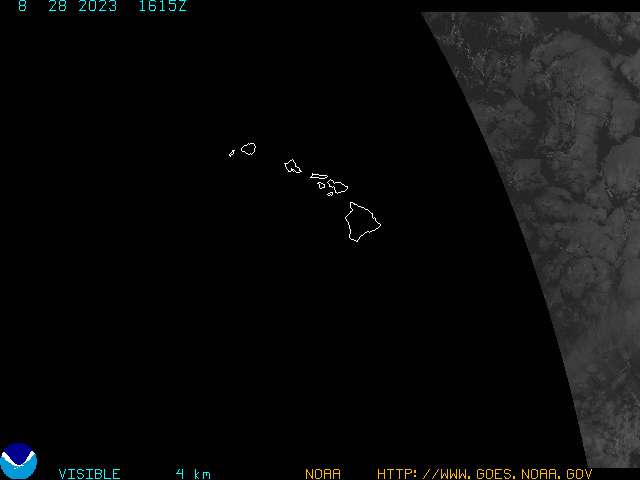





Blair Thorndike Says:
I see we are in for a spell of light winds next week. Looking into your crystal ball, do you think the trades will rebound by the weekend of the 17th-18th? There is a big downwind race that Sunday!
Thanks!
Blair~~~If I was a betting man, I’d bet on that Blair…this time of year its not common to see the trade winds stop blowing, or even slow down all that much during July. Aloha, Glenn
ML Says:
I’ve been looking for a site to find good information on vog forecasts for Maui, without much luck. I wasn’t sensitive to vog until the extended period of vog we had this past December. Now I want some advance warning so I know when I need to close up my house. I’ve been using information in your discussion to try to guess if we’re likely to have vog. It would be great if you could have a vog announcement when necessary. I know I’m not the only one who would benefit from that!
Thanks for your great information!
Mary Lynne~~~Hi Mary Lynne, sorry to hear about your new condition. As it turns out, I always mention when I see voggy weather coming up, or try and forecast that the best that I can. The next time that we could see a bit of vog might be at some point between Monday and Wednesday coming up. Not for sure this time, but a slight chance, keep an eye out for that haze that lets you know to shut things up. Aloha, Glenn