February 10-11, 2009
Air Temperatures – The following maximum temperatures were recorded across the state of Hawaii Tuesday afternoon:
Lihue, Kauai – 74
Honolulu, Oahu – 78
Kaneohe, Oahu – 77
Kahului, Maui – 82
Hilo, Hawaii – 73
Kailua-kona – 82
Air Temperatures ranged between these warmest and coolest spots near sea level, and on the highest mountains…at 4 p.m. Tuesday afternoon:
Kahului, Maui – 81F
Molokai airport – 72
Haleakala Crater – 50 (near 10,000 feet on Maui)
Mauna Kea summit – 27 (near 14,000 feet on the Big Island)
Precipitation Totals – The following numbers represent the largest precipitation totals (inches) during the last 24 hours on each of the major islands, as of Tuesday afternoon:
0.04 Mount Waialaele, Kauai
2.18 Mililani, Oahu
0.05 Molokai
0.00 Lanai
0.00 Kahoolawe
0.48 Kaupo Gap, Maui
1.14 Piihonua, Big Island
Weather Chart – Here’s the latest (automatically updated) weather map continues showing a trough of low pressure to the north of the state, with generally light ESE to southeast winds blowing, which will gradually become more regular trade winds Thursday.
Satellite and Radar Images: To view the cloud conditions we have here in Hawaii, please use the following satellite links, starting off with the Infrared Satellite Image of the islands to see all the clouds around the state during the day and night. This next image is one that gives close images of the islands only during the daytime hours, and is referred to as a Close-up visible image. This next image shows a larger view of the Pacific…giving perspective to the wider ranging cloud patterns in the Pacific Ocean. Finally, here’s a looping IR satellite image, making viewable the clouds around the islands 24 hours a day. To help you keep track of where any showers may be around the islands, here’s the latest animated radar image.
Hawaii’s Mountains – Here’s a link to the live webcam on the summit of near 14,000 foot Mauna Kea on the Big Island of Hawaii. The tallest peak on the island of Maui is the Haleakala Crater, which is near 10,000 feet in elevation. These two webcams are available during the daylight hours here in the islands…and when there’s a big moon rising just after sunset for an hour or two! Plus, during the nights and early mornings you will be able to see stars, and the sunrise too…depending upon weather conditions.
Aloha Paragraphs

Hanapepe overlook…Kauai
Photo Credit: flickr.com
A trough of low pressure located to the north of the islands turned our winds to the southeast, which will depart Wednesday…allowing our trade winds to return. Southeast winds split around the Big Island, putting the smaller islands in a wind shadow. At the same time, SE winds carry volcanic haze over some areas of the state as well. As the trade winds return Wednesday, and then pick up more substantially Thursday, they will become much stronger, necessitating small craft wind advisories over all coastal and channel waters…with even perhaps a gale warning in those windiest areas Friday into the weekend.
The temporary southeast breezes prompted interior afternoon clouds again Tuesday, which became thunderstorms on Oahu and the Big Island…along with some incoming showers along the southeast exposures. Those cumulonimbus clouds that grew over interior sections on those two islands, were due to the daytime heating of the islands, and the still colder than normal air aloft over the Aloha state. As the trade winds pick up Wednesday, and then get considerably stronger Thursday, the windward biased showers will increase markedly…spreading a few showers over to the leeward sides in places too.
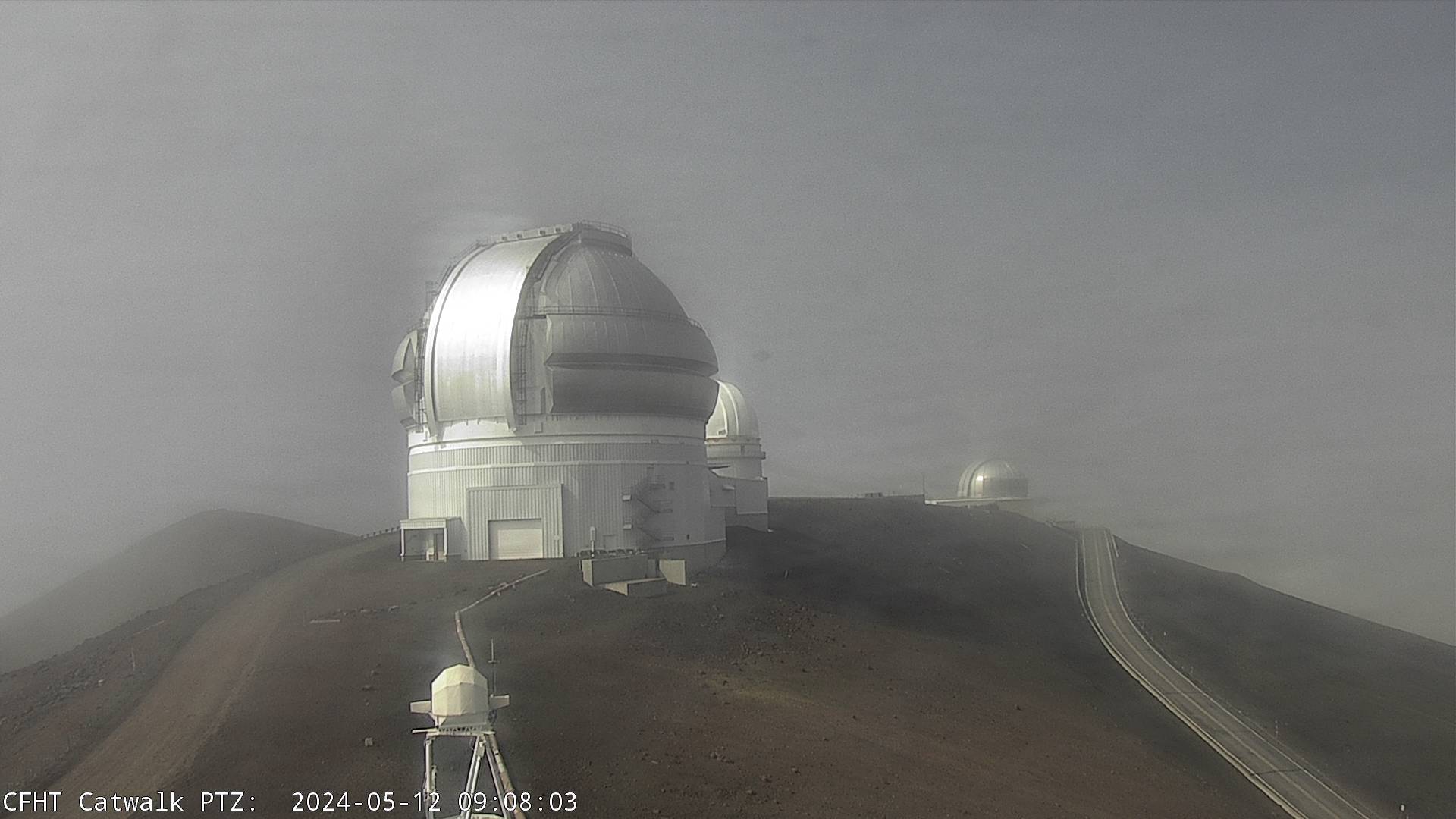
It’s cold atop Hawaii’s mountains now, as shown in this webcam shot of Mauna Kea on the Big Island…reading 27F degrees Tuesday evening! This webcam view, when the clouds don’t block the view, will show cloudy periods, along with some passing snow showers. This camera won’t be available again, after dark, until first light Wednesday morning.
This short period of southeast winds gave us muggy conditions…and locally hazy conditions Tuesday afternoon. If you didn’t mind that, it was generally fine, especially along our warm leeward beaches. Once the winds become more blustery Thursday, we’ll see our local ocean all frothed-up with white caps. The expected increase in showers, in association with an upper air low pressure system that will edge into our area, and the incoming moisture carried in our direction on the gusty trade winds…will make our windward sides wet starting later Wednesday or Thursday.
It’s Tuesday evening here in Kihei, Maui, as I begin writing this last paragraph of today’s narrative. Tuesday was a fine day, other than some spotty thunderstorms over central Oahu, and on the slopes of the Big Island. Those lightning and thunder bearing cumulonimbus clouds, dropped generous rainfall locally Tuesday afternoon. Otherwise, it was quite nice, although some folks may have noted the volcanic haze (vog) that was carried up over some parts of the state, on the generally light southeast breezes. Our trade winds will be returning Wednesday, which will do nothing but get stronger as we move into Thursday…through the rest of the week. These blustery trade winds will pick up quite a bit of moisture as they pass over the surrounding ocean, bringing an increase in showers…especially to our windward coasts and slopes. ~~~ Looking out the window here in Kihei, I see a hazy atmosphere out there, along with quite a large area of clear skies. Glancing up towards the Haleakala Crater, and over towards the West Maui Mountains, there are way more clouds there. I may see some fog up around the elevation of my house in Kula, as I drive home soon. I may even see evidence of some late afternoon showers as well. ~~~ I’ll be back very early Wednesday morning with your next new weather narrative from paradise. I hope you have a great Tuesday night until then, under that still rather large moon, that will be beaming down on us! Aloha for now…Glenn.
Unique – A youtube video starring a dog, a cat…and a white rat!
Interesting: Long-term multivitamin use has no impact on the risk of common cancers, cardiovascular disease or overall mortality in postmenopausal women, a new study finds. The message is simple and echoes the advice of most researchers who have looked into the effects of diet: Eat real food. Several other studies have shown vitamin supplements to be next to worthless and in some cases harmful. "Get nutrients from food," said study leader Marian L. Neuhouser of the Public Health Sciences Division at the Hutchinson Center. "Whole foods are better than dietary supplements. Getting a wide variety of fruits, vegetables and whole grains is particularly important." Multivitamins because they are the most commonly used supplement in the United States, used by more than half of residents, who spend more than $20 billion on these products each year, Neuhouser said. "To our surprise, we found that multivitamins did not lower the risk of the most common cancers and also had no impact on heart disease," she said. The results were published in the Feb. 9 issue of the Archives of Internal Medicine. The study was big.
It assessed multivitamin use among nearly 162,000 women enrolled in the Women’s Health Initiative, one of the largest U.S. prevention studies of its kind designed to address the most common causes of death, disability and impaired quality of life in postmenopausal women. The women were followed for about eight years. Of the participants, 41.5 percent reported using multivitamins on a regular basis. Multivitamin users were more likely to be white, live in the western United States, have a lower body-mass index, be more physically active and have a college degree or higher as compared to non-users. Multivitamin users also were more likely to drink alcohol and less likely to smoke than non-users, and they reported eating more fruits and vegetables and consuming less fat than non-users. During the eight-year study period, 9,619 cases of breast, colorectal, endometrial, renal, bladder, stomach, lung or ovarian cancer were reported, as well as 8,751 cardiovascular events and 9,865 deaths. The data showed no significant differences in risk of cancer, heart disease or death between the multivitamin users and non-users.
Interesting2: Life has not yet been found on Mars, and no one is sure whether it will be. But some researchers say it is not too early to consider the possibility that humans could do irreversible damage to indigenous Martian life. A group of international experts will meet as early as this September to discuss whether it is time to revise policies that protect Mars from contamination. At issue is the ethics of exploring the Red Planet – in particular whether hitchhiking Earth microbes could harm Martian habitats. Past missions, including NASA’s twin rovers, have already ferried hundreds of thousands of bacterial cells to the Red Planet. Most of the microbes on the exterior of these craft were quickly destroyed by intense ultraviolet radiation, which passes easily through Mars’s thin atmosphere. But dormant microbes might survive for tens of thousands of years on the interior of the crafts.
And in the case of the Mars Polar Lander, which crashed into the planet’s south pole in 1999, its interior surfaces may have come in direct contact with soil rich in water ice, which could potentially provide a habitable environment for the hitchhikers. "The option of not contaminating Mars is an option that’s no longer available to humanity," says Christopher McKay, a planetary scientist at NASA’s Ames Research Center, who wrote a commentary about the need to protect any Martian life in the current issue of the journal Science. "Mars already has earthlings. We know that for a fact." He warns that Earth life could be reawakened if weather conditions on the planet change. This could happen as a result of periodic swings in the planet’s tilt, or if humans purposely alter the Martian environment, which, ironically, they might do to make conditions cosier for any Martian life they might discover. Microbes on subsurface drills in search of liquid water could also contaminate potential Martian habitats.
Interesting3: An asteroid that had initially been deemed harmless has turned out to have a slim chance of hitting Earth in 160 years. While that might seem a distant threat, there’s far less time available to deflect it off course. Asteroid 1999 RQ36 was discovered a decade ago, but it was not considered particularly worrisome since it has no chance of striking Earth in the next 100 years – the time frame astronomers routinely use to assess potential threats. Now, new calculations show a 1 in 1400 chance that it will strike Earth between 2169 and 2199, according to Andrea Milani of the University of Pisa in Italy and colleagues. With an estimated diameter of 560 meters, 1999 RQ36 is more than twice the size of the better-known asteroid Apophis, which has a 1 in 45,000 chance of hitting Earth in 2036. Both are large enough to unleash devastating tsunamis if they were to smash into the ocean. Although 1999 RQ36’s potential collision is late in the next century, the window of opportunity to deflect it comes much sooner, prior to a series of close approaches to Earth that the asteroid will make between 2060 and 2080.
Asteroid trajectories are bent by Earth’s gravity during such near misses, and the amount of bending is highly dependent on how close they get to Earth. A small nudge made ahead of a fly-by will get amplified into a large change in trajectory afterward. In the case of 1999 RQ36, a deflection of less than 1 kilometer would be enough to eliminate any chance of collision in the next century. But after 2080, the asteroid does not come as close to Earth before the potential impact, so any mission to deflect it would have to nudge the asteroid off course by several tens of kilometers – a much more difficult and expensive proposition. "That’s worth thinking about," says Clark Chapman of the Southwest Research Institute in Boulder, Colorado. As is often the case, more precise calculations enabled by future observations will most likely rule out a collision. But Milani’s team says that routine monitoring of asteroids should be extended to look for potential impacts beyond the 100-year time frame, to identify any other similar cases.
Interesting4: More than 200 dolphins beached themselves Tuesday in the northern Philippines, but local fishermen and volunteers were able to guide them safely back to sea hours later, officials said. The Bureau of Fisheries and Aquatic Resources said at least four of the mammals were found dead in Pilar and Balanga towns in Bataan province, 75 kilometres north-west of Manila. Most of the dolphins had crowded the sea off Pilar town beginning early Tuesday, said provincial Governor Enrique Garcia, whose office immediately called on public and private agencies for help. "This is a phenomenon," he told a radio station in Manila. "It is only now that this happened in our province."
The Fisheries Bureau said most of the dolphins returned to the sea after fishermen and volunteers under the supervision of experts guided the mammals to deep water. The agency said it plans to conduct a "water quality and water parameter test" as part of an investigation into the incident. Beached dolphins are common in the Philippine archipelago of more than 7,000 islands but rarely occur in such huge numbers. Bureau Director Malcolm Sarmiento said the dolphins could have reacted to a "heat wave or disturbance at sea," such as a possible major underwater earthquake. He said he ordered 72 hours of monitoring of the coastal areas in Bataan to ensure that the dolphins would not return.
Interesting5: San Francisco will become the first city in the country to convert large batches of "brown grease" – the smelly, mucky mess left over from foods cooked in oil – into biodiesel and other fuels under a program set to start by the end of the year. The $1.2 million pilot program, which is being funded by state and federal grants, will go toward building a grease recycling plant near the city’s Oceanside treatment plant. The program will allow the city to collect about 10,000 gallons a week of dirty grease, which can be converted into roughly 500 gallons of fuel. "At home, when you’re making eggs and it burns and you get that brown stuff and you scrape it off, that’s what brown grease in essence is," Mayor Gavin Newsom said at a news conference Wednesday. "But it also becomes commercial-grade biodiesel. This is the good stuff, environmentally speaking." About 10 million gallons of brown grease are produced in San Francisco every year, most of it safely collected and treated in the city’s sewer system like any other waste material.
Grease that isn’t treated usually gets dumped down the drain, where it can cause major clogs to city pipes – at a cost of about $3.5 million a year, say city officials. Not only is that a waste of money, but it’s a waste of a potential natural resource, said Ed Harrington, general manager of the San Francisco Public Utilities Commission. "It’s being treated through the wastewater system like any other solid now. That doesn’t take advantage of the fact that there’s energy in it," Harrington said. San Francisco has been recycling "yellow grease" – oil that’s been used for "clean" cooking like frying potatoes – since 2007. Programs that convert used cooking oil into biodiesel are becoming increasingly common in the United States, but so far no one has created a large-scale system for converting brown grease into fuel, said Karri Ving, the biofuel program coordinator for the Public Utilities Commission.
Interesting6: Scientists have found proof in Bermuda that the planet’s sea level was once more than 70 feet higher about 400,000 years ago than it is now. Storrs Olson, research zoologist at the Smithsonian’s National Museum of Natural History, and geologist Paul Hearty of the Bald Head Island Conservancy discovered sedimentary and fossil evidence in the walls of a limestone quarry in Bermuda that documents a rise in sea level during an interglacial period of the Middle Pleistocene in excess of 21 meters above its current level. Hearty and colleagues had published preliminary evidence of such a sea-level rise nearly a decade ago, which was met with skepticism among geologists. This marine fossil evidence now provides unequivocal evidence of the timing and extent of this event. The nature of the sediments and fossil accumulation found by Olson and Hearty was not compatible with the deposits left by a tsunami but rather with the gradual, yet relatively rapid, increase in the volume of the planet’s ocean caused by melting ice sheets.
A rise in sea level to such a height would have ramifications well beyond geology and climate modeling. For the organisms of coastal areas, and particularly for low islands and archipelagos, such a rise would have been catastrophic. The Florida peninsula, for example, would have been reduced to a relatively small archipelago along the higher parts of its central ridge. “We have only to look at Bermuda to begin to assess the impact for terrestrial organisms or seabirds dependant on dry land for nesting sites,” said Olson. “This group of islands in the Atlantic was so compromised as a nesting site for seabirds that at least one species of shearwater became extinct as well as the short-tailed albatross, marking the end of all resident albatrosses in the North Atlantic.”
Interesting7: The decline of amphibian populations worldwide has been documented primarily in frogs, but salamander populations also appear to have plummeted, according to a new study by University of California, Berkeley, biologists. By comparing tropical salamander populations in Central America today with results of surveys conducted between 1969 and 1978, UC Berkeley researchers have found that populations of many of the commonest salamanders have steeply declined. On the flanks of the Tajumulco volcano on the west coast of Guatemala, for example, two of the three commonest species 40 years ago have disappeared, while the third was nearly impossible to find. "There have been hints before – people went places and couldn’t find salamanders. But this is the first time we’ve really had, with a very solid, large database, this kind of evidence," said study leader David Wake, professor of integrative biology at UC Berkeley and curator of herpetology in the campus’s Museum of Vertebrate Zoology.
Frog declines have been attributed to a variety of causes, ranging from habitat destruction, pesticide use and introduced fish predators to the Chytrid fungus, which causes an often fatal disease, chytridiomycosis. These do not appear to be responsible for the decline of Central American salamanders, Wake said.
Instead, because the missing salamanders tend to be those living in narrow altitude bands, Wake believes that global warming is pushing these salamanders to higher and less hospitable elevations. "We are losing some of these treasures of high-elevation and mid-elevation cloud forests in Central America," he said. "It is very worrying because it implies there are severe environmental problems." Because several of the sampled salamander populations were in protected reserves, one message is that threatened species cannot be protected merely by putting a fence around their habitat. Global warming is affecting species even in protected areas – a phenomenon also documented among small mammals in Yosemite National Park by Museum of Vertebrate Zoology scientists.
Interesting8: Can algae save the world again? The microscopic green plants cleaned up the earth’s atmosphere millions of years ago and scientists hope they can do it now by helping remove greenhouse gases and create new oil reserves. In the distant past, algae helped turn the earth’s then inhospitable atmosphere into one that could support modern life through photosynthesis, which plants use to turn carbon dioxide and sunlight into sugars and oxygen. Some of the algae sank to sea or lake beds and slowly became oil. "All we’re doing is turning the clock back," says Steve Skill, a biochemist at the Plymouth Marine Laboratory. "Nature has done this many millions of years ago in producing the crude oil we’re burning today.
So as far as nature is concerned this is nothing new," he said. The race is now on to find economic ways to turn algae, one of the planet’s oldest life forms, into vegetable oil that can be made into biodiesel, jet fuel, other fuels and plastic products. "So we are harvesting sunshine directly using algae, then we are extracting that stored energy in the form of oil from the alga and then using that to make fuels and other non-petroleum based products," Skill said. He predicted that industry will be cultivating algae in viable quantities for commercial oil production with a decade. Such fuels are considered to be net carbon neutral because the algae absorb greenhouse gases when they grow.
 Email Glenn James: