February 9-10, 2009
Air Temperatures – The following maximum temperatures were recorded across the state of Hawaii Monday afternoon:
Lihue, Kauai – 76
Honolulu, Oahu – 80
Kaneohe, Oahu – 79
Kahului, Maui – 83
Hilo, Hawaii – 76
Kailua-kona – 82
Air Temperatures ranged between these warmest and coolest spots near sea level, and on the highest mountains…at 4 p.m. Monday afternoon:
Kahului, Maui – 81F
Molokai airport – 75
Haleakala Crater – 50 (near 10,000 feet on Maui)
Mauna Kea summit – 28 (near 14,000 feet on the Big Island)
Precipitation Totals – The following numbers represent the largest precipitation totals (inches) during the last 24 hours on each of the major islands, as of Monday afternoon:
0.15 Mount Waialaele, Kauai
0.64 Oahu Forest NWR, Oahu
0.00 Molokai
0.00 Lanai
0.00 Kahoolawe
0.35 Kaupo Gap, Maui
0.95 Waiakea Uka, Big Island
Weather Chart – Here’s the latest (automatically updated) weather map showing high pressure systems to the north and northeast of the Hawaiian Islands. Our winds will remain in the light to moderately strong range through Tuesday
Satellite and Radar Images: To view the cloud conditions we have here in Hawaii, please use the following satellite links, starting off with the Infrared Satellite Image of the islands to see all the clouds around the state during the day and night. This next image is one that gives close images of the islands only during the daytime hours, and is referred to as a Close-up visible image. This next image shows a larger view of the Pacific…giving perspective to the wider ranging cloud patterns in the Pacific Ocean. Finally, here’s a looping IR satellite image, making viewable the clouds around the islands 24 hours a day. To help you keep track of where any showers may be around the islands, here’s the latest animated radar image.
Hawaii’s Mountains – Here’s a link to the live webcam on the summit of near 14,000 foot Mauna Kea on the Big Island of Hawaii. The tallest peak on the island of Maui is the Haleakala Crater, which is near 10,000 feet in elevation. These two webcams are available during the daylight hours here in the islands…and when there’s a big moon rising just after sunset for an hour or two! Plus, during the nights and early mornings you will be able to see stars, and the sunrise too…depending upon weather conditions.
Aloha Paragraphs

Diamond Head Crater…near Honolulu, Oahu
Photo Credit: flickr.com
The trade winds will remain light to moderately strong through the first half of the week…then become strong and gusty Thursday into the weekend. These trade winds, at least through the first part of this new week, will keep favorably inclined weather conditions over the Hawaiian Islands. As the winds begin to pick up more substantially, starting Thursday, they will become much stronger, necessitating small craft wind advisories over all coastal and channel waters…with even perhaps a gale warning in those windiest areas Friday and Saturday.
Showers won’t be a problem now, with most of them arriving along our windward sides…as well as a few over the upcountry areas during the afternoons. This is pretty normal with a trade wind weather pattern in place. Those few interior showers will occur due to the daytime heating of the islands, and the still colder than normal air aloft. As the trade winds get considerably stronger beginning Thursday, the windward biased showers will increase as well…spreading a few showers over to the leeward sides in places too.
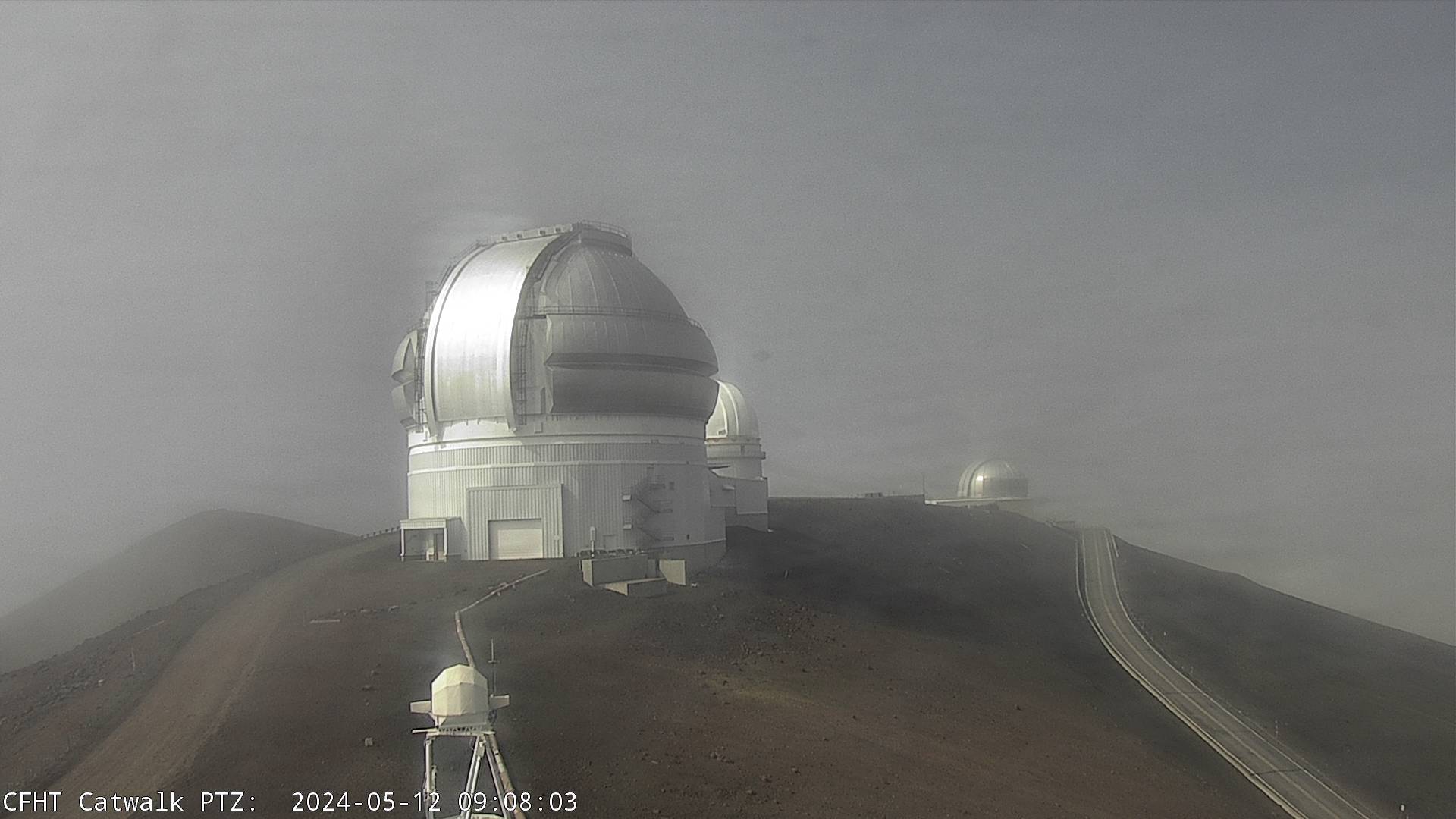
It’s cold atop Hawaii’s mountains now, as shown in this webcam shot of Mauna Kea on the Big Island…below freezing late Monday afternoon! This webcam view will of course go away once it gets dark over the Big Island.
The two most influential weather features that affect the Hawaiian Islands this week, will be the stronger winds after mid-week…and the increase in showers then into the weekend. Our weather until then will remain quite nice, with lots of daytime sunshine beaming down, especially over our warm leeward beaches. Once the winds become more blustery Thursday, we’ll see unusually strong winds, stronger than we’ve seen for a while. The showers, in association with an upper air low pressure system that will edge into our area, should should bring more showers in then too.
It’s a little after 5pm here in Kihei, Maui, as I begin writing this last paragraph of today’s narrative. Our weather Monday was just fine, with relatively light trade winds blowing, and not many showers around either. Several beach areas were able to climb to 80F degrees, with the Kahului airport rising all the way to 83 degrees. Whatever rainfall that fell, was for the most part restricted to the windward coasts and slopes. This generally fine trade wind weather pattern will hold tight through Wednesday. Thereafter, as noted in the paragraphs above, our winds will become blustery, and carry an increased amount of showers in on those much stronger trade winds. As the trade winds are bringing in relatively warm air from over our surrounding tropical ocean, it was quite warm at sea level. Case in point, at 5pm Monday evening, it was still 80F degrees at the Kahului airport…with Kapalua, Maui, and the Kona coast both registering a warm 79 degrees. This would be another great night to take a glance at that full moon! By the way, when I got home to Kula, and after taking my walk, I could see that there was a fair amount of haze, which looks volcanic in origin to me. I’ll be back very early Tuesday morning with your next new weather narrative from paradise, of course written from my upcountry home in Kula! Aloha for now…Glenn.
Interesting: The worst wildfires in history are still raging in the state of Victoria, triggered by an intense heat wave in southeast Australia. Temperatures significantly above normal have been experienced in the region since the start of 2009, coupled with rainfall totals well below average for the time of year. This combination of high temperatures, low rainfall and hot dry winds has led to optimum conditions for the wildfires to start and spread. Although wildfires are a common feature of Australian summers, the current extreme weather situation may be being enhanced by a weather phenomenon known as the Indian Ocean Dipole (IOD). The IOD is a phenomenon that results in an irregular warming and cooling of sea temperatures in the southeastern and southwestern Indian Ocean.
It was first recognized in 1999, and climate scientists from the University of South Wales have now linked the IOD to drought conditions in southern Australia. The IOD has two phases, a positive and a negative phase. During the positive phase, the sea temperature drops in the southeastern Indian Ocean and rises in the southwestern Indian Ocean. During the negative phase, the reverse is true. These differences in sea temperature determine how much water evaporates into the atmosphere, which in turn controls the amount of rainfall received in the adjacent areas. Higher sea temperatures lead to increased rainfall, whereas lower sea temperatures can lead to drought conditions. It seems that Australia is currently stuck in a positive phase of IOD, which may be contributing to the unprecedented wildfire situation.
Interesting2: As President Obama pursues green infrastructure projects and other programs aimed at fighting climate change, he is eventually going to have to confront an unpleasant truth: None of it will matter unless the developing world, particularly China, does the same. With China having passed the U.S. as the country with the highest greenhouse gas emissions in the world, and with its per-capita emissions rising four to six times faster than ours, any carbon reductions here will be more than canceled out by increases there. A smart way of addressing that problem was presented last week in a report by a multi- disciplinary team of experts, who proposed that Obama convene a summit with Chinese President Hu Jintao to outline a plan of action against global warming and create high-level councils in both countries to develop ways to implement it.
What makes this project, a joint effort of the Asia Society and the Pew Center on Global Climate Change, different from the usual think-tank fodder is that it was co-chaired by Steven Chu, who as the new secretary of Energy presumably has Obama’s ear when it comes to climate policy. The idea of cooperating more closely with China on such matters isn’t new. Former Treasury Secretary Henry M. Paulson began a series of high-level talks on economic issues with China in 2006, and last year he convened a session on energy and the environment that established various goals and set up task forces to address them. But climate change wasn’t really Paulson’s priority — the session took place in June, when high oil prices were the top economic and political issue, and it was aimed mainly at putting downward pressure on oil demand and prices.
Interesting3: University of Utah biologists discovered that young "right whales" learn from their mothers where to eat, raising concern about their ability to find new places to feed if Earth’s changing climate disrupts their traditional dining areas. "A primary concern is, what are whales going to do with global warming, which may change the location and abundance of their prey?" asks Vicky Rowntree, research associate professor of biology and a coauthor of the new study. "Can they adapt if they learn from their mother where to feed — or will they die?" Previous research by Rowntree and colleagues showed that when climate oscillations increase sea temperatures, southern right whales give birth to fewer calves because the warm water reduces the abundance of krill, which are small, shrimp-like crustaceans eaten by the whales.
The new study — scheduled for publication in the Feb. 15 issue of the journal Molecular Ecology — used genetic and chemical isotope evidence to show that mothers teach their calves where to go for food. "Southern right whales consume enormous amounts of food and have to travel vast distances to find adequate amounts of small prey," says study coauthor Jon Seger, professor of biology at the University of Utah. "This study shows that mothers teach their babies in the first year of life where to go to feed in the immensity of the ocean."
Interesting4: The answer to what’s killing the world’s coral reefs may be found in a tiny chip that fits in the palm of your hand. Scientists at Lawrence Berkeley National Laboratory and the University of California, Merced are using an innovative DNA array developed at Berkeley Lab to catalog the microbes that live among coral in the tropical waters off the coast of Puerto Rico. They found that as coral becomes diseased, the microbial population it supports grows much more diverse. It’s unclear whether this surge in microbial diversity causes the disease, or is a result of it. What is clear is that coral disease is accompanied by a microbial bloom, and the DNA array, called the PhyloChip, offers a powerful way to both track this change and shed light on the pathogens that plague one of the ocean’s most important denizens. “The PhyloChip can help us distinguish different coral diseases based on the microbial community present,” says Shinichi Sunagawa, a graduate student in UC Merced’s School of Natural Sciences who helped to conduct the research.
“This is important because we need to learn more about what’s killing coral reefs, which support the most diverse ecosystem in the oceans. Losing them is much more than losing a reef, it means losing fish and marine mammals, even tourism.” Worldwide, coral is threatened by rising sea temperatures associated with global warming, pollution from coastal soil runoff and sewage, and a number of diseases. The organism’s acute susceptibility to environmental change has given it a reputation as a canary in the coalmine: if it suffers, other species will soon follow. Fortunately, there are ways to give coral a health checkup. Scientists have recently learned that healthy coral supports certain microbial populations, while coral inflicted with diseases such as White Plague Disease support different populations.
Interesting5: Scientists from the California Institute of Technology (Caltech) and an international team of collaborators have returned from a month-long deep-sea voyage to a marine reserve near Tasmania, Australia, that not only netted coral-reef samples likely to provide insight into the impact of climate change on the world’s oceans, but also brought to light at least three never-before-seen species of sea life. "It was truly one of those transcendent moments," says Caltech’s Jess Adkins of the descents made by the remotely operated submersible Jason. Adkins was the cruise’s lead scientist and is an associate professor of geochemistry and global environmental science at Caltech. "We were flying–literally flying–over these deep-sea structures that look like English gardens, but are actually filled with all of these carnivorous, Seuss-like creatures that no one else has ever seen." The voyage on the research vessel RV Thompson explored the Tasman Fracture Commonwealth Marine Reserve, southwest of Tasmania. The voyage was funded by the National Science Foundation and was the second of two cruises taken by the team, which included researchers from the United States–including scientists from Caltech and the Woods Hole Oceanographic Institution in Massachusetts, which owns and operates the submersible Jason–and Australia’s Commonwealth Scientific and Industrial Research Organization (CSIRO).
The first of those voyages was taken in January 2008, with this most recent one spanning 33 days from mid-December 2008 through mid-January 2009. Up until now, the area of the reef the scientists were exploring–called the Tasman Fracture Zone–had only been explored to a depth of 1,800 meters (more than 5,900 feet). Using Jason, the researchers on this trip were able to reach as far down as 4,000 meters (well over 13,000 feet). "We set out to search for life deeper than any previous voyage in Australian waters," notes scientist Ron Thresher from CSIRO’s Climate Adaptation and Wealth from Oceans Flagships. The cruise had two main goals, says Adkins. One was to try to use deep-sea corals to reconstruct the paleo-climate–with an emphasis on the changes in climate over the last 100,000 years–and to understand the fluctuations in CO2 found in the ice-core records. Investigators also wanted to look at changes in the ocean over a much smaller slice of time–the past few hundred to one thousand or so years. "We want to see what’s happened to the corals over the Industrial Revolution timescale," says Adkins. "And we want to see if we can document those changes." The second goal? "Simply to document what’s down there," says Adkins.
Interesting6: It turns out a lot of what we throw in the garbage is stuff that could be composted. Stuff like food scraps, used Kleenex and greasy pizza cartons. In Duluth, the Sanitary District runs a compost site that turns 50-foot-long piles of anything you can think of into compost. The district’s Susan Darley-Hill calls these piles "windrows" because they look like giant rows of hay, only brown. It takes a couple of days to put together enough material to make these windrows, and each one has a small electric pump at the end to force air through it. "When the windrow is complete, we turn that air on, and that will circulate through the pile," Darley-Hill explains. "That keeps the ‘bugs’ as we call them, the microorganism, well supplied with oxygen, which is a really critical part of digestion process." A thermometer with a long stem reaches deep into the pile. "It looks like it’s reading about 143 degrees Fahrenheit, which is a great temperature," says Darley-Hill. "It’s probably about 10 degrees outside right now but it’s really toasty-warm inside.
Interesting7: Paleontology is a science that is noted for its tedium, typically involving researchers and their crews in weeks of painstaking searches of terrain that is often remote and hostile, looking for a fossilized bone shard that indicates the discovery of an ancient creature. Then there is Steve Sweetman, a paleontologist from England’s University of Portsmouth who in the past four years has discovered 48 new species from the age of dinosaurs. Sweetman discovered the new species in ancient river deposits on the Isle of Wight, which is known to bone hunters as "Dinosaur Island" because it is a rich source of dinosaur bones.
But instead of walking the island looking for telltale bone shards, Sweetman gathered up, bucket-by-bucket, some three and a half tons of mud for analysis. He took the mud to a laboratory he set up in his farm on the island and dried and sieved the mud until it became sand. He examined the sand under a microscope and discovered an assortment of tiny fossil bones and teeth. "In the very first sample I found a tiny jaw of an extinct newt-sized salamander-like amphibian and then new species just kept coming," he said. Sweetman has published papers on two of the mammals he’s discovered in the journal Palaeontology. The bucket-based research is continuing.
Interesting8: While parts of North America have been in the icy grips of an unusually cold and snowy winter recently, the Arctic has been downright balmy compared to past winters. These warmer-than-normal temperatures mean that the sea ice in the Arctic is looking pretty anemic, despite the winter season. Arctic ice goes through a normal cycle of summer thaw and winter re-freeze. In recent decades, however, sea ice has become overall less extensive and thinner, leading to forecasts that in future decades the polar region will be ice-free during summer. The trend looks to be continuing this winter, scientists now say. Climate swings in any single season are part of Nature, of course. That’s why records — warm or cold, wet or dry — get broken. For much of the United States, this winter has been an exceptionally chilly one.
The average temperature for the United States in December, 32.5 F, was almost 1 degree Fahrenheit below the average for the 20th century, according to the National Oceanic and Atmospheric Administration. Much of the West and Midwest had a particularly frigid month, with temperatures plunging several degrees below average. This winter in the Arctic has been a completely different story. "It’s warm everywhere in the Arctic. It’s anomalously warm," said Julienne Stroeve, of the National Snow & Ice Data Center (NSIDC) in Boulder, Colo. Both December and January have been abnormally warm months, which impacts the cyclical re-freezing of sea ice over the years, because these are "two crucial ice-growing months.
Interesting9: A futurist in Britain predicts contact lenses will double as TVs in 10 years time. "You will just pop it into your eye in the morning and take it out at the end of the day," said Ian Pearson in The Daily Mail. While it’s unclear why anyone would want such an annoying device, you’d change the channel with voice commands, the thinking goes, and body heat would run the electronics. The whole experience might then be more immersive, according to a related report commissioned by electrical retailer Comet. "We could even get to the point where we’ll be able to immerse ourselves in a football game, making it feel like you’re running alongside your favorite player or berating the ref," the report states. While the idea may sound farfetched, it’s actually rooted in technologies that are being developed. Already, glasses have been turned into private theaters. More dramatically, last year engineers attached electronic circuit and lights to a regular contact lens as a proof of concept for future digital contact lenses that would zoom in on distant objects or display useful facts. And this weekend, researchers announced a step forward in miniaturizing transistors to the point that they’ll be transparent — a key to creating informational displays on windshields or, one might imagine, contact lenses.
 Email Glenn James: