February 8-9, 2009
Air Temperatures – The following maximum temperatures were recorded across the state of Hawaii Sunday afternoon:
Lihue, Kauai – 76
Honolulu, Oahu – 80
Kaneohe, Oahu – 77
Kahului, Maui – 81
Hilo, Hawaii – 77
Kailua-kona – 81
Air Temperatures ranged between these warmest and coolest spots near sea level, and on the highest mountains…at 5 p.m. Sunday afternoon:
Kailua-kona – 79F
Lihue, Kauai – 73
Haleakala Crater – 46 (near 10,000 feet on Maui)
Mauna Kea summit – 27 (near 14,000 feet on the Big Island)
Precipitation Totals – The following numbers represent the largest precipitation totals (inches) during the last 24 hours on each of the major islands, as of Sunday afternoon:
2.81 Mount Waialaele, Kauai
0.27 Oahu Forest NWR, Oahu
0.00 Molokai
0.00 Lanai
0.00 Kahoolawe
0.59 West Wailuaiki, Maui
0.70 Honokaa, Big Island
Weather Chart – Here’s the latest (automatically updated) weather map showing high pressure systems to the north and northeast of the Hawaiian Islands. Our winds will remain in the light to moderately strong range through Tuesday
Satellite and Radar Images: To view the cloud conditions we have here in Hawaii, please use the following satellite links, starting off with the Infrared Satellite Image of the islands to see all the clouds around the state during the day and night. This next image is one that gives close images of the islands only during the daytime hours, and is referred to as a Close-up visible image. This next image shows a larger view of the Pacific…giving perspective to the wider ranging cloud patterns in the Pacific Ocean. Finally, here’s a looping IR satellite image, making viewable the clouds around the islands 24 hours a day. To help you keep track of where any showers may be around the islands, here’s the latest animated radar image.
Hawaii’s Mountains – Here’s a link to the live webcam on the summit of near 14,000 foot Mauna Kea on the Big Island of Hawaii. The tallest peak on the island of Maui is the Haleakala Crater, which is near 10,000 feet in elevation. These two webcams are available during the daylight hours here in the islands…and when there’s a big moon rising just after sunset for an hour or two! Plus, during the nights and early mornings you will be able to see stars, and the sunrise too…depending upon weather conditions.
Aloha Paragraphs

Full moon time again
Photo Credit: flickr.com
The trade winds will stick around into the new week. The trade winds will get a little lighter Monday and Tuesday, before boosting-up again starting Wednesday. Looking further ahead, the computer forecast models continue to suggest that our winds will remain out of the trade wind direction through the next week…becoming quite strong and gusty during the second half of the week.
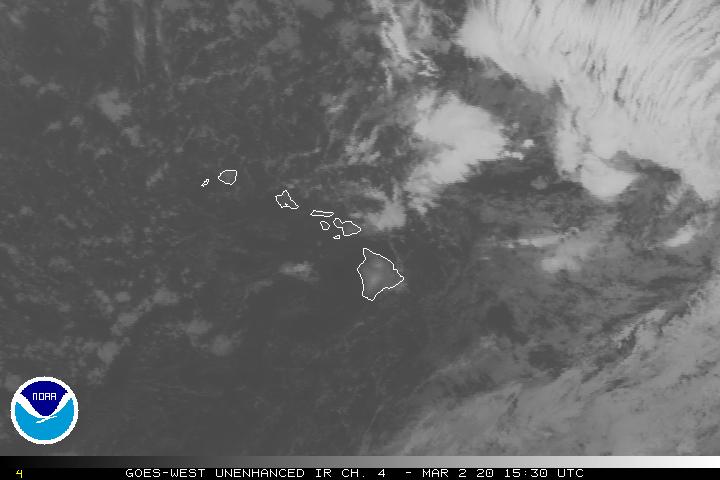
Besides the locally cloudy afternoons, and a few showers along the windward sides…our weather will be generally quite nice. As this satellite image points out, the weather remained nice in most places across the island chain Sunday. The one exception was over the slopes on the Big Island, where towering cumulus clouds, and even a thunderstorm popped-up during the afternoon hours, providing a few heavy showers. The upcoming week will start off with a few showers, although again, our weather will be mostly ok.
~~~ It’s around 6pm here in Kula, Maui, with a few clouds around…although most of the afternoon was amazingly clear. The air temperature is running close to 70F degrees at the moment, although now that the sun is getting ready to go down, the temperature will be dropping fairly quickly here in the upcountry area. Speaking of the sun going down, that will mean that the February full moon will be coming up soon!
~~~ This afternoon I bbq’d boneless organic chicken thighs, which I’ll eat for dinners during the coming week nights. I also sauteed fresh vegetables, including onion, potatoes, carrots, mushrooms, celery, and aspargus. This will take care of me for the upcoming dinner meals, which makes it easy to heat up. Since it‘s almost sunset, I’ll be heading out to witness that pleasant treat, sharing it with the two cats lounging around out there at the moment, Kiwi and Redgirl. I hope you have a great Sunday night, and make it outside tonight, to check out the huge moon rising out of of the eastern horizon. I hope too that you can come back again Monday morning, at which point I’ll have your next new weather narrative paradise waiting for you! Aloha for now…Glenn.
Interesting: Federal fisheries managers have voted to bar all commercial fishing in U.S. waters from north of the Bering Strait and east to the Canadian border in light of the rapid climate changes that are transforming the Arctic. In a unanimous vote yesterday, the North Pacific Fishery Management Council ruled that scientists and policymakers need to better assess how global warming is affecting the region before allowing fishing on stocks such as Arctic cod, saffron cod and snow crab. "There’s concern over unregulated fishing, there’s concern about warming, there’s concern about how commercial fishing might affect resources in the region, local residents and subsistence fishing and the ecosystem as a whole," said Bill Wilson, a council aide. Environmentalists and fishing interests praised the move as sensible, given the changes to ice cover and other features of the Arctic environment. The Marine Conservation Alliance — an association representing fishermen and processors who harvest ground fish and crab off Alaska’s coast — endorsed the council’s decision to close an area spanning nearly 200,000 square miles, an area nearly twice as large as the U.S. national park system.
Interesting2: Coral reefs off the southeast coast of Taiwan have turned black with disease possibly due to sewage discharge, threatening fragile undersea ecosystems and tourism, a study released Friday said. The discovery on a problem long suspected but seldom documented shows that coral is suffering widely in waters up to five meters (16.4 feet) deep and 300 meters offshore from two outlying islands, said researcher Chen Chao-lun of Taiwan’s state-funded Academia Sinica. "This is a large distribution and we had no previous information," said Chen, whose began doing research with local environmental groups in 2007. "If you snorkel, you’ll see it’s black. If it’s all black, there won’t be too many tourists." Coral reefs, delicate undersea structures resembling rocky gardens made by tiny animals called coral polyps, are important nurseries and shelters for fish and other sea life.
They also protect coastlines, provide a critical source of food for millions of people and are potential storehouses of medicines. Taiwan’s study did not pinpoint a cause for the diseased coral, but untreated sewage may a factor, Chen said. On Green Island, a tourism hotspot and one the sites surrounded by diseased coral, garbage and excrement are dumped into the surrounding azure waters while reefs are often plundered by coral-robbing tourists, officials and long-time divers say. The Taiwan researchers have sent their report to the government and plan to check for problems in other offshore areas known to support coral, Chen said.
Interesting3: Wind and solar power grew at a blistering pace in recent years, and that growth seemed likely to accelerate, especially in the United States under the green-minded administration of the new president, Barack Obama. But because of the credit crisis and the broader economic downturn, the opposite is happening: Except in isolated markets, like China, installation of wind and solar power is slowing, and in some cases plummeting. Factories building parts for these industries in the United States have announced a wave of layoffs in recent weeks, and trade groups are projecting 30 percent to 50 percent declines this year in the installation of new equipment, a decrease that bars more help from the government. Prices for turbines and solar panels, which soared when the boom began a few years ago, are falling. Communities that were patting themselves on the back just last year for attracting a wind or solar plant are now coping with cutbacks. ”I thought if there was any industry that was bulletproof, it was that industry,” said Rich Mattern, the mayor of West Fargo, North Dakota, where DMI Industries of Fargo operated a plant that makes towers for wind turbines.
Even though the flat Dakotas are among the best places in the world for wind farms, DMI recently announced a cut of about 20 percent of its work force because of falling sales. Much of the problem stems from the credit crisis that has left Wall Street banks reeling. Once, as many as 18 big banks and financial institutions were willing to help finance installation of wind turbines and solar arrays, taking advantage of generous government tax incentives. But with the banks in so much trouble, that number has dropped to four, according to Keith Martin, a tax and project finance specialist with the law firm Chadbourne & Parke. Wind and solar developers have been left hunting for capital. ”It’s absolutely frozen,” said Craig Mataczynski, president of Renewable Energy Systems Americas, a wind developer. He projected his company would build just under half as much this year as it did last year. The effects of the banking crisis were also being felt in Europe, although industry groups said it was too soon to tell what effect the credit freeze would have on the fast-growing sector.
Interesting4: Martha Kermel holds out rail-thin arms covered with a latticework of scratches from her encounter with a plague of caterpillars that has devastated crops and spread fear through this corner of West Africa. "They scratched my arms when they moved," said Kermel, a mother of four, telling how the small creatures poured down onto her from the tree branches overhead as she set out from her village to a rice farm cultivated by her community in Liberia. That was two weeks ago. Now the millions of caterpillars which covered the road and nearby bushes have retreated into cocoons, or hatched already into moths ready to spawn a new generation of grubs here or further afield. The insects can travel up to 60 miles a day, and have already crossed the border to Guinea, an agriculturally rich country and the source of many of Liberia’s food imports.
That has set alarm bells ringing in neighboring Ivory Coast, the world’s top cocoa grower and an important producer of coffee, rubber, palm oil and other cash crops. The creatures were first thought to be army worms, a moth caterpillar, but they were identified this week as the young of another kind of moth, the Achaea catocaloides, which are also known to damage cocoa and other tree crops. For the time being, the moths are headed north, and experts in Ivory Coast said this week they should avoid Ivory Coast’s valuable cocoa belt, which produces about 40 percent of world supply. But they remain a risk to Ivory Coast’s central borderlands, which produce around 100,000 tons of cocoa and 70,000 tons of robusta coffee a year.
Interesting5: A researcher at North Carolina State University is tracking the movement of the Redbay Ambrosia beetle, an invasive insect that, if it spreads to southeast Florida, may severely affect the production of avocados, a $15 million to $30 million industry in the state. First detected in the United States near Savannah, Ga., in 2002, the beetle had spread to Hilton Head Island, S.C., by 2004, causing widespread mortality in Redbay trees. Dr. Frank Koch, a research assistant professor at NC State who works with the United States Forest Service to help monitor and track the geographical movement of invasive species like the Redbay Ambrosia beetle, says it currently is continuing its journey south.The female Ambrosia beetle carries fungal spores on its body, a source of food for adult beetles and their larvae, which then inoculate Redbay trees. The fungus causes laurel wilt, the source of widespread and severe levels of Redbay mortality in the Southeastern coastal plain.
When the beetles bore into the sapwood of a host tree, the fungus germinates in the tree tissue and can cause tree death. "This beetle is very small – roughly two millimeters long – but it kills extremely rapidly," Koch says. "There are thousands of species of Ambrosia beetles, but they usually don’t cause damage to this extent. This particular beetle is very serious because the fungus it carries is remarkably lethal." The worry, Koch says, is that as the beetle continues to spread down the coast, it will begin to affect avocado trees, which belong to the same genus as Redbay trees. "This beetle is moving very fast, and it may be in the avocado-growing region of Florida within a year or two," Koch says. "The avocado industry is very concentrated – about 7,500 acres southwest of Miami – and an invasion by these beetles could cause major damage to the production of avocados."
Interesting6: A new University of British Columbia study reconciles a debate that has long raged among marketers and psychologists: What color most improves brain performance and receptivity to advertising, red or blue? It turns out they both can, it just depends on the nature of the task or message. The study, which could have major implications for advertising and interior design, finds that red is the most effective at enhancing our attention to detail, while blue is best at boosting our ability to think creatively. "Previous research linked blue and red to enhanced cognitive performance, but disagreed on which provides the greatest boost," says Juliet Zhu of UBC’s Sauder School of Business, author of the study which will appear in the Feb. 5 issue of Science. "It really depends on the nature of the task."
Between 2007 and 2008, the researchers tracked more than 600 participants’ performance on six cognitive tasks that required either detail-orientation or creativity. Most experiments were conducted on computers, with a screen that was red, blue or white. Red boosted performance on detail-oriented tasks such as memory retrieval and proofreading by as much as 31 per cent compared to blue. Conversely, for creative tasks such as brainstorming, blue environmental cues prompted participants to produce twice as many creative outputs as when under the red color condition. These variances are caused by different unconscious motivations that red and blue activate, says Zhu, noting that color influences cognition and behavior through learned associations.
Interesting7: Australia is to be the hottest place on the planet this weekend with temperatures set to breach 113F degrees in the south-east corner of the continent, officials warned Friday. The big worry is that arsonists would take advantage of ideal conditions and lay potentially deadly forest fires. "We are going to have unbelievably high temperatures, and we are also going to have unbelievably high winds," Victoria state Premier John Brumby said. "We have got a state which is just tinder-dry." He warned of a possible repeat of the blazes of 1983 that left 75 people dead.
Fire brigades are on high alert with all the state’s fleet of water-bombing aircraft on standby. Residents of Melbourne fear a repeat of the power blackout the heat wave has brought in recent weeks. In neighboring New South Wales, all 70,000 volunteer firefighters were to be on call. National parks where the danger of arson is high would be placed out-of-bounds to the public. People were being asked to watch out for those deliberately lighting fires and to report any suspicious behavior to police. More than half of Australia’s forest fires are believed to be the work of arsonists.
 Email Glenn James: