February 5-6, 2009
Air Temperatures – The following maximum temperatures were recorded across the state of Hawaii Thursday afternoon:
Lihue, Kauai – 75
Honolulu, Oahu – 80
Kaneohe, Oahu – 72
Kahului, Maui – 80
Hilo, Hawaii – 73
Kailua-kona – 80
Air Temperatures ranged between these warmest and coolest spots near sea level, and on the highest mountains…at 4 p.m. Thursday afternoon:
Honolulu, Oahu – 78F
Hilo airport – 72
Haleakala Crater – 54 (near 10,000 feet on Maui)
Mauna Kea summit – 36 (near 14,000 feet on the Big Island)
Precipitation Totals – The following numbers represent the largest precipitation totals (inches) during the last 24 hours on each of the major islands, as of Thursday afternoon:
1.67 Mount Waialaele, Kauai
0.08 Kahuku, Oahu
0.01 Molokai
0.00 Lanai
0.00 Kahoolawe
0.33 West Wailuaiki, Maui
0.97 Glenwood, Big Island
Weather Chart – Here’s the latest (automatically updated) weather map showing a 1036 millibar high pressure system far to the northeast of the Hawaiian Islands Friday. Our winds will remain out of the trade wind direction…locally gusty into Saturday.
Satellite and Radar Images: To view the cloud conditions we have here in Hawaii, please use the following satellite links, starting off with the Infrared Satellite Image of the islands to see all the clouds around the state during the day and night. This next image is one that gives close images of the islands only during the daytime hours, and is referred to as a Close-up visible image. This next image shows a larger view of the Pacific…giving perspective to the wider ranging cloud patterns in the Pacific Ocean. Finally, here’s a looping IR satellite image, making viewable the clouds around the islands 24 hours a day. To help you keep track of where any showers may be around the islands, here’s the latest animated radar image.
Hawaii’s Mountains – Here’s a link to the live webcam on the summit of near 14,000 foot Mauna Kea on the Big Island of Hawaii. The tallest peak on the island of Maui is the Haleakala Crater, which is near 10,000 feet in elevation. These two webcams are available during the daylight hours here in the islands…and when there’s a big moon rising just after sunset for an hour or two! Plus, during the nights and early mornings you will be able to see stars, and the sunrise too…depending upon weather conditions.
Aloha Paragraphs

Gusty trade winds…less cloudy soon
Photo Credit: flickr.com
Trade winds, trade winds…and more trade winds. A trade wind generating high pressure system to our northeast, will be moving away soon, allowing our winds to slack-off a little going into the weekend. The computer models show another high pressure system moving into place to our north however…which will boost our trade wind speeds again shortly thereafter.
The long lasting bout with cloudy weather, will finally be coming to an end…especially on the leeward sides going into the weekend. The trough of low pressure aloft, to the south of the islands, will keep high and middle level clouds around locally Friday. There will be an increasing amount of thin spots in this cloud cover however, so that we we’ll see some sunshine breaking through during the days. This trough will move away during the weekend, allowing sunny weather to return. Meanwhile, the low clouds being carried our way on the trade winds, will bring some fairly typical showers onto our windward sides.
It’s early Thursday evening here in Kihei, Maui, as I begin writing this last section of today’s narrative. The trade winds will be the primary mover and shaker in our Hawaiian Island weather picture going forward. The good thing about the trade winds during the winter month of February, is that they often keep fair weather conditions around, with just those usual passing showers along the windward coasts and slopes.
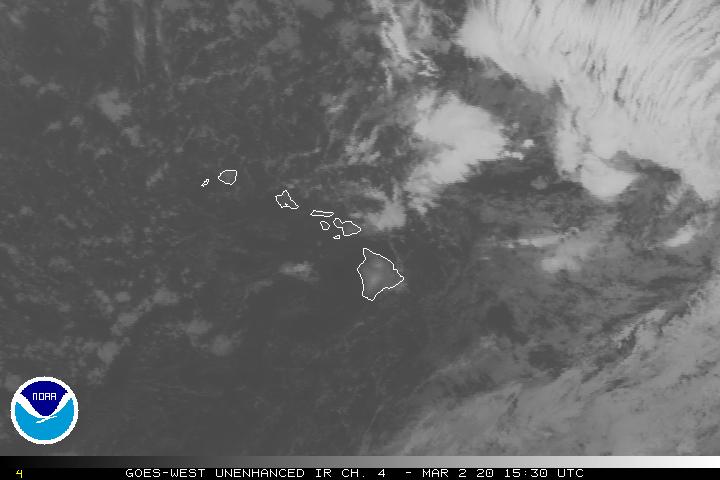
~~~ I’m about ready to leave Kihei, for the drive back upcountry to Kula. Looking out the window before I leave, I’d like to say that it’s mostly clear…although it isn’t! As a matter of fact, as it has been all this week, it’s actually mostly cloudy. Speaking of which, here’s a satellite image, showing you the nature, and extent of this cloudiness. There is light at the end of the tunnel however, as this stuff will soon be exiting our area, and shifting to the east, away from all the Hawaiian Islands. I can imagine that already by Friday, we will see considerably more of our famous Hawaiian sunshine…which will do nothing but increase more so going into the weekend!
~~~ Let me turn back to the winds for a second before I leave. Looking around the state at 5pm, the strongest gust that I found was 35 mph down at South Point, on the Big Island…along with the 30 mph gust on the small island of Kahoolawe at the same time. Here in Kihei, at least outside this building at the moment, there is hardly a breathe of air. I’m sure that once I get upcountry to Kula, it will be calm as well, as the trades are blocked by the hulk of the Haleakala Crater. At any rate, I hope you have a great Thursday night! I’ll be back very early Friday morning with your next new weather narrative from paradise…very early at least here in the islands. Aloha for now…Glenn.
Interesting: In that strange intersection of economics and politics, there is a new fashion: Trillion is the new billion. A billion is a thousand million, and a trillion is a thousand billion. To provide some perspective on just how big a trillion dollars is, think about it like this: A trillion dollars is the number 1 followed by 12 zeroes. Or you can think of it this way: One trillion $1 bills stacked one on top of the other would reach nearly 68,000 miles (about 109,400 kilometers) into the sky, or about a third of the way from the Earth to the moon. Some Republicans are hardly over the moon about the growing size of the proposed economic stimulus plan. Senate Republican leader Mitch McConnell said this week that Americans have become desensitized to just how much money that is. "To put a trillion dollars in context, if you spend a million dollars every day since Jesus was born, you still wouldn’t have spent a trillion," McConnell said.
"A million dollars a day for 2,000 years is only three-quarters of a trillion dollars. It’s a big number no matter how you slice it," Paulos said. Here’s another way to look at it. "A million seconds is about 11½ days. A billion seconds is about 32 years, and a trillion seconds is 32,000 years," Paulos said. "People tend to lump them together, perhaps because they rhyme, but if you think of it in terms of a jail sentence, do you want to go to jail for 11½ days or 32 years or maybe 32,000 years? So, they’re vastly different, and people generally don’t really have a real visceral grasp of the differences among them." Everyone is tossing around the words million, billion and trillion. With the national debt now topping $10 trillion, following a $700 billion bank rescue and proposed $800 billion-plus stimulus package, have we become numb to the numbers?"
Interesting2: A nationwide craze for screen golf cafes has brought golf out of the open spaces in South Korea, turning it into one of the most popular new indoor entertainments for the masses. Golf has traditionally been perceived as an elitist sport, with the country’s 4 million golfers regarded as people of class, status and money. Only a chosen few are able to splurge on the expensive golf club membership fees that can be as high as 200 million to 300 million won, or 144,000 to 210,000 US dollars. Only those at the top executive level are able to spare the time, as well as the money, needed to play an 18-hole round of real golf. But the image of golf as a pastime only for the rich began to change in 2002, when screen golf cafes began to catch on. In South Korea today there are some 175 major real golf courses, compared to some 5,000 screen golf cafes. At the golf cafes, golfers swing real golf clubs, hitting a real ball into a wall-sized interactive screen displaying some of the fairways of the world’s most popular golf courses.
Screen golf itself had already been around for many years, but it was mostly used as a teaching tool for golf rookies. But it was the advancement in Korean simulation technology that enhanced the real-life feel of golfing, closely replicating the fairways and accurately simulating the golfing action, that has made it appealing not only for practice but also for affordable fun and informal social gatherings. When the virtual reality screen golf was first launched in 2001 by South Korean venture company Golfzon, it initially targeted golf rookies who were too shy to play outdoors before honing their skill. But now screen golf has spread to include a fan base of ordinary people who had wanted to play golf but could not afford it. Compared with the 250 dollars that an 18-hole round real golf would cost, a round of screen golf costs only 10 to 20 dollars for a 9-hole to 18-hole round of virtual golf. Screen golf has become a prime pastime at social gatherings. It usually brings together three to six friends, colleagues or family members to play during a one or two hour break.
Interesting3: A thick cloud of dust from the Sahara desert engulfed the Greek capital Thursday, a phenomenon uncommon for this time of year according to meteorologists. Weather experts said the arrival of the thick dust from Africa, which was brought on southerly winds, normally occurs in the autumn. "There will probably be problems with the landing and take-off of flights due to the lack of visibility above airports," said meteorologist Kostas Lagouvardos, adding that "a few days ago there was a thick cloud of dust on the southern Mediterranean island of Crete." Lagouvardos said the concentration of dust particles in the atmosphere would probably linger for a few more days and would affect those suffering from asthma or lung-related problems.
Interesting4: Sub-freezing temperatures across the South may spell disaster for farmers at the height of the winter harvest. The same cold snap that sprinkled North Carolina with snow and brought tornado-strength winds and frigid air to Georgia has sent Florida into a big chill – threatening the state’s usually abundant citrus crops. "It can be incredibly devastating. If it’s below 28F degrees for four to six hours, you can do damage to citrus, which is one of the heartier crops we have," Terry McElroy, a Florida Agriculture Department spokesman, told CBS News.
Most of the country’s winter fruits and vegetables come from Florida fields and a deep freeze can be costly. Across the state, workers rushed to get truck loads of produce out of the fields and on to market ahead of the cold. "Right now, the valencias are coming in, the honeybells are finishing up. And it … would be devastating to the industry," grower Bob Roth told CBS Radio News. Fortunately, temperatures in citrus country were not expected to stay low long enough to do significant damage to that crop, reports Cobiella. And there’s even better news for growers – the weather’s expected to warm up Thursday.
Interesting5: The European Commission has unveiled measures aimed at protecting sharks, many of which are in sharp decline. The proposals would close loopholes in current shark fining regulations, cut catches of endangered species and set quotas according to scientific advice. About half of ocean-going shark species are threatened with extinction. Conservation groups have given a mixed reaction to the commission’s proposals, which now go to the European Parliament and Council of Ministers for approval. "The plan is a great step forwards for the conservation of sharks in European waters and beyond," said Sonja Fordham, policy director of the Shark Alliance, a coalition of organizations representing conservation, science and recreational interests. "The commitments to science-based fishing limits, endangered species protection, and a stronger fining ban are essential to securing a brighter future for some of Europe’s most vulnerable and neglected animals."
The regulations will also apply to sharks’ close relatives, skates and rays. But the Madrid-based conservation group Oceana said the proposals did not go far enough. "We have got a vague document which does not contain measures to achieve the goal of conservation and sustainable management of sharks," said the group’s director of investigations, Ricardo Aguilar. "Key omissions include a commitment to the precautionary approach, and integration with existing EU and global environmental measures that aim to protect threatened sharks and their habitats." Among other things, Oceana had been lobbying for a much tighter timescale on the introduction of these controls, some of which may not come into force for four years – and then only if the European Parliament and Council of Ministers agree.
Interesting6: Researchers in California are reporting an advance toward the long-sought goal of "invisible electronics" and transparent displays, which can be highly desirable for heads-up displays, wind-shield displays, and electronic paper. The scientists describe development of tiny, transparent electronic circuits — the most powerful of their kind to date — that could pave the way for transparent electronics and other futuristic applications, including flexible electronic newspapers and wearable clothing displays. In the new study, Chongwu Zhou and colleagues point out that although scientists have previously developed nano-sized transparent circuits, previous versions are limited to a handful of materials that are transparent semiconductors. The researchers describe the development of transparent thin-film transistors (TTFTs) composed of highly aligned, single-walled carbon nanotubes — each about 1/50,000th the width of a single human hair. They are transparent, flexible, and perform well. Laboratory experiments showed that TTFTs could be easily applied to glass and plastic surfaces, and showed promise in other ways for a range of possible practical applications.
Interesting7: Emergency officials in British Columbia, Yukon and Alaska are preparing for the possible eruption of the Mount Redoubt volcano near Anchorage. The volcano, 166 kilometers southwest of the Alaskan city, has been showing signs of minor activity since the fall. In November, geologists saw changes in emissions and some minor melting near the summit, and the threat rating was upgraded. Recently, it was upgraded again and there have been conference calls among agencies to review emergency-measures plans. "Right now, it’s sort of in watch mode," Michael Templeton, manager of the Yukon Emergency Measures Organization, said yesterday. Whether an eruption would affect the territory remains unknown, he said. Volcanic ash has been known to travel thousands of kilometers, but distance and direction depend on factors such as the height of the volcano’s smoke plume and the direction of the wind.
Officials are watching the Alaska Volcano Observatory website, which provides updates on activity at Redoubt. "Seismic activity at Redoubt continues at an elevated level and is well above background levels. A major concern is the possibility of ash ending up in the flight path of aircraft. Mr. Templeton said planes in the air at the time of an eruption would be notified by radio. Should the volcano erupt, officials in Alaska would contact B.C. officials, who would then contact those in Yukon. Mr. Templeton said the B.C. Provincial Emergency Program has more employees and is staffed around the clock, while Yukon emergency officials are available only on call outside regular working hours.In 1992, parts of the Alaska Highway in Yukon were closed when the Mount Spurr volcano erupted close to the Canada-U.S. border.
 Email Glenn James: