January 28-29, 2009
Air Temperatures – The following maximum temperatures were recorded across the state of Hawaii Wednesday afternoon:
Lihue, Kauai – 73
Honolulu, Oahu – 76
Kaneohe, Oahu – 73
Kahului, Maui – 72
Hilo, Hawaii – 79
Kailua-kona – 80
Air Temperatures ranged between these warmest and coolest spots near sea level, and on the highest mountains…at 4 p.m. Wednesday afternoon:
Kailua-kona – 78F
Kapalua, Maui – 66
Haleakala Crater – 43 (near 10,000 feet on Maui)
Mauna Kea summit – 32 (near 14,000 feet on the Big Island)
Precipitation Totals – The following numbers represent the largest precipitation totals (inches) during the last 24 hours on each of the major islands, as of Wednesday afternoon:
0.01 Hanapepe, Kauai
0.13 Oahu Forest NWR, Oahu
0.69 Molokai
0.34 Lanai
1.40 Kahoolawe
1.67 West Wailuaiki, Maui
0.16 Kahua Ranch, Big Island
Weather Chart – Here’s the latest (automatically updated) weather map showing high pressure systems far to the northeast and northwest of the Hawaiian Islands. Our winds will gradually become trade winds into Friday.
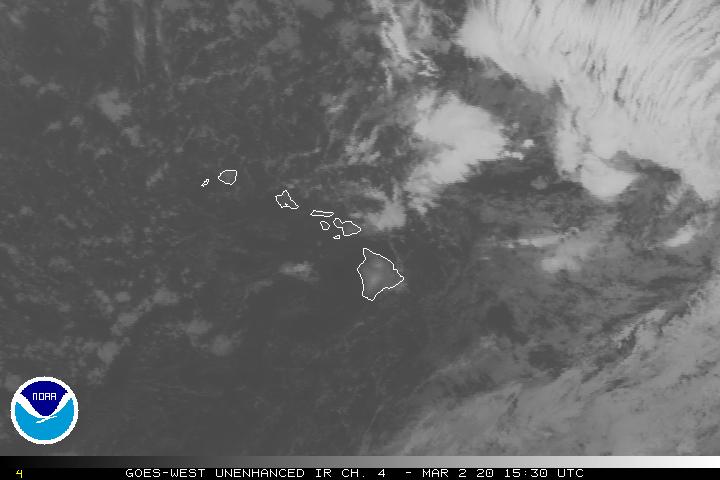
Satellite and Radar Images: To view the cloud conditions we have here in Hawaii, please use the following satellite links, starting off with the Infrared Satellite Image of the islands to see all the clouds around the state during the day and night. This next image is one that gives close images of the islands only during the daytime hours, and is referred to as a Close-up visible image. This next image shows a larger view of the Pacific…giving perspective to the wider ranging cloud patterns in the Pacific Ocean. To help you keep track of where any showers may be around the islands, here’s the latest animated radar image.
Hawaii’s Mountains – Here’s a link to the live webcam on the summit of near 14,000 foot Mauna Kea on the Big Island of Hawaii. The tallest peak on the island of Maui is the Haleakala Crater, which is near 10,000 feet in elevation. These two webcams are available during the daylight hours here in the islands…and when there’s a big moon rising just after sunset for an hour or two! Plus, during the nights and early mornings you will be able to see stars, and the sunrise too…depending upon weather conditions.
Aloha Paragraphs

Your reliable Hawaiian weather report!
Photo Credit: flickr.com
We’re on the outer edge of the cool north to northeast breezes, associated with the long lasting cold front…which will give way to warmer trade winds later Thursday into the weekend. The frontal cloud band that brought these cool breezes to the state, stalled over Maui County…and has been cemented into place for the last several days. The trade winds, once they fill back into the state, will blow in the light to moderately strong category. As usual though, those typically windier locations will see gusty conditions with time.
The lion’s share of Wednesday’s showers, or rain as the case may be, fell over the islands of Maui County. Clouds continue to stick like glue over the central part of the state. Here’s a looping radar image, so you can see where the precipitation is falling over the Hawaiian islands. We may to see some showers over and around Maui County, and perhaps on Oahu overnight, into the early hours of Thursday. Our local weather conditions will improve later Thursday, with a fairly normal trade wind weather pattern taking over then into the weekend…although the windward showers will continue locally.
Yesterday’s cold front is still stretched across the central Islands, with both the Big Island and Kauai outside its associated precipitation shield. Speaking of this difficult to retire cold front, this satellite image shows what’s left of the cloud band. The models continue to show this front, or what’s left of it, dissipating quite a bit on Thursday…which will be good news for those folks who have been wet for the last several days. As the trade winds return, look for off and one showers spraying their way along the windward coasts and slopes. The leeward areas, yes, even in Maui County, will finally see quite a bit of sunshine beaming down!
I’m about ready to leave Kihei for the Upcountry area of Kula. Looking out the window here before heading out, it’s totally cloudy, with a light drizzle falling…like it’s looked all day! I didn’t see one single second of sunshine the entire day here in Kihei, despite its being known for its dry and sunny weather. I know that down on the Big Island, and even on Oahu and Kauai, it has been a nice day, with sunshine galore in many areas. Here on Maui though, as I suspected would happen, with the front stalling over us, has been wintery and cool. It was slightly warmer today than yesterday, but not by much! I know that as I get up to Kula, it will be certainly cooler than down here by sea level, and that the mist will be falling too.
~~~ I’ll be back early Thursday morning with your next new weather narrative. I anticipate improving weather later Thursday, so all you folks who are hanging on by a thread, here in Maui County, please contain yourself a little while longer…the sun will be back sooner than later. I hope you have a great Wednesday night wherever you happen to be reading from. By the way, did you see the whole new set of interesting news stories below, and the comments that we received from you readers today as well? Aloha for now…Glenn.
Interesting:
The United Nations has warned of acute food shortages in parts of
Production has dropped by half in the Irrawaddy Delta – but in other regions, yields have been much higher, so that there is actually a healthy surplus available for export. But the number of Burmese who cannot grow or buy enough to eat has risen sharply to six million, says the WFP. The UN wants to increase food aid – but cannot, because the government inexplicably stopped it from buying rice locally last year, and because the military restricts access to the worst-hit areas along the western border. These are where ethnic Rohingya and Chin people live; their plight is reported to be desperate, with Chin state hit by a huge plague of rats. The UN is hoping its appeal will persuade the Burmese government to lift these restrictions. The dire conditions in which most Rohingyas live is one of the factors driving so many of them to Thailand.
Interesting2: Residents of south-eastern Australia are being warned to expect the worst heat wave in a century. Emergency services are on high alert and, in the state of Victoria, locals are being urged to prepare bush fire plans in case they need to flee. Temperatures went up to 114F in Adelaide, its hottest day in 70 years. In Melbourne, two people died in the searing heat, including a 75-year-old man who collapsed while walking to his car, the AFP news agency said. Some train and tram services were cancelled as rail lines buckled in the heat. There were also power outages, as people turned on their air-conditioning units to cool down. The heat wave in Victoria is expected to last several days and be the region’s worst since 1908, according to AFP. The average temperature in Melbourne at this time of year is 78F.
Play at the Australian Open tennis tournament in Melbourne was interrupted as temperatures reached 106F and organizers for the first time enacted their "extreme heat policy". The women’s singles quarter-final between Serena Williams and Svetlana Kuznetsova was halted for about 45 minutes as the roof on the Rod Laver Arena was closed, allowing the temperature on court to be lowered. Williams said: "I was in like an out-of-body experience. I kept trying to tell myself that it’s not hot, you know… But it got hotter." Meanwhile in the state of South Australia, officials cancelled a horse race meeting in the town of Gawler because of the extreme weather conditions.
Interesting3: Despite the recent winter storms causing havoc across much of the Midwest and northeast USA, ski resorts in the Rockies have been left reaping the benefits. Winter storms during last weekend and at the start of this week have pushed snow depths above 200 inches. The latest storm dumped more than 42 inches of fresh powdery snow across Steamboat in Colorado, bringing their total snowfall to 229 inches so far this season. Crested Butte received 33 inches pushing their snowfall to 202 inches.
Other Colorado resorts also enjoyed fresh snowfall; Aspen Mountain saw around 27 inches and Wolf Creek, Echo Mountain and Powder horn yielded around a foot of snow. With further winter storms likely to develop in the near future, many more resorts could reach their 200 inch benchmark early. Skiing conditions in the Rockies could get even better over the next few weeks as further winter storms are forecast to develop. There is still a lot of ski season left in Colorado, including the month of March, which is traditionally the states snowiest month.
Interesting4: Is luck contagious? A new study in the Journal of Consumer Research sheds light on why, at a casino, people seem to gather around machines and people on a winning streak. "It is common to find that people consider luck to be contagious—they are likely to believe that being near a person on a winning streak somehow enhances their own chances of winning," writes author Arul Mishra (University of Utah, Salt Lake City). His research focused on testing whether consumers would make product choices based on the same contagion principle. Participants in one of Mishra’s studies were asked to choose a Pepsi bottle from one of two groups. In one group the bottles were close together and in the other they had been arranged apart.
When the consumers were told that one of the bottles in each group contained a gift coupon, the majority of subjects chose a bottle from the close-together group. But, when participants were told that one of the bottles in each group was defective, they were more likely to choose from the group with the bottles arranged apart. The research showed that "the age-old belief that qualities are contagious and transferable is quite pervasive in simple everyday decisions," writes Mishra. Mishra determined that a group that is considered contagious appears to spread the qualities of one of its members to the complete group. So, for gain, the contagious (close) group appears more attractive since the whole group seems to reflect the positive quality. However, for loss, a non-contagious group appears more attractive since in such a group the loss quality appears to spread less.
Interesting5: The Cretaceous–Tertiary mass extinction, 65 million years ago, may have wiped out the dinosaurs, but those that survived – the ancestors of today’s birds – may have done so because of their bird brains. Analysis of computer tomography (CT) scans of fossilized bird skulls shows they had a more developed, larger brain than previously thought. ‘Birds today are the direct descendents of the Cretaceous extinction survivors, and they went on to become one of the most successful and diverse groups on the planet,’ says Natural History Museum palaeontologist (fossil expert), Dr Stig Walsh.
‘There were other flying animals around, such as pterosaurs and older groups of birds,’ says Dr Walsh, ‘but we’ve not really known why the ancestors of the birds we see today survived the extinction event and the others did not. It has been a great puzzle for us – until now.’ A larger and more complex brain may have given them a competitive advantage over the other more ancient birds and pterosaurs, helping them to better adapt when the environment changed after the mass extinction event.
Interesting6: Give a cow a name and she will reward you with an increased milk yield, researchers in Britain have found. A study by Newcastle University published Wednesday said that cows given names such as Ermintrude or Daisy were happier than those remaining anonymous. "By placing more importance on the individual, such as calling a cow by her name or interacting with the animal more as it grows up, we not only improve the animal’s welfare and her perception of humans, but also increase milk production," said research team leader Catherine Douglas.
"Just as people respond better to the personal touch, cows also feel happier and more relaxed if they are given a bit more one-to-one attention." The research team at the university’s School of Agriculture, Food and Rural Development asked 516 British dairy farmers about their attitude to the behavior and welfare of their cows. Almost half – 46 per cent – said the cows on their farm had individual names. Data showed that farmers who called cows by name had a 258 liter higher milk yield than those who did not. About 48 per cent of respondents said positive human contact was more likely to produce cows with a good milking temperament, and 10 per cent said that a fear of humans resulted in a poor milking temperament.
Interesting7: Imagine never forgetting anything. Virtue? Curse? Four people are said to have such "super-memories," including the latest case, a Southern California man who researchers don’t plan to identify by name. According to USA Today, the man recalls in detail most days of his life, as well as the day and date of key public events, said researchers Larry Cahill. The newspaper interviewed Jill Price, another person with a super memory. Price discussed her mind lat year in the book "The Woman Who Can’t Forget." There is much about memory that scientists don’t understand.
Only this month, in fact, they found that a single brain cell can hold a memory for a brief period before it’s put in long-term storage, a feat that requires connections between brain cells. Two areas in Price’s brain are responsible: the caudate nuclei, typically used for memory when forming automatic habits; and a part of the temporal lobe that stores facts, dates and events, Cahill told USA TODAY. The two brain areas might work together, in ways not realized before, to make allow the unforgettable connections. Better understanding of the condition could lead to improvements in grasping the science of memory in regular folks, the researchers figure.
Interesting8: Tech-savvy South Korea has nearly as many cell phones as people, officials said Wednesday. There were 45.6 million mobile phone subscribers in South Korea in December in a country with a population of 48.6 million, Sung Suk-ham of the Korea Communications Commission said. That’s over 93 percent, a slight rise in rates from six months ago. The number is expected to rise further in the coming year, despite the economic downturn, Sung said.
This indicates one of the highest cell phone saturation rates in the world. Cell phones have become a vital part of everyday life in South Korea, used for shopping, surfing the Web, bank transactions, sending e-mail, listening to music as well as talking. The country — home to Samsung Electronics and LG Electronics, the world’s No. 2 and No. 4 manufacturers of mobile phones — also has a high rate of Internet usage. In addition to an average of 2.75 mobile phones per household, more than 15.4 million South Koreans — just under a third of the population — have high-speed Internet, the commission said.
 Email Glenn James: