January 26-27, 2009
Air Temperatures – The following maximum temperatures were recorded across the state of Hawaii Monday afternoon:
Lihue, Kauai – 76
Honolulu, Oahu – 79
Kaneohe, Oahu – 78
Kahului, Maui – 81
Hilo, Hawaii – 76
Kailua-kona – 81
Air Temperatures ranged between these warmest and coolest spots near sea level, and on the highest mountains…at 4 p.m. Monday afternoon:
Kailua-kona – 79F
Barking Sands, Kauai – 71
Haleakala Crater – missing (near 10,000 feet on Maui)
Mauna Kea summit – 34 (near 14,000 feet on the Big Island)
Precipitation Totals – The following numbers represent the largest precipitation totals (inches) during the last 24 hours on each of the major islands, as of Monday afternoon:
1.15 Mount Waialaele, Kauai
0.17 Oahu Forest NWR Oahu
0.00 Molokai
0.00 Lanai
0.00 Kahoolawe
0.10 Hana airport Maui
0.07 Mountain View, Big Island
Weather Chart – Here’s the latest (automatically updated) weather map showing a 1035 millibar high pressure system located far to the northeast of the Hawaiian Islands. This high pressure cell has its ridge to the east of the islands, which has turned our winds to the southeast through southwest ahead of a cold front.
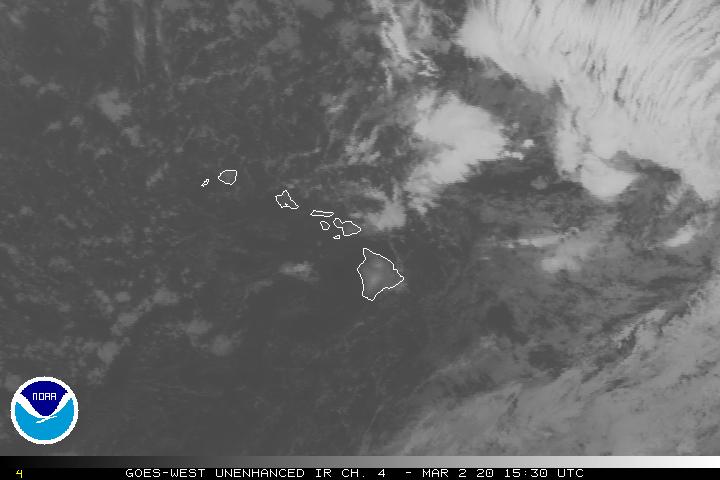
Satellite and Radar Images: To view the cloud conditions we have here in Hawaii, please use the following satellite links, starting off with the Infrared Satellite Image of the islands to see all the clouds around the state during the day and night. This next image is one that gives close images of the islands only during the daytime hours, and is referred to as a Close-up visible image. This next image shows a larger view of the Pacific…giving perspective to the wider ranging cloud patterns in the Pacific Ocean. To help you keep track of where any showers may be around the islands, here’s the latest animated radar image.
Hawaii’s Mountains – Here’s a link to the live webcam on the summit of near 14,000 foot Mauna Kea on the Big Island of Hawaii. The tallest peak on the island of Maui is the Haleakala Crater, which is near 10,000 feet in elevation. These two webcams are available during the daylight hours here in the islands…and when there’s a big moon rising just after sunset for an hour or two! Plus, during the nights and early mornings you will be able to see stars, and the sunrise too…depending upon weather conditions.
Aloha Paragraphs

Cold front moving down through the island chain
Photo Credit: flickr.com
A cold front has caused our winds to become southeast through southwest across the Hawaiian Islands Monday evening. There may be localized gusty winds, especially around any thunderstorms that occur over or around Maui County Tuesday morning. In the wake of the frontal cloud band, we’ll experience a period of cooler than normal north to northeast winds, followed by the return of warmer trade winds starting later Wednesday or Thursday…continuing through the remainder of the week.
The Hawaiian Islands will see clouds and showers…as a cold front moves down through the island chain through Tuesday. This shower bearing cold front arrived over Kauai during the fternoon, moving over Oahu during the night, bringing briefly heavy precipitation with it. As the frontal band moves down over Maui County early Tuesday, there will be the chance of somewhat heavier rains, and even a thunderstorm. The Big Island will be on the receiving end of these showers later Tuesday. Here’s a looping radar image, so we can track the rainfall marching down through the island chain. Our local weather conditions will improve after Wednesday, with a fairly normal trade wind weather pattern taking over through the rest of the week…althought the windward biased showers will likely continue.
It’s Monday evening a cold front moving down through the island chain. This well advertised cold front, which moved over Kauai Monday afternoon, will bring rains to Oahu during the night. As the frontal cloud band migrates down over Maui County Tuesday morning, arriving colder air aloft may trigger heavier showers, and even a thunderstorm or two. It appears that the Big Island will find some of these showers arriving later in the day Tuesday into the night and Wednesday. Speaking of the Big Island, the summits there will likely find snow falling with time too. Speaking of the cold front, this satellite image shows the frontal cloud band. As the winds turn north and northeast in the wake of the front, and then ENE trades arrive Thursday…some of the leftover moisture from the front will be carried back over the windward sides of the islands. The leeward sides will return to generally dry conditions through the rest of the week however.
~~~ The term cold front, will aptly describe the air that floods into the state in the wake of this frontal passage. By the way, here’s a looping satellite image of the cold front. It’s not always that the islands receive colder air (tropically speaking) after a cold front, but this time will be one of those! This chilly reality won’t last too long, as the more easterly trade winds arrive after Wednesday. It may be a good idea to get that extra blanket on your bed soon, especially by Tuesday and Wednesday nights…as temperatures will plummet into the 50F’s…even in many sea level areas.
~~~ I’m about ready to take the drive from Kihei, upcountry to Kula, Maui. Looking out the window, I can see clouds riding in on the south to southwest Kona winds, ahead of the cold front. There’s still quite a bit of clear blue skies out there, but the clouds are increasing rather quickly it seems. I’ll be back very early Tuesday morning with more information about this front. I hope you have a great Monday night until then! Please use the satellite and radar images up a few paragraphs, to follow the progress of this fronts passage down through the state. Aloha for now…Glenn.
~~~ One of the readers of this website sent me some information on the important event occurring now. "The Lunar New Year, which begins Monday, January 26, 2009, is observed in much of the East Asian world. Monday marks the beginning of the Year of the Ox. People born in this sign are dependable, patient and methodical. They do not back down in the face of obstacles. President Obama is an Ox."
Interesting: U.S. President Barack Obama will start reversing former President George W. Bush’s climate change policies on Monday with steps to raise fuel efficiency standards and grant states authority to limit greenhouse gas emissions from cars. An administration official said late on Sunday that Obama, who took office last week, would direct the Environmental Protection Agency to reconsider a request by California to impose its own strict limits on automobile carbon dioxide emissions. The request was denied under the Bush administration, prompting California and several other states to sue. The official said a final decision by the EPA would likely take several months. Another official familiar with the policy shift said Obama would instruct the EPA to approve the waiver allowing California to impose the rules. The state asked the new administration last week to reconsider its request. If the EPA reverses the previous ruling, more than 12 U.S. states could proceed with plans to impose strict carbon dioxide limits. California wants to reduce the emissions by 30 percent by 2016 — the most ambitious federal or state effort to address global warming.
Interesting2: Why is it acceptable for someone who would never purchase "expired" milk at the store to pour "expired" milk into a cup of coffee at breakfast? A new study in the Journal of Consumer Research explores the reasons consumers are more likely to consume products that are past their expiration dates if they are in their refrigerators than if they are in a store. Authors Sankar Sen and Lauren G. Block (both Baruch College/CUNY) explored a phenomenon termed the "endowment effect," meaning that owning a product increases a consumer’s valuation of it. The endowment effect has been studied before, but not in regard to perishable products. "Few people would knowingly purchase products past their freshness dates; in fact, shoppers often leave supermarket shelves in disarray after combing the display for, say, the carton of milk stamped with the freshness date furthest away," the authors write.
While there are many possible reasons consumers may want to consume "expired" food in their refrigerators, including "getting their money’s worth," the authors found that even when they controlled for costs and motivations, consumers were still more likely to eat or drink expired products that were already in their possession. "In this research, we show that merely owning a product past its freshness date provides enough reason for people to be willing to consume such expired products…Importantly, this increase in a person’s willingness to consume an expired product is accompanied by lower estimates of the perceived risk of getting sick from consuming it," the authors explain. In three studies, the researchers compared whether people wanted to consume yogurt smoothies that were past or not past their freshness dates. The authors believe that "ownership" of the smoothie shifted the default hypothesis from "shouldn’t consume because expired" to "okay to consume." "If you caught a glimpse of moldy cheese being served at a function you were attending, you wouldn’t eat it, thinking it likely that you could get sick from old cheese," write the authors. "However, if that same moldy cheese is in your refrigerator, hey, what’s a little mold?
Interesting3: Fish could vanish from huge stretches of the ocean for tens of thousands of years unless we drastically reduce our carbon emissions. Gary Shaffer of the University of Copenhagen, Denmark, and his colleagues used computer models to analyze the long-term impact of global warming on the oceans, looking up to 100,000 years into the future. This is important because less oxygen dissolves in warmer water, affecting the amount of life the oceans can support. To estimate just how much oxygen will be lost, the team used two existing scenarios of future fossil fuel burning published by the Intergovernmental Panel on Climate Change: a worst case scenario in which we burn three quarters of the Earth’s fossil fuel reserves over the coming century, and a mid-range scenario in which we burn only a quarter of reserves.
In both cases it is assumed that burning then stops. Under the worst-case scenario, average ocean oxygen levels will fall by up to 40%, and there will be a 20-fold expansion in the area of "dead zones", like those already discovered in the eastern Pacific and northern Indian Ocean, where there is too little oxygen for fish to survive. Even in the mid-range scenario, dead zones would expand by a factor of 3 or 4. Cold, deep waters will also be affected if warming stifles the currents that deliver oxygen to greater depths. Shaffer’s projections suggest that the oxygen content in surface layers will dip to its lowest levels during the 22nd century, and in deep water a thousand years later. Recovery to pre-industrial levels will be very slow: "Even after 100,000 years, oxygen levels will only have recovered by around 90%, he says."
Interesting4: The heat wave continues across southern Australia this week, with temperatures set to remain close to 104F. Melbourne has been reeling under the unseasonable heat, taking its toll on the competitors of the Australian Tennis Open which is being held there. An area of high pressure off the eastern of coast of Australia will dominate the weather over the next few days, leading to the winds coming from inland. As the winds track over warm land they cause temperatures to rise, leading to unseasonably hot weather across the southeast. Despite it being summer in Australia at the moment, the average temperature for Melbourne at this time of year is around 79F, more than 10C below what they have been experiencing this week. Forecasters at the Australian Bureau of Meteorology expect the heat to continue for the rest of this week, as the area of high pressure remains to the east of Australia. Meanwhile, over the other side of the country, residents of Queensland are bracing themselves for Tropical Cyclone Dominic which formed off the western coast. It is due to make landfall on Tuesday, and is expected to bring strong winds and heavy rain.
Interesting5: Donning a face mask is an easy way to boost protection from severe respiratory illnesses such as influenza and SARS, new research from the University of New South Wales (UNSW) has found, but convincing a reluctant public and health workers is proving a struggle. In a world-first clinical trial of the efficacy of masks, researchers found adult mask wearers in the home were four times more likely than non-wearers to be protected against respiratory viruses, including the common cold. The findings – published recently in Emerging Infectious Diseases, the journal of the US Centres for Disease Control and Prevention – have global implications and are particularly relevant to efforts to combat the spread of flu pandemics and other emerging respiratory diseases such as SARS. "In the event of a severe pandemic, demand for protection could become a law and order issue," said lead author of the paper, Raina MacIntyre, who is Professor of Infectious Diseases Epidemiology and head of UNSW’s School of Public Health and Community Medicine.
"In a crisis, vaccine development is likely to be delayed and drugs may be in short supply or not available at all," she said. "Limited supplies will be directed first to front line health workers, so masks are an important means of protection for the community, who otherwise may be last in line for vaccines and drugs." While some governments are already stockpiling masks for use in emergencies, Professor MacIntyre said these guidelines had been implemented without evidence to support them. "We now have provided that evidence. Masks play an important role in reducing transmission if they are worn properly." At a day-to-day level, the study is also good news for parents of toddlers and young children. "There is no effective treatment for the 90 or so common cold viruses that make families sick each winter, but masks could provide simple and effective protection," Professor MacIntyre said.
Interesting6: Indonesians in several provinces on Monday viewed a partial solar eclipse, but thick clouds blocked the sighting for many others. The annular eclipse, in which the moon is on the far side of its orbit and can’t completely cover the Sun, while not as dramatic as a total eclipse, attracted wide attention throughout the archipelago nation. Among the best viewing locations in Indonesia were Lampung province in southern Sumatra, which experienced more than six minutes of solar annularity near sunset, and the tip of West Java’s Banten province, which saw five minutes of annularity. Thick clouds appeared to follow the solar eclipse as it was tracked across Indonesia, sparking anxiety among viewers at Taman Ismail Marzuki Planetarium in the Indonesian capital of Jakarta, where the partial eclipse began at 3:21 pm (0821 GMT).
However, about 10 minutes before the peak of the eclipse the sky cleared, allowing visitors to view through a big screen the moon passing in front of the sun, local media reports said. But hundreds of residents in West Java district of Tasikmalaya said they were unable to see the phenomenon because thick clouds blocked the view. Many Muslims were conducting prayers at mosques as the eclipse occurred, reported the state-run Antara news agency. Hundreds of others, including foreign visitors, were lined up at Bosscha Observatory in West Java’s Lembang district to get an opportunity to view the sun during the solar eclipse through the telescopes equipped with protective film to protect the eyes. In addition of the South-East Asia, the partial eclipse was visible from southern Africa and Australia.
Interesting7: Emperor penguins, the waddling stars of the 2005 movie March of the Penguins, could face extinction by 2100 as Antarctic sea ice melts because of global warming, a study reported Monday. The study, the first to link climate change with this penguin species, is published in the Proceedings of the National Academy of Sciences. Antarctic sea ice is projected to melt as greenhouse gases, from the burning of fossil fuels warms the atmosphere. "Sea ice is essential to the emperor penguin life cycle, as the animals use it to breed, feed, and molt," the authors write in the study. The scientists, led by Stephanie Jenouvrier and Hal Caswell of the Woods Hole Oceanographic Institution in Massachusetts, based their sea-ice projections on 10 computer models used by the 2007 United Nations’ Intergovernmental Panel on Climate Change.
If sea ice shrinks in Antarctica as the models predict, authors say an emperor penguin colony in Terre Adélie, Antarctica, would decline from its peak of 6,000 breeding pairs in the 1960s to about 400 by 2100. Study co-author Caswell, a Woods Hole biologist, says researchers believe that would qualify as a "quasi-extinction," based on the 95% or more population decline. But last month, the U.S. Fish and Wildlife Service declined to list the emperor penguin as an endangered species. In an online report, the service wrote that "review of the best available scientific information found no significant threats to the current survival of the emperor penguin." Caswell and his co-authors say that "to avoid extinction, emperor penguins will have to adapt, migrate or change the timing of their growth stages." But unlike other Antarctic bird species, emperor penguins have historically seemed slow to change, they note.
Interesting8: First it was too cold. Then it was too warm. Well, now the weather is just right for dog mushers to begin racing in Fairbanks. Racing organized by the Alaska Dog Musher’s Association has finally kicked off with a series of weekend competition. The delays lasted more than one month, organizers said. It started with a cold snap featuring extreme temperatures that gripped much of the state for more than two weeks. In the Fairbanks area, temperatures never rose above 20F below zero for 16 straight days, beginning Dec. 27th. Temperatures even dipped to nearly 50 below zero during that stretch.
Such temperatures not only grounded planes and kept people inside, it also keept mushers off the snow trails. "It’s a bummer, but that’s the way it is," co-organizer George Salmon said. "People understand." Those frigid temperatures were followed by warmer temperatures that turned snow into ice and left mushers and skiers with little time to train. This also meant dogs’ bones growing creaky while they waited. "They get out of shape pretty quick," said Scott Campbell of his dogs shortly after winning the race’s three-dog skijoring contest. Various delays and cancellations now put racers on a tight schedule, forcing them to compete nearly every weekend for the remainder of the winter, Campbell said.
 Email Glenn James: