January 5-6, 2009
Air Temperatures – The following maximum temperatures were recorded across the state of Hawaii Monday afternoon:
Lihue, Kauai – 76
Honolulu, Oahu – 80
Kaneohe, Oahu – 78
Kahului, Maui – 83
Hilo, Hawaii – 78
Kailua-kona – 81
Air Temperatures ranged between these warmest and coolest spots near sea level, and on the highest mountains…at 4 p.m. Monday afternoon:
Kahului, Maui – 82F
Lihue, Kauai – 74F
Haleakala Crater – 50 (near 10,000 feet on Maui)
Mauna Kea summit – 28 (near 14,000 feet on the Big Island)
Precipitation Totals – The following numbers represent the largest precipitation totals (inches) during the last 24 hours on each of the major islands, as of Monday afternoon:
1.44 Mount Waialaele, Kauai
0.27 Poamoho 2, Oahu
0.00 Molokai
0.00 Lanai
0.00 Kahoolawe
0.07 Oheo Gulch, Maui
0.26 Mountain View, Big Island
Weather Chart – Here’s the latest (automatically updated) weather map showing a 1033 millibar high pressure system to the northeast of the Hawaiian Islands…moving further away from our islands. Our local trade winds will become softer Tuesday, then regain a some strength later Wednesday.
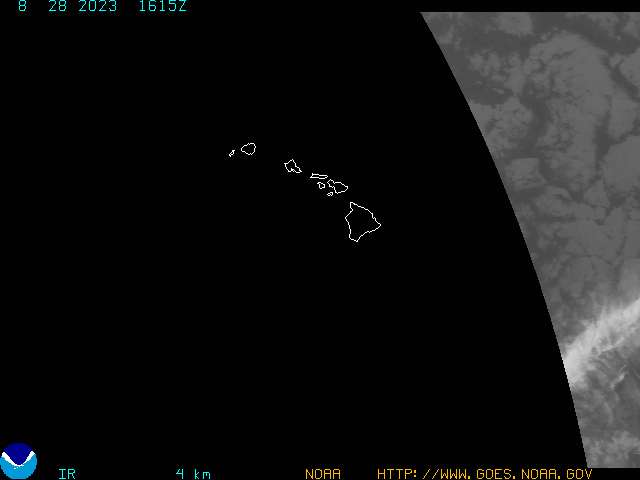
Satellite and Radar Images: To view the cloud conditions we have here in Hawaii, please use the following satellite links, starting off with the Infrared Satellite Image of the islands to see all the clouds around the state during the day and night. This next image is one that gives close images of the islands only during the daytime hours, and is referred to as a Close-up visible image. This next image shows a larger view of the Pacific…giving perspective to the wider ranging cloud patterns in the
Aloha Paragraphs

Gliding through life in a peaceful way…the Hawaiian Stilt
Photo Credit: flickr.com
The gusty trade winds are beginning their decline, although won’t stop altogether anytime soon. We still have small craft wind advisories active across some Hawaiian waters Monday evening, although they have been pulled back to just those windiest areas near Maui and the Big island. The winds were locally strong Monday before sunset, with a top gust of 36 mph at South Point on the Big Island…that southernmost point in the United States by the way. The computer models show our local trade winds remaining active into Thursday. As we get into Friday and the weekend, our winds will shift to the southeast and south, ahead of an approaching cold front…and may become stronger and gusty from the Kona directions then. We will see hazy conditions developing as our winds swing around the compass to the southeast.
We finally have mostly clear skies across the Hawaiian Islands, which is a nice change…from the mostly cloudy skies we’ve seen over the last week at least. As the trade winds are still on the strong side of the wind spectrum, we’ll continue to see a few bands of generally light showers, arriving along our windward sides. Later this week, by Thursday and Friday we’ll see afternoon clouds and a scattered showers developing. As we move into the weekend, developing southeast southwest Kona winds will begin carrying pre-frontal showers onto the leeward sides of some of the islands…especially on the islands of Kauai and Oahu. The next significant rainfall event will wait until the second half of the upcoming weekend…when an active cold front brings heavy showers to the entire state.
It’s early Monday evening here in Kihei, Maui, as I start writing this last section of today’s narrative. This work week will be quite a nice one from a weather perspective, with more sunny skies gracing our lovely Hawaiian Islands…for a change! The trade winds will remain with us, although becoming lighter as we go forward. As the winds take on a more southeasterly and southerly aspect starting Thursday into Friday, we will begin to see more volcanic haze drifting up over the state, from the vents on the Big Island. An active cold front will bring locally heavy rains to the state starting on Kauai later Saturday, ending up on the Big Island Sunday night into Monday morning. ~~~ Speaking of Saturday night, I will be flying to Phoenix, Arizona, to attend the Annual American Meteorological Society Conference. I will be there for five days, at which point I will fly to Long Beach, to visit with my family for another five days. So there will be a 10 day break in my daily filings of this website. There will however be weather forecasts available throughout that period. I’ll have more to say about this later this week. ~~~ Glancing out the window here in Kihei, before I jump in my car for the ride upcountry to Kula, I see lusciously clear blue skies…although with slightly hazy skies too! Now that the winds are getting lighter, and there are no more high cirrus clouds acting as a blanket to keep the previous days heat from escaping out to space…we will find cooler temperatures getting at us Monday night, especially in the upcountry areas. I personally leave all my windows open at night, unless its raining, so that I can have that cold air surrounding me, since I’m warm as toast under my down comforter! ~~~ I’ve gotta head out now, as I want to get home in time to take my walk before dark. I love walking in the early morning, and then again just before sunset. I hope you have a great Monday night, and that perhaps you will find the time, or have the inclination to drop by again on Tuesday. I’ll be here, putting your next new weather narrative from paradise out by around 630am HST, 830am PST, and then an hour or two later going through the time zones towards the east coast and beyond. Aloha for now…Glenn.
Interesting: Powerful winds reaching hurricane intensity slammed the tiny, storm-prone islands off the coast of southern British Columbia, Canada on Sunday. The strong Pacific storm responsible for the high winds came ashore in northwestern British Columbia, but bad weather extended southward along its cold front to southern parts of the province as well as portions of the northwestern United States. On Solander Island, which lies off the northwestern coast of much larger Vancouver Island, sustained winds roared as high as 80 mph on Sunday afternoon; highest gusts were nearly 115 mph. Nearby, Sartine Island also withstood 80-mph sustained winds. Along with severe winds, the storm and its cold front also unloaded heavy rain and heavy snow in western British Columbia. At Terrace, 20 inches of snow fell within 18 hours as of late Sunday afternoon.
Interesting2: A violent storm broke out across KwaZulu-Natal over the weekend killing at least eight people and injuring many others. This freak storm was described by residents as one of the worst storms in living memory. Trees were uprooted, roofs were torn off and some places there were reports of water mains bursting. At least four people were killed by lightning strikes and more than 2000 households were affected by the intense storm. The worst affected areas were Ndwendwe, Pietermaritzburg and Dalton, where authorities set up temporary tents to accommodate the homeless families. This violent storm comes after a series of similar storms that have struck the province over the past few months causing much damage and loss of life. Over much of South Africa, summer (mid-October to mid-February) is characterized by hot and sunny weather, often with afternoon convective thunderstorms that clear away quickly. However, active cold fronts associated with low pressure systems can sometimes give rise to intense thunderstorms that occur during the day or night and cause a lot of damage. The storm in KwaZulu-Natal over the weekend was one such event.
Interesting3: For centuries, grist-grinders and sailors have exploited the wind. Now, New York developers, homeowners and city leaders might be coming around. A handful of buildings are already drawing electricity from wind turbines, which typically resemble table fans, or mounted airplane propellers. Unlike some of the skyscraping versions that dot rural hillsides, small turbines supply power directly to homes without first sending it through a utility company’s lines. One major sticking point in the city is that densely packed buildings tend to scatter breezes, making it tough to capture steady gusts. Although this and other kinks need to be addressed before the widespread rollout of small turbines is possible, there are signs of gains. “We’re always excited to try new things in the area of green building,” says Les Bluestone, a partner in the Blue Sea Development Company, which is building a five-story brick apartment building in the Melrose section of the South Bronx that will be partly powered by wind. Its 10 one-kilowatt turbines, from AeroVironment of Monrovia, Calif., will generate electricity for lights in the building’s hallways, elevators and other common areas. But because wind speeds in the Bronx, as in other parts of New York, aren’t consistent, the turbines must be supplemented with a separate basement power plant, Mr. Bluestone said.
Interesting4: Cities may sprout vertical farms. Proposed high-rise greenhouses could help solve a looming food crisis, professor says. Farming would seem to be a horizontal occupation. Iowa corn or Kansas wheat pokes up from flat fields that stretch to the horizon. That’s why the idea of "vertical farms" seems ripe for humor. When its biggest advocate appeared on the faux news show "The Colbert Report" earlier this year, comedian Stephen Colbert prefaced the interview by guessing it would have something to do with corn that grows sideways or perhaps "Chia blimps" that float overhead. Such teasing hasn’t deterred Dickson Despommier, the Col umbia University professor of public health. He sees putting crops into skyscrapers as a better way to feed a hungry world. Professor Despommier’s website, verticalfarm.com, features architectural concepts of high-rise buildings that could grow fresh produce in urban areas while at the same time being much more environmentally sustainable than conventional agriculture. The trouble is, he concedes, none of the beautiful drawings would work exactly as shown. "They all look pretty," he says. "[A]t least it means they’re thinking in the right direction." What’s needed before millions of dollars are spent to construct or renovate an existing 30-story building into a vertical farm, Despommier says, are prototypes just a few stories high.
They should be built at leading agricultural universities and tinkered with until the concept is proved. "Once it does, drive it out of the showroom and take it home," he says. While Despommier has won admirers around the world for his innovative thinking, skeptics still wonder how he’s going to handle the problem of solar energy – bringing necessary light to the interior and lower floors of his agri-towers. "As soon as you go vertical, you compound that problem of getting that [solar] energy to the plant," says Gene Giacomelli, director of the Controlled Environment Agriculture Center at the University of Arizona in Tucson. Dr. Giacomelli likes the audacity of vertical farms, but says a lot of problems must be solved first. Despommier, he says, "is a forward thinker. He’s challen ging all of us to try to make it happen." The challenges also include finding and training indoor "farmers" who can operate what is likely to be a complex system. "There’s nobody at the moment," Giacomelli says. The technical problems aren’t insurmountable – crops are being grown indoors at the South Pole, albeit at great expense, he says. But, he adds, "There are many more ways to fail [at indoor agriculture] than to grow a crop correctly and succeed."
Interesting5: "Please erase your image of electric cars being like golf carts," a spokesman for Japan’s fourth-biggest automaker said before taking a zero-emission vehicle out for a spin. As mass-produced electric cars come closer to reality, their makers are trying to polish the image of what experts say could be a hard sell in the current recession. "It’s fast, powerful and smooth," Mitsubishi Motors Corp. spokesman Kai Inada said of the iMiEV electric car, which is due to be launched next year. Zero-emission vehicles may not be a novel concept for long. Japanese carmakers are racing to develop electric cars, and US and European manufacturers have also announced plans to roll them out within a few years. The dream of an electric car, which has been around since the time of Thomas Edison, has so far failed to break into the mainstream because of limited battery life that makes such vehicles impractical for most purposes.
But after technological breakthroughs in the development of long-lasting lithium-ion batteries, soon it may not just be Hollywood stars who are zipping around in zero-emission automobiles. Mitsubishi’s electric car now runs 100 miles on one charge, which takes 14 hours when using a conventional 100 volt outlet on the wall, or 30 minutes to charge 80 percent of the battery using a special quick charger. With the help of government subsidies, Mitsubishi Motors aims to sell its iMiEV at a price of less than three million yen ($A42,123) as early as 2010. "The price and the short mileage per charge are the two biggest challenges we must address," admitted Kazuhiro Yamana, head of Mitsubishi’s public relations department. "But we expect that technological breakthroughs in lithium-ion batteries will continue, realising longer distances – for example triple the current distance in 10 years," he said. Nissan Motor Co. aims to start selling an electric car in the United States and Japan in 2010 and the rest of the world in 2012.
Interesting6: Governments could slow global warming dramatically, and buy time to avert disastrous climate change, by slashing emissions of one of humanity’s most familiar pollutants…soot according to NASA scientists. A study by the space agency shows that cutting down on the pollutant can have an immediate cooling effect and prevent hundreds of thousands of deaths from air pollution at the same time. At the beginning of the make-or-break year in international attempts to negotiate a treaty to replace the Kyoto protocol, the soot removal proposal offers hope of a rapid new way of tackling global warming. Governments have long experience in acting against soot. Cutting its emissions has a virtually instantaneous effect, because it rapidly falls out of the atmosphere, unlike carbon dioxide which remains there for over 100 years. And because soot is one of the worst killers among all pollutants, radical reductions save lives and so should command popular and political support.
The study from NASA’s Goddard Institute for Space Studies, and published in the journal Atmospheric Chemistry and Physics concludes that tackling the pollution provides ”substantial benefits for air quality while simultaneously contributing to climate change mitigation” and ”may present a unique opportunity to engage parties and nations not yet fully committed to climate change mitigation for its own sake”. Black carbon, the component of soot that gives it its colour, is thought to be the second-largest cause of global warming after carbon dioxide. Formed through incomplete combustion of fossil fuels, wood and vegetation, it delivers a double whammy. While in the air, it is spread around the globe by the wind, and helps to heat the atmosphere by absorbing and releasing solar radiation. And when it falls, it darkens snow and ice, at the poles or high in mountains, reducing its ability to reflect sunlight. As a result, it melts more quickly, and exposes more dark land or water which absorbs even more energy, and so increases warming.
Interesting7:
New laws pertaining to ‘green’ issues are predicted to be the fourth most important legal trend in 2009. The consultancy, owned by Reuters, released a top ten of legal hot topics for 2009 which also lists urban living, employee rights, military rights and legal issues impacting small business as hotly pursued. Green legal issues, which dominated early in 2008 because of the high price of fuel, a rising awareness of environment issues like climate change, and the election campaign, are set to become much more important during 2009, the lawyers say. They predict that their clients will especially seek advice about legislative issues supporting the creation and growth of "green" industries such as alternative energy, climate and automobiles. The growth is spurred by President elect Barack Obama’s call for the rise of a green collar sector.

Mr. Obama singled out a goal to create a Roosevelt-style public works program which will result in many unprecedented issues and situations. FindLaw experts say that 2009 will be the year of many controversies. Hotly contested and integral consumer issues centering on green laws and employee rights, military rights and internet privacy laws are going to be standard routine, the lawyers believe. All the elements leading to precarious situations are already emerging. For instance, joblessness is climbing, which means that job seekers increasingly are going to rely on online social networks. That in turn may call for legislative action to further protect individual rights and secure personal information. "In addition, with the new administration taking office in January, returning military personnel will continue to drive demand for information around military rights", the lawyers predict.
 Email Glenn James: