Air Temperatures – The following maximum temperatures were recorded across the state of Hawaii Wednesday:
83 Lihue, Kauai
83 Honolulu, Oahu
83 Molokai
87 Kahului, Maui
86 Kona, Hawaii
85 Hilo, Hawaii
Air Temperatures ranged between these warmest and coolest spots near sea level – and on the highest mountain tops around the state…as of 810pm Wednesday evening:
Kailua Kona – 81
Hilo, Hawaii – 72
Haleakala Summit – 45 (near 10,000 feet on Maui)
Mauna Kea Summit – 34 (13,000+ feet on the Big Island)
Hawaii’s Mountains – Here’s a link to the live web cam on the summit of near 13,800 foot Mauna Kea on the Big Island of Hawaii. This web cam is available during the daylight hours here in the islands…and when there’s a big moon shining down during the night at times. Plus, during the nights you will be able to see stars, and the sunrise and sunset too… depending upon weather conditions. Here’s the Haleakala Crater webcam on Maui – if it’s working.
Aloha Paragraphs

It’s Mango time in the islands again!
Wind Advisory…Big Island summits
Gradually returning trades…finally
The following numbers represent the most recent top wind gusts (mph), along with directions as of Wednesday evening:
13 Puu Opae, Kauai – SW
18 Kuaokala, Oahu – N
09 Molokai – SSE
10 Kahoolawe – SW
13 Lipoa, Maui – NE
25 Kawaihae, Big Island – NW
Here are the latest 24-hour precipitation totals (inches) for each of the islands as of Wednesday evening:
0.30 Wailua, Kauai
0.28 Punaluu Pump, Oahu
0.00 Molokai
0.00 Kahoolawe
0.16 Kula Branch Station, Maui
0.89 Waiakea Uka, Big Island
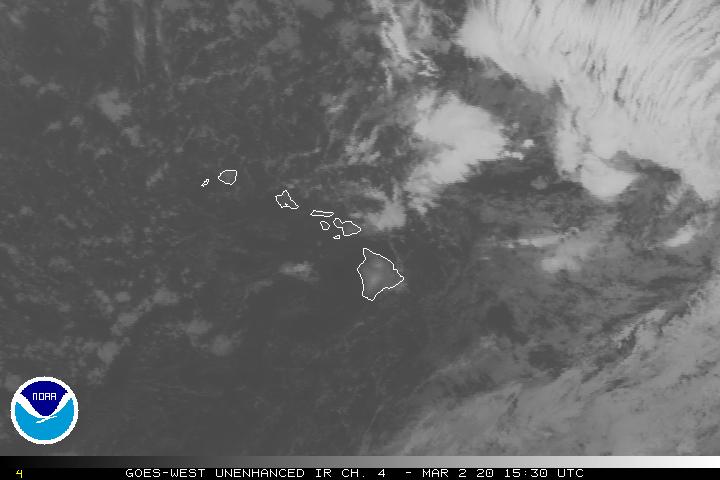
We can use the following links to see what’s going on in our area of the north central Pacific Ocean. Here’s the latest NOAA satellite picture – the latest looping satellite image… and finally the latest looping radar image for the Hawaiian Islands.
~~~ Hawaii Weather Narrative ~~~
The trade winds will gradually fill back into our Hawaiian Island weather picture Thursday…strengthening Friday into the weekend. Here’s a weather chart showing a strong near 1035 millibar high pressure system located far to the northeast. At the same time, we find a trough of low pressure near the Big Island, and others to the north and northwest of the islands. The winds will begin to rebound later Thursday, strengthening further as we move into the weekend and beyond. The southeast winds have caused very voggy skies on a few of the islands, including Maui County and parts of the Big Island.
Satellite imagery shows low cloud patches over and around the islands…generally along the windward sides as we get into the evening hours. Here’s the looping radar image, showing a few showers over the ocean, and over the interior sections of the islands locally as well. Here’s a looping satellite image – showing clearing as the low to our north goes away. As the trade winds return later Thursday into the weekend, we’ll find passing showers along our windward sides at times.
We’re on the verge of pushing back into a trade wind weather pattern, although it will be slow going into Thursday. There’s still a trough of low pressure to our north, which continues to be in the way of the trade wind flow. As this trough gradually loses its influence, the trade winds will begin to show a bit of muscle. This flexing I’m afraid will have to wait until Friday, and then will really get going by the weekend. At the moment, the volcanic haze is super thick on Maui, and parts of the Big Island! It will take until the trade winds get moving again, before we see some relief from this untoward situation. As the trade winds return, we’ll see showers starting to show up again along our north and east facing coasts and slopes. These showers will likely be somewhat more active than normal by the weekend, and perhaps even into the first day or two of next week. Meanwhile. the leeward beaches will be in good shape, as the trade winds kick in soon. I’ll be back with a new weather narrative early Thursday morning, I hope you have a great Wednesday night wherever you’re spending it. Aloha for now…Glenn.
Here in Kula, Maui, it was partly cloudy, and very volcanically hazy…with an air temperature of 70.5F degrees – just past 535pm this evening
The Central Pacific Hurricane Center (CPHC) has announced that the 2013 hurricane season should see less than a normal number of tropical cyclones. For 2013, the outlook calls for a 70% chance of a below-normal season, a 25% chance of a near-normal season, and a 5% chance of an above-normal season. They expect 1 to 3 tropical cyclones to affect the central Pacific this season. An average season has 4-5 tropical cyclones, which include tropical depressions, tropical storms, and hurricanes.
This outlook is a general guide to the overall seasonal hurricane activity in the central Pacific and does not predict whether, where, when, or how many of these systems will affect Hawaii.
~~~Here’s the new County of Maui Tsunami Evacuation Maps
World-wide tropical cyclone activity:
Atlantic Ocean/Caribbean Sea: There are no active tropical cyclones / Here’s a link to the National Hurricane Center in Miami…which covers tropical cyclone activity in the Atlantic, Caribbean Sea…and the Gulf of Mexico. The hurricane season in the Atlantic, Caribbean, and the Gulf of Mexico all begin as of June 1.
Gulf of Mexico: There are no active tropical cyclones
Eastern Pacific Ocean: There are no active tropical cyclones / AN AREA OF DISTURBED WEATHER LOCATED ABOUT 475 MILES SOUTH-SOUTHWEST OF ACAPULCO MEXICO HAS CHANGED LITTLE IN ORGANIZATION OVERNIGHT. SOME DEVELOPMENT IS POSSIBLE AS THE DISTURBANCE MOVES SLOWLY TOWARD THE WEST OR WEST-NORTHWEST. THIS SYSTEM HAS A LOW CHANCE…20 PERCENT…OF BECOMING A TROPICAL CYCLONE DURING THE NEXT 48 HOURS.
TROPICAL CYCLONE FORMATION IS NOT EXPECTED DURING THE NEXT 48 HOURS.
Here’s a wide satellite image that covers the entire area between Mexico, out through the central Pacific…to the International Dateline.
Central Pacific Ocean: There are no active tropical cyclones / Here’s a link to the Central Pacific Hurricane Center (CPHC)…covering our central Pacific. The hurricane season in this part of the Pacific begins as of June 1st.
Western Pacific Ocean: There are no active tropical cyclones / Here’s a link to the Joint Typhoon Warning Center (JTWC), which covers tropical cyclone activity in the western Pacific, and the North and South Indian Ocean…and adjacent Seas.
South Pacific Ocean: There are no active tropical cyclones
North and South Indian Oceans: There are no active tropical cyclones
 Email Glenn James: