Air Temperatures – The following maximum temperatures were recorded across the state of Hawaii Friday:
Lihue, Kauai – 78
Honolulu airport, Oahu – 80
Molokai airport – 78
Kahului airport, Maui – 81
Kona airport, Hawaii – 81
Hilo airport, Hawaii – 79
Air Temperatures ranged between these warmest and coolest spots near sea level – and on the highest mountain tops around the state…as of 610am Saturday morning:
Honolulu, Oahu – 74
Hilo airport, Hawaii – 63
Haleakala Summit – 32 (near 10,000 feet on Maui)
Mauna Kea Summit – 25 (13,000+ feet on the Big Island)
Hawaii’s Mountains – Here’s a link to the live web cam on the summit of near 13,800 foot Mauna Kea on the Big Island of Hawaii. This web cam is available during the daylight hours here in the islands…and when there’s a big moon shining down during the night at times. Plus, during the nights you will be able to see stars, and the sunrise and sunset too…depending upon weather conditions. Here's the Haleakala Crater webcam on Maui – if it's working.
Tropical Cyclone activity in the eastern and central Pacific – Here’s the latest weather information coming out of the National Hurricane Center, covering the eastern north Pacific. You can find the latest tropical cyclone information for the central north Pacific (where Hawaii is located) by clicking on this link to the Central Pacific Hurricane Center. A satellite image, which shows the entire ocean area between Hawaii and the Mexican coast…can be found here. The 2012 hurricane season is over in the eastern and central Pacific…resuming on May 15th and June 1st 2013.
Aloha Paragraphs

Wind Advisory for the Big Island Summits
Precipitation increases today – Kona
breezes from the south to southwest...
A cold front will bring generous rainfall to
the state late today through early Monday
morning, first on Kauai…and then
the rest of the state
Here's a looping radar image, so we can keep
track of where showers are falling, not
too much yet … more soon
~~~623am HST Saturday morning: mostly clear, breezy
at my upcountry Kula, Maui weather tower, the
air temperature was 58.1F degrees~~~
The following numbers represent the most recent top wind gusts (mph), along with directions as of Friday evening:
23 Makaha Ridge, Kauai – SSE
22 Wheeler Field, Oahu – SE
17 Molokai – SE
15 Kahoolawe – SSW
21 Kula 1, Maui – SSW
20 PTA Range 17, Big Island – NW
Here are the latest 24-hour precipitation totals (inches) for each of the islands as of Friday evening:
0.02 Kilohana, Kauai
0.04 Ahuimanu Loop, Oahu
0.07 Molokai
0.00 Lanai
0.00 Kahoolawe
0.37 Kahakuloa, Maui
0.27 Kealakomo, Big Island
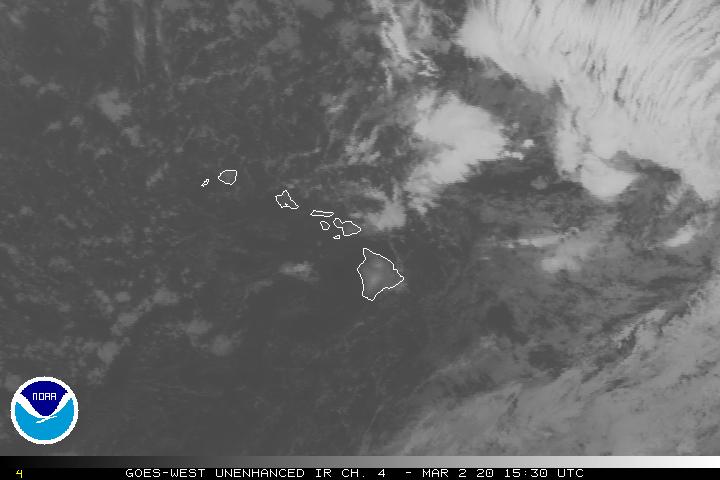
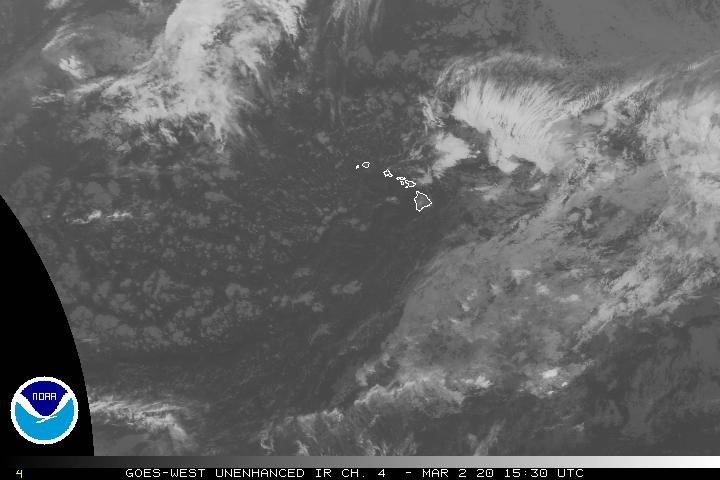
We can use the following links to see what’s going on in our area of the north central Pacific Ocean. Here's the latest NOAA satellite picture – the latest looping satellite image…and finally the latest looping radar image for the Hawaiian Islands.
~~~ Hawaii Weather Narrative ~~~
Our winds will be generally from the south to southwest…into the weekend. Here's a weather chart showing high pressure systems far to the northwest, north, and to the northeast of Hawaii. At the same time, we see a cold front to our northwest…whose parent low is a developing gale to the north of Hawaii. Our local winds are generally lighter now, having veered to the south and southwest in most areas. This has occurred thanks to this late winter cold front, as it continues to advance towards the islands. This front will move down through the state this weekend. Slightly cooler north to northeast breezes will fill in behind the frontal passage…later Sunday into early in the new week ahead.
Satellite imagery shows clear skies in most areas, with low clouds generally offshore to the southwest of the islands, with some high cirrus clouds to the northeast of the state. The overlying atmosphere remains on the dry and stable side, which will continue to limit showers for the time being. This condition will begin to change, as a trough of low pressure aloft begins to make our atmosphere more shower prone…this weekend. This larger satellite picture shows an area of bright white, high level cloudiness to the northeast. We also see the approaching cold front to our northwest, which will reach the state later Saturday…bringing showers as it rides down through the state into Monday morning. There's a good chance that some of these frontal showers will be quite generous at times.
As noted above, our winds are lighter now, and haze has moved over the state as well…with a shower bearing cold front on tap this weekend. All of the above are thanks to the cold front, to our northwest, which is taking aim on us this weekend. If you've had a chance to be outside lately, you've seen that the winds are coming up from the deeper tropics, from the south to southwest…which are called Kona winds. This is a Polynesian word meaning leeward, signifying that winds will be coming in along our south and west facing sides of the islands. These are initiated, as the air flow moves northward towards the approaching cold front. There will be several associated influences for us, as this weather situation develops as we push through the weekend time frame.
Look for showers, some of which will be generous this weekend, which will make driving more challenging at times locally…be careful if you're out and about. As the cold front arrives, it will drop rain as it moves down through the island chain, first later Saturday on Kauai…then down through the rest of the island chain Sunday into early Monday morning on the Big Island, hopefully it will get that far. There's always that chance that a few of these showers will be heavy enough…to trigger a brief flood advisory. The front may stall around Maui, or the Big Island Sunday night into Monday morning, keeping residual showers falling over the windward sides of those eastern islands, for a day or two longer than the rest of the state. Northerly, and then northeast winds will fill into our area, in the wake of the frontal passage. I'll be back Saturday morning with your next new weather narrative, I hope you have a great Friday night wherever you happen to be spending it! Aloha for now…Glenn.
Notice: This next Wednesday, March 13th, I'll be flying to northern California, beginning a visit with family and friends…through April 11th. As usual, the daily weather forecasts on this website will remain available in my absence. I'll have more to say about this trip before leaving, although I just wanted to give you a heads-up before I took off.
Friday evening film: I typically don't go to see a film on its opening night, although this week I'm making an exception. This film is called Dead Man Down, starring Colin Farrell, Noomi Rapace, Dominic Cooper, Terrence Howard, and Isabelle Huppert. The synopsis: two strangers, who are irresistibly drawn to one another…by their mutual desire for revenge. It's being called a thriller, with definite criminal overtones. This film will have its fair share, if not more than that…of violence. I don't know how many of you would want to take a look at the trailer, but here it is, it's not a mild mannered viewing.
World-wide tropical cyclone activity:
Atlantic Ocean/Caribbean Sea: There are no active tropical cyclones
Gulf of Mexico: There are no active tropical cyclones
Eastern Pacific Ocean: There are no active tropical cyclones
Central Pacific Ocean: There are no active tropical cyclones
Western Pacific Ocean: There are no active tropical cyclones
South Pacific Ocean: Tropical cyclone 19P (Sandra) remains active in the southwest Pacific, located approximately 615 NM northwest of Noumea, New Caledonia. TC 19P has 65 knot sustained winds, with gusts to near 80 knots. Here's the Joint Typhoon Warning Center (JTWC) graphical track map, along with a satellite image.
North and South Indian Oceans: There are no active tropical cyclones
Interesting: A new study looking at 11,000 years of climate temperatures shows the world in the middle of a dramatic U-turn, lurching from near-record cooling to a heat spike. Research released Thursday in the journal Science uses fossils of tiny marine organisms to reconstruct global temperatures back to the end of the last ice age. It shows how the globe for several thousands of years was cooling until an unprecedented reversal in the 20th century.
Scientists say it is further evidence that modern-day global warming isn't natural, but the result of rising carbon dioxide emissions that have rapidly grown since the Industrial Revolution began roughly 250 years ago.
The decade of 1900 to 1910 was one of the coolest in the past 11,300 years — cooler than 95 percent of the other years, the marine fossil data suggest. Yet 100 years later, the decade of 2000 to 2010 was one of the warmest, said study lead author Shaun Marcott of Oregon State University. Global thermometer records only go back to 1880, and those show the last decade was the hottest for this more recent time period.
"In 100 years, we've gone from the cold end of the spectrum to the warm end of the spectrum," Marcott said. "We've never seen something this rapid. Even in the ice age the global temperature never changed this quickly." Using fossils from all over the world, Marcott presents the longest continuous record of Earth's average temperature.
One of his co-authors last year used the same method to look even farther back. This study fills in the crucial post-ice age time during early human civilization. Marcott's data indicates that it took 4,000 years for the world to warm about 1.25 degrees from the end of the ice age to about 7,000 years ago.
The same fossil-based data suggest a similar level of warming occurring in just one generation: from the 1920s to the 1940s. Actual thermometer records don't show the rise from the 1920s to the 1940s was quite that big and Marcott said for such recent time periods it is better to use actual thermometer readings than his proxies.
Before this study, continuous temperature record reconstruction only went back about 2,000 years. The temperature trend produces a line shaped like a "hockey stick" with a sudden spike after what had been a fairly steady line. That data came from tree rings, ice cores and lake sediments. Marcott wanted to go farther back, to the end of the last ice age in more detail by using the same marine fossil method his colleague used.
That period also coincides with a "really important time for the history of our planet," said Smithsonian Institution research anthropologist Torben Rick. That's the time when people started to first domesticate animals and start agriculture, which is connected to the end of the ice age. Marcott's research finds the climate had been gently warming out of the ice age with a slow cooling that started about 6,000 years ago. Then the cooling reversed with a vengeance.
The study shows the recent heat spike "has no precedent as far back as we can go with any confidence, 11,000 years arguably," said Pennsylvania State University professor Michael Mann, who wrote the original hockey stick study but wasn't part of this research. He said scientists may have to go back 125,000 years to find warmer temperatures potentially rivaling today's.
However, another outside scientist, Jeff Severinghaus of the Scripps Institution of Oceanography thinks temperatures may have been notably warmer just 12,000 years ago, at least in Greenland based on research by some of his colleagues.
Several outside scientists praised the methods Marcott used, but said it might be a bit too oriented toward the Northern Hemisphere. Marcott said the general downward trend of temperatures that reversed 100 years ago seemed to indicate the Earth was heading either toward another ice age or little ice age from about 1550 to 1850.
Or it was continuing to cool naturally until greenhouse gases from the burning of fossil fuels changed everything. The reason the globe warmed after the ice age and then started cooling about 6,000 years ago has to do with the tilt of the Earth and its distance from the sun, said Marcott and Severinghaus.
Distance and angle in the summer matter because of heat absorption and reflection and ground cover. "We have, through human emissions of carbon dioxide and other heat-trapping gases, indefinitely delayed the onset of the next ice age and are now heading into an unknown future where humans control the thermostat of the planet," said Katharine Hayhoe, an atmospheric scientist at Texas Tech University, responding in an email.
 Email Glenn James: