











Air Temperatures – The following maximum temperatures were recorded across the state of Hawaii Friday afternoon:
Lihue, Kauai – 78
Honolulu airport, Oahu – 83
Molokai airport – 79
Kahului airport, Maui – 82
Kona airport – 81
Hilo airport, Hawaii – 79
Air Temperatures ranged between these warmest and coolest spots near sea level – and on the highest mountain tops around the state…as of 710am Saturday morning:
Kaneohe, Oahu – 74
Kahului, Maui – 59
Haleakala Summit – 43 (near 10,000 feet on Maui)
Mauna Kea Summit – 34 (13,000+ feet on the Big Island)
Hawaii’s Mountains – Here’s a link to the live web cam on the summit of near 13,800 foot Mauna Kea on the Big Island of Hawaii. This web cam is available during the daylight hours here in the islands…and when there’s a big moon shining down during the night at times. Plus, during the nights you will be able to see stars, and the sunrise and sunset too…depending upon weather conditions. Here's the Haleakala Crater webcam on Maui.
Tropical Cyclone activity in the eastern and central Pacific – Here’s the latest weather information coming out of the National Hurricane Center, covering the eastern north Pacific. You can find the latest tropical cyclone information for the central north Pacific (where Hawaii is located) by clicking on this link to the Central Pacific Hurricane Center. A satellite image, which shows the entire ocean area between Hawaii and the Mexican coast…can be found here. The 2012 hurricane season is over in the eastern and central Pacific…resuming on May 15th and June 1st 2013.
Aloha Paragraphs

High Surf Advisory for north and west shores
of Niihau, Kauai, Oahu, Molokai – north shore
of Maui…west shore of the Big Island of Hawaii
Small Craft Advisory for rising northwest swells,
becoming larger later today…into Sunday
Generally good weather, with just a few showers…
more windward showers later Sunday into Monday
~~~720am HST Saturday morning: clear, calm…at my
upcountry Kula, Maui weather tower: 48.2F degrees~~~
The following numbers represent the most recent top wind gusts (mph), along with directions as of Friday evening:
15 Poipu, Kauai – NE
20 Kahuku Trng, Oahu – ESE
20 Molokai – ENE
29 Kahoolawe – ENE
17 Lipoa, Maui – E
28 Kealakomo, Big Island – ENE
Here are the latest 24-hour precipitation totals (inches) for each of the islands as of late Friday evening:
1.43 Mount Waialeale, Kauai
1.00 Poamoho RG 1, Oahu
0.00 Molokai
0.00 Lanai
0.00 Kahoolawe
0.43 Puu Kukui, Maui
0.77 Island Dairy, Big Island
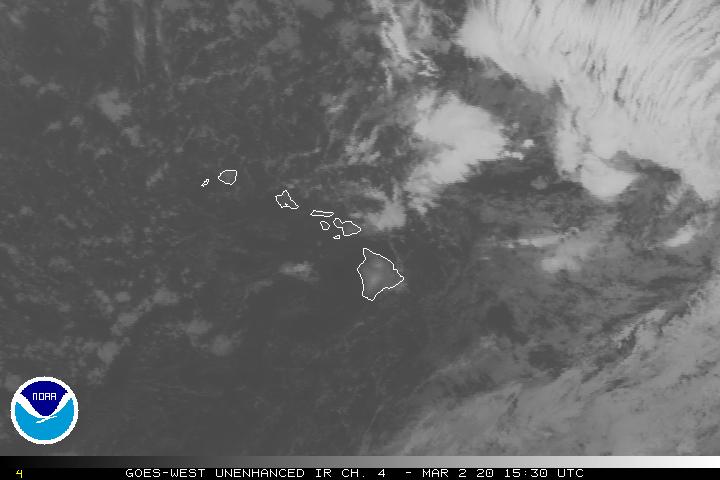
We can use the following links to see what’s going on in our area of the north central Pacific Ocean. Here's the latest NOAA satellite picture – the latest looping satellite image…and finally the latest looping radar image for the Hawaiian Islands.
~~~ Hawaii Weather Commentary ~~~
Our trade winds will remain active, although fairly light through Saturday…then increase again later Sunday into the middle of the new week ahead. Here's a weather chart showing a large, near 1035 millibar high pressure system located to the northeast of Hawaii, with another near 1025 millibar high pressure cell to our northwest. At the same time, we see a deep, near 964 millibar storm low pressure system far to our north. This low has a comma shaped cold front draping south and southwest from its center, well offshore to our north. Our trade wind weather pattern will continue, generally blow in the light to lower moderate range, then increasing again, quite substantially…later Sunday into the new work week.
Satellite imagery shows just a few low clouds over and around the islands now. As the trades hold firm, although quite light in character, they will be able to bring us a few windward biased showers…although not many for the time being. The leewards sides will continue to have generally good weather, with lots of sunshine during the days. Meanwhile, a cold front will approach the state this weekend, pushing our high pressure ridge down closer to the islands in the process. As we push into the second part of the weekend, our trade winds will increase noticeably, becoming strong and gusty through the following several days.
The weakening cold front to our north-northwest…will stall to our north this weekend. This front will come close enough however, to keep our trade winds tamped-down through most of Saturday, thus the lighter trade wind forecast. As we push into Sunday though, these trade winds will build strength, becoming strong and gusty for several days. This blustery trade flow, will help to carry moisture from this frontal boundary to our north, into our windward sides…later Sunday into the first several days of the new week ahead. As these trades will be robust, they will be able to transport some of this moisture over into the leeward sides of the smaller islands at times too. ~~~ I'll be back Saturday morning with your next new weather narrative, I hope you have a great Friday night wherever you happen to be spending it! Aloha for now…Glenn.
Friday evening Film: I'll finally be seeing one of the films that's been around for many weeks. I'm meeting some friends down at Whole Foods for dinner and conversation, and then walking over to the theater, to see Zero Dark Thirty. This film stars Joel Edgerton, Jason Clarke, Jessica Chastain, Mark Strong, Chris Pratt, Kyle Chandler, and Jennifer Ehle…among many others. The synopsis: for a decade, an elite team of intelligence and military operatives, working in secret across the globe, devoted themselves to a single goal: to find and eliminate Osama bin Laden. Zero Dark Thirty reunites the Oscar winning team of director-producer Kathryn Bigelow and writer-producer Mark Boal (The Hurt Locker) for the story of history's greatest manhunt for the world's most dangerous man. ~~~ This film is receiving high grades by the critics, and is being called a thriller. I'm greatly looking forward to seeing this one, it looks like one of those sitting on the edge of your seat kind of movies! I'll be sure to let you know what we all thought, when I get back online Saturday morning. Although, until then, here's the trailer for this film.
World-wide tropical cyclone activity:
Atlantic Ocean/Caribbean Sea: There are no active tropical cyclones
Gulf of Mexico: There are no active tropical cyclones
Eastern Pacific Ocean: There are no active tropical cyclones
Central Pacific Ocean: There are no active tropical cyclones
Western Pacific Ocean: There are no active tropical cyclones
South Pacific Ocean: There are no active tropical cyclones
North and South Indian Oceans: There are no active tropical cyclones
Interesting: Average wave size will increase in many parts of the southern hemisphere over the twenty-first century, but decrease in the north, according to an international study on the impact of climate change on oceanic activity. The study, published in Nature Climate Change last month (13 January), predicts a wave height increase of between 20 and 30 centimeters in an area covering at least seven per cent of the surface of the world's oceans.
This is due to the poleward intensification of the westerly winds in the southern hemisphere, resulting from climate change. Antarctica, Australia, Indonesia and Papua New Guinea are the four places that scientists think will chiefly be affected. But the scientists also predict a drop in wave height across a quarter of the area of the world's oceans, particularly in the northern hemisphere, with potentially far-reaching impacts.
"The decreased wave height in the northern oceans is good news for the fishing industry there because the sea will be calmer," says Nobuhito Mori, associate professor at Kyoto University, Japan, and the study's co-author. But the opposite may happen for fisheries in the South, as bigger waves may make conditions more difficult, Mori says.
He warns that the seaweed industry may also be affected, as higher waves are disruptive for seaweed and prevent the plants from settling. He also tells SciDev.Net that higher waves in the South could affect coral reefs and bring changes to coastal morphology, "as coastal sediment is influenced by wave height".
John Pariwono, a marine scientist based at Indonesia's Bogor Agricultural Institute, agrees that increased wave height could affect reefs. "Higher waves could decrease the intensity of sunlight for coral reefs, which is not good for them," he says.
Pariwono believes that if wave height does increase as predicted, it will harm fisheries in the South, with traditional fishermen the group most likely to be affected. Coastal communities in Indonesia and Papua New Guinea are among the poorest in the world and depend heavily on the ocean for their survival.
A US Department of State report estimates that coastal fisheries in Indonesia have grown by 40 per cent in the last ten years and that fisheries generate some 20 per cent of the country's economy. "They should change the way they use marine resources to survive," Pariwono says.
"In the future, they could turn more to aquaculture," he adds. When asked about specific wave height predictions for other countries, such as Thailand and the Philippines, Mori explains that the narrow seas in these areas have much larger natural variability and micro-climates, so that it is currently more difficult to make projections.
"Our study had a global focus and is therefore unable to determine the wave height of specific and narrow ocean areas. However, we are planning to make this our next project," Mori says.
 Email Glenn James:





sharon Says:
never too many dogs!
and new computer that may let me post here-~~~Hi Sharon, always enjoy hearing from you. Aloha, Glenn
Jay Says:
love the picture! what cute buddies sharing a board and wave! thanks…wish you were in New York? for the storm?~~~Hi Jay, that is a great picture isn’t it! You know, the thought did cross my mind several times, it would be very exciting to experience a storm of that magnitude! Good to hear from you again, Aloha, Glenn