











Air Temperatures – The following maximum temperatures were recorded across the state of Hawaii Monday afternoon:
Lihue, Kauai – 76
Honolulu airport, Oahu – 76
Molokai airport – M
Kahului airport, Maui – 78
Kona airport – 82
Hilo airport, Hawaii – 84
Air Temperatures ranged between these warmest and coolest spots near sea level – and on the highest mountain tops around the state…as of 330am Tuesday morning:
Kailua Kona – 74
Hana airport, Maui – 63
Haleakala Summit – 36 (near 10,000 feet on Maui)
Mauna Loa Summit – M (13,000+ feet on the Big Island)
Hawaii’s Mountains – Here’s a link to the live web cam on the summit of near 13,800 foot Mauna Kea on the Big Island of Hawaii. This web cam is available during the daylight hours here in the islands…and when there’s a big moon shining down during the night at times. Plus, during the nights you will be able to see stars, and the sunrise and sunset too…depending upon weather conditions. Here's the Haleakala Crater webcam on Maui…if it's available.
Tropical Cyclone activity in the eastern and central Pacific – Here’s the latest weather information coming out of the National Hurricane Center, covering the eastern north Pacific. You can find the latest tropical cyclone information for the central north Pacific (where Hawaii is located) by clicking on this link to the Central Pacific Hurricane Center. A satellite image, which shows the entire ocean area between Hawaii and the Mexican coast…can be found here. The 2012 hurricane season is over in the eastern and central Pacific…resuming on May 15th and June 1st 2013.
Aloha Paragraphs

High Surf Warning for north and west shores of Kauai,
Niihau…and the north facing shores of Oahu, Molokai
and Maui
Small Craft Advisory for a northwest swell
tonight…through 6am Tuesday
~~~542am HST Tuesday morning: partly cloudy,
with calm winds…at my upcountry Kula, Maui
weather tower: 53.6F degrees~~~
The following numbers represent the most recent top wind gusts (mph), along with directions as of Monday evening:
21 Poipu, Kauai – NE
17 Kii, Oahu – NE
12 Molokai – NE
10 Kahoolawe – SW
14 Kaupo Gap, Maui – SW
15 PTA West, Big Island – NW
Here are the latest 24-hour precipitation totals (inches) for each of the islands as of Monday evening:
0.45 Waialae, Kauai
8.08 Punaluu Stream, Oahu
4.90 Molokai
0.43 Kahoolawe
0.03 Lanai
2.58 Kahakuloa, Maui
0.28 Kamuela, Big Island
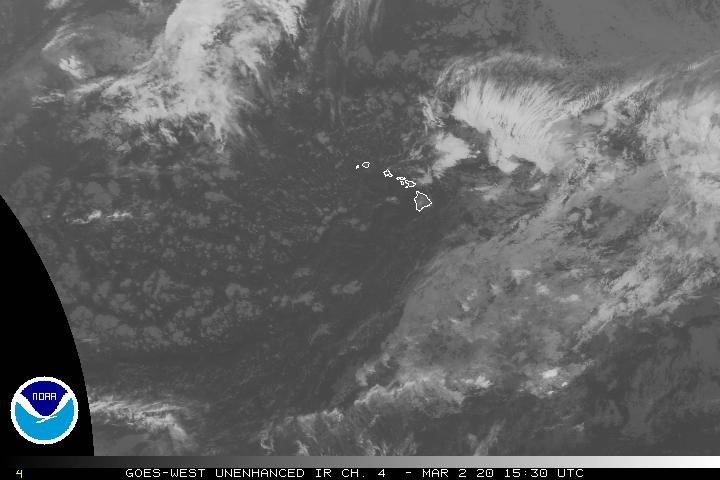
We can use the following links to see what’s going on in our area of the north central Pacific Ocean. Here's the latest NOAA satellite picture – the latest looping satellite image…and finally the latest looping radar image for the Hawaiian Islands.
~~~ Hawaii Weather Commentary ~~~
Generally light and variable breezes along, and to the southeast of a dissipating cold front, which has stalled over Molokai, with stronger northeast winds on Kauai…behind the front. Here's a weather chart showing a large high pressure system located far to the northeast of Hawaii. At the same time, we see deep storm low pressure systems far to our north through west-northwest…with an associated weakening cold front/trough, which has stalled its forward progress into the tropics…over Maui County.
Satellite imagery shows what's left of the cold front stretched across the Hawaiian Islands…with the clearing back edge still over parts of Kauai this evening. This front is keeping light and variable winds under the retiring cold front, with northeast winds in its wake near Kauai. We find ourselves in a still somewhat unstable environment this evening, with the continued chance of heavy showers falling locally, with a flash flood watch continuing over Oahu and Maui County…through Tuesday morning.
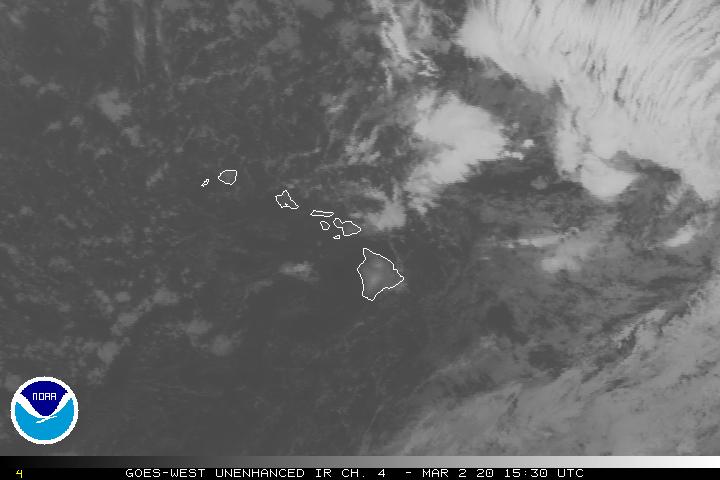
Here's a closer satellite image, showing lots of clouds stretching from Kauai to the Big Island. We see those heavy shower bearing clouds, and the high cirrus above – those brighter white ones on these satellite photos. Clouds have brought locally heavy precipitation over Kauai, Oahu, Molokai, and parts of Maui too…although missing the Big Island so far. The winds from the deeper tropics to our south and southwest, are feeding this flooding rainfall, at least in places…as the cold front slowly retires over the central part of the state tonight into Tuesday.
In sum: the gradually weakening cold front, after dropping locally heavy rainfall over parts of Oahu and Maui County today…will gradually lose its influence Tuesday. The front dumped lots of rainfall over parts of Kauai, Oahu, Molokai, and now Maui during the past 24 hours. The largest amounts were 8.08" on Oahu, and 4.90" on Molokai, with 2.58" on Maui. Since the cold front will continue to act as a focus for showers, there will be the continued chance for heavy rains near it tonight…generally over parts of Maui County and Oahu. Kauai and the Big Island, outside this rainy area, will see fewer showers. This frontal boundary is expected to dissipate as we get into Tuesday. The remnant moisture however will keep off and on showers falling wherever the residual clouds are found. As the trade winds fill into our area later Tuesday into Wednesday, they will keep some passing shower activity over the windward sides of all the islands. The leeward sides should see generally good weather, with much more sunshine than we found today. Here's the looping radar image here, so we can keep track of showers and rain, as they fall over the islands in places today. I'll be back this evening with more updates, Aloha for now…Glenn.
World-wide tropical cyclone activity:
Atlantic Ocean/Caribbean Sea: There are no active tropical cyclones
Gulf of Mexico: There are no active tropical cyclones
Eastern Pacific Ocean: There are no active tropical cyclones
Central Pacific Ocean: There are no active tropical cyclones
Western Pacific Ocean: There are no active tropical cyclones
South Pacific Ocean: There are no active tropical cyclones
North and South Indian Oceans: Tropical cyclone 13S (Felleng) remains active in the South Indian Ocean, located approximately 420 NM north of La Reunion Island. The Joint Typhoon Warning Center (JTWC) shows this cyclone with 90 knot sustained winds, with gusts to 110 knots. 13S will remain active over the next 120 hours, heading towards Madagascar…and swinging southward offshore to the east of that large island. Here's the graphical track map, along with a satellite image.
Interesting: It has been known for a long time that cities create warmer temperatures due to heat stored in buildings, roads, and other man-made structures. They also add heat from air conditioners, boilers, and other combustion sources. This is known as the urban "heat island". What has not been known until now, is that cities also raise temperatures in the areas surrounding them, out thousands of miles.
A new study shows the extent to which human activities are influencing the atmosphere, both locally, and at distant locations. Scientists have concluded that the heat generated by everyday activities in metropolitan areas alters the character of the jet stream and other major atmospheric systems.
This affects temperatures across thousands of miles, significantly warming some areas and cooling others, according to the study this week in Nature Climate Change. The extra "waste heat" generated from buildings, cars, and other sources in major Northern Hemisphere urban areas causes winter warming across large areas of northern North America and northern Asia.
Temperatures in some remote areas increase by as much as 1.8 degrees Fahrenheit, according to the research by scientists at the Scripps Institution of Oceanography; University of California, San Diego; Florida State University; and the National Center for Atmospheric Research.
At the same time, the changes to atmospheric circulation caused by the waste heat cool areas of Europe by as much as 1.8 degrees F, with much of the temperature decrease occurring in the fall. The net effect on global mean temperatures is nearly negligible—an average increase worldwide of just about 0.02 degrees F.
This is because the total human-produced waste heat is only about 0.3 percent of the heat transported across higher latitudes by atmospheric and oceanic circulations. However, the noticeable impact on regional temperatures may explain why some regions are experiencing more winter warming than projected by climate computer models, the researchers conclude. They suggest that models be adjusted to take the influence of waste heat into account.
 Email Glenn James:


Frank Says:
MOLOKA'I is GREEN!!!!!!!!!!!!~~~Hey Frank, that’s not surprising with all the rain you folks got the last couple of days! Thanks for letting us know, Aloha, Glenn
Mary Says:
Yep, here in north Kihei I was fooled a dozen times by the sound of the dry palm trees in the wind- sounds so much like rain! Alas,only a few scant droplets fell. Ah well, maybe next time.~~~Gosh, not enough rain, many folks are feeling the same way here on Maui, as well as down on the Big Island! As far as Kihei goes, with the trade winds coming back soon, that means more dry weather. Still a chance tonight, although the time is running out on this particular rainfall event. Thanks for your report Mary, I know that sound of palm trees in the wind, its kind of like banana leaves too. Bu the way, just now before 9pm, it just started to rain again up here in Kula. Aloha, Glenn
MauiTom Says:
Glenn, I was looking forward to a good soaking up here in Kula….I think we got all of 2 big showers that lasted 10 minutes or so. At what point to we start to move out of the 'cold front' season?~~~Hi Tom, we got two good showers at my place here in Kula, with a big downpour late this afternoon, which really let loose with the sky water…was great! Cold fronts will be possible over the next several months, although upper level low pressure systems can give us good rain locally as well. We still have lots of time for more winter and early spring rains, no doubt. Good question, Aloha, Glenn
Eliza Says:
Only brief showers today, so far (7pm) in upper Pukalani, Glenn. A friend off of Pulehu (upper end also), said she had a 10 minute rain shower, also. Booo hisss! Looks like Kahalawai (West Maui Mtns) got soaked as well as certain sections near Hana.
Happy evening ~ Eliza~~~Hi Eliza, sorry you missed the big stuff here in Pukalani. Here in Kula we had a big downpour, that lasted about 20+ minutes, really nice late this afternoon. There were pockets of heavy rain here on Maui at times today, not enough, but we still have plenty of winter left for more cold fronts and such. Nice to hear from you again! Aloha, Glenn
Marie0nmaui Says:
North Wailea: I stood out in two rains since 4:50 am. Each lasted less than 6 minutes. I could feel the drops land on my arms, but the heat of my body was enough to dry the water. My arms did not "get wet" to the touch.~~~Hi Marie, standing out in the rain, starting at 450am, that’s the kind of thing that impresses a man of the weather like me! Short little things though, although north Wailea can use every single little drop of rain that arrives…I’m sure you agree. We’ve had a couple of light showers up here in Kula, and then one harder one, or actually two…that didn’t last very long. We’ve been dry up here too, so I’m was happy, as I’ve watched the showers. It’s now foggy, which I like too. Thanks for letting us know about your area Marie, keep us informed if you wish. Aloha, Glenn