











Air Temperatures – The following maximum temperatures were recorded across the state of Hawaii Tuesday afternoon:
Lihue, Kauai – 76
Honolulu airport, Oahu – 78
Molokai airport – 83
Kahului airport, Maui – 82
Kona airport – 82
Hilo airport, Hawaii – 76
Air Temperatures ranged between these warmest and coolest spots near sea level – and on the highest mountain tops around the state…as of 730pm Tuesday evening:
Kaneohe, Oahu – 77
Hilo, Hawaii – 71
Haleakala Summit – 46 (near 10,000 feet on Maui)
Mauna Kea Summit – 36 (near 13,800 feet on the Big Island)
Hawaii’s Mountains – Here’s a link to the live web cam on the summit of near 13,800 foot Mauna Kea on the Big Island of Hawaii. This web cam is available during the daylight hours here in the islands…and when there’s a big moon shining down during the night at times. Plus, during the nights you will be able to see stars, and the sunrise and sunset too…depending upon weather conditions. Here's the Haleakala Crater webcam on Maui.
Tropical Cyclone activity in the eastern and central Pacific – Here’s the latest weather information coming out of the National Hurricane Center, covering the eastern north Pacific. You can find the latest tropical cyclone information for the central north Pacific (where Hawaii is located) by clicking on this link to the Central Pacific Hurricane Center. A satellite image, which shows the entire ocean area between Hawaii and the Mexican coast…can be found here. The 2012 hurricane season is over in the eastern and central Pacific…resuming on May 15th and June 1st 2013.
Aloha Paragraphs

Partly to mostly cloudy, with showers around locally
East to southeast winds over the next few days…
locally quite gusty at times
High surf advisory for the north and west shores of Niihau,
Kauai, and Molokai…and the north shores of Oahu and Maui
The following numbers represent the most recent top wind gusts (mph), along with directions as of Tuesday evening:
20 Port Allen, Kauai – SE
25 Kahuku Trng, Oahu – SE
29 Molokai – E
35 Kahoolawe – ENE
30 Kahului, Maui – NE
M Lanai – NE
28 Upolu airport, Big Island – NE
Here are the latest 24-hour precipitation totals (inches) for each of the islands as of Tuesday evening:
0.42 Mount Waialeale, Kauai
0.86 Poamoho RG 1, Oahu
0.11 Molokai
0.00 Kahoolawe
1.13 Kaupo Gap, Maui
3.79 Hilo airport, Big Island
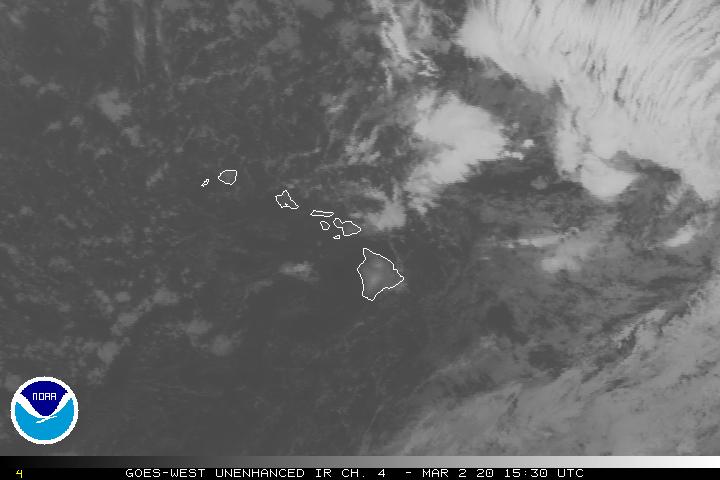
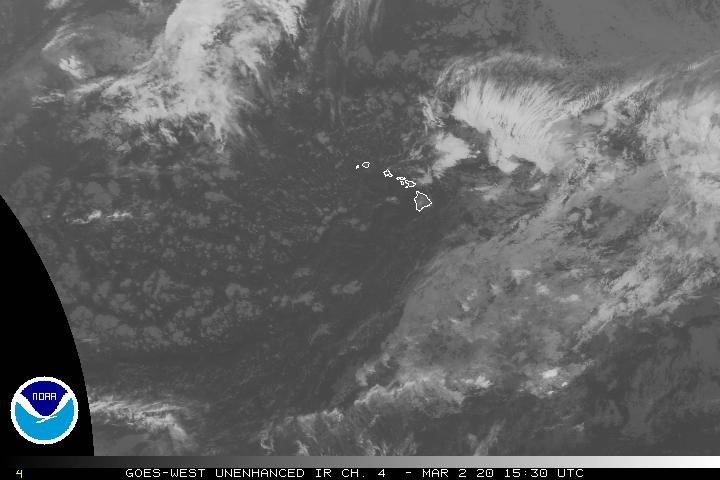
We can use the following links to see what’s going on in our area of the north central Pacific Ocean. Here's the latest NOAA satellite picture – the latest looping satellite image…and finally the latest looping radar image for the Hawaiian Islands.
~~~ Hawaii Weather Commentary ~~~
Our winds will pick up in strength from the east to southeast…continuing over the next several days. Here's a weather chart showing high pressure centers to our northeast. At the same time, we find a couple of low pressure systems over the ocean far to our northwest, with a much weather cell to our west. Our local winds will range between southeast and east through the next several days. They will increase a bit in strength too, gusting up into the 30+ mph…as they did today. Winds will likely shift to the south to southeast this weekend, ahead of an approaching cold front arriving on New Years Eve.
Our weather will be partly to mostly cloudy, with light to moderate showers falling locally. Here's a satellite image, showing extensive high and middle level clouds still over the state this evening. There has been an increase in showers along our windward sides, and in a few other places too, which will remain active over the next few days. Here's the looping radar image, so we can keep track of those showers tonight. The impressive area of high and middle level cloudiness continues to stream over us, and will remain in our skies for the time being. These clouds will definitely filter and dim our sunshine during the daytime hours…while they're around. This larger satellite image, shows this extensive area of bright white clouds to the southwest through northwest of the state.
We'll see east to southeast winds ushering in fairly typical early winter trade wind weather conditions through Saturday. Looking even further ahead, it appears that a cold front, will approach the state later in the upcoming weekend, which will veer our winds around to the southeast or even south then…as mentioned above. It's looking more and more likely that a cold front will move into the Aloha state on New Years Eve. Kauai and Oahu at least may experience this frontal passage, with increased rainfall into New Years Eve day. It's still unclear whether our whole island chain will benefit from this precipitation bearing front…or not.
It was a cloudy Christmas day here in Hawaii, as expected. It's nice of course to see a sunny day for any holiday, although personally, I don't mind having clouds or even rain during this particular time of year. There wasn't all that much rainfall, although some places got a little here and there. Here in Kula, Maui, it sprinkled briefly once or twice, getting things slightly wet for a short time. I expect that with the winds picking up some over the next few days, that the windward sides will find more of this shower activity. Thursday into the weekend should find drier weather generally. It could quite easily become rather voggy this coming weekend, as that approaching cold front swings our winds around to the southeast or even south. I'll have more on all of this early Wednesday morning, when I'll return with your next weather narrative. I trust you had a good Christmas Day, and are now already looking forward to our next holiday, which of course is the ending and beginning of 2012-2013. I hope you have a great Tuesday night wherever you happen to be spending it! Aloha for now…Glenn.
World-wide tropical cyclone activity:
Atlantic Ocean/Caribbean Sea: There are no active tropical cyclones
Gulf of Mexico: There are no active tropical cyclones
Eastern Pacific Ocean: There are no active tropical cyclones
Central Pacific Ocean: There are no active tropical cyclones
Western Pacific Ocean: Tropical storm Wukong (27W) is active in the Philippine Sea, located approximately 170 NM miles south of Manila, Philippines. Sustained winds are 35 knots, with gusts to near 45 knots. This modestly strengthening tropical cyclone will continue to move across the central Philippine islands as a tropical storm, and then out into the South China Sea…where it will dissipate. Here's the Joint Typhoon Warning Center (JTWC) graphical track map, along with a satellite image.
South Pacific Ocean: There are no active tropical cyclones
North and South Indian Oceans: There are no active tropical cyclones
Interesting: If the sinful excess of holiday eating sends your system into butter-slathered, brandy-soaked overload, you are not alone: People who are jet-lagged, people who work graveyard shifts and plain-old late-night snackers know just how you feel. All these activities upset the body's "food clock," a collection of interacting genes and molecules known technically as the food-entrainable oscillator, which keeps the human body on a metabolic even keel.
A new study by researchers at the University of California, San Francisco (UCSF) is helping to reveal how this clock works on a molecular level. Published this month in the journal Proceedings of the National Academy of Sciences, the UCSF team has shown that a protein called PKCγ is critical in resetting the food clock if our eating habits change.
The study showed that normal laboratory mice given food only during their regular sleeping hours will adjust their food clock over time and begin to wake up from their slumber, and run around in anticipation of their new mealtime. But mice lacking the PKCγ gene are not able to respond to changes in their meal time — instead sleeping right through it.
The work has implications for understanding the molecular basis of diabetes, obesity and other metabolic syndromes because a de-synchronized food clock may serve as part of the pathology underlying these disorders, said Louis Ptacek, MD, the John C. Coleman Distinguished Professor of Neurology at UCSF and a Howard Hughes Medical Institute Investigator.
It may also help explain why night owls are more likely to be obese than morning larks, Ptacek said. "Understanding the molecular mechanism of how eating at the "wrong" time of the day de-synchronizes the clocks in our body can facilitate the development of better treatments for disorders associated with night-eating syndrome, shift work and jet lag," he added.
Resetting the Food Clock Look behind the face of a mechanical clock and you will see a dizzying array of cogs, flywheels, reciprocating counterbalances and other moving parts. Biological clocks are equally complex, composed of multiple interacting genes that turn on or off in an orchestrated way to keep time during the day.
In most organisms, biological clockworks are governed by a master clock, referred to as the "circadian oscillator," which keeps track of time and coordinates our biological processes with the rhythm of a 24-hour cycle of day and night. Life forms as diverse as humans, mice and mustard greens all possess such master clocks.
And in the last decade or so, scientists have uncovered many of their inner workings, uncovering many of the genes whose cycles are tied to the clock and discovering how in mammals it is controlled by a tiny spot in the brain known as the "super-chiasmatic nucleus." Scientists also know that in addition to the master clock, our bodies have other clocks operating in parallel throughout the day.
One of these is the food clock, which is not tied to one specific spot in the brain but rather multiple sites throughout the body. The food clock is there to help our bodies make the most of our nutritional intake. It controls genes that help in everything from the absorption of nutrients in our digestive tract to their dispersal through the bloodstream, and it is designed to anticipate our eating patterns.
Even before we eat a meal, our bodies begin to turn on some of these genes and turn off others, preparing for the burst of sustenance — which is why we feel the pangs of hunger just as the lunch hour arrives. Scientist have known that the food clock can be reset over time if an organism changes its eating patterns, eating to excess or at odd times, since the timing of the food clock is pegged to feeding during the prime foraging and hunting hours in the day.
But until now, very little was known about how the food clock works on a genetic level. What Ptacek and his colleagues discovered is the molecular basis for this phenomenon: the PKCγ protein binds to another molecule called BMAL and stabilizes it, which shifts the clock in time.
 Email Glenn James:


Dan Hunt Says:
Glenn :Merry Christmas and Happy New Year !~~~ Hey Dan, good to hear from you, sending back warm holiday wishes your way too! Aloha, Glenn