











Air Temperatures – The following maximum temperatures were recorded across the state of Hawaii Monday afternoon:
Lihue, Kauai – 76
Honolulu airport, Oahu – 82
Molokai airport – 78
Kahului airport, Maui – 81
Kona airport – 81
Hilo airport, Hawaii – 75
Air Temperatures ranged between these warmest and coolest spots near sea level – and on the highest mountain tops around the state…as of 930pm Monday evening:
Kailua Kona – 75
Port Allen, Kauai – 68
Haleakala Summit – 45 (near 10,000 feet on Maui)
Mauna Kea Summit – 39 (near 13,800 feet on the Big Island)
Hawaii’s Mountains – Here’s a link to the live web cam on the summit of near 13,800 foot Mauna Kea on the Big Island of Hawaii. This web cam is available during the daylight hours here in the islands…and when there’s a big moon shining down during the night at times. Plus, during the nights you will be able to see stars, and the sunrise and sunset too…depending upon weather conditions. Here's the Haleakala Crater webcam on Maui.
Tropical Cyclone activity in the eastern and central Pacific – Here’s the latest weather information coming out of the National Hurricane Center, covering the eastern north Pacific. You can find the latest tropical cyclone information for the central north Pacific (where Hawaii is located) by clicking on this link to the Central Pacific Hurricane Center. A satellite image, which shows the entire ocean area between Hawaii and the Mexican coast…can be found here. The 2012 hurricane season is over in the eastern and central Pacific…resuming on May 15th and June 1st 2013.
Aloha Paragraphs

Merry Christmas!
Mostly cloudy…with showers around locally
Light and variable winds will gradually
turn easterly over the next few days…
locally quite voggy
High surf warning for north shores of
Niihau, Kauai, Molokai and Maui…and
west shores of Niihau, Kauai and Molokai
High surf advisory for west shores of Oahu,
and north shores of the Big Island of Hawaii
Welcome back to Hawaii President Obama,
Michelle…and kids
Good colors for Christmas sunrise!
The following numbers represent the most recent top wind gusts (mph), along with directions as of Monday evening:
10 Puu Lua, Kauai – NE
13 Waianae harbor, Oahu – W
16 Molokai – E
16 Kahoolawe – NE
10 Hana, Maui – SE
M Lanai – NE
23 South Point, Big Island – NE
Here are the latest 24-hour precipitation totals (inches) for each of the islands as of Monday afternoon:
0.01 Omao, Kauai
0.05 Nuuanu Upper, Oahu
0.00 Molokai
0.00 Kahoolawe
0.31 Kahakuloa, Maui
1.31 Kapapala, Big Island
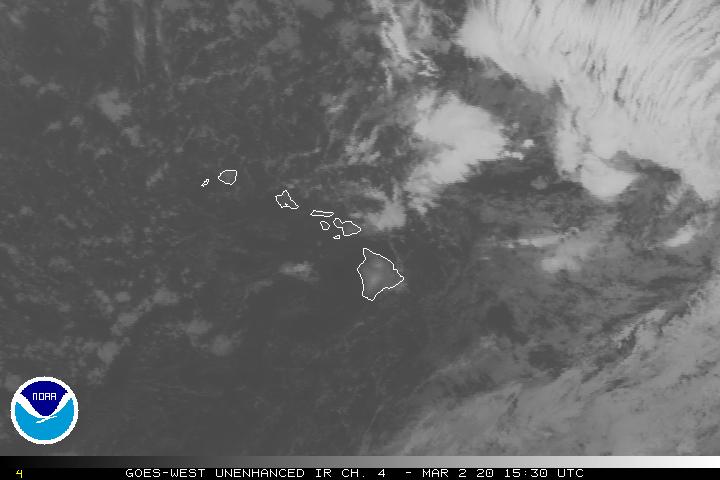
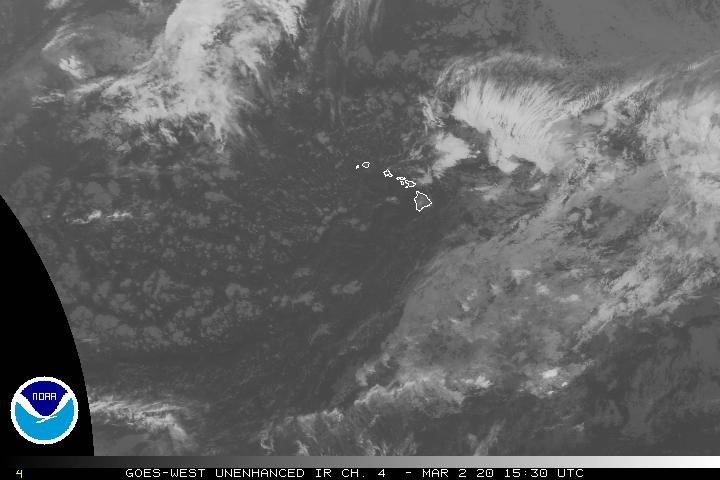
We can use the following links to see what’s going on in our area of the north central Pacific Ocean. Here's the latest NOAA satellite picture – the latest looping satellite image…and finally the latest looping radar image for the Hawaiian Islands.
~~~ Hawaii Weather Commentary ~~~
Our winds are lighter now…gradually turning back towards the east over the next few days. Here's a weather chart showing the north central Pacific, with a near 1026 millibar high pressure cell to our east-northeast…moving westward towards Hawaii. At the same time, we find another near 1022 millibar cell to our north-northwest…swiftly moving east-northeast. There's a cold front and a trough of low pressure to the northwest and west, through southwest of our islands. Our local winds have become quite a bit lighter now. The breezes will shift back to the easterly trade wind direction over the next few days, and strength some.
Our weather will be partly to mostly cloudy through Christmas Day, with increased windward biased showers. Here's a satellite image, showing extensive high and middle level clouds edging in from the west. The overlying atmosphere remains quite stable at the moment, thus limiting showers quite a bit. There will be an increase in showers over the next few days however, generally along our windward sides. The leading edge of all of this impressive cloudiness is streaming over us, and will remain in our skies through Christmas Day. These clouds will definitely filter and dim our sunshine during the daytime hours. This larger satellite image, shows this extensive area of bright white clouds to the southwest through northwest of the state. This is the cloudiness that will be cutting off our famous Hawaiian sunshine, as it intrudes into our area. Now that we're into our winter season, and with all the higher and middle level clouds over us now…we'll feel the slight coolness of the season.
Right after Christmas, we'll see the trade winds ushering in fairly typical early winter trade wind weather conditions through Thursday or Friday. Looking even further ahead, it appears that a cold front, or even a couple of fronts, will approach the state by the weekend, which will probably veer our winds around to the southeast…or even south then. It's still a bit sketchy, in relation to whether these cold fronts will move into the Aloha state on New Years Eve day, about a week from today. At any rate, and back to this week's weather, I don't see any major changes, with generally fine weather, with some windward biased showers at times by midweek through the end of the work week.
The main thing now of course…is that it's Christmas Eve, heading quickly towards Christmas morning. It's exciting, and especially for those families that have children! I remember as a child myself, with the other siblings in my family, we were on the edge of our seats…in anticipation of those presents that Santa Claus would be putting underneath our Christmas tree. I recall looking out the window next to my bed Christmas Eve night, for as long as I could stay awake as a young boy, for the sight of Santa being pulled across the sky, by those marvelous reindeer of his! It was by far the most exciting holiday back then. Now, I guess New Years Eve is my favorite. Here's wishing everyone a most Merry Christmas, particularly those of you who have been following along with me on this website, over the last 17 years! My gift to all of you, is the long lasting interest in weather that we delight in, and that I truly enjoy sharing with you, yes you…sitting in front of your keyboard there! I'll be back on Tuesday with your Christmas morning weather narrative from paradise. Aloha for now…Glenn.
World-wide tropical cyclone activity:
Atlantic Ocean/Caribbean Sea: There are no active tropical cyclones
Gulf of Mexico: There are no active tropical cyclones
Eastern Pacific Ocean: There are no active tropical cyclones
Central Pacific Ocean: There are no active tropical cyclones
Western Pacific Ocean: Tropical depression Wukong (27W) is active in the Philippine Sea, located approximately 370 NM miles southeast of Manila, Philippines. Sustained winds are 30 knots, with gusts to near 40 knots. This modestly strengthening tropical cyclone will move across the Philippine islands as a tropical storm, and then out into the South China Sea…where it will dissipate. Here's the Joint Typhoon Warning Center (JTWC) graphical track map, along with a satellite image.
South Pacific Ocean: There are no active tropical cyclones
North and South Indian Oceans: There are no active tropical cyclones
Interesting: Solar panels have been popping up on everything from rooftops to parking garages and even Christmas lights. However, these stiff and rigid heavy panels often limit their applications. Fortunately, researchers at Stanford University have developed flexible, decal-like solar panels that can be peeled off like stickers and stuck to virtually any surface, from papers to window panes.
Unlike standard thin-film solar cells, peel-and-stick thin-film solar cells do not require any direct fabrication on the final carrier substrate. This is a far more dramatic development than it may initially seem. All the challenges associated with putting solar cells on unconventional materials are avoided with the new process, vastly expanding the potential applications of solar technology.
Thin-film photovoltaic cells are traditionally fixed on rigid silicon and glass substrates, greatly limiting their uses, says Chi Hwan Lee, lead author of the paper. And while the development of thin-film solar cells promised to inject some flexibility into the technology, explains Xiaolin Zheng, a Stanford assistant professor of mechanical engineering and senior author of the paper, scientists found that use of alternative substrates was problematic in the extreme.
"Nonconventional or 'universal' substrates are difficult to use for photovoltaics because they typically have irregular surfaces and they don't do well with the thermal and chemical processing necessary to produce today’s solar cells," Zheng says. "We got around these problems by developing this peel-and-stick process, which gives thin-film solar cells flexibility and attachment potential we've never seen before, and also reduces their general cost and weight."
Utilizing the process, researchers attached thin-film solar cells to paper, plastic and window glass, among other materials. While others have been successful in fabricating thin-film solar cells on flexible substrates before, those efforts have required modifications of existing processes or materials, notes Lee.
"The main contribution of our work is that we have done so without modifying any existing processes, facilities or materials, making them viable commercially. And we have demonstrated our process on a more diverse array of substrates than ever before," Lee says.
"Now you can put them on helmets, cell phones, convex windows, portable electronic devices, curved roofs, clothing — virtually anything," says Zheng. Moreover, peel-and-stick technology isn't necessarily restricted to thin-film solar cells, Zheng said.
The researchers believe the process can also be applied to thin-film electronics, including printed circuits, ultra thin transistors and LCDs.
 Email Glenn James:


Glenn Says:
Mele Kalikimaka!!!
Glenn in South Jersey~~~Hi Glenn, good to hear from you on Christmas Day…sending back a warm holiday greeting to you as well…there in South Jersey! Aloha, Glenn
Nancy Says:
Merry Christmas, from a 17+ year veteran! Hana Hou!
Nancy~~~Nancy, you go way, way back, that’s for sure, glad to still have you along for this long ride together! Again, Happy Holidays to you and yours. Aloha, Glenn
Sandra J Says:
Merry Christmas Glenn, from all of us on Vancovuer Island. Wishing you peace and love. Sandra J from Comox, B.C.~~~Hi Sandra, nice to hear from you on Christmas Eve, all the way up there on Vancouver Island, Canada! Thank you so much for your warm Christmas wishes, kind of you. Here’s returning lots of Hawaiian warmth to you, and all the rest of my friends in Canada! Aloha, Glenn