











Air Temperatures – The following maximum temperatures were recorded across the state of Hawaii Tuesday afternoon:
Lihue, Kauai – 80
Honolulu airport, Oahu – 81
Molokai airport – 79
Kahului airport, Maui – 81
Kona airport – 88
Hilo airport, Hawaii – 77
Air Temperatures ranged between these warmest and coolest spots near sea level – and on the highest mountain tops around the state…as of 810pm Tuesday evening:
Kailua-kona – 77
Hilo, Hawaii – 68
Haleakala Summit – M (near 10,000 feet on Maui)
Mauna Kea Summit – 39 (near 13,800 feet on the Big Island)
Hawaii’s Mountains – Here’s a link to the live web cam on the summit of near 13,800 foot Mauna Kea on the Big Island of Hawaii. This web cam is available during the daylight hours here in the islands…and when there’s a big moon shining down during the night at times. Plus, during the nights you will be able to see stars, and the sunrise and sunset too…depending upon weather conditions. Here's the Haleakala Crater webcam on Maui.
Tropical Cyclone activity in the eastern and central Pacific – Here’s the latest weather information coming out of the National Hurricane Center, covering the eastern north Pacific. You can find the latest tropical cyclone information for the central north Pacific (where Hawaii is located) by clicking on this link to the Central Pacific Hurricane Center. A satellite image, which shows the entire ocean area between Hawaii and the Mexican coast…can be found here.
Aloha Paragraphs

Trade winds gradually easing up later today,
veering to the southeast…voggy locally thereafter
Fewer windward showers, more sunshine
along our leeward sides during the days
Full moon tonight!
The following numbers represent the most recent top wind gusts (mph), along with directions as of Tuesday evening:
30 Lihue, Kauai – NE
31 Kuaokala, Oahu – NE
21 Molokai – NE
29 Kahoolawe – NE
30 Kahului, Maui – NE
37 Lanai – NE
31 Pali 2, Big Island – NNE
Here are the latest 24-hour precipitation totals (inches) for each of the islands as of Tuesday evening:
0.42 Mount Waialeale, Kauai
0.11 Hawaii Kai, Oahu
0.20 Molokai
0.00 Lanai
0.00 Kahoolawe
0.25 Puu Kukui, Maui
1.58 Kawainui Stream, Big Island
We can use the following links to see what’s going on in our area of the north central Pacific Ocean. Here's the latest NOAA satellite picture – the latest looping satellite image…and finally the latest looping radar image for the Hawaiian Islands.
~~ Hawaii evening commentary ~~
Gradually lighter trade winds into Wednesday…veering to the southeast and south during the second half of the week. We currently have a moderately strong high pressure system (weather map), located to the north-northwest…moving southeast. As this high gets closer, bringing its associated ridge over the state, our winds will slow way down. Meanwhile, we see all kinds of low pressure systems to our west, northwest, north, northeast, and east! Our local winds will shift around the east and southeast later Wednesday…and then all the way around the southeast to south Thursday into Friday. As we get into the weekend, we'll find our winds blowing from the south to southwest, ahead of a cold front expected to arrive later Sunday into Monday.
As we look at this satellite image, we see just a few minor streaks of high cirrus clouds around the central islands…with fairly minor low level clouds along our windward sides. We'll find a few windward biased showers falling at times tonight, into Wednesday morning. The leeward sides should have a dry night, with perhaps a couple of light showers falling here and there.
In sum: the trade winds will give way to lighter south and southeast breezes, carrying volcanic haze, from the Big Island vents, to other areas on the smaller islands over the next few days. As this light wind regime takes effect into the weekend, we'll see clouds gathering around the mountains during the afternoons, with some shower activity developing in places. Now the weather models are back to showing a cold front arriving late Sunday, bringing clouds and showers to the state. There's likely to be a bit more fine tuning with this front over the next few days…stay tuned. I be back with your next new weather narrative early Wednesday morning. I hope you have a great Tuesday night wherever you're spending it! Aloha for now…Glenn.
World-wide tropical cyclone activity:
Atlantic Ocean/Caribbean Sea: There are no active tropical cyclones
Gulf of Mexico: There are no active tropical cyclones
Eastern Pacific Ocean: There are no active tropical cyclones
Central Pacific Ocean: There are no active tropical cyclones
Western Pacific Ocean: Tropical cyclone Bopha (26W) remains active in the western Pacific…located approximately 140 NM south of Chuuk, FSM. Sustained winds were 55 knots, with gusts to near 70 knots. The JTWC indicates that this system will reach typhoon status in 12 hours, as it moves well south of Guam, and between Yap and Palau…towards the Philippines. Here's the JTWC graphical track map…along with a satellite image.
South Pacific Ocean: There are no active tropical cyclones
North and South Indian Oceans: There are no active tropical cyclones
Interesting: The Yasuni-ITT Initiative has been called many things: controversial, ecological blackmail, revolutionary, pioneering, and the best chance to keep oil companies out of Ecuador's Yasuni National Park. But now, after a number of ups and downs, the program is beginning to make good: the Yasuni-ITT Initiative has raised $300 million, according to the Guardian, or 8 percent of the total amount needed to fully fund the idea.
The program, which is the first of its kind, proposes to leave an estimated 850 million barrels of oil untouched in Yasuni National Park if donors worldwide compensate Ecuador for about half of the worth of the oil: $3.6 billion. The money would keep oil companies out of 200,000 hectares known as the Ishpingo-Tambococha-Tiputinin (ITT) blocs.
The money doesn't go directly to the Ecuador government, but instead to a United Nations Development Fund (UNDF) which will be used to fund green energy projects, conservation initiatives, reforestation programs, and community development. The involvement of the UNDF also adds extra assurances that if the funds are raised, the oil will stay in the ground.
While the $300 million raised is not yet near the full amount requested, it shows significant progress from a year ago when many predicted the Yasuni-ITT Initiative would suffer a quick demise. Ecuador has said it will give the program 13 years for full funding.
Proponents of the Yasuni-ITT Initiative argue that it will preserve one of the most biodiverse places on Earth, keep an estimated 410 million tons of CO2 out of the atmosphere, and protect indigenous people in the reserve. With one sweep, the initiative could help mitigate several of the world's ecological crisis: mass extinction, deforestation, and climate change.
However, critics argue that the program is little more than blackmail from Ecuador: as a National Park oil drilling should not be occurring in Yasuni in the first place. Still, Ecuador is not alone in seeking to exploit its national parks.
More and more countries worldwide are opening protected areas to fossil fuel extraction as well as mining, logging, and plantations. If successful, the Yasuni-ITT Initiative could have a major impact on how nations combat both climate change and biodiversity loss in the future.
For example, the International Energy Agency (IEA) recently warned that if the world is to avoid dangerous climate change, two thirds of the world's fossil fuels must be left in the ground.
Interesting2: The stems of shrubs have given researchers a window into a glacier's past, potentially allowing them to more accurately assess how they're set to change in the future. Their findings have been published today, 27 November, in IOP Publishing's journal Environmental Research Letters, and show how a glacier's history of melting can be extended way past the instrumental record.
Much like the rings on a tree stump indicate how old it is, measuring the width of rings on the stem of a shrub can give a good indication of how well it has grown year on year. Under extreme environmental conditions, such as those close to a glacier, a shrub's growth relies heavily on summer temperatures, meaning the ring-width of a shrub can be used a proxy for glacial melting, which also relies heavily on summer temperatures.
Lead author of the study, Allan Buras, said: "In warm summers, shrubs grow more compared to cold summers. In contrast, a glacier's summer mass balance is more negative in warm summers, meaning there is more melting compared to cold summers. "Big rings in shrubs therefore indicate comparably warm summers, and thus a strongly negative summer mass balance — in other words, more melting."
The researchers, from the University of Greifswald, tested this theory on a local icecap in the Scandic Mountains of southern Norway. They took 24 samples of shrubs from a site close to the glacier and analyzed their ring-widths.
Monthly precipitation and temperature data from a local climate station were retrieved from the Norwegian Meteorological Office, and the summer mass balance of the glacier, from 1963 to 2010, was retrieved from the existing literature.
Each of these data sets was then statistically tested to see if there was a correlation between them. The results showed a robust and reliable correlation between the ring-width of shrubs and the summer melting of the glacier.
 Email Glenn James: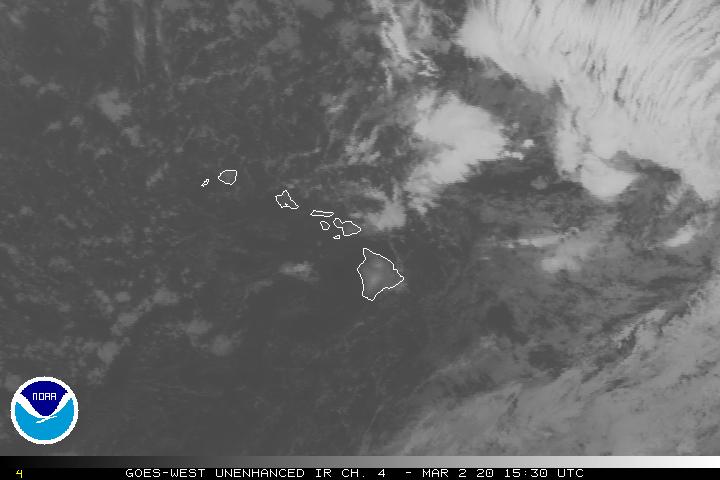


Linda Denhart Says:
Hi Glenn,
I wonder if you could settle a debate(argument?) that my gentleman friend and I are having. I contend that because Hawaii is such a small land mass that it is more difficult to predict the weather there than on the mainland. He says that weather can be predicted the same everywhere . We live in northern CA, he in Sonoma, me in Marin. We both grew up in Long Beach, CA ; we went to Wilson High School.
Thanks for your help.
Linda ~~~Hi Linda, I grew up in Long Beach, went to Millikan, and then moved to Sonoma County for five years, before moving here to Maui back in 1975. We have similar backgrounds! At any rate, I’m not sure I can settle your debate, or even know whether I want to. There’s so many things to consider in such a question, like along the coast, inland, on an island, the season, elevation, etc. Weather forecasting is tricky, although weather models have certainly made it more accurate these days. You both have your valued points of view, why not just pour a nice glass of Sonoma County wine, and call it a truce!? Aloha, Glenn
suzie dorn Says:
Hi Glenn,
I keep reading and seeing that the forecast for today (and the past few days) is for strong tradewinds but the wind has been so light in the Kahului area and unusually strong (in the mornings) in kihei. Can you explain why this is? thanks!!!~~~Hi Suzie, good question. The primary reason is due to the more northeast wind direction of the trades now (over the open ocean), rather than east. When they are more broadly from the east, Kahului has stronger winds in general. When the trades have more north in them, as they do now, the winds shoots down through the central valley, and out through Maalaea Bay towards Kihei. I hope this helps, thanks for your inquiry! Aloha, Glenn