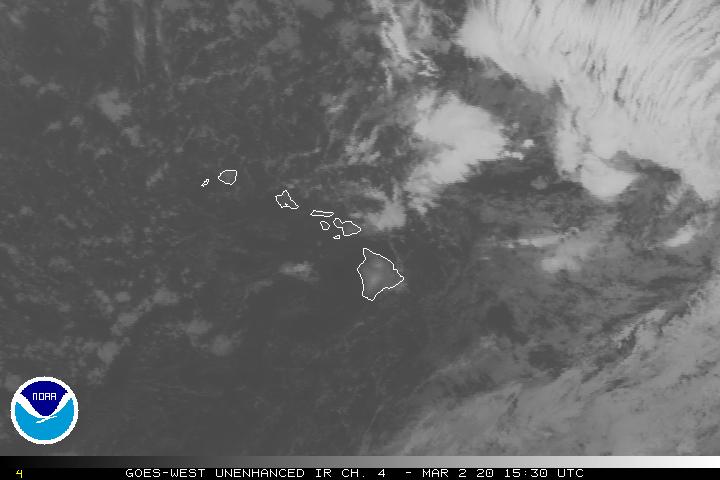
Air Temperatures – The following maximum temperatures were recorded across the state of Hawaii Monday afternoon:
Lihue, Kauai – 80
Honolulu airport, Oahu – 79
Molokai airport – 78
Kahului airport, Maui – 77
Kona airport – 82
Hilo airport, Hawaii – 77
Air Temperatures ranged between these warmest and coolest spots near sea level – and on the highest mountain tops around the state…as of 510pm Monday evening:
Barking Sands, Kauai – 79
Hana airport, Maui – 72
Haleakala Summit – M (near 10,000 feet on Maui)
Mauna Kea Summit – 36 (near 13,800 feet on the Big Island)
Hawaii’s Mountains – Here’s a link to the live web cam on the summit of near 13,800 foot Mauna Kea on the Big Island of Hawaii. This web cam is available during the daylight hours here in the islands…and when there’s a big moon shining down during the night at times. Plus, during the nights you will be able to see stars, and the sunrise and sunset too…depending upon weather conditions. Here's the Haleakala Crater webcam on Maui.
Tropical Cyclone activity in the eastern and central Pacific – Here’s the latest weather information coming out of the National Hurricane Center, covering the eastern north Pacific. You can find the latest tropical cyclone information for the central north Pacific (where Hawaii is located) by clicking on this link to the Central Pacific Hurricane Center. A satellite image, which shows the entire ocean area between Hawaii and the Mexican coast…can be found here.
Aloha Paragraphs

Trade winds…strong and gusty through Tuesday
night…relatively cool weather for the next few days…
with winds letting up during the second half of the week
Cloudy…with windward showers easing up
Tuesday…drier with fewer clouds into Wednesday
Great sunset this evening!
High cirrus clouds filtering moonshine tonight
High surf advisory east shores…
starts Tuesday morning at 6am
Full moon early Wednesday morning
The following numbers represent the most recent top wind gusts (mph), along with directions as of Monday evening:
27 Port Allen, Kauai – NE
42 Waianae Valley, Oahu – NE
28 Molokai – NE
33 Kahoolawe – NE
23 Lipoa, Maui – NE
37 Lanai – NE
38 Kealakomo, Big Island – NE
Here are the latest 24-hour precipitation totals (inches) for each of the islands as of Monday evening:
0.24 Mount Waialeale, Kauai
0.48 Manoa Lyon Arboretum, Oahu
1.10 Molokai
0.00 Lanai
0.00 Kahoolawe
0.72 Puu Kukui, Maui
0.72 Kawainui Stream, Big Island
We can use the following links to see what’s going on in our area of the north central Pacific Ocean. Here's the latest NOAA satellite picture – the latest looping satellite image…and finally the latest looping radar image for the Hawaiian Islands.
~~ Hawaii evening commentary ~~
Strong and gusty trade winds through the next day or so…veering to the southeast, south and southwest during the second half of the week. We currently have high pressure systems (weather map), located to the north-northwest and far east-northeast. A weak cold front pushed down through the state during the last 12 hours or so…which resulted in an increase in windward showers…which is dissipating near the Big Island now. The trade winds remain blustery during this first part of the week, although shower activity will diminish, even along the windward coasts and slopes for the most part starting Tuesday.
As we look at this satellite image, we see a large area of clouds to our south and east…the northern fringe of which is moving over the state from Oahu eastward to the Big Island. The frontal cloud band has moved through the state from the north, although was still bringing a few showers to parts of Maui and the Big Island as we moved into the evening. Brisk winds continue behind this frontal band, with slightly cool trade wind weather conditions remaining in effect through Tuesday night. Thereafter, our trade winds will falter again, with much lighter south to southeasterly breezes returning later Wednesday or Thursday into Friday…bringing back volcanic haze over some parts of the islands. The weather models continue to show our winds turning southwest by the upcoming weekend, with a possible cold front bringing showers by next Monday or so.
In sum, our skies will remain quite cloudy overnight, along with gusty trade winds blowing across our islands…with that relatively cool feel to our air. The clouds consist of both upper level cirrus, which will dim our moonshine tonight, and lower level cumulus clouds too. The blustery trade winds reached 42 mph on the small island of Lanai during the afternoon, with strong gusts continuing in many areas through Tuesday. These gusty winds are causing small craft wind advisories in many of our coastal and channel waters…statewide. At the same time, these blustery trades have kicked up the surf along our east shores, where a high surf advisory will be active as of 6am Tuesday.We'll find less passing showers dampening our north and east facing windward coasts and slopes going forward. This windy weather will last through mid-week, then back off quite a bit thereafter.
These trade winds will give way to much lighter south and southeast breezes, carrying volcanic haze, from the Big Island vents, to other areas on the smaller islands Thursday into Friday. These breezes may gradually shift to southwest Kona direction into the weekend, ahead of a possible cold front arriving later Sunday or next Monday. As this light wind regime takes effect Thursday into the weekend, we'll likely some clouds gathering around the mountains during the afternoons, with some shower activity developing in places. There's still some uncertainty around how close the next cold front gets to our islands next Monday, or will it stall before arriving? I'll share more information about this slightly cool windy weather through mid-week, and the potential showers late this weekend into early next week, as it becomes available. I hope you have a great Monday night, wherever you're spending it! Aloha for now…Glenn.
Extra: Youtube video, Most Amazing Humans…HD (full screen)
World-wide tropical cyclone activity:
Atlantic Ocean/Caribbean Sea: There are no active tropical cyclones
Gulf of Mexico: There are no active tropical cyclones
Eastern Pacific Ocean: There are no active tropical cyclones
Central Pacific Ocean: There are no active tropical cyclones
Western Pacific Ocean: Tropical cyclone Bopha (26W) remains active in the western Pacific…located approximately 270 NM southeast of Chuuk, FSM. Sustained winds were 45 knots, with gusts to near 55 knots. The JTWC indicates that this system will reach typhoon status in 36 hours, as it moves south of Chuuk, Guam, and Yap…then more or less towards Palau. Here's the JTWC graphical track map…along with a satellite image.
South Pacific Ocean: There are no active tropical cyclones
North and South Indian Oceans: There are no active tropical cyclones
Interesting: The human knee is an extremely important joint. It holds the weight of the entire body, provides the strength needed to lift heavy objects, and bends and flexes to give us mobility. Since this crucial joint is under stress at almost all times (except when sitting or lying down), it is susceptible to wear over time. This is especially true for the cartilage which holds together all the bones in the knee. As we age, the knee ages and the cartilage can develop a number of ailments that could potentially prohibit mobility.
A new study presented at the annual meeting of the Radiological Society of North America found that both too much and too little physical activity can accelerate the degeneration of knee cartilage in middle-aged adults. Knee problems are one of the most common afflictions around the world. In the United States, nearly 50 percent of all people may develop knee osteoarthritis by age 85.
It is predicted by the 2030, that an estimated 67 million Americans over age 18 will have physician-diagnosed arthritis. A previous study from the University of California at San Francisco (UCSF) found the connection between physical activity and cartilage degeneration. The new study from UCSF looked at the correlation over a 4-year period rather than a single point in time using MRI T2 relaxation times to track the evolution of the cartilage deterioration.
"T2 relaxation times generated from MR images allow for analysis of the biochemical and molecular composition of cartilage," said Wilson Lin, B.S., research fellow and medical student at UCSF. "There is increased water mobility in damaged cartilage, and increased water mobility results in increased T2 relaxation time." Over 200 individuals, age 45-60, were given a questionnaire to record their physical activity.
Cartilage at the patella, femur, and tibia of the right knee joint was measured at baseline, two-year and four-year visits. The results show that frequent running and other high-impact activities appear to be associated with more cartilage degeneration and a higher risk of developing osteoarthritis. However, they also found that people with very low levels of physical activity had accelerated cartilage degeneration, suggesting that there is an optimal level of physical activity to preserve cartilage.
The researchers also stress other factors involved, such as a genetic disposition for osteoarthritis, obesity, or a history of knee injury or surgery. For those people at most risk, it is imperative to maintain a healthy weight and avoid high-impact exercise. "Lower impact sports, such as walking or swimming, are likely more beneficial than higher impact sports, such as running or tennis, in individuals at risk for osteoarthritis," he said.
 Email Glenn James: