Air Temperatures – The following maximum temperatures were recorded across the state of Hawaii Friday afternoon:
Lihue, Kauai – 84
Honolulu airport, Oahu – 86
Molokai airport – 83
Kahului airport, Maui – 85
Kona airport – 85
Hilo airport, Hawaii – 84
Air Temperatures ranged between these warmest and coolest spots near sea level – and on the highest mountain tops around the state…as of 830pm Friday evening:
Barking Sands, Kauai – 78
Hilo, Hawaii – 72
Haleakala Summit – 46 (near 10,000 feet on Maui)
Mauna Kea Summit – 41 (near 13,800 feet on the Big Island)
Hawaii’s Mountains – Here’s a link to the live web cam on the summit of near 13,800 foot Mauna Kea on the Big Island of Hawaii. This web cam is available during the daylight hours here in the islands…and when there’s a big moon shining down during the night at times. Plus, during the nights you will be able to see stars, and the sunrise and sunset too…depending upon weather conditions. Here's the Haleakala Crater webcam on Maui…although this webcam is not always working correctly.
Tropical Cyclone activity in the eastern and central Pacific – Here’s the latest weather information coming out of the National Hurricane Center, covering the eastern north Pacific. You can find the latest tropical cyclone information for the central north Pacific (where Hawaii is located) by clicking on this link to the Central Pacific Hurricane Center. A satellite image, which shows the entire ocean area between Hawaii and the Mexican coast…can be found here.
Aloha Paragraphs

Jumping for joy!
Lighter winds this weekend…into the new week
Some afternoon interior showers…and
potentially voggy Sunday onwards locally
Lowering surf south shores Saturday…
Good sunrise/sunset Saturday in some areas
Big full moon!
As this weather map shows, we have moderately strong high pressure systems located to the northeast of the islands. At the same time, we have a 1006 millibar gale low pressure system to our north-northwest, with its associated cold front. Our local winds will be easing up, and turning to the southeast through the weekend…into the first part of the new week ahead.
The following numbers represent the most recent top wind gusts (mph), along with directions as of Friday evening:
24 Port Allen, Kauai – NE
36 Kuaokala, Oahu – NE
32 Molokai – NE
35 Kahoolawe – E
36 Kahului, Maui – NE
30 Lanai – NE
32 Pali 2, Big Island – NNE
We can use the following links to see what’s going on in our area of the north central Pacific Ocean. Here's the latest NOAA satellite picture – the latest looping satellite image…and finally the latest looping radar image for the Hawaiian Islands.
Here are the latest 24-hour precipitation totals (inches) for each of the islands as of Friday evening:
0.44 Mount Waialeale, Kauai
0.65 Manoa Lyon Arboretum, Oahu
0.35 Molokai
0.01 Lanai
0.01 Kahoolawe
0.73 Puu Kukui, Maui
0.54 Kawainui Stream, Big Island
~~ Hawaii Sunset Commentary ~~
Our trade winds will give way to east to southeast breezes, and become lighter later Saturday into early next week. We find moderately strong high pressure systems (weather map), located to the northeast of the islands this evening. At the same time we find a low pressure system moving by to our north…with its associated cold front dropping south and southeastward to Hawaii. It's presence will turn our winds lighter from the southeast into early next week…although the Big Island, and perhaps east Maui…may remain in a light trade wind flow. We may see the southeast breezes carry volcanic haze over parts of the island chain by Sunday for a couple of days. At the same time, aided by daytime heating of the islands…we'll likely see a few spotty afternoon showers in the leeward upcountry areas each afternoon Saturday through next Tuesday or so. The trade winds may try to rebound around the middle of next week, although the models keep them light to moderate.
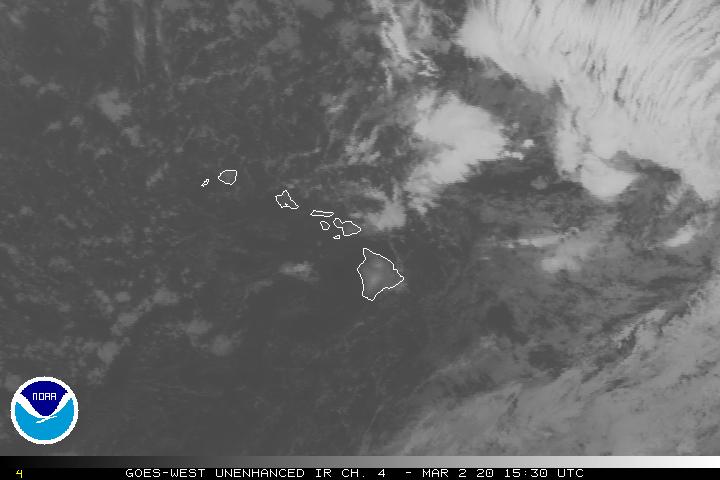
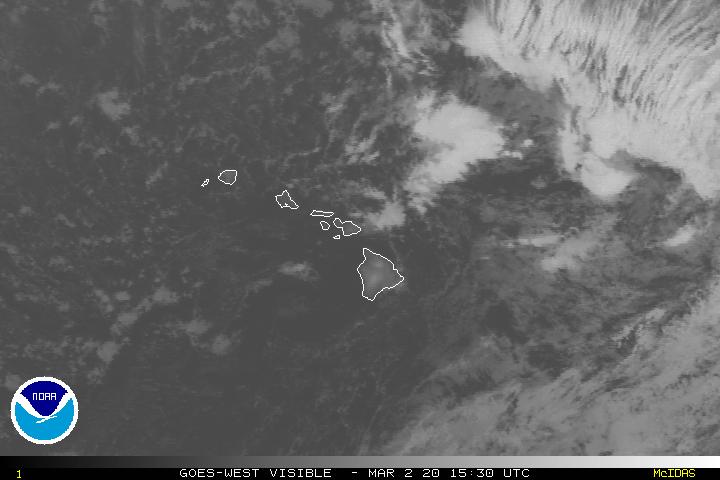
As we look at this satellite image, it shows scattered clouds upwind to the east and northeast, which will bring a few showers our way at times. These lower level clouds will bring a few showers to our windward sides, although the leeward sides should remain dry in most cases. There will be breaks in these clouds, and their off and on passing showers to our windward sides as usual. At the same time, there's a large swath of high cirrus clouds over the state – there will be good sunset and sunrise colors while they remain over our area.
Here in Kula, Maui at 545am Friday evening, it was partly cloudy…with an air temperature of 73.2F degrees. As mentioned above, we'll see a few windward showers falling at times, mostly during the night and early morning hours tonight. As we get into the weekend, our winds will gradually veer to the southeast and become lighter, in response to an area of low pressure developing to our north. This gale low pressure system has an associated cold front, which will push a ridge of high pressure down closer to our islands. As this happens, we'll find the resultant lighter winds, and the daytime heating of the islands, combining to trigger at least a few afternoon clouds and showers over the upcountry leeward slopes. There's a decent chance of volcanic haze spreading up from the Big Island vents, to other parts of the state by Sunday into the first part of next week. This lighter wind regime, with locally hazy skies, afternoon upcountry showers…will prevail perhaps until the middle of next week.
~~~ This evening I went down to the Astronomy Institute in Pukalani, as they had an open house. My neighbor Jeff Kuhn gave an excellent presentation on the Roundness of the Sun. I'll be getting up even earlier than I usually do Saturday morning, to prepare your next weather narrative. The reason is that I'll be joining a friend to surf, down in Kihei, at 545am. This means that I'll need to be leaving my house in Kula at around 5am or so. I haven't surfed for a while, so I'm excited to get my board back into the waves. Later in the day I'm going down to Paia to see a Zen Master friend who I know, who lives in the Sierra Nevada foothills of California, who will be giving a presentation at the Buddhist Mission down on the ocean there. Then a quick jump in the warm ocean, followed by shopping at the health food store. I'll finally get back here to Kula in time to attend to the updating of this website, have dinner, and then head down to Kahului with Jeff to see a new film called The Master…which looks very good! I'll check in with you early Saturday before I head over to Kihei for that surfing excursion I was mentioning above. I hope you have a great Friday night wherever you're spending it! Aloha for now…Glenn.
Extra: youtube music video, Coldplay…Yellow live in Sydney 2003 (best in full screen view)
World-wide tropical cyclone activity:
Atlantic Ocean/Caribbean Sea: Tropical storm Nadine remains active, located about 655 miles southwest of the Azores. Sustained winds were 70 mph, moving north-northwest at 12 mph. Here's the NHC graphical track map, along with the satellite image showing Nadine's position.
Gulf of Mexico: There are no active tropical cyclones
Eastern Pacific Ocean: Tropical depression Norman (14E) remains active off the west coast of Mexico…located about 40 miles west-northwest of Los Mochis, Mexico. Sustained winds are 30 mph, moving northwest at 5 mph. Here's the NHC graphical track map, and a satellite image of Norman.
Central Pacific Ocean: There are no active tropical cyclones
Western Pacific Ocean: Typhoon Jelawat (19W) remains active…located about 160 NM northeast of Kadena AB, Okinawa, Japan. This tropical cyclone currently has sustained winds of 85 knots, with gusts to near 105 knots. The JTWC shows Jelawat continuing to slowly weaken. Here's a graphical track map, along with a satellite image.
Tropical storm Ewiniar (19W) is active in the western Pacific…located about 475 NM east-southeast of Yokosuka, Japan. Sustained winds are 35 knots, with gusts to near 45 knots. The current JTWC forecast keeps it over the open ocean, away from land through the remainder of its life cycle. Here's the JTWC graphical track map, and a satellite image for Ewiniar. – Final Warning
South Pacific Ocean: There are no active tropical cyclones
North and South Indian Oceans: There are no active tropical cyclones
Interesting: The first traces of plastic debris have been found in the once pristine environment of the Southern Ocean, according to a new study. The findings come after a 2.5-year, 70,000-mile voyage by the French scientific research vessel Tara, which has been sailing the world's oceans to investigate the impacts of climate change. Samples from locations in the Southern Ocean and Antarctica revealed traces of plastic waste at a rate comparable to the global average.
This came as a surprise to the researchers, who had expected levels some ten times lower. "Discovering plastic at these very high levels was completely unexpected because the Southern Ocean is relatively separated from the world's other oceans and does not normally mix with them," said Chris Bowler, scientific coordinator of Tara Oceans.
In addition to large items of waste, such as plastic bags, bottles and other plastic items, the world's oceans also contain microscopic fragments that result from the degradation of larger items through years of exposure to seawater and sunlight. The researchers were surprised to find that synthetic fibers, largely made up of clothing residues from washing machines, also comprised a significant portion of the plastic fragments they found.
Plastic pollution has many long-lasting and even fatal impacts on marine life. Birds, fish and other animals are known to regularly consume plastic waste, mistaking it for jellyfish or other prey, but it cannot be digested and remains in the stomach. Plastics also slowly release toxins and other chemicals, which can build up in the food chain.
Although it is difficult to identify the main source of the waste in the Southern Ocean, much of it is thought to originate from Africa, South America, or Australia. Sadly, the fact that plastic debris has reached the Southern Ocean shows that our throw-away culture now has impacts around the globe. Talking about the findings in the Southern Ocean, Chris Bowler said, "We had always assumed that this was a pristine environment, very little touched by human beings.
The fact that we found these plastics is a sign that the reach of human beings is truly planetary in scale." According to Bowler, it is too late to do much about the plastic already circulating in our oceans, as it will take thousands of years to degrade. However, we can take action against future pollution, for example by advocating the use of biodegradable materials and by changing consumer attitudes and behavior.
The research ship Tara will continue its marine research in 2013, when it will travel to the Arctic to investigate the impacts of melting sea ice, a result of global climate change.
 Email Glenn James: