Air Temperatures – The following maximum temperatures were recorded across the state of Hawaii Wednesday afternoon:
Lihue, Kauai – 85
Honolulu airport, Oahu – 86
Molokai airport – 83
Kahului airport, Maui – 84
Kona airport – 83
Hilo airport, Hawaii – 83
Air Temperatures ranged between these warmest and coolest spots near sea level – and on the highest mountain tops around the state…as of 810pm Wednesday evening:
Barking Sands, Kauai – 78
Hilo, Hawaii – 73
Haleakala Summit – 50 (near 10,000 feet on Maui)
Mauna Kea Summit – 39 (near 13,800 feet on the Big Island)
Hawaii’s Mountains – Here’s a link to the live web cam on the summit of near 13,800 foot Mauna Kea on the Big Island of Hawaii. This web cam is available during the daylight hours here in the islands…and when there’s a big moon shining down during the night at times. Plus, during the nights you will be able to see stars, and the sunrise and sunset too…depending upon weather conditions. Here's the Haleakala Crater webcam on Maui…although this webcam is not always working correctly.
Tropical Cyclone activity in the eastern and central Pacific – Here’s the latest weather information coming out of the National Hurricane Center, covering the eastern north Pacific. You can find the latest tropical cyclone information for the central north Pacific (where Hawaii is located) by clicking on this link to the Central Pacific Hurricane Center. A satellite image, which shows the entire ocean area between Hawaii and the Mexican coast…can be found here.
Aloha Paragraphs
Gusty trade winds…off and on passing windward
showers, a few elsewhere at times too
As this weather map shows, we have two near 1032 millibar high pressure systems located far to the northeast of the islands. Our local winds will remain locally strong and gusty Thursday…then becoming slightly lighter Friday into the weekend.
The following numbers represent the most recent top wind gusts (mph), along with directions as of Wednesday evening:
30 Port Allen, Kauai – ESE
38 Kuaokala, Oahu – NE
33 Molokai – NE
42 Kahoolawe – NE
36 Kahului, Maui – NE
35 Lanai – NE
35 Pali 2, Big Island – NE
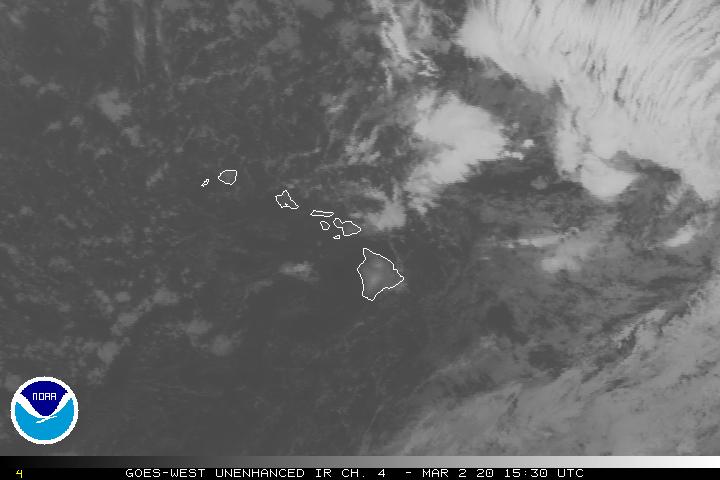
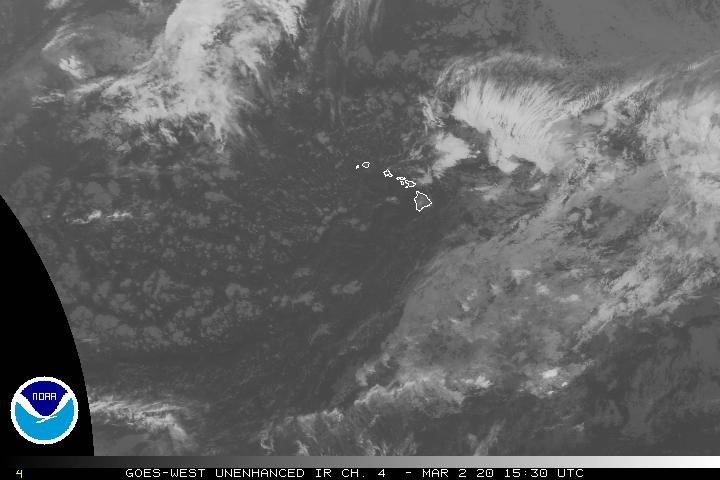
We can use the following links to see what’s going on in our area of the north central Pacific Ocean. Here's the latest NOAA satellite picture – the latest looping satellite image…and finally the latest looping radar image for the Hawaiian Islands.
Here are the latest 24-hour precipitation totals (inches) for each of the islands as of Wednesday evening:
0.48 Mount Waialeale, Kauai
0.46 Kamananui Stream, Oahu
0.22 Molokai
0.01 Lanai
0.00 Kahoolawe
1.60 Puu Kukui, Maui
0.48 Kainaliu, Big Island
~~ Hawaii Sunset Commentary ~~
Our trade winds will remain moderate to locally strong and gusty through Thursday and possibly Friday…then gradually ease up a little into the weekend and beyond. We find a couple of near 1032 millibar high pressure systems (weather map), located far to the northeast of the islands Wednesday evening. The NWS forecast office in Honolulu is keeping the small craft wind advisory active around those windiest coasts and channels around Maui and the Big Island. There will be moisture arriving on the trade winds, bringing showers to the windward sides of the state at times…with a few along leeward slopes locally. The overlying atmosphere continues to become slowly more stable, with a gradual drying trend expected by the weekend.
As we look at this satellite image, it shows more low clouds upstream of the islands…heading towards the windward sides. These lower level clouds will bring showers at times, as they arrive on the trade wind flow…keeping our windward sides off and on showery tonight. At the same time, we find the very northern fringe of an area of high cirrus clouds to the south of the state as well. If we pull up this larger satellite picture, we can see that there's lots of high cirrus well south, to the southwest and west…and the northwest too.
Here in Kula, Maui at 530pm Wednesday evening, it was partly cloudy and calm…with an air temperature of 72.5F degrees. Our local winds will remain quite strong and gusty for the next 24-48 hours or so…and then mellow out a touch through the weekend. These winds were gusting up over 40 mph in a few of the windier spots around the state today. Trade showers will remain active, as clouds impact the windward sides of the islands, at least at times. However, there will gradually be a drying trend as we move towards the weekend. I'll be back again early Thursday morning, I hope you have a great Wednesday night wherever you're spending it! Aloha for now…Glenn.
World-wide tropical cyclone activity:
Atlantic Ocean/Caribbean Sea: Tropical storm Nadine (14L) remains active about 770 miles east-northeast of the Lesser Antilles. Sustained winds are 70 mph, moving northwesterly at 16 mph. It will strengthen into a hurricane soon. Here's the NHC graphical track map for this storm, which isn't expected to impact any land areas. Here's what the hurricane models are doing with Nadine. Here's a satellite image showing tropical storm Nadine.
Eastern Pacific Ocean: Tropical storm Kristy (11E) remains active about 280 miles south of the southern tip of Baja California. Sustained winds are 50 mph, and it is moving west-northwest at 10 mph. Here's the NHC graphical track map. Here's a satellite image showing this tropical storm. Here's what the hurricane models are showing for this system. There will be no threat to land areas throughout the remainder of Kristy's life cycle.
Central Pacific Ocean: There are no active tropical cyclones
Western Pacific Ocean: Super typhoon Sanba (17W) remains active in the Philippine Sea to the east of the Philippine islands…located about 600 miles south of Kadena AB, Okinawa, Japan. Sustained winds are 135 knots, with gusts to near 165 knots! This unusually strong super typhoon will move more or less north to north-northwest…to the east of the Philippines and eventually Taiwan. Here's the JTWC graphical track map for Sanba. Here's a satellite image of Sanba over the Philippine Sea. The JTWC forecast calls for Sanba to continue strengthening…eventually moving just to the west of Okinawa towards South Korea.
South Pacific Ocean: There are no active tropical cyclones
North and South Indian Oceans: There are no active tropical cyclones
Interesting: The tragic 2010 blowout at the BP Deepwater Horizon oil platform left the United States and world in shock, as massive quantities of crude oil streamed unabated from the undersea well. Everyone looked on as scientific experts helplessly tried for three months to plug a hole one-half mile below the water surface.
The blowout was finally ceased when a new well was drilled into the existing well, providing the necessary pressure relief. But not before nearly 5 million barrels of oil were released into the Gulf, causing ecological disaster in the gulf and along the coast.
Efforts were made to clean up the oil from the surface, and dispersants were used underwater. However, most contamination could not be collected, and was hoped to be naturally attenuated over years in the gulf through biological mechanisms.
A new study from the University of Rochester and Texas A&M found that for five months following the disaster, bacteria in the gulf consumed and removed at least 200,000 tons of oil and natural gas. Fossil fuels are organic material which can be fed upon by microbes in the environment.
The research analyzed an extensive data set to determine not only how much was eaten by bacteria, but how the characteristics of this "feast" changed over time. "A significant amount of the oil and gas that was released was retained within the ocean water more than one-half mile below the sea surface.
It appears that the hydrocarbon-eating bacteria did a good job of removing the majority of the material that was retained in these layers," said co-author John Kessler of the University of Rochester. The researchers found that the consumption of oil and gas by bacteria in the deep Gulf ceased by September 2010, five months after the blowout.
"It is unclear if this indicates that this great feast was over by this time or if the microorganisms were simply taking a break before they start on dessert and coffee" said Kessler. "Our results suggest that some (about 40%) of the released hydrocarbons that once populated these layers still remained in the Gulf post September 2010, so food was available for the feast to continue at some later time. But the location of those substances and whether they were biochemically transformed is unknown."
 Email Glenn James: