Air Temperatures – The following maximum temperatures were recorded across the state of Hawaii Monday afternoon:
Lihue, Kauai – 84
Honolulu airport, Oahu – 85
Kaneohe, Oahu – M
Molokai airport – 82
Kahului airport, Maui – 85
Kona airport – 85
Hilo airport, Hawaii – 83
Air Temperatures ranged between these warmest and coolest spots near sea level – and on the highest mountain tops around the state…as of 7pm Monday evening:
Barking Sands, Kauai – 81
Hilo, Hawaii – 75
Haleakala Summit – 45 (near 10,000 feet on Maui)
Mauna Kea Summit – M (near 13,800 feet on the Big Island)
Hawaii’s Mountains – Here’s a link to the live web cam on the summit of near 13,800 foot Mauna Kea on the Big Island of Hawaii. This web cam is available during the daylight hours here in the islands…and when there’s a big moon shining down during the night at times. Plus, during the nights you will be able to see stars, and the sunrise and sunset too…depending upon weather conditions. Here's the Haleakala Crater webcam on Maui…although this webcam is not always working correctly.
Tropical Cyclone activity in the eastern and central Pacific – Here’s the latest weather information coming out of the National Hurricane Center, covering the eastern north Pacific. You can find the latest tropical cyclone information for the central north Pacific (where Hawaii is located) by clicking on this link to the Central Pacific Hurricane Center. A satellite image, which shows the entire ocean area between Hawaii and the Mexican coast…can be found here.
Aloha Paragraphs

Gusty trade winds, windward showers at times…
a few elsewhere on the leeward sides as well
High cirrus clouds at times…should be
a nice colorful sunrise in places Tuesday
As this weather map shows, we have a moderately strong high pressure system located far to the north of the islands. Our local trade winds will be moderately strong and gusty through this week…with stronger gusts occurring at times.
The following numbers represent the most recent top wind gusts (mph), along with directions as of Monday evening:
31 Port Allen, Kauai – ENE
37 Kuaokala, Oahu – NE
31 Molokai – NE
29 Kahoolawe – NE
30 Kahului, Maui -NE
40 Lanai – NE
38 Puu Malu, Big Island – E
We can use the following links to see what’s going on in our area of the north central Pacific Ocean. Here's the latest NOAA satellite picture – the latest looping satellite image…and finally the latest looping radar image for the Hawaiian Islands.
Here are the latest 24-hour precipitation totals (inches) for each of the islands as of Monday evening:
1.15 Kilohana, Kauai
0.85 Manoa Lyon Arboretum, Oahu
0.87 Molokai
0.10 Lanai
0.00 Kahoolawe
1.68 Puu Kukui, Maui
0.80 Lower Kahuku, Big Island
~~ Sunset Commentary ~~
Our trade winds will remain active through the next week here in our Hawaiian Island chain. We still find our primary, moderately strong high pressure system (weather map) located to the far north of the islands Monday evening. Windward showers will fall at times, enhanced at times by a low pressure trough aloft. At the same time, the leeward coasts and slopes will see a few showers here and there too.
Here in Kula, Maui at 515pm Monday evening, it was clear to partly and breezy at times…with an air temperature of 75.5F degrees. The trades are forecast to continue across our island chain, with no breaks expected well into the future. These trade winds will blow generally in the moderately strong realms…with stronger gusts at times. Case in point, we find a strong gust of 40 mph occurring at the anemometer (wind instrument) on the small island of Lanai early this evening.
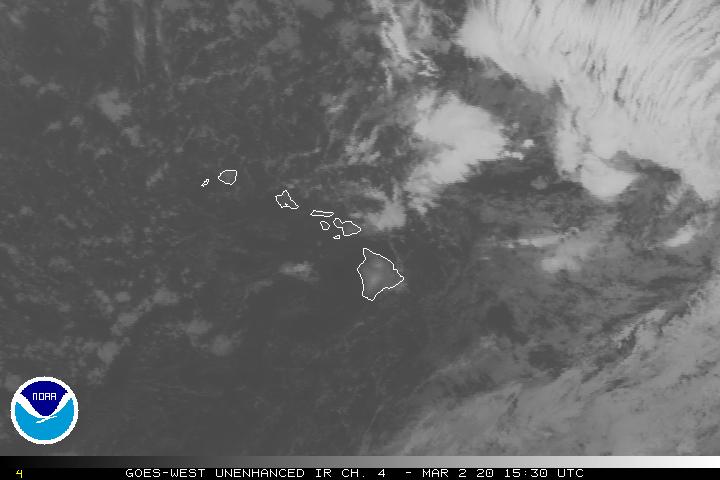
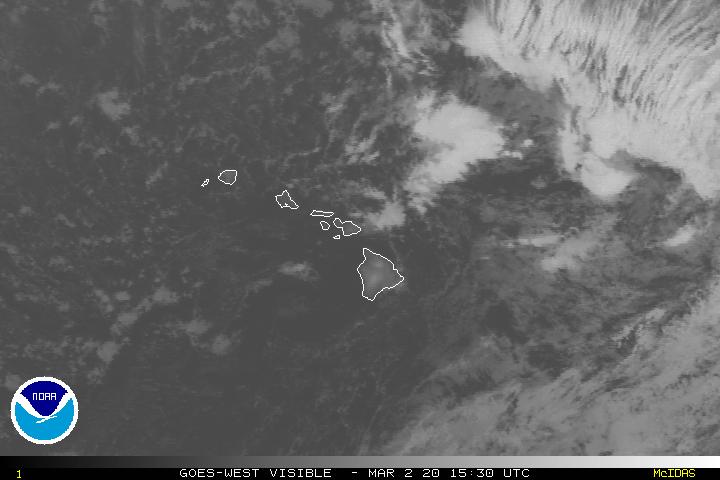
If we look at this satellite image, it shows partly cloudy conditions surrounding the islands, some of which are dropping passing showers to our windward sides. At the same time, we see an area of high cirrus clouds to the west through north of the state, which are moving over the islands at times. These in turn will provide nice colorful sunrise colors perhaps on Tuesday. Looking ahead, this week looks like it will continue to have partly cloudy skies in general, with the trade winds blowing steadily, and somewhat more than the normal amount of passing windward showers at times. The forecast goes on to suggest that we'd see some increase in the clouds and showers along our leeward sides at times too, with drier weather slated for the upcoming weekend. I'll be back early Tuesday morning with your next new weather narrative, I hope you have a great Monday night wherever you happen to be spending it! Aloha for now…Glenn.
World-wide tropical cyclone activity:
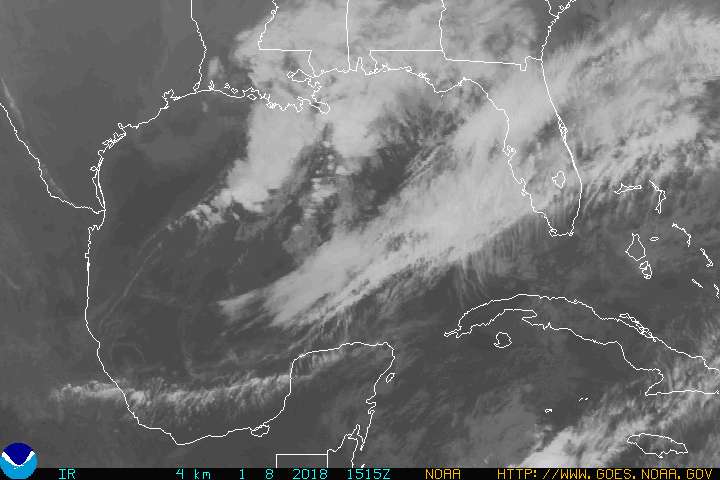
Gulf of Mexico: Tropical storm Isaac (9L) is moving through the Gulf of Mexico towards the north-central Gulf coast. It is located about 165 miles southeast of New Orleans, Louisiana…moving northwest at 10 mph. The latest sustained wind speeds were 70 mph. Here's the NHC graphical track map. Here's a satellite image of Isaac. The latest NHC forecast shows Isaac becoming a hurricane today, then striking the Gulf coast near New Orleans this evening. Heavy flooding rainfall, strong hurricane force winds, and significant storm surge threat is expected on a relative large area of the Gulf coast as this sprawling tropical cyclone arrives. Top sustained winds are forecast to be 75 mph as this hurricane makes landfall…with gusts to near 98 mph.
Atlantic Ocean/Caribbean Sea: There are no active tropical cyclones
There is however, an active tropical disturbance about 1250 miles west-northwest of the Cape Verde Islands. It has a medium 40% chance of developing into a tropical depression over the next 48 hours.
At the same time, a second tropical disturbance remains active in the eastern Atlantic…located near the Cape Verde Islands. It has a low 10% chance of forming into a tropical depression within the next 48 hours.
Here's a satellite image showing tropical storm Isaac (9L)…and these two areas of disturbed weather in the Atlantic.
Eastern Pacific Ocean: Tropical storm Ileana (9E) remains active offshore from the Mexico east coast…located about 415 miles west-southwest of Manzanillo, Mexico. Sustained winds were 50 mph, with strengthening expected into a hurricane within 36 hours. Here's the NHC graphical track map, along with a satellite image. Here's what the hurricane models are doing with Ileana. Fortunately, and in contrast to the other "I" named storm, Isaac in the Gulf of Mexico, there is no threat to land from this storm…despite its strengthening nature.
Central Pacific Ocean: There are no active tropical cyclones
Western Pacific Ocean: Tropical storm Tembin (15W) remains active about 110 NM east of Taipei, Taiwan. Sustained winds are 50 knots, with gusts to near 65 knots. The JTWC shows Tembin to the east of Taiwan, moving north-northeast. The forecast has this weakening tropical cyclone heading northwards offshore to the east of Shanghai, China as a weakening tropical storm…then impacting the west coast of South Korea. Here's the JTWC graphical track map.
Tropical storm Bolaven (16W) is active in the western Pacific…located about 140 NM northwest of Seoul, South Korea. Sustained winds are 45 knots, with gusts to near 55 knots. The JTWC shows that Bolaven will be moving generally northwards offshore from the west coast of South Korea…making a landfall along the northwest coast of North Korea into the Chinese mainland as a weakening tropical storm. Here's the JTWC graphical track map.
South Pacific Ocean: There are no active tropical cyclones
North and South Indian Oceans: There are no active tropical cyclones
Interesting: Americans are throwing away 40 percent of food in the U.S., the equivalent of $165 billion in uneaten food each year, according to a new analysis by the Natural Resources Defense Council. In a time of drought and skyrocketing food prices, NRDC outlines opportunities to reduce wasted food and money on the farm, in the grocery store and at home.
"As a country, we're essentially tossing every other piece of food that crosses our path — that's money and precious resources down the drain," said Dana Gunders, NRDC project scientist with the food and agriculture program. "With the price of food continuing to grow, and drought jeopardizing farmers nationwide, now is the time to embrace all the tremendous untapped opportunities to get more out of our food system. We can do better."
NRDC's issue brief — Wasted: How America is Losing Up to 40 Percent of Its Food from Farm To Fork to Landfill — analyzes the latest case studies and government data on the causes and extent of food losses at every level of the U.S. food supply chain. It also provides examples and recommendations for reducing this waste. Key findings include:
– Americans trash 40 percent of our food supply every year, valued at about $165 billion;
– The average American family of four ends up throwing away an equivalent of up to $2,275 annually in food;
– Food waste is the single largest component of solid waste in U.S. landfills;
– Just a 15 percent reduction in losses in the U.S. food supply would save enough food to feed 25 million Americans annually;
– There has been a 50 percent jump in U.S. food waste since the 1970s.
The causes of losses in our food system are complex, but there are notable problem areas. At the retail level, grocery stores and other sellers are losing as much as $15 billion annually in unsold fruits and vegetables alone, with about half of the nationwide supply going uneaten.
In fact, fresh produce is lost more than any other food product — including seafood, meat, grains and dairy — at nearly every stage in the supply chain. Some of this is avoidable. For instance, retailers can stop the practice of unnecessary abundance in their produce displays, which inherently leads to food spoilage.
But consumers are also a major contributor to the problem, with the majority of food losses occurring in restaurants and household kitchens. A significant reason for this is large portions, as well as uneaten leftovers. Today, portion sizes are two to eight times larger than the government's standard serving sizes.
Wasted food also translates into wasted natural resources, because of the energy, water and farmland necessary to grow, transport, and store food. About half of all land in the U.S. goes to agriculture; some 25 percent of all the freshwater consumed in this country, along with 4 percent of the oil, goes into producing food that is never eaten.
Moreover, uneaten food accounts for 23 percent of all methane emissions in the U.S. – a potent climate change pollutant. Increasing the efficiency of our food system is a triple-bottom-line solution that requires collaborative efforts by businesses, governments and consumers.
Specifically:
– The U.S. government should conduct a comprehensive study of losses in our food system and set national goals for waste reduction. This may require steps such as clarifying date labels on food, encouraging food recovery, and improving public awareness about ways to waste less. State and local governments can also lead by setting similar targets.
– Businesses should seize opportunities to streamline their own operations, reduce food losses and save money. The Stop and Shop grocery chain is already doing this successfully, saving an estimated $100 million annually after an analysis of freshness, loss, and customer satisfaction in their perishables department. Others should follow suit.
– Consumers can waste less food by shopping wisely, knowing when food goes bad, buying produce that is perfectly edible even if it’s less cosmetically attractive, cooking only the amount of food they need, and eating their leftovers.
Europe is leading the way in reducing food waste. In January 2012, the European Parliament adopted a resolution to reduce food waste 50 percent by 2020, and designated 2014 as the “European year against food waste.” In the U.K., an extensive five-year public awareness campaign called “Love Food Hate Waste” has contributed to an 18 percent reduction in avoidable food waste. And 53 of the leading U.K. food retailers and brands have adopted waste reduction resolutions.
“No matter how sustainably our food is farmed, if it’s not being eaten, it is not a good use of resources,” said Gunders. “Fortunately, there are ways to tackle the food waste problem, and everyone can play a role.”
 Email Glenn James: