Air Temperatures – The following maximum temperatures were recorded across the state of Hawaii Monday afternoon:
Lihue, Kauai – 85
Honolulu airport, Oahu – 89
Kaneohe, Oahu – M
Molokai airport – 84
Kahului airport, Maui – 87
Kona airport – 87
Hilo airport, Hawaii – 83
Air Temperatures ranged between these warmest and coolest spots near sea level – and on the highest mountain tops around the state…as of 8pm Monday evening:
Barking Sands, Kauai – 82
Hilo, Hawaii – 73
Haleakala Summit – 43 (near 10,000 feet on Maui)
Mauna Kea Summit – M (near 13,800 feet on the Big Island)
Hawaii’s Mountains – Here’s a link to the live web cam on the summit of near 13,800 foot Mauna Kea on the Big Island of Hawaii. This web cam is available during the daylight hours here in the islands…and when there’s a big moon shining down during the night at times. Plus, during the nights you will be able to see stars, and the sunrise and sunset too…depending upon weather conditions. Here's the Haleakala Crater webcam on Maui…although this webcam is not always working correctly.
Tropical Cyclone activity in the eastern and central Pacific – Here’s the latest weather information coming out of the National Hurricane Center, covering the eastern north Pacific. You can find the latest tropical cyclone information for the central north Pacific (where Hawaii is located) by clicking on this link to the Central Pacific Hurricane Center. A satellite image, which shows the entire ocean area between Hawaii and the Mexican coast…can be found here.
Aloha Paragraphs

Trade winds continuing well into the
future…windward showers at times
As this weather map shows, we have a moderately strong high pressure systems aligned to the northwest and northeast of the islands. Our local trade winds will remain moderately strong in general through the next week.
The following numbers represent the most recent top wind gusts (mph), along with directions as of Monday evening:
30 Port Allen, Kauai – NE
38 Kuaokala, Oahu – NE
31 Molokai – NE
37 Kahoolawe – NE
35 Kahului, Maui – NE
32 Lanai – NE
27 South Point, Big Island – NE
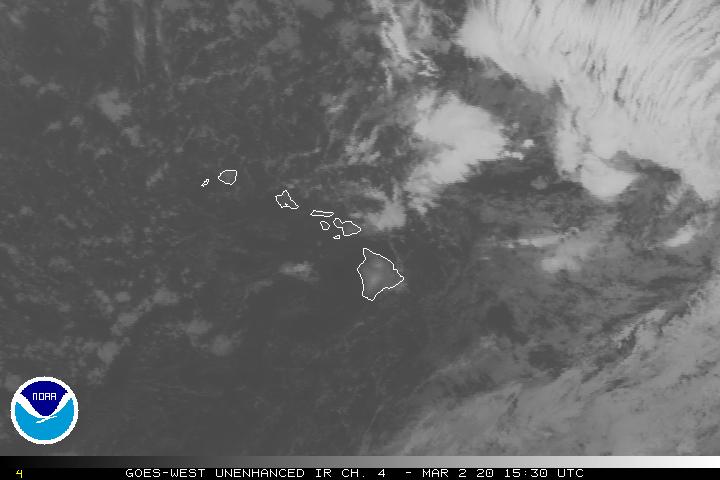
We can use the following links to see what’s going on in our area of the north central Pacific Ocean. Here's the latest NOAA satellite picture – the latest looping satellite image…and finally the latest looping radar image for the Hawaiian Islands.
Here are the latest 24-hour precipitation totals (inches) for each of the islands as of Monday evening:
0.61 Mount Waialeale, Kauai
0.36 Poamoho RG 1, Oahu
0.21 Molokai
0.00 Lanai
0.00 Kahoolawe
3.55 Puu Kukui, Maui
4.45 Kawainui Stream, Big Island
~~ Sunset Commentary ~~
Moderately strong trade winds continuing through the next week. We find a couple of moderately strong high pressure systems (weather map) located to the north-northwest through northeast of the islands Monday evening. These trades will carry windward showers our way…some will be locally heavy. The leeward sides will remain relatively dry, although a few showers could fall here and there too, especially along the Kona slopes on the Big Island during the afternoon and evening hours.
Here in Kula, Maui at 525pm Monday evening, it was partly cloudy…with an air temperature of 76.3F degrees. The trade winds will continue across our islands through the next week and more. These trade winds will blow generally in the moderately strong realms. If we look at this satellite image, we see an area of showery clouds sticking around the Big Island. The Kawainui Stream gauge on the Big Island ended up receiving a very generous 4.45" of rain during the last 24 hours, with many of the other gauges on the Big Island having 1-3"+ inches of moisture falling locally. The forecast continues to show windward biased showers continuing at times going forward. I'll be back again early Tuesday morning, I hope you have a great Monday night wherever you happen to be spending it! Aloha for now…Glenn.
World-wide tropical cyclone activity:
Central Pacific Ocean: There are no active tropical cyclones
Eastern Pacific Ocean: There are no active tropical cyclones
Atlantic Ocean/Gulf of Mexico/Caribbean: Tropical depression 9L has formed in the Atlantic…located about 580 miles east of Guadeloupe…moving westward at a quick 20 mph. This new tropical cyclone will be gradually strengthening, becoming a tropical storm named Isaac later today. It is forecast by the NHC to become a hurricane within 48 hours…as it moves into the Caribbean Sea.
Showers and thunderstorms are located over the southwestern Gulf of Mexico, with a medium 30% chance of developing into a tropical depression over the next day or two.
Finally, an area of disturbed weather is located southwest of the Cape Verde Islands in the eastern Atlantic, moving westward, with a high 60% chance of becoming a tropical depression within 48 hours.
Here's a satellite image showing tropical depression 9L, and the area of disturbed weather in the southwest Gulf…and finally the area of disturbed weather in the central Atlantic.
Western Pacific Ocean: Typhoon Tembin (15W) remains active…located about 280 NM southeast of Taipei, Taiwan. Sustained winds are 100 knots, with gusts to near 125 knots. The JTWC keeps Tembin over the ocean for awhile, although eventually brings it over the central part of Taiwan, and then across the Taiwan Strait into the east coast of mainland China, close to Hong Kong. Here's the JTWC graphical track map…which shows it peaking in strength now, with a gradual reduction in strength going forward.
Newly formed Typhoon Bolaven (16W) is active in the western Pacific…located about 385 NM south-southwest of Iwo To, Japan. The JTWC keeps Bolaven over the ocean, away from land through the next 5 days. Here's the JTWC graphical track map…which shows it continuing to strengthen as a stronger typhoon. Sustained winds are 65 knots, with gusts to near 80 knots.
South Pacific Ocean: There are no active tropical cyclones
North and South Indian Oceans: There are no active tropical cyclones
Interesting: A new study has revealed the under-appreciation that exists for the role dams play in climate change; how the reservoirs behind them can cause surges of greenhouse gases as the water levels go up and down. In a study of the water column at such a reservoir, marine scientists found an astonishing 20-fold increase in methane emissions as water levels were drawn down. Bubbles coming out of the mud and sediment at the bottom were chock full of this potent greenhouse gas.
The role of lakes, reservoirs, and streams often go unnoticed when calculating carbon emissions. Most of the time we think about fossil fuel vehicles, factories, power plants, and landfills. The truth is that there is a lot biological activity going on behind the dam.
This is where the natural flow of sediment and living things stop and therefore accumulate. Through the decomposition of such creatures and organic material comes methane gas that builds up in the lake bed. As levels of water go down, the lake bed heats up because more sunlight is hitting it. The rising temperatures cause the methane to bubble up and out into the atmosphere.
This is particularly true in summer because low oxygen conditions at the depth of the reservoir creates an ideal condition for microbial activity that creates the methane. The recent study was conducted at Lacamas Lake in Clark County, Washington, by Washington State University researchers Bridget Deemer and Maria Glavin.
They wanted to challenge the notion that lakes and reservoirs acted as carbon sinks, where carbon dioxide is absorbed from the atmosphere. They concluded that their carbon storage abilities could be less than one fourth what was estimated, when accounting for the drawdown of water in reservoirs.
In the United States, reservoirs behind dams take up a tiny fraction of overall land surface. However, due to their increased biological activity, they have an outsized effect on methane emissions. Across the country there are about 80,000 dams.
According to the student's advisor, John Harrison, assistant professor of Earth and Environmental Sciences, this research could lead to new methods of managing reservoirs by timing the water drawdowns to avoid the summer months.
"We have the ability to manage the timing, magnitude and speed of reservoir drawdowns, which all could play a role in how much methane gets released to the atmosphere," Harrison says. Their research continues to find out the optimal way to drawdown water from a reservoir, the optimal time for dam removal, and whether or not the placing of certain plants and soils might help.
The current study is being presented at the national meeting of the Ecological Society of America in Portland, Oregon.
 Email Glenn James: