Air Temperatures – The following maximum temperatures were recorded across the state of Hawaii Tuesday afternoon:
Lihue, Kauai – 84
Honolulu airport, Oahu – 86
Kaneohe, Oahu – M
Molokai airport – 83
Kahului airport, Maui – 87
Kona airport – 86
Hilo airport, Hawaii – 84
Air Temperatures ranged between these warmest and coolest spots near sea level – and on the highest mountain tops around the state…as of 6pm Tuesday evening:
Barking Sands, Kauai – 83
Molokai airport – 75
Haleakala Summit – 46 (near 10,000 feet on Maui)
Mauna Kea Summit – 32 (near 13,800 feet on the Big Island)
Hawaii’s Mountains – Here’s a link to the live web cam on the summit of near 13,800 foot Mauna Kea on the Big Island of Hawaii. This web cam is available during the daylight hours here in the islands…and when there’s a big moon shining down during the night at times. Plus, during the nights you will be able to see stars, and the sunrise and sunset too…depending upon weather conditions. Here's the Haleakala Crater webcam on Maui…although this webcam is not always working correctly.
Tropical Cyclone activity in the eastern and central Pacific – Here’s the latest weather information coming out of the National Hurricane Center, covering the eastern north Pacific. You can find the latest tropical cyclone information for the central north Pacific (where Hawaii is located) by clicking on this link to the Central Pacific Hurricane Center. A satellite image, which shows the entire ocean area between Hawaii and the Mexican coast…can be found here.
Aloha Paragraphs

Gusty trades…generally
fine weather
Wind Advisory…Maui and
Big Island summits
As this weather map shows, we have a moderately strong high pressure system located far to the northeast of the islands, with a low pressure trough, and a cold front far to our north. Our local trade winds will remain moderately strong through the week.
The following numbers represent the most recent top wind gusts (mph), along with directions as of Tuesday evening:
35 Port Allen, Kauai – ENE
39 Kuaokala, Oahu – NE
36 Molokai – NE
39 Kahoolawe – NE
40 Kaupo Gap, Maui – NNE
38 Lanai – NE
44 Pali 2, Big Island – NNE
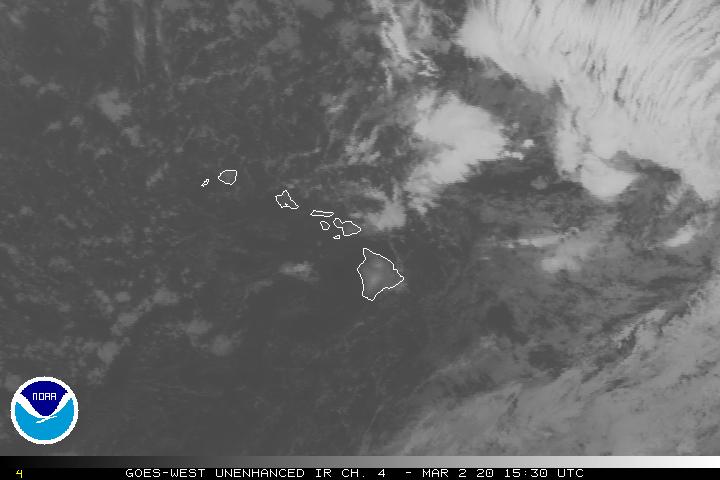
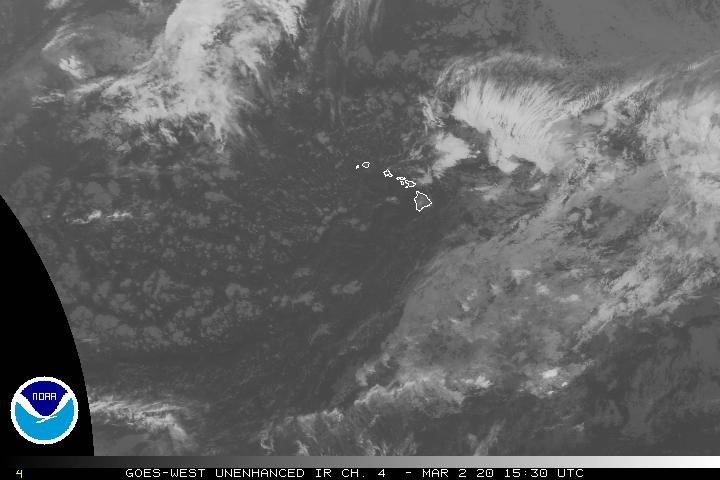
We can use the following links to see what’s going on in our area of the north central Pacific Ocean. Here's the latest NOAA satellite picture – the latest looping satellite image…and finally the latest looping radar image for the Hawaiian Islands.
Here are the latest 24-hour precipitation totals (inches) for each of the islands as of Tuesday evening:
1.15 Mount Waialeale, Kauai
0.39 Oahu Forest NWR, Oahu
0.11 Molokai
0.00 Lanai
0.01 Kahoolawe
0.23 Puu Kukui, Maui
1.42 Kawainui Stream, Big Island
Sunset Commentary:
A relatively stable and dry atmosphere overlies the Hawaiian Islands now, with moderate trade winds continuing through the rest of this week…although with still higher gusts locally. We find a near 1030 millibar high pressure system (weather map) located to the northeast of the islands Tuesday evening…with an elongated high pressure ridge running from its center southwest to the north and northwest of Kauai. These trades will carry a few windward showers towards us at times. The leeward sides will be generally dry, although the leeward Kona slopes on the Big Island may see a few afternoon or early evening showers at times. I don't see any substantial deviations in this normal summertime trade wind weather pattern through the end of the week…at least.
Here in Kula, Maui at 515pm Tuesday evening, it was clear to partly cloudy and quite hazy…with an air temperature of 79.3F degrees. The trade winds will continue to blow across our islands through the next week and more. Tuesday's winds reached in gusts, at least at a couple of places…up into the 40-50+ mph range! These trade winds will likely ease up a touch, enough in fact, to allow the small craft wind advisories to expire by Thursday or Friday onwards. If we look at this satellite image, we see scattered patches of low level clouds upstream of our islands, to the east and northeast. At the same time, we see an area of high cirrus clouds over parts of the Big Island and Maui County. As usual, the cooler night time hours will prompt localized modest increases in showers, at least where cloud patches impact the windward sides of the islands. In sum: gusty trade wind weather pattern is expected to continue, then easing up a touch after mid-week. I'll be back early Wednesday morning with your next new weather narrative, I hope you have a great Tuesday night wherever you happen to be spending it! Aloha for now…Glenn.
World-wide tropical cyclone activity:
Central Pacific Ocean: There are no active tropical cyclones
Eastern Pacific Ocean: Tropical storm Hector (8E) remains active over the waters offshore from Mexico…located about 285 miles west-southwest of Socorro Island…with sustained winds of 40 mph. Tropical storm Hector is weakening steadily, and forecast to drop back down to a tropical depression early Thursday morning. Here's a NHC graphical track map. Here's the NHC satellite image showing tropical storm Hector.
Here's a satellite image showing TS Hector
Atlantic Ocean/Gulf of Mexico/Caribbean: There are no active tropical cyclones
The remnants of retired tropical depression 7L has moved ashore over Nicaragua and northeast Honduras. There's a low 0% chance that this area could regenerate into a tropical cyclone. Here's a satellite image of this remnant low. There is forecast to be gusty winds and heavy rains over portions of Central America today.
Meanwhile, another area of disturbed weather is located about 715 miles east-southeast of Bermuda. This system has a high 80% chance of developing into a tropical cyclone within the next 48 hours.
Here's a satellite image showing former 7L over Central America and the Yucatan Peninsula…and this other area of disturbed weather in the Atlantic.
Western Pacific Ocean: Tropical storm Kai-tak (14W) is located approximately 320 NM east-southeast of Hong Kong, China. Sustained winds were 55 knots with gusts to near 70 knots. It continues to be on a strengthening trend, and forecast by the JTWC to become a typhoon today. The forecast track takes this storm across the South China Sea towards mainland China…making landfall over or very near Hong Kong on Thursday. Here's a JTWC graphical track map.
South Pacific Ocean: There are no active tropical cyclones
North and South Indian Oceans: There are no active tropical cyclones
Interesting: Sea ice in the Arctic is disappearing at a far greater rate than previously expected, according to data from the first purpose-built satellite launched to study the thickness of the Earth's polar caps. Preliminary results from the European Space Agency's CryoSat-2 probe indicate that 900 cubic kilometres of summer sea ice has disappeared from the Arctic ocean over the past year.
This rate of loss is 50% higher than most scenarios outlined by polar scientists and suggests that global warming, triggered by rising greenhouse gas emissions, is beginning to have a major impact on the region. In a few years the Arctic ocean could be free of ice in summer, triggering a rush to exploit its fish stocks, oil, minerals and sea routes.
Using instruments on earlier satellites, scientists could see that the area covered by summer sea ice in the Arctic has been dwindling rapidly. But the new measurements indicate that this ice has been thinning dramatically at the same time. For example, in regions north of Canada and Greenland, where ice thickness regularly stayed at around five to six meters in summer a decade ago, levels have dropped to one to three meters.
"Preliminary analysis of our data indicates that the rate of loss of sea ice volume in summer in the Arctic may be far larger than we had previously suspected," said Dr Seymour Laxon, of the Center for Polar Observation and Modelling at University College London (UCL), where CryoSat-2 data is being analyzed. "Very soon we may experience the iconic moment when, one day in the summer, we look at satellite images and see no sea ice coverage in the Arctic, just open water."
Interesting2: Calling the African lion (Panthera leo) the 'king of the jungle' is usually a misnomer, as the species is usually found in savannah or dry forests, but recent photos by the Germany-based Nature and Biodiversity Conservation Union (NABU) document lions in Ethiopian rainforests. Taken in the Kafa Biosphere Reserve, the photos show a female lion hiding out in thick montane jungle. "We are delighted with this news and look forward to studying these exceptional animals in their unusual habitat," said NABU’s Vice-President Thomas Tennhardt in a press release.
"To manage potential conflict with local communities, NABU will set up a dedicated conservation fund." NABU has been working in the region since 2006. Long known to locals, the lions are actually thought not to be permanent residents, but possibly passing through Kafa Biosphere Reserve in the dry season.
Kafa Biosphere Reserve covers 760,000 hectares of montane rainforest and preserves the last place on Earth where wild coffee (Coffea arabica) still grows naturally. The reserve is home to at least 106 woody plants, 100 birds, and 48 mammals.
Although mighty, lions are gravely imperiled: habitat loss, prey depletion, hunting, poisonings, and conflict with humans have decimated Africa's lions. In the last twenty years alone, the lion population is believed to have declined by 30 percent, prompting the species to be listed as Vulnerable on the IUNC Red List.
 Email Glenn James: