Air Temperatures – The following maximum temperatures were recorded across the state of Hawaii Friday afternoon:
Lihue, Kauai – 84
Honolulu airport, Oahu – 87
Kaneohe, Oahu – 86
Molokai airport – 86
Kahului airport, Maui – 88
Kona airport – 86
Hilo airport, Hawaii – 83
Air Temperatures ranged between these warmest and coolest spots near sea level – and on the highest mountain top around the state…as of 5pm Friday afternoon:
Kahului, Maui – 84
Hilo, Hawaii – 79
Haleakala Summit – M (near 10,000 feet on Maui)
Mauna Kea Summit – 41 (near 13,800 feet on the Big Island)
Hawaii’s Mountains – Here’s a link to the live web cam on the summit of near 13,800 foot Mauna Kea on the Big Island of Hawaii. This web cam is available during the daylight hours here in the islands…and when there’s a big moon shining down during the night at times. Plus, during the nights you will be able to see stars, and the sunrise and sunset too…depending upon weather conditions. Here's the Haleakala Crater webcam on Maui…although this webcam is not always working correctly.
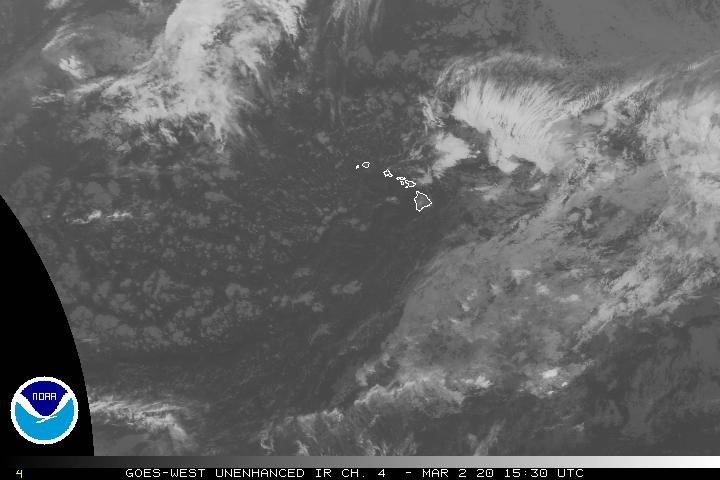
Tropical Cyclone activity in the eastern and central Pacific – Here’s the latest weather information coming out of the National Hurricane Center, covering the eastern north Pacific. You can find the latest tropical cyclone information for the central north Pacific (where Hawaii is located) by clicking on this link to the Central Pacific Hurricane Center. A satellite image, which shows the entire ocean area between Hawaii and the Mexican coast…can be found here.
Aloha Paragraphs

Trade winds prevail, common summer
conditions, high clouds at times…locally hazy
Big Moon!
As this weather map shows, we have moderately strong high pressure systems located far to the northwest, north and northeast of the islands…with a low pressure system and trough to our northwest. Our local trade winds will remain moderately strong into the weekend…and beyond.
The following numbers represent the most recent top wind gusts (mph), along with directions as of Friday evening:
27 Port Allen, Kauai – ENE
37 Kuaokala, Oahu – NE
27 Molokai – NE
35 Kahoolawe – NE
30 Kahului, Maui – NE
30 Lanai – NE
27 South Point, Big Island – NE
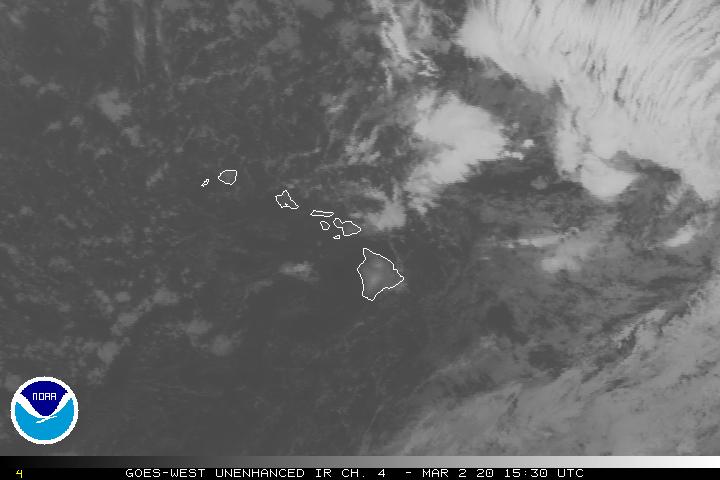
We can use the following links to see what’s going on in our area of the north central Pacific Ocean. Here's the latest NOAA satellite picture – the latest looping satellite image…and finally the latest looping radar image for the Hawaiian Islands.
Here are the latest 24-hour precipitation totals (inches) for each of the islands as of Friday afternoon:
1.48 Mount Waialeale, Kauai
0.05 Ahuimanu Loop, Oahu
0.06 Molokai
0.00 Lanai
0.00 Kahoolawe
0.02 Hana airport, Maui
0.25 Kealakekua, Big Island
Sunset Commentary:
There's little change expected in our moderately strong trade wind flow across the Hawaiian Islands…through this weekend into next week. We continue to find near 1030 millibar high pressure systems (weather map) located far to the northeast, north and northwest of Hawaii…supporting this wind flow across our islands. The trade winds will carry just a few windward showers towards us, with generally dry conditions expected along our leeward sides. We can use this satellite image to see just the usual array of scattered low level clouds to our east and northeast. These low clouds upwind of our islands will bring just a few windward biased showers periodically…generally during the night and early morning hours. At the same time, there are lots of high and middle level clouds around too, especially to our northwest through southwest…associated with a low pressure system out that way
Friday evening film: I'm picking up some friends in Pukalani in a little while, and from there we're heading down to Kahului to see a film. Before we see this new film, we'll all have dinner out together beforehand. The film, called The Dark Knight Rises, stars Christian Bale, Michael Cane, Gary Oldman, Morgan Freeman, Anne Hathaway, Marion Cotillard, Juno Temple…among many others. The synopsis: It has been eight years since Batman vanished into the night, turning, in that instant, from hero to fugitive. Assuming the blame for the death of D.A. Harvey Dent, the Dark Knight sacrificed everything for what he and Commissioner Gordon both hoped was the greater good. For a time the lie worked, as criminal activity in Gotham City was crushed under the weight of the anti-crime Dent Act. But everything will change with the arrival of a cunning cat burglar with a mysterious agenda. Far more dangerous, however, is the emergence of Bane, a masked terrorist whose ruthless plans for Gotham drive Bruce out of his self-imposed exile. But even if he dons the cape and cowl again, Batman may be no match for Bane. ~~~ I'll be sure to let you know what we all thought Saturday morning. Here's a trailer in case you are curious.
Here in Kula, Maui at 515pm Friday evening, it was partly cloudy, somewhat hazy with light breezes…an air temperature of 73.6F degrees. As mentioned above, the trade winds will continue to blow well into the future. Winds will remain quite breezy, at least in gusts, ranging between 30-40 mph in those windiest places around the state. If we look at this satellite image, providing a larger view, we see lots of thunderstorms and high cirrus clouds far to our southwest through southeast…down towards the Equator. At the same time, an area of low pressure far to our west, towards Midway Island in the western Pacific, is causing lots of upper level clouds too. Despite low pressure to our west, and all the high clouds that will sweep into the state at times, our normal summertime trade wind weather conditions will prevail. Meanwhile, when cirrus around around during the days, they will cause sun dimming and filtering of our famous Hawaiian sunshine at times. These are also famous for bringing colorful sunrise and sunsets to our islands too! I'll be back Saturday morning with your next new weather narrative. I hope you have a great Friday night wherever you happen to be spending it! Aloha for now…Glenn.
Extra: Youtube video showing what will happen to Curiosity, as it lands on Mars this Sunday evening
World-wide tropical cyclone activity:
Central Pacific Ocean: There are no active tropical cyclones
Eastern Pacific Ocean: There are no active tropical cyclones
Atlantic Ocean/Gulf of Mexico/Caribbean: Tropical storm Ernesto (5L) remains active in the Caribbean Sea, located about 590 miles east-southeast of Kingston, Jamaica. Maximum sustained winds are 50 mph, which is expected to increase to a hurricane Sunday evening…to the south of Jamaica. Here's the official NHC graphical track map / Here's a satellite image of this storm / Here's the hurricane model output for TS Ernesto.
The 6th tropical cyclone of the 2012 hurricane season remains active in the far eastern Atlantic Ocean…called tropical storm Florence (6L). This storm will strengthen for the 36 hours or so, and be called be called tropical storm Florence. It will run into unfavorable environment conditions by the 48 hour mark, and will then quickly dissipate over the open ocean…away from any land or island areas. Here's the NHC graphical track map for 6L…along with a satellite view, located far to the right hand side of the picture
Meanwhile, there's an area of disturbed weather to the east of Cape Canaveral Florida, that has a low 10% chance of developing into a tropical depression within the next 48 hours. Regardless if this first tropical disturbance develops or not…it may bring heavy rains to Florida later today into Sunday.
Here's a satellite image showing these three areas, circled in yellow…along with tropical storms Ernesto and Florence.
Western Pacific Ocean: Tropical storm Haikui (12W) remains active in the western Pacific, located approximately 175 NM east of Kadena AB, Okinawa, Japan. Sustained winds were 45 knots, with gusts to near 55 knots. It is expected to strengthen into a typhoon within 24 hours or so…moving by just north of Kadena AB, and then on into the east coast of mainland China to the south of Shanghai. Here's the JTWC graphical track map, along with a NOAA satellite image.
South Pacific Ocean: There are no active tropical cyclones
South and North Indian Oceans: There are no active tropical cyclones
Interesting: What is the world wide trend in air pollution? On the surface North America and Europe have been gradually improving. However, that is due to often moving industry to other countries such as China or India where air pollution is a bit more of a problem. Most of the world's population will be subject to degraded air quality by 2050 if human-made emissions continue as usual.
In this business-as-usual scenario, the average world citizen 40 years from now will experience similar air pollution to that of today's average East Asian citizen. These conclusions are those of a study published August 1 in Atmospheric Chemistry and Physics, an Open Access journal of the European Geosciences Union (EGU). Air pollution is a major health risk that may worsen with increasing industrial activity.
At present, urban outdoor air pollution causes 1.3 million estimated deaths per year worldwide, according to the World Health Organization. The atmospheric chemistry general circulation model EMAC was used to estimate the impact of anthropogenic emission changes on global and regional air quality in recent and future years (2005, 2010, 2025 and 2050).
The emission scenario assumes that population and economic growth largely determine energy and food consumption and consequent pollution sources with the current technologies. This scenario is chosen to show the effects of not implementing legislation to prevent additional climate change and growing air pollution, other than what is in place for the base year 2005, representing a pessimistic (but plausible) future.
To identify possible future hot spots of poor air quality, a multi pollutant index (MPI), suited for global model output, was applied. It appears that East and South Asia and the Middle East represent such hotspots due to very high pollutant concentrations, while a general increase of MPIs is observed in all populated regions in the Northern Hemisphere.
In East Asia a range of pollutant gases and fine particulate matter (PM2.5) is projected to reach very high levels from 2005 onward, while in South Asia air pollution, including ozone, will grow rapidly towards the middle of the century. Around the Persian Gulf, where natural PM2.5 concentrations are already high (desert dust), ozone levels are expected to increase strongly.
The population weighted MPI (PW-MPI), which combines demographic and pollutant concentration projections, shows that a rapidly increasing number of people worldwide will experience reduced air quality during the first half of the 21st century.
Following this business as usual scenario, it is projected that air quality for the global average citizen in 2050 would be almost comparable to that for the average citizen in East Asia in the year 2005, which underscores the need to pursue emission reductions.
"At present the post-Kyoto climate negotiations are progressing slowly, and it is unclear how air quality policies will develop globally," explains co-author Greet Janssens-Maenhout of the European Commission Joint Research Centre in Italy.
"In regions with economic growth, it might be less effective to implement emission-reduction measures due to strong growth in activities in particular sectors; in countries suffering from the economic downturn, implementing expensive air-quality measures could prove difficult in coming years," she adds.
Air pollution would increase in Europe and North America, but to a much lesser extent than in Asia, due to the effect of local mitigation policies that have been in place for over two decades. The results show that in 2025 and 2050, under the business-as-usual scenario studied, East Asia will be exposed to high levels of pollutants, such as nitrogen dioxide, sulfur dioxide and fine particulate matter (PM 2.5.) Northern India and the Arabian Gulf region, on the other hand, will suffer a marked increase in ozone levels.
The analysis now published is the first to include all five major air pollutants know to negatively impact human health: PM 2.5, nitrogen dioxide, sulfur dioxide, ozone, and carbon monoxide. The scientists considered pollutants released through human activity, as well as those occurring naturally such as desert dust, sea spray, or volcanic emissions.
Taking all pollutants into account, eastern China, northern India, the Middle East, and North Africa are projected to have the world's poorest air quality in the future. In the latter locations this is due to a combination of natural desert dust and man-induced ozone. The effect of anthropogenic pollution emissions are predicted to be most harmful in East and South Asia, where air pollution is projected to triple compared to current levels.
 Email Glenn James: