Air Temperatures – The following maximum temperatures were recorded across the state of Hawaii Monday:
Lihue, Kauai – 83
Honolulu airport, Oahu – 87
Kaneohe, Oahu – 85
Molokai airport – 82
Kahului airport, Maui – 88 (Record high temperature for Monday / 97 -1951)
Kona airport – 85
Hilo airport, Hawaii – 84
Air Temperatures ranged between these warmest and coolest spots near sea level – and on the highest mountain top around the state…as of 8pm Monday evening:
Barking Sands, Kauai – 79
Hilo, Hawaii – 75
Haleakala Summit – M (near 10,000 feet on Maui)
Mauna Kea Summit – 43 (near 13,800 feet on the Big Island)
Hawaii’s Mountains – Here’s a link to the live web cam on the summit of near 13,800 foot Mauna Kea on the Big Island of Hawaii. This web cam is available during the daylight hours here in the islands…and when there’s a big moon shining down during the night at times. Plus, during the nights you will be able to see stars, and the sunrise and sunset too…depending upon weather conditions. Here's the Haleakala Crater webcam on Maui…although this webcam is not always working correctly.
Tropical Cyclone activity in the eastern and central Pacific – Here’s the latest weather information coming out of the National Hurricane Center, covering the eastern north Pacific. You can find the latest tropical cyclone information for the central north Pacific (where Hawaii is located) by clicking on this link to the Central Pacific Hurricane Center. A satellite image, which shows the entire ocean area between Hawaii and the Mexican coast…can be found here.
Aloha Paragraphs

Gusty trade winds…windward showers
at times here and there
As this weather map shows, we have a strong near 1037 millibar high pressure system located far to the northeast of the islands…with a low pressure system and cold front to our northwest. Our local trade winds will rebound today and Tuesday…remaining active well into the future. A small craft wind advisory remains active in those windiest coasts and channels around Maui and the Big Island.
The following numbers represent the most recent top wind gusts (mph), along with directions as of Monday evening:
25 Port Allen, Kauai – SE
36 Kuaokala, Oahu – NE
30 Molokai – ENE
35 Kahoolawe – NE
33 Kahului, Maui – NE
32 Lanai – NE
35 Pali 2, Big Island – NE
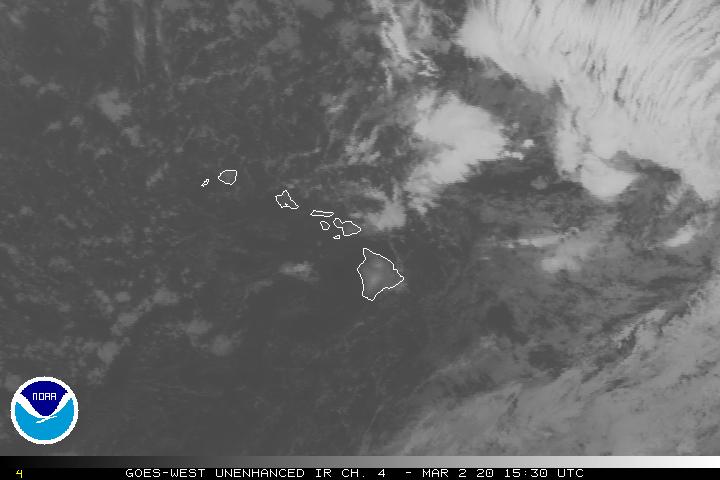
We can use the following links to see what’s going on in our area of the north central Pacific Ocean. Here's the latest NOAA satellite picture – the latest looping satellite image…and finally the latest looping radar image for the Hawaiian Islands.
Here are the latest 24-hour precipitation totals (inches) for each of the islands as of Monday evening
1.20 Wailua, Kauai
0.51 Oahu Forest NWR, Oahu
0.03 Molokai
0.00 Lanai
0.00 Kahoolawe
0.12 Puu Kukui, Maui
0.38 Glenwood, Big Island
Sunset Commentary:
There will be a strengthening of our local trade winds Tuesday…which will remain active through the rest of this week. We find a strong near 1037 millibar high pressure system to the northeast of Hawaii, along with troughs of low pressure to our northwest. The trades will pick up a notch or two through this new week…as these troughs move away to the west. The trade winds will carry windward showers our way at times, with just a few along our leeward sides. This satellite image shows areas of high cirrus clouds to the north, northeast, and east of the state at the time of this writing.
Here in Kula, Maui at 530pm, it was partly cloudy and calm…with an air temperature of 73F degrees. The trade winds will prevail this week, which is our bread and butter reality in the islands during our summer season. These winds will be moderately strong, with those typical stronger gusts locally. These strengthening breezes will carry passing showers to our windward sides as usual…at times. The leeward sides on the smaller islands will be nearly dry…while the Kona area will see an occasional late afternoon or evening shower. In sum, nothing unusual in regards to our weather conditions through the next week. ~~~ I'll be back again early Tuesday morning with your next new weather narrative from paradise, I hope you have a great Monday night wherever you happen to be spending it! Aloha for now…Glenn.
[World-wide tropical cyclone activity:
Central Pacific Ocean: There are no active tropical cyclones
Eastern Pacific Ocean: There are no active tropical cyclones
THERE HAS BEEN LITTLE CHANGE WITH THE LOW PRESSURE SYSTEM CENTERED ABOUT 950 MILES SOUTHWEST OF MANZANILLO MEXICO. HOWEVER… ENVIRONMENTAL CONDITIONS REMAIN CONDUCIVE FOR A TROPICAL DEPRESSION TO FORM DURING THE NEXT DAY OR SO. THIS SYSTEM HAS A HIGH CHANCE…80 PERCENT…OF BECOMING A TROPICAL CYCLONE DURING THE NEXT 48 HOURS AS IT MOVES WESTWARD OR WEST-NORTHWESTWARD AT 10 MPH.
Here's a satellite image of this area located southwest of Manzanillo, Mexico.
Atlantic Ocean/Gulf of Mexico/Caribbean: There are no active tropical cyclones
SHOWER AND THUNDERSTORM ACTIVITY HAS INCREASED NEAR A NON-TROPICAL LOW PRESSURE AREA OVER THE NORTH ATLANTIC OCEAN ABOUT 525 MILES EAST-NORTHEAST OF BERMUDA. WHILE SIGNIFICANT DEVELOPMENT IS NOT ANTICIPATED…THIS SYSTEM COULD PRODUCE WINDS TO GALE FORCE AS IT MOVES TO THE NORTHEAST AT ABOUT 15 MPH. THIS SYSTEM HAS A LOW CHANCE…10 PERCENT…OF BECOMING A SUBTROPICAL OR TROPICAL CYCLONE DURING THE NEXT 48 HOURS.
Western Pacific Ocean: Typhoon Vicente (9W) is dissipating approximately 110 NM west of Hong Kong, China. Sustained winds are now down to 100 knots, with gusts to near 125 knots. It's expected to remain a typhoon a little while longer, then drop back into the tropical storm category….completely dissipating inland over Vietnam within 36 hours. It has impacted the southern China coast…and is moving away from the coast, and quickly dissipating as it interacts with the physical terrain features of China. Here's the JTWC graphical track map for this tropical cyclone. Final Warning
South Pacific Ocean: There are no active tropical cyclones
South and North Indian Oceans: There are no active tropical cyclones
Interesting: A picture is worth a thousand words: this common adage comes instantly to mind when viewing T.J. Watt's unforgettable photos of lost trees. For years, Watt has been photographing the beauty of Vancouver Island's ancient temperate rainforests, and documenting their loss to clearcut logging.
The photographer and environmental activist recently helped co-found the Ancient Forest Alliance (AFA), a group devoted to saving the island's and British Columbia's (BC) last old-growth while working with the logging industry to adopt sustainable practices.
This February the organization succeeded in saving Avatar Grove—which was only discovered in 2009—from being clearcut. The grove, a rare stand of massive and ancient trees named after the popular eco science-fiction movie, has become a popular tourist destination, providing a new economic incentive for communities to protect rather than cut Canada's last great forests.
"If we have laws that recognize and protect Heritage Buildings that are 100 years old, why don’t we have laws that recognize and protect our 1,000 year old Heritage Trees?," Watt told mongabay.com in a recent interview, nothing that, "Old-growth forests provide clean air and water for both people and salmon; they help mitigate climate change by storing twice the amount atmospheric carbon that second-growth plantations do; they are pillars of a multi-billion dollar tourism industry; and are important to many First Nations cultures.
They're what make BC, BC—a place of wild beauty with the finest remaining intact ancient temperate rainforests on Earth." Watt's organization, the AFA, wants the logging industry in British Columbia to switch from clear-cutting old-growth forests to logging only in secondary forests with more sustainable regulations.
 Email Glenn James: