Air Temperatures – The following maximum temperatures were recorded across the state of Hawaii Monday:
Lihue, Kauai – 83
Honolulu airport, Oahu – 86
Kaneohe, Oahu – 81
Molokai airport – 83
Kahului airport, Maui – 87 (Record high temperature for Monday / 93 -1950, 1968)
Kona airport – 85
Hilo airport, Hawaii – 80
Air Temperatures ranged between these warmest and coolest spots near sea level – and on the highest mountain top around the state…as of 5pm Monday evening:
Port Allen, Kauai – 82
Lihue, Kauai – 74
Haleakala Summit – M (near 10,000 feet on Maui)
Mauna Kea Summit – 36 (near 13,800 feet on the Big Island)
Hawaii’s Mountains – Here’s a link to the live web cam on the summit of near 13,800 foot Mauna Kea on the Big Island of Hawaii. This web cam is available during the daylight hours here in the islands…and when there’s a big moon shining down during the night at times. Plus, during the nights you will be able to see stars, and the sunrise and sunset too…depending upon weather conditions. Here's the Haleakala Crater webcam on Maui…although this webcam is not always working correctly.
Tropical Cyclone activity in the eastern and central Pacific – Here’s the latest weather information coming out of the National Hurricane Center, covering the eastern north Pacific. You can find the latest tropical cyclone information for the central north Pacific (where Hawaii is located) by clicking on this link to the Central Pacific Hurricane Center. A satellite image, which shows the entire ocean area between Hawaii and the Mexican coast…can be found here.
Aloha Paragraphs
Gusty trade winds, off and on windward showers…elsewhere at times locally
As this weather map shows, we have an unusually strong near 1037 millibar high pressure system located far to the north-northeast of the islands. Our local winds will remain active from the trade wind direction…moderately strong with some stronger gusts through Wednesday.
The following numbers represent the most recent top wind gusts (mph), along with directions as of Monday evening:
25 Port Allen, Kauai – ENE
37 Kuaokala, Oahu – NE
32 Molokai – NE
31 Kahoolawe – NE
38 Kahului, Maui – NE
35 Lanai – NE
33 Pali 2, Big Island – NE
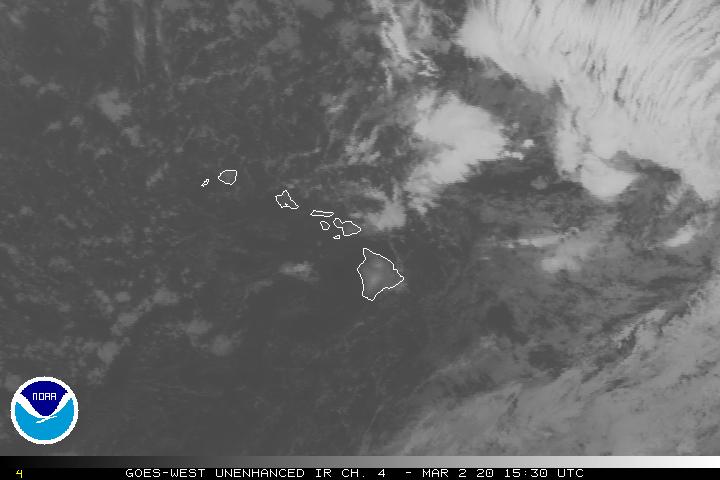
We can use the following links to see what’s going on in our area of the north central Pacific Ocean. Here's the latest NOAA satellite picture – the latest looping satellite image…and finally the latest looping radar image for the Hawaiian Islands.
Here are the latest 24-hour precipitation totals (inches) for each of the islands as of Monday evening:
0.70 Mount Waialeale, Kauai
0.83 Manoa Lyon Arboretum, Oahu
0.38 Molokai
0.15 Lanai
0.00 Kahoolawe
1.50 Puu Kukui, Maui
0.60 Kawainui Stream, Big Island
Sunset Commentary:
Variable clouds with off and on passing showers, with little change in the gusty trade winds Tuesday into mid-week along our windward sides…although with some clearing in the leeward sections. Stronger than normal high pressure to the north-northeast of Hawaii, will drive this locally strong trade wind flow. The passage of now retired tropical cyclone Emilia to our south, will add a bit of strengthening to our trades into Tuesday. These trades will carry off and on windward showers our way through Wednesday, stretching over into the leeward sides locally…then tapering off some thereafter.
Here in Kula, Maui at 505pm, it was partly cloudy and a little breezy…with an air temperature of 79.2F degrees. Our local trade winds will continue blowing, generally in the moderately strong range through the first half of this week. There will be wind gusts in the 30-40 mph range…gradually tapering off by the end of the work week into the weekend. Part of this continued strong trade wind flow will be prompted by the passage of a low pressure system to our south over the next few days…which is the remnant circulation of former tropical cyclone Emilia. Meanwhile, an area of showers, loosely associated with retired Emilia, will keep our windward sides a bit showery at times, lasting into mid-week perhaps. The leeward sides will see a few of these passing showers, carried by the gusty trade winds at times too. In sum, our gusty trade winds will continue, with somewhat more than the normal amount of windward showers. ~~~ I'll be back early Tuesday morning with more updates, I hope you have a great Monday night wherever you happen to be spending it! Aloha for now…Glenn.
[World-wide tropical cyclone activity:
Central Pacific Ocean: There are no active tropical cyclones
Eastern Pacific Ocean: Weakening tropical storm Fabio (6E) remains active in the northeast Pacific…located 700 miles west-southwest of the southern tip of Baja, California. Sustained winds were 65 mph, as it moves in a more or less northerly direction. Here's the official NHC graphical track map, along with a satellite image. Here's the hurricane model output for this weakening tropical storm Fabio, showing it staying relatively close to Mexico…offshore to the west of Baja California.
Elsewhere…tropical cyclone formation is not expected during the next 48 hours
Atlantic Ocean/Gulf of Mexico/Caribbean: There are no active tropical cyclones
Western Pacific Ocean: Tropical storm Khanun (08W)…located 186 NM east of Kadena AB, Okinawa. Khanun will continue to travel in a northwest direction over open ocean, remaining offshore to the southwest and west of the main southern Japanese islands…before impacting south Korea in about two days. Here's the JTWC graphical track map, along with a NOAA satellite image of this gradually strengthening tropical cyclone. Sustained winds were 40 knots, with gusts to near 50 knots.
South Pacific Ocean: There are no active tropical cyclones
South and North Indian Oceans: There are no active tropical cyclones
Interesting: Oxford University held its Re|Source forum recently, and former US President Bill Clinton addressed the group on the subject of scarce resources and how to manage their development and use in a way that is fair and equitable. The most important decision of the 21st century is whether the human race can learn to share its scarce natural resources for the common good, President Bill Clinton told delegates at Re|Source 2012 during a two-day forum at the University of Oxford.
Clinton said: 'The only strategy that makes sense is the one that says we are going to share the world with other human beings and we will share its natural resources.' This, he said, 'is the fundamental decision of the 21st century.'
This is an important issue, and the extent to which it can be fairly managed will make an enormous difference to us all. Clinton's address reflected a key theme from the conference about the need for greater cooperation between governments, businesses and other organizations to successfully meet the resource challenges the world.
In particular, he noted, the private sector has the commercial leverage and influence to drive significant changes — and can create new models in finance to support these changes. Mr Clinton was the keynote speaker at Re|Source, a gathering of 250 leaders from business, finance, policy and government, dedicated to the issue of how the world can manage resource scarcity with economic growth.
His keynote address on Friday concluded the event, which had earlier heard from speakers including Nobel laureate Amartya Sen; Amory Lovins, named by Time magazine as one of the world’s 100 most influential people; Rt Hon David Miliband MP, former UK Foreign Secretary; and David Nabarro, the UN's Special Representative on Food Security and Nutrition.
Interesting2: Most Americans think of the Arctic as an icy, distant place; beautiful, remote and teeming with wildlife, but unrelated to their daily lives. Nothing could be further from the truth. This summer, big doings on America's northern doorstep will have enormous consequences to the economic, strategic and environmental future of the nation. Yet we are unprepared for the challenges and opportunities.
What happens in the Arctic as ice melts there could soon cheapen the cost of the gas you buy and products you purchase from Asia. It could help make the nation more energy independent. It could draw our leaders into a conflict over undersea territory.
It is already challenging Washington to protect millions of square miles filled with some of the most magnificent wildlife on Earth, and native people whose culture and way of life is at risk as a squall line of development sweeps across the once inaccessible top of the planet.
For America, the stakes are huge: A chance to gain wealth and global influence in the newest geopolitical playing field, but there is also potential environmental and security disaster if looming challenges are mishandled or ignored.
If that sounds farfetched, consider the following: — Shell is poised to sink exploratory wells — temporary ones drilled from ships — 70 miles north of Alaska in a few weeks. The operation will assess whether an estimated 27 billion barrels of oil is there. This is roughly three times the amount that has been extracted from the Gulf of Mexico over the past 20 years.
Proponents believe a discovery would cut America's dependence on foreign oil and provide jobs and needed revenue to the Treasury Department. They say the oil could be extracted safely. Opponents fear a spill would be a disaster, being difficult to clean up in icy seas. More oil companies wait in the wings and also own offshore leases.
— In Washington, politicians are jockeying over whether to ratify "The Law of the Sea Treaty," under which countries abutting oceans will be able to claim up to 200 extra miles of undersea territory if they can prove it an extension of their continental shelves. For the U.S., that could mean extra territory the size of California off Alaska.
President Barack Obama and former President George W. Bush support the treaty, as does an oddly aligned group including the Pentagon, Sierra Club, oil companies, shipping companies and environmentalists, who favor the part of the treaty designed to help protect the world's oceans. Although every other Arctic country has ratified the treaty, in the U.S. it has been blocked for years by conservative senators who fear that it gives too much influence to multinational bodies.
— An undersea land rush has started under the treaty, with Russia claiming an area the size of France and Spain combined. Norway's claim has been granted, and other Arctic nations preparing to file claims. One U.S. Coast Guard admiral, speaking of the treaty, told me, "If this was a ball game, the U.S. wouldn't be on the field, in the stadium or even in the parking lot. We're last in this race."
— The Russian military has identified the Arctic as one of the likely places for conflict to erupt in the 21st century over resources. Even if actual combat never occurs, whoever controls the high north will wield enormous influence in the coming decades. Russia has 18 working icebreakers. The U.S. has one.
Russia is opening their Arctic sea lanes to commercial shipping. The U.S. has no permanent Coast Guard or Naval presence yet in the high north, although both branches of the service are preparing to move north. Naval war games last fall anticipated security challenges in the near future: how to deal with terrorists in the Arctic, how to deal with a rogue ship carrying nuclear weapons in the Arctic, how to move a U.S. fleet around the top of the planet, how to help clean up an oil spill. Gamers concluded the Navy needs to prepare and needs more resources.
— The Northwest Passage is the long-dreamed-of, formerly iced-over sea route between Europe and Asia. This route around the top of Canada and Alaska has killed hundreds of sailors and explorers for centuries, locking their ships in ice, starving them, freezing them, driving them insane and causing survivors to eat each other.
Yet in summers, that passage is now so clear that tourist ships routinely sail through it. Even private yachts make the trip. It is expected that commercial shipping will follow. That's because a single Chinese container ship sailing the Northwest Passage between Shanghai and New York instead of using the Panama Canal would save an estimated $2 million each way on gas and tolls.
In short, the region is opening.
For the past three years, I've spent much time in northern Alaska researching for my book, "The Eskimo and the Oil Man." It's about the grand challenges facing the world there, as seen through the eyes of an Inupiat Eskimo leader who is a grandfather and whale hunter, and the Shell executive sent to drill for oil off Alaska's North Slope. I sailed on the only U.S. icebreaker for six weeks, sat in on meetings at the Senate over the Arctic, attended a naval war game and met regularly with other oil executives and Inupiat leaders, whale hunters and families on the North Slope.
That 4,000-year-old culture sits at the border between wise development and environmental anarchy, and the people of America's polar county will soon watch with hope and fear as the oil ships move north. Their concerns are not just local ones but should engage every American. If you care about the environment, if you care about gas prices, if you care about where our soldiers and navy may serve next, if you want the U.S. to remain strong and dominant in the world, look to the north this summer. Look to the Arctic. That's where much of our common future is about to play out.
 Email Glenn James: