











Air Temperatures – The following maximum temperatures were recorded across the state of Hawaii Friday:
Lihue, Kauai – 83
Honolulu airport, Oahu – 86 (Record high temperature for Friday / 92 -1985)
Kaneohe, Oahu – 84
Molokai airport – 85
Kahului airport, Maui – 86 (Record high temperature for Friday / 91 -1984, 1993)
Kona airport – 84
Hilo airport, Hawaii – 80
Air Temperatures ranged between these warmest and coolest spots near sea level – and on the highest mountain top around the state…as of 6pm Friday evening:
Barking Sands, Kauai – 81
Hilo, Hawaii – 77
Haleakala Summit – M (near 10,000 feet on Maui)
Mauna Kea Summit – 43 (near 13,800 feet on the Big Island)
Hawaii’s Mountains – Here’s a link to the live web cam on the summit of near 13,800 foot Mauna Kea on the Big Island of Hawaii. This web cam is available during the daylight hours here in the islands…and when there’s a big moon shining down during the night at times. Plus, during the nights you will be able to see stars, and the sunrise and sunset too…depending upon weather conditions. Here's the Haleakala Crater webcam on Maui…although this webcam is not always working correctly.
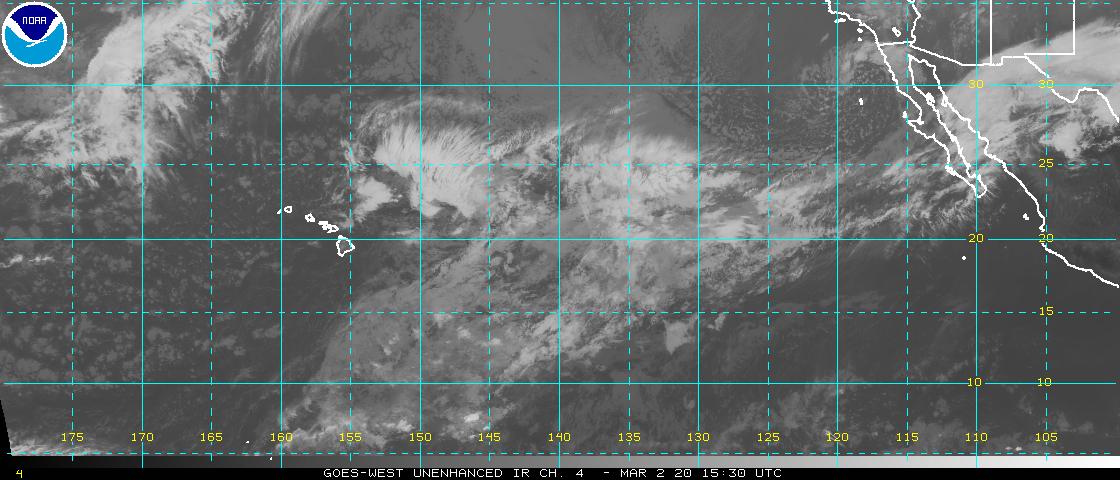
Tropical Cyclone activity in the eastern and central Pacific – Here’s the latest weather information coming out of the National Hurricane Center, covering the eastern north Pacific. You can find the latest tropical cyclone information for the central north Pacific (where Hawaii is located) by clicking on this link to the Central Pacific Hurricane Center. A satellite image, which shows the entire ocean area between Hawaii and the Mexican coast…can be found here.
Aloha Paragraphs
Tropical cyclones Emilia & Fabio far to the east-southeast – former Daniel southwest of Oahu
Swirl of low clouds associated with former tropical storm Daniel…moving by to the south-southwest of the islands
NHC official track – tropical storm Emilia

Gusty trade winds, some windward showers, although
most of the more generous showers associated
with former Daniel…will move by to our south
High surf advisory for the east shores of the Big
Island…generated by former tropical cyclone Daniel
Improving weather during the weekend
As this weather map shows, we have high pressure systems spread out from the far northwest through the northeast of the islands. Our local winds will remain active from the trade wind direction…moderately strong with stronger gusts as former tropical cyclone Daniel moves by south of the island chain.
The following numbers represent the most recent top wind gusts (mph), along with directions as of Friday evening:
30 Port Allen, Kauai – ENE
37 Kuaokala, Oahu – NE
44 Molokai – NE
40 Kahoolawe – NE
44 Kahului, Maui – E
43 Lanai – NE
37 Puu Mali, Big Island – NE
We can use the following links to see what’s going on in our area of the north central Pacific Ocean. Here's the latest NOAA satellite picture – the latest looping satellite image…and finally the latest looping radar image for the Hawaiian Islands.
Here are the latest 24-hour precipitation totals (inches) for each of the islands as of Friday evening:
1.33 Mount Waialeale, Kauai
1.22 Oahu Forest NWR, Oahu
0.42 Molokai
0.00 Lanai
0.00 Kahoolawe
0.77 Puu Kukui, Maui
1.40 Kawainui Stream, Big Island
Sunset Commentary:
A few scattered showery clouds are located to the northeast of former tropical cyclone Daniel…and will be carried into the state tonight into Saturday morning. As the weak low pressure circulation system, what's left of Daniel, moves by to the south of the state…there will be a couple of influences. They will include an increase in our trade wind speeds statewide into Saturday. High surf generated from former tropical cyclone Daniel has prompted a high surf advisory on the Big Island's east facing shores through 6am Saturday morning as well.
Yes, of course I'm going to see a new film this evening, I'm hooked on this type of entertainment…as you know! This time around I'll be driving down to Kahului to see the Woody Allen film called To Rome With Love, starring Woody Allen, Alec Baldwin, Roberto Benigni, Penelope Cruz, Judy Davis, and Greta Gerwig, and Jesse Eisenberg, and Ellen Page…among many others. The synopsis: a story about a number of people in Italy — some American, some Italian, some residents, some visitors — and the romances and adventures and predicaments they get into. The critics are leaning on this film pretty heavily, with not great reviews. I like the actors in this film though, and typically enjoy seeing what Woody Allen has to put out. I'll be sure to let you know what I think in the morning, as usual. Here's a trailer for this film.
Here in Kula, Maui at 525pm, it was partly cloudy and breezy…with an air temperature of 81F degrees. Our local trade winds will continue blowing well into the future. These winds accelerated a notch today…and will remain breezy into the first part of the weekend. Tropical moisture associated with former hurricane Daniel will remain south of the state, thus limiting our local rainfall. Although an area of clouds, with a few embedded showers, is approaching the windward sides from the east…which will bring in some showers tonight into Saturday morning. ~~~ Meanwhile, we still have weakening tropical storm Emilia, and strengthening hurricane Fabio in the eastern Pacific. Neither of these tropical cyclones will have any bearing on our islands for the time being, although there will be some small surf arriving along our east shores from Emilia with time. There's a chance that an area of showers out ahead of Emilia, might be carried in our direction later in the day Monday into the night. Otherwise, whatever is left of Emilia, and it won't be much, will be passing by to the south of our island chain around the middle of the new week ahead. There's more information about those two tropical cyclones below. ~~~ I'll be back Saturday morning with more local weather updates, and more information about these tropical cyclones too. I hope you have a great Friday night wherever you happen to be spending it! Aloha for now…Glenn.
[World-wide tropical cyclone activity:
Central Pacific Ocean: There are no active tropical cyclones
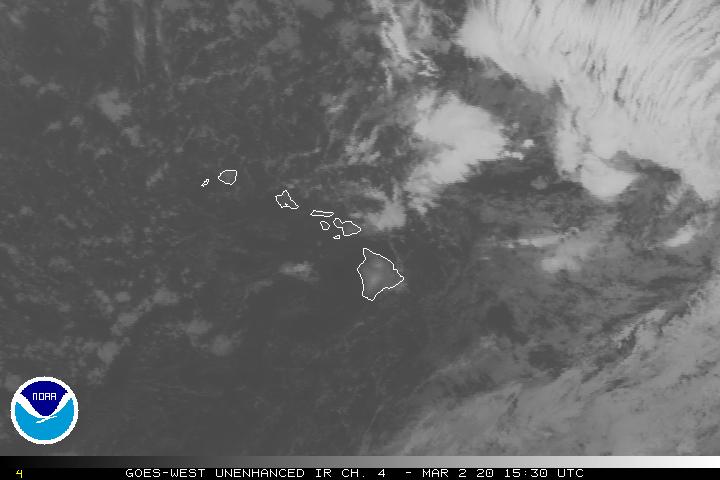
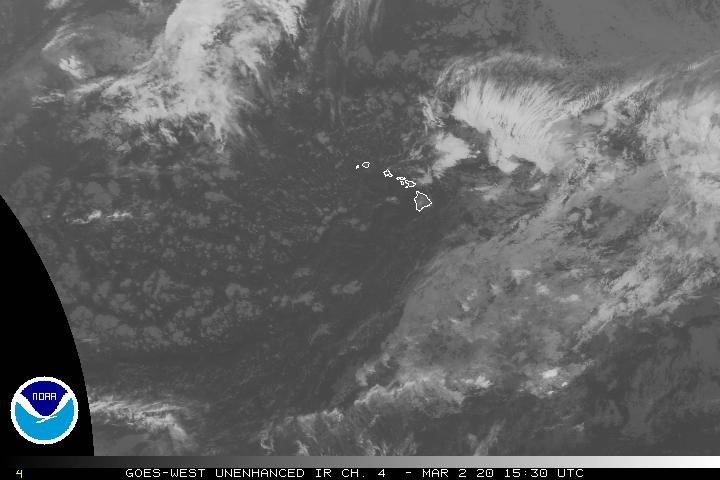
The remnant low pressure system (former Daniel) will continues to move generally west across the central Pacific…to the south of the Hawaiian Islands. Here's a satellite image of this area, several hundred miles south of here. What's left of this swirling area of low clouds will pass into the area southwest of our island chain early this weekend. Stable low clouds to the north of retired Daniel will move over the windward sides of the islands at times.
Eastern Pacific Ocean: Tropical storm Emilia (5E) remains active…located approximately 1485 miles west-southwest of the southern tip of Baja California…with 50 mph sustained winds. This weakening storm will gradually become less intense throughout the remainder of its life cycle…as it moves in a general westerly direction. At this point it's forecast to drop down into the tropical depression category early Sunday morning…while still in the eastern Pacific. Here's the official NHC graphical track map. Here's a satellite image showing Emilia in the eastern Pacific...along with hurricane Fabio further to the east. The Hawaiian Islands may begin to feel some breezy and showery influences from Emilia around next Tuesday night or Wednesday.
The 6th tropical cyclone of the 2012 hurricane season, called Hurricane Fabio (6E)…is located 540 miles south-southwest of the southern tip of Baja, California. Sustained winds were 90 mph, making this a category 1 hurricane, as it moves in a more or less west-northwest direction away from the Mexican coast. Here's the official NHC graphical track map, along with a satellite image. Here's the hurricane model output for this strengthening hurricane, showing it staying relatively close to Mexico…and heading generally into the area offshore west of Baja California.
ELSEWHERE…TROPICAL CYCLONE FORMATION IS NOT EXPECTED DURING THE NEXT 48 HOURS.
Atlantic Ocean/Gulf of Mexico/Caribbean: There are no active tropical cyclones
Western Pacific Ocean: There are no active tropical cyclones
South Pacific Ocean: There are no active tropical cyclones
South and North Indian Oceans: There are no active tropical cyclones
Interesting: Corals are marine animals in class Anthozoa of phylum Cnidaria typically living in compact colonies of many identical individual polyps. The group includes the important reef builders that inhabit tropical oceans and secrete calcium carbonate to form a hard skeleton. Scientists have discovered two viruses that appear to infect the single-celled microalgae that reside in corals and are important for coral growth and health, and they say the viruses could play a role in the serious decline of coral ecosystems around the world.
These viruses, including an RNA virus never before isolated from a coral, have been shown for the first time to clearly be associated with these microalgae called Symbiodinium. If it’s proven that they are infecting those algae and causing disease, it will be another step toward understanding the multiple threats that coral reefs are facing. The research was published today in the ISME Journal, in work supported by the National Science Foundation.
Most corals obtain the majority of their energy and nutrients from photosynthetic unicellular algae called zooxanthellae that live within the Most corals require sunlight and grow in clear, shallow water, typically at depths shallower than 200 ft. Corals can be major contributors to the physical structure of the coral reefs that develop in tropical and subtropical waters, such as the enormous Great Barrier Reef off the coast of Queensland, Australia.
Other corals do not have associated algae and can live in much deeper water, with the cold-water genus Lophelia surviving as deep as 9,800 ft. The genus Symbiodinium encompasses the largest and most prevalent group of endosymbiotic dinoflagellates. These unicellular algae commonly reside in the endoderm of tropical cnidarians such as corals, sea anemones, and jellyfish, where they translocate products of photosynthesis to the host and in turn receive inorganic nutrients.
"We’re way behind in our knowledge of how viral disease may affect coral health," said Adrienne Correa, a researcher with the Department of Microbiology at Oregon State University. "If viral infection is causing some bleaching, it could be important in the death of corals and contribute to reef decline. This potential threat from viruses is just starting to be recognized."
Corals co-exist with these algae in a symbiotic relationship, scientists say, in which the algae provide energy to the coral, and contribute to the construction of reefs. The coral in turn offers a place for the algae to live and provides nutrients for it. Corals and viruses have evolved along with their resident algae for millions of years.
They have persisted through previous climate oscillations, and the presence of viruses within corals or their algae doesn’t necessarily indicate they are affecting coral colony health. If viruses are causing disease or bleaching of colonies, it’s also unknown whether this is happening now more than in the past. "Corals are known to face various environmental threats, such a warming temperatures, competition and pollution," Correa said.
"Some of the environmental changes of the past were likely more gradual and allowed the coral and its associates more time to adapt." "The stresses challenging coral reefs now are more intense and frequent," she said. "This may mean viruses cause more problems for corals and their algae now than they did historically." In continued research at OSU, scientists will inoculate Symbiodinium with the viruses and try to prove they are causing actual disease.
If the viruses are killing the algae, scientists said, it could have significant implications for coral reef health and survival. There are almost two dozen known diseases that are affecting coral, and scientists still do not know the cause of most of them.
 Email Glenn James:









Joy Says:
Good morning, Glenn
If I remember correctly, today is a special day for you……
Happy Birthday! Wishing you a wonderful day and many thanks for the fabulous weather reporting! ~~~Thanks so much Joy, you’re correct, this would be my birthday, although I’m way too old to be providing the number here! Aloha, Glenn