Air Temperatures – The following maximum temperatures were recorded across the state of Hawaii Thursday:
Lihue, Kauai – 82
Honolulu airport, Oahu – 86 (Record high temperature for Thursday – 91F / 1995)
Kaneohe, Oahu – 82
Molokai airport – 81
Kahului airport, Maui – 85
Kona airport – 86
Hilo airport, Hawaii – 81
Air Temperatures ranged between these warmest and coolest spots near sea level – and on the highest mountain top around the state…as of 5pm Thursday evening:
Port Allen, Kauai – 83
Hilo, Hawaii – 73
Haleakala Summit – M (near 10,000 feet on Maui)
Mauna Kea Summit – 39 (near 13,800 feet on the Big Island)
Hawaii’s Mountains – Here’s a link to the live web cam on the summit of near 13,800 foot Mauna Kea on the Big Island of Hawaii. This web cam is available during the daylight hours here in the islands…and when there’s a big moon shining down during the night at times. Plus, during the nights you will be able to see stars, and the sunrise and sunset too…depending upon weather conditions. Here's the Haleakala Crater webcam on Maui…although this webcam is not always working correctly.
Tropical Cyclone activity in the eastern and central Pacific – Here’s the latest weather information coming out of the National Hurricane Center, covering the eastern north Pacific. You can find the latest tropical cyclone information for the central north Pacific (where Hawaii is located) by clicking on this link to the Central Pacific Hurricane Center. A satellite image, which shows the entire ocean area between Hawaii and the Mexican coast…can be found here. Here's a tropical cyclone tracking map for the eastern and central Pacific.
Aloha Paragraphs

Locally strong and gusty trade winds, windward
showers…a few elsewhere
Slowly lowering surf along leeward beaches…still
high surf advisory until noon Friday
As this weather map shows, we have a large near 1029 millibar high pressure system to the north-northwest of the islands. Our local winds will remain active from the trade wind direction through the next week…increasing a touch today and Friday.
The following numbers represent the most recent top wind gusts (mph), along with directions as of Thursday evening:
31 Lihue, Kauai – NE
40 Kuaokala, Oahu – NE
33 Molokai – NE
44 Kahoolawe – ENE
42 Kahului, Maui – NE
39 Lanai – NE
31 South Point, Big Island – ENE
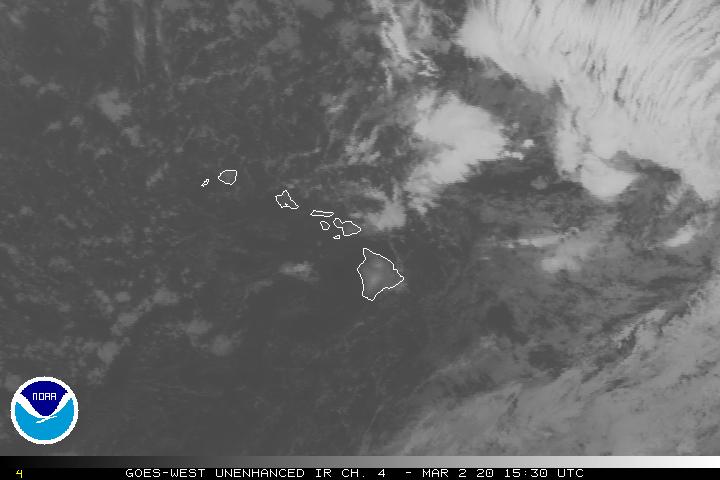
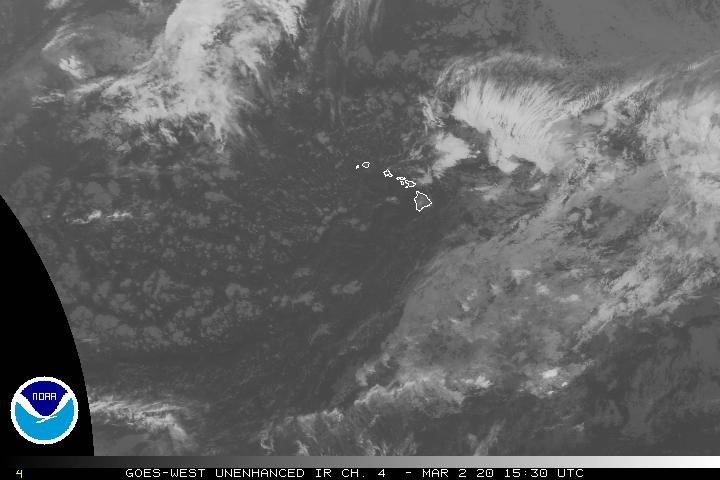
We can use the following links to see what’s going on in our area of the north central Pacific Ocean. Here's the latest NOAA satellite picture – the latest looping satellite image…and finally the latest looping radar image for the Hawaiian Islands.
Here are the latest 24-hour precipitation totals (inches) for each of the islands as of Thursday evening:
2.62 Mount Waialeale, Kauai
1.47 Manoa Lyon Arboretum, Oahu
0.83 Molokai
0.03 Lanai
0.00 Kahoolawe
2.57 Puu Kukui, Maui
1.14 Kawainui Stream, Big Island
Sunset Commentary: Our trade wind weather pattern will prevail through the rest of this week…into next week. The trade winds remain strong enough to keep small craft wind advisories active across those windiest channels and coastal areas around the state. These trade winds will carry windward biased showers our way periodically…most generously during the night and morning hours. A few of these showers will be carried over into leeward sides at times locally. There will be light afternoon showers at times on the slopes in the Kona and Kau districts on the Big Island…and perhaps along the leeward upcountry slopes of the Haleakala Crater on Maui here and there too.
As this satellite image shows, we have a rather endless array of upstream clouds to the east and northeast of the islands. There's no reason to believe that these stratus and stratocumulus clouds won't drop occasional showers along our windward sides…a few more than that locally. Meanwhile, there continues to be areas of high cirrus clouds over the ocean in several different directions. The closest ones were located near Kauai and Oahu, and southeast of the Big Island at the time of this writing. Here's a closer look at our islands using this satellite picture…so we can keep track of whatever clouds are upstream of the islands…as they continue to be carried our way on the gusty trade wind flow.
Here in Kula, Maui at 505pm, it was partly to mostly cloudy…with an air temperature of 72.9F degrees. As noted above, our trade winds will continue blowing well into the future. The NWS is keeping the high surf advisory for our south facing leeward beaches active through Friday noon…be careful if you aren't used to the waves. Our local surfing community is enjoying this early summer fun, and taking full advantage of all those warm breaking waves! Overall, our weather will remain generally quite nice, sticking pretty closely to what could be considered a typical summertime trade wind weather pattern. I'll be back again early Friday morning with your next new weather narrative, and with more information about soon to be hurricane Daniel in the eastern Pacific (see below) as well. I hope you have a great Thursday night wherever you happen to be spending it! Aloha for now…Glenn.
[World-wide tropical cyclone activity:
Central Pacific Ocean: There are no active tropical cyclones
Eastern Pacific Ocean: Tropical storm Daniel (4E) is active about 650 miles south-southwest of the southern tip of Baja California…with 70 mph sustained winds. Here's the official NHC graphical track map. Here's what the hurricane models are doing with this storm. Here's a satellite image of this tropical cyclone, and the area of disturbed weather described below. As you can see, Daniel will continue migrating westward away from Mexico, over open ocean in the eastern Pacific. TS Daniel is now forecast to increase into a hurricane later today…remaining at that level for a couple of days. Daniel will then move over cooler sea water, and a more stable environment , both of which will begin taking this system downward in strength by Sunday morning. Thereafter, Daniel will weaken even further into a tropical depression while still in the eastern Pacific. If it continues that far, it is forecast to dissipate into a remnant low pressure system as it moves into the far eastern part of our central Pacific basin.
MEANWHILE, A BROAD AREA OF LOW PRESSURE LOCATED SEVERAL HUNDRED MILES SOUTH OF THE GULF OF TEHUANTEPEC IS PRODUCING A LARGE AREA OF DISORGANIZED SHOWER AND THUNDERSTORM ACTIVITY. ENVIRONMENTAL CONDITIONS APPEAR FAVORABLE FOR SOME GRADUAL DEVELOPMENT OF THIS SYSTEM OVER THE NEXT FEW DAYS AS IT MOVES WESTWARD AT 10 TO 15 MPH. THIS SYSTEM HAS A MEDIUM CHANCE…30 PERCENT…OF BECOMING A TROPICAL CYCLONE DURING THE NEXT 48 HOURS.
ELSEWHERE…TROPICAL CYCLONE FORMATION IS NOT EXPECTED DURING THE NEXT 48 HOURS.
Atlantic Ocean/Gulf of Mexico/Caribbean: There are no active tropical cyclones
Western Pacific Ocean: There are no active tropical cyclones
South Pacific Ocean: There are no active tropical cyclones
South and North Indian Oceans: There are no active tropical cyclones
Interesting: A significant rise in sea levels due to global warming could result in the loss of species and habitats in the coastal areas of more than a thousand islands in South-East Asia and the Pacific region, leading to the potential displacement of many millions of people, according to a study. "Sea level rise will lead to the permanent inundation and erosion of coastal areas," said Florian Wetzel, first author of the study which appeared in the journal Global Change Biology, and an ecologist from the Konrad Lorenz Institute of Ethology of the University of Veterinary Medicine in Vienna, Austria.
Some of the areas at risk — such as Indonesia, Malaysia, the Philippines, East Timor, Papua New Guinea and Thailand — are known biodiversity hotspots. Others, like Fiji, Samoa and Vanuatu, possess endemic species. The study, 'Future climate change driven sea-level rise: secondary consequences from human displacement for island biodiversity', points out that some species, particularly those mammals that range widely within low-lying coastal zones or in hinterland regions, could be wiped out entirely.
Many of these species, including endemic tigers, panthers, squirrels, rats, cats and monkeys, are already endangered. People are also likely to have to migrate from coastal areas to island interiors due to permanent flooding in littoral settlements, added Wetzel.
The research modeled scenarios of sea level rises of one, three and six meters, and evaluated species vulnerability to the secondary effects of these rises, using published assumptions of sea level rise in the Pacific. Depending upon the scenario, between 3 and 32 per cent of an area's coastal zone could be lost due to flooding — the primary effect of sea level rise.
This would turn from 8 to 52 million people into flood refugees, said Wetzel. Biologist Marilou Nicolas, executive director of the Center for Integrative and Development Studies at the University of the Philippines, confirms that "island nations are the most vulnerable to sea level rise."
"With the rise in sea level, it is expected that areas lower than 10 meters above sea level will be inundated," destroying beaches and marshlands, which are breeding grounds for animals such as turtles, Nicolas explained. "The loss of a species can have a 'domino effect' on the survival of other species, because all living organisms are effectively connected in a web of life," she added.
Marine geologist Fernando Siringan, a member of the Philippines National Academy of Science and Technology, emphasized that the problem of sea level rise can also be traced to other factors, such as ground subsidence due to the movement of the Earth's tectonic plates, the transformation of mangrove areas into fishponds, or excessive groundwater withdrawal.
Interesting2: The United Nations had set a target for developing countries around the world to cut the proportion of children who suffer from hunger in half by 2015 from 1990 levels. It is true that childhood hunger has improved since its peak in 1985. However, insufficient progress has been made, and only five percent of the developing world is on track to meet the UN target. One in five infants and children are moderately or severely underweight, amounting to 110 million children around the world.
Further, another 148 million are mildly underweight. A recent study has documented the lack of progress on this issue, conducted by researchers at the School of Public Health at Imperial College London. They took the UN target, outlined as part of its Millennium Development Goals, and compared it to their findings.
They found that 61 out of the 141 developing countries are projected to meet that target. However, in the developing world as a whole, less than five percent of people have a chance at succeeding. The strongest improvements have been in Asia and Latin America. The region falling behind is sub-Saharan Africa.
To assess childhood hunger, they based their scores off of height and weight relative to age. The data was obtained through national surveys and other sources. The analysis produced the following conclusions:
– One half of the world's underweight children live in South Asia, mostly in India.
– Moderately to severely underweight children dropped from 30.1% to 19.4% between 1985 and 2011.
– Moderate to severe stunting (insufficient growth in height for their age) dropped from 47.2% to 29.9% during the same period.
– Nutritional status in Ivory Coast and Niger was worse in 2011 than in 1985. All other regions improved over this time period.
According to lead author, Majid Ezzati, "Our analysis shows that the developing world as a whole has made considerable progress towards reducing child malnutrition, but there are still far too many children who don't receive sufficient nutritious foods or who lose nutrients due to repeated sickness. Severe challenges lie ahead.
There is evidence that child nutrition is best improved through equitable economic growth, investment in policies that help smallholder farmers and increase agricultural productivity, and primary care and food programs targeted at the poor. We mustn't allow the global economic crisis and rising food prices to cause inequalities to increase, or cut back on investments in nutrition and healthcare."
 Email Glenn James: