Air Temperatures – The following maximum temperatures were recorded across the state of Hawaii Friday:
Lihue, Kauai – 83
Honolulu airport, Oahu – 86 (Highest recorded temperature Friday – 90 / 1987)
Kaneohe, Oahu – 82
Molokai airport – 82
Kahului airport, Maui – 85
Kona airport – 84
Hilo airport, Hawaii – 81
Air Temperatures ranged between these warmest and coolest spots near sea level – and on the highest mountain top around the state…as of 5pm Friday evening:
Barking Sands, Kauai – 83
Hilo, Hawaii – 77
Haleakala Summit – M (near 10,000 feet on Maui)
Mauna Kea Summit – 39 (near 13,800 feet on the Big Island)
Hawaii’s Mountains – Here’s a link to the live web cam on the summit of near 13,800 foot Mauna Kea on the Big Island of Hawaii. This web cam is available during the daylight hours here in the islands…and when there’s a big moon shining down during the night at times. Plus, during the nights you will be able to see stars, and the sunrise and sunset too…depending upon weather conditions. Here's the Haleakala Crater webcam on Maui…although this webcam is not always working correctly.
Tropical Cyclone activity in the eastern and central Pacific – Here’s the latest weather information coming out of the National Hurricane Center, covering the eastern north Pacific. You can find the latest tropical cyclone information for the central north Pacific (where Hawaii is located) by clicking on this link to the Central Pacific Hurricane Center. A satellite image, which shows the entire ocean area between Hawaii and the Mexican coast…can be found here. Here's a tropical cyclone tracking map for the eastern and central Pacific.
Aloha Paragraphs

Moderately strong trade winds this weekend
A few passing windward showers,
hardly any leeward sections
As this weather map shows, we have a large near 1033 millibar high pressure system to the north-northwest of the islands. Our local winds will remain active from the trade wind direction…a little lighter through the weekend.
The following numbers represent the most recent top wind gusts (mph), along with directions as of Friday evening:
29 Port Allen, Kauai – NE
37 Kuaokala, Oahu – ENE
32 Molokai – NE
35 Kahoolawe – NE
33 Kahului, Maui – NE
36 Lanai – NE
31 PTA Keamuku, Big Island – NE
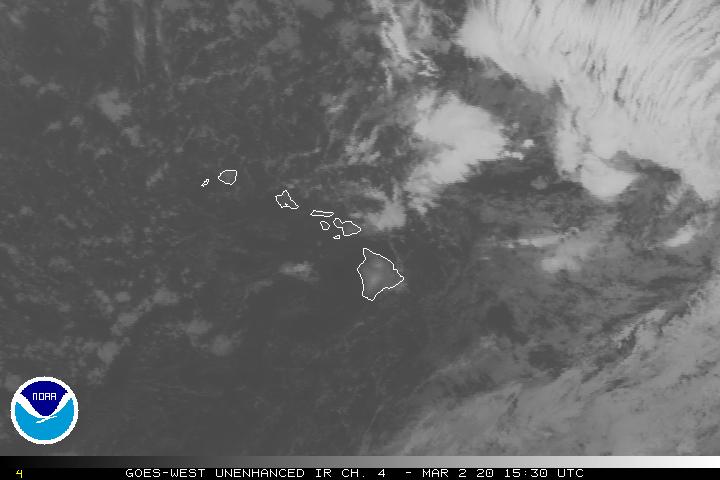
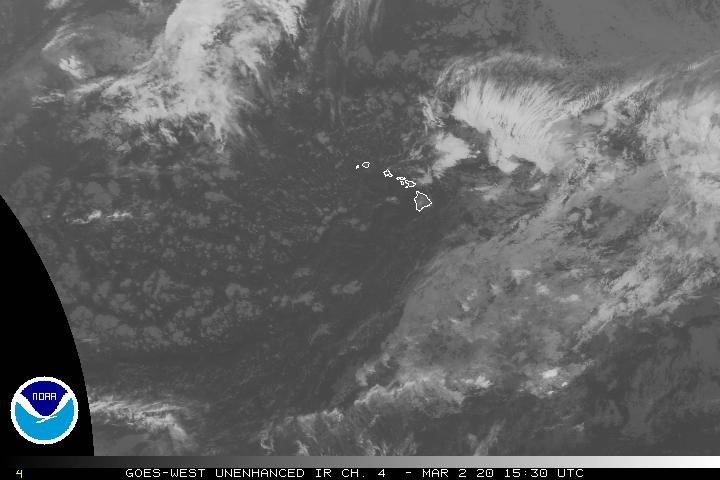
We can use the following links to see what’s going on in our area of the north central Pacific Ocean. Here's the latest NOAA satellite picture – the latest looping satellite image…and finally the latest looping radar image for the Hawaiian Islands.
Here are the latest 24-hour precipitation totals (inches) for each of the islands as of Friday evening:
0.78 Mount Waialeale, Kauai
0.33 Kahana, Oahu
0.05 Molokai
0.00 Lanai
0.00 Kahoolawe
0.15 Puu Kukui, Maui
0.88 Kawainui Stream, Big Island
Sunset Commentary: Our trade winds will remain at moderately strong level this weekend…through the next week at least. There will continue to be a few off and on showers falling along our windward sides, running at about normal levels for the most part. These showers won't stretch over into leeward sides very much, with generally dry conditions prevailing there. The general outlook looks good going forward, with favorably inclined weather on tap this weekend and beyond.
As this large view satellite image shows, we have just a few patches of clouds to our east. Meanwhile, there continues to be those brighter white, high and middle level clouds far to the west of our islands. Finally, here's a closer look at our islands using this satellite picture…so we can keep track of those few generally small clouds upstream of the islands…as they continue to be carried in our direction on the gusty trade wind flow. In sum, not all that many showers anywhere in the state for the time being.
This evening I'm going to take the drive down to Kahului and see a new film, one that I'm not overly excited about seeing, although it is getting high grades by the critics. It's called Moonshine Kingdom, starring Jared Gilman, Bruce Willis, Edward Norton, Kara Hayward, Bill Murray and Frances McDormand…among many others. The synopsis: set on an island off the coast of New England in the summer of 1965, Moonrise Kingdom tells the story of two twelve-year-olds who fall in love, make a secret pact, and run away together into the wilderness. As various authorities try to hunt them down, a violent storm is brewing off-shore — and the peaceful island community is turned upside down in more ways than anyone can handle. Bruce Willis plays the local sheriff. Edward Norton is a Khaki Scout troop leader. Bill Murray and Frances McDormand portray the young girl's parents. The cast also includes Tilda Swinton, Jason Schwartzman, and Jared Gilman and Kara Hayward as the boy and girl. As almost always, I don't have high hopes going to see a comedy about kids, although I've been fooled before, and lets hope that it happens again! I'll let you know what I thought Saturday morning, in the interim, here's the trailer…which for once doesn't need me to warn you about violence!
Here in Kula, Maui at 5pm, it was partly cloudy with light breezes…and an air temperature of 79F degrees. As noted above, our trade winds will continue blowing, with just a few of those windward biased showers arriving periodically. Glancing at that satellite image above, we can see a minimal amount of showery clouds upstream of the islands. The largest patch at the moment looks to be taking aim on the windward side of the Big Island…although may just pass to the south of there. Looking even further ahead, our summer weather outlook for next week looks like it will match the climatological norm quite well…which is good. ~~~ I'll be back Saturday morning with your next new weather narrative from paradise, I hope you have a great Friday night wherever you're spending it! Aloha for now…Glenn.
[World-wide tropical cyclone activity:
Central Pacific Ocean: There are no active tropical cyclones expected through the next 48 hours.
Eastern Pacific Ocean: There are no active tropical cyclones expected through the next 48 hours.
Atlantic Ocean/Gulf of Mexico/Caribbean: There are no active tropical cyclones expected through the next 48 hours.
A LOW PRESSURE AREA…THE POST-TROPICAL REMNANTS OF DEBBY…IS LOCATED ABOUT 250 MILES NORTH-NORTHEAST OF BERMUDA AND MOVING EAST- NORTHEASTWARD AT ABOUT 20 MPH. WHILE THE ASSOCIATED SHOWER ACTIVITY HAS INCREASED DURING THE PAST SEVERAL HOURS…ENVIRONMENTAL CONDITIONS REMAIN UNFAVORABLE FOR RE-DEVELOPMENT TO OCCUR. THIS SYSTEM HAS A LOW CHANCE…10 PERCENT…OF BECOMING A TROPICAL CYCLONE AGAIN DURING THE NEXT 48 HOURS.
A TROPICAL WAVE LOCATED ABOUT 750 MILES EAST OF THE WINDWARD ISLANDS IS MOVING WESTWARD AT ABOUT 10 TO 15 MPH. THE ASSOCIATED THUNDERSTORM ACTIVITY HAS CHANGED LITTLE IN ORGANIZATION DURING THE PAST SEVERAL HOURS. HOWEVER…ANY DEVELOPMENT OF THIS DISTURBANCE SHOULD BE SLOW TO OCCUR DUE TO THE PROXIMITY OF DRY AIR. THIS SYSTEM HAS A LOW CHANCE…20 PERCENT…OF BECOMING A TROPICAL CYCLONE DURING THE NEXT 48 HOURS.
AN AREA OF CLOUDINESS AND THUNDERSTORMS CONTINUES OVER THE WESTERN GULF OF MEXICO. SURFACE PRESSURES ARE RELATIVELY HIGH IN THIS AREA…AND DEVELOPMENT…IF ANY…SHOULD BE SLOW TO OCCUR. THIS SYSTEM HAS A LOW CHANCE…10 PERCENT…OF BECOMING A TROPICAL CYCLONE DURING THE NEXT 48 HOURS AS IT MOVES NORTHWARD AT 5 TO 10 MPH.
ELSEWHERE…TROPICAL CYCLONE FORMATION IS NOT EXPECTED DURING THE NEXT 48 HOURS.
Here is a graphical tropical weather outlook…showing these tropical disturbances in the Atlantic Ocean
Western Pacific Ocean: There are no active tropical cyclones
The JTWC is pointing out an area of disturbed weather in the western Pacific, located well to the southeast of both Palau and Yap…as shown on this graphical map. This area is being given a high chance of developing into a tropical cyclone within the next 24 hours. This is a satellite image of this area.
South Pacific Ocean: The Joint Warning Center (JTWC) shows that newly formed tropical cyclone 21P is already falling apart in the Coral Sea. It is located approximately NM 320 NM west-southwest of Honiara, Solomon Islands. 21P has sustained wind speeds of 35 mph, with gusts to near 46 mph. Here's a JTWC graphical track map showing this short-lived tropical cyclone…remaining away from land and islands in the vicinity. – Final Warning
South and North Indian Oceans: There are no active tropical cyclones
Interesting: The story of acid rain from the 1970s is preserved in newspaper headlines, textbooks, and, it turns out, the soils of the northeastern United States. Forty years after humans first began tackling the problem, the impact of acid rain still lingers in New York, Vermont, New Hampshire, and Maine, according to a new study. But the research also shows the first signs of recovery.
At the height of the acid rain problem, sulfur dioxide from burning coal drifted into the atmosphere and lowered the pH of rainwater. When this acidic rain fell to the ground, it leached calcium from the soil, depriving plants of a key nutrient.
Acid rain also dissolved aluminum-rich minerals, freeing the metal to further poison plants. To combat the problem, the U.S. Congress imposed strict emission regulations on industry in 1970 through the Clean Air Act, which was strengthened in 1990. By 2003, sulfur dioxide raining down on the northeastern United States had decreased by as much as 40%.
But were soils improving, too? To find out, Gregory Lawrence, a biogeochemist at the U.S. Geological Survey in Troy, New York, and colleagues tested soils in six spruce forests. The sites included the Adirondack Park in New York, the White Mountain National Forest in New Hampshire, Groton State Park in Vermont, and two research reserves in Maine.
uried below the forest floor, soil mixes with rocks that, as they weather, slowly leak calcium. The researchers reasoned that if they dug beneath the surface, they might find one early indicator of recovery: rising calcium concentrations in soil. They had first tested the soils in the region in 1992 and 1993. Eleven years later, they went back and tested again.
There were modest signs of improvement, the team will report online next month in the Soil Science Society of America Journal. Calcium levels in the soil were still low, but aluminum in surface soils had begun to disappear—at least in Vermont, New Hampshire, and Maine; New York soils still sported high levels of the metal. "The way the soils were recovering was not really the way we expected," Lawrence says.
Lawrence suggests a two-step explanation. First, less acid rain means less aluminum dissolving from minerals and circulating in the soil. Second, surface soils are being replenished by decaying plant matter, which has low levels of aluminum and is essentially diluting the concentration of the metal in soil. “This is a response to the declining acid rain levels," Lawrence says.
"It's just being driven more by the plants than it is the geology.” Calcium is not rebounding in the soil because the rocks at these sites, which are typical of the region, are not rich in the nutrient and weather very slowly, says Lawrence. That’s one reason the soils take so long to recover.
In fact, calcium can buffer soils against some of the worst consequences of acid rain, but now—because there is so little calcium left to stand in the way of harmful chemical reactions such as the ones that mobilize aluminum— these soils “are actually more sensitive to acid rain today than they were 25 years ago,” he says.
On their way to recovery these soils are hanging by a precarious thread. The study “is the first to hint that the deterioration of northeastern U.S. soils from acidic deposition has finally bottomed out,” says Brenden McNeil, a biogeochemist at West Virginia University in Morgantown, who was not involved in the work.
He points out, however, that the impacts of acid rain extend beyond northeastern spruce forests to areas where the extent of the damage and the status of the recovery remain unknown. A 2012 global acidification assessment reports, for example, that in Canada and Western Europe, sulfur dioxide emissions have declined at about the same rate as in the United States, but in places like China, sulfur dioxide emissions are now reaching levels that haven’t been seen in the U.S. since 1970.
Even in the region studied, McNeil says, the subtle improvements in soil are “not near as dramatic as the reductions in emissions”—a sign that clearing the air of sulfur dioxide is just the first milestone on a long road to recovery.
 Email Glenn James: