











Air Temperatures – The following maximum temperatures were recorded across the state of Hawaii Thursday:
Lihue, Kauai – 83
Honolulu airport, Oahu – 84
Kaneohe, Oahu – 84
Molokai airport – 84
Kahului airport, Maui – 88 (Record high for Thursday / 92 – 1953, 1996)
Kona airport – 84
Hilo airport, Hawaii – 82
Air Temperatures ranged between these warmest and coolest spots near sea level – and on the highest mountain tops…as of 5pm Thursday evening:
Kahului, Maui – 84
Barking Sands, Kauai – 75
Haleakala Crater – M (near 10,000 feet on Maui)
Mauna Kea – 43 (near 13,800 feet on the Big Island)
Hawaii’s Mountains – Here’s a link to the live web cam on the summit of near 13,800 foot Mauna Kea on the Big Island of Hawaii. This web cam is available during the daylight hours here in the islands…and when there’s a big moon shining down during the night at times. Plus, during the nights you will be able to see stars, and the sunrise and sunset too…depending upon weather conditions. Here's the Haleakala Crater webcam on Maui…although this webcam is not always working correctly.
Tropical Cyclone activity in the eastern and central Pacific – Here’s the latest weather information coming out of the National Hurricane Center, covering the eastern north Pacific. You can find the latest tropical cyclone information (once the season begins June 1) for the central north Pacific (where Hawaii is located) by clicking on this link to the Central Pacific Hurricane Center. A satellite image, which shows the entire ocean area between Hawaii and the Mexican coast…can be found here. Here's a tropical cyclone tracking map for the eastern and central Pacific.
Aloha Paragraphs

Strengthening trade winds into the weekend…
with passing windward showers at times
As this weather map shows, we have a large near 1028 millibar high pressure system far to the northeast of the islands. At the same time, a ridge of high pressure extending southwest of this high pressure cell is located just to the north and northwest of Kauai. Our local winds will blow from the east to southeast…gradually strengthening through Saturday.
The following numbers represent the most recent top wind gusts (mph), along with directions as of Thursday evening:
07 Lihue, Kauai – E
18 Honolulu, Oahu – SSE
09 Molokai – SE
32 Kahoolawe – ESE
27 Kapalua, Maui – NE
06 Lanai – WNW
25 South Point, Big Island – NE
We can use the following links to see what’s going on in our area of the north central Pacific Ocean. Here's the latest NOAA satellite picture – the latest looping satellite image…and finally the latest looping radar image for the Hawaiian Islands.
Here are the latest 24-hour precipitation totals (inches) for each of the islands as of Thursday evening:
1.06 Kilohana, Kauai
0.26 Oahu Forest NWR, Oahu
0.00 Molokai
0.01 Lanai
0.00 Kahoolawe
0.03 Kula Branch Station, Maui
0.24 Kealakekua, Big Island
Sunset Commentary: Our local winds will shift back around from the southeast soon, to our more classic trade wind directions…strengthening in the process into the weekend. We'll find passing showers along the windward sides at times, perhaps most notably by Saturday evening into Sunday morning. Small craft wind advisories will be issued, first around those windiest parts of Maui County and the Big Island early this weekend…and then likely through much of the rest of the island chain Sunday into early next week.
Here in Kula, Maui at 530pm, it was mostly cloudy, with calm winds and a few light showers…and an air temperature of 68.4F degrees. As this satellite image shows, we can see clouds out over the ocean, stretching over the islands in places too. As we move into Friday and the weekend, the trade winds will increase in strength into next week. The trade winds will prompt our showers back over to the windward sides. ~~~ I'll be back early Friday morning with your next new weather narrative, I hope you have a great Thursday night wherever you happen to be spending it! Aloha for now…Glenn.
[World-wide tropical cyclone activity:]
Central Pacific Ocean: There are no active tropical cyclones expected through the next 48 hours.
Eastern Pacific Ocean: Tropical storm Carlotta (3E) is almost at hurricane strength, as it continues to spin in the waters of the far eastern Pacific, located approximately 440 miles southeast of Acapulco, Mexico. Sustained winds were 70 mph, with further strengthening forecast. TS Carlotta is expected to become a hurricane by Friday…as it heads towards the southern Mexican coastline. Here is the NHC graphical track map for this tropical cyclone, along with a satellite image.
Here's a satellite image showing Carlotta's exact position
Atlantic Ocean: There are no active tropical cyclones expected through the next 48 hours.
Western Pacific Ocean: Typhoon Guchol (05W) is located approximately 667 NM east-southeast of Manila, Philippines. Sustained winds were 98 mph, with gusts to near 121 mph. This typhoon will move west-northwest and then turn northwest and north…strengthening further over the next 2-3 days. Guchol is forecast to remain offshore to the east of the Philippine Islands, and Taiwan too, as it moves nearly over Okinawa…towards southern Japan. Here is a JTWC graphical track map for this tropical cyclone, along with a satellite image.
South Indian Ocean: There are no active tropical cyclones
Interesting: Stuff is constantly falling down on the Earth from outside its atmosphere. This might be very large rocks that we will notice to specks of dust that fall and float down. Currently, estimates of the Earth's intake of space dust vary from around five tons to as much as 300 tons every day.
The Cosmic Dust in the Terrestrial Atmosphere (CODITA) project will investigate what happens to the dust from its origin in the outer solar system all the way to the earth's surface. The work, funded by the European Research Council, will also explore whether cosmic dust has a role in the Earth's climate and how it interacts with the ozone layer in the stratosphere.
Over the next five years, the scientists at Leeds, and visiting colleagues from Germany and the United States, will duplicate in the laboratory the chemical processes that dust particles undergo as they enter and filter down through the atmosphere.
"Our work in the lab will look at the nature of cosmic dust evaporation and the formation of meteoric smoke particles, which play a role in ice nucleation and the freezing of polar stratospheric clouds," said Professor Plane. In the atmosphere, the dust particles undergo very rapid heating through collisions with air molecules, reaching temperatures well in excess of 1600 degrees Celsius. At this point they melt and evaporate.
The larger particles can be seen as "shooting stars", whilst the electrons produced from ionizing collisions with air enable smaller dust particles to be detected using high-powered radar equipment. By replicating this heating in the lab, it is hoped that radar measurements of meteors can be better understood and used to make accurate measurements of the cosmic dust input rates.
The metallic vapors re condense in the atmosphere to form nanometer-sized particles known as meteor smoke. "Cosmic dust and meteor smoke are both believed to interact with the clouds which play a key role in causing stratospheric ozone depletion – most notably the formation of the Antarctic Ozone Hole," said Professor Martyn Chipperfield, from the University's School of Earth and Environment.
"We will use the lab data in a detailed chemistry-climate model of the whole atmosphere. This will make it possible, for the first time, to model the effects of cosmic dust consistently from the outer reaches of the Solar System all the way down to the Earth's surface," said Professor Chipperfield.
"It has been suggested that to combat global warming sulfate aerosol could be released into the atmosphere to reflect some of the Sun's heat. Understanding the quantity of cosmic dust and the potential chemical reactions which may occur is crucial to moving this idea forward," said Professor Chipperfield.
The effects of aerosol on climate could be severe as noted in a study over central and northern India. It has led to a reduction in the monsoon rainfall over India in the past 50 years and above. This study was published online by the journal Science.
Recent studies of the Sahel drought and major increases since 1967 in rainfall over the Northern Territory, Kimberley, Pilbara and around the Nullarbor Plain have led some scientists to conclude that the aerosol haze over South and East Asia has been steadily shifting tropical rainfall in both hemispheres southward.
 Email Glenn James: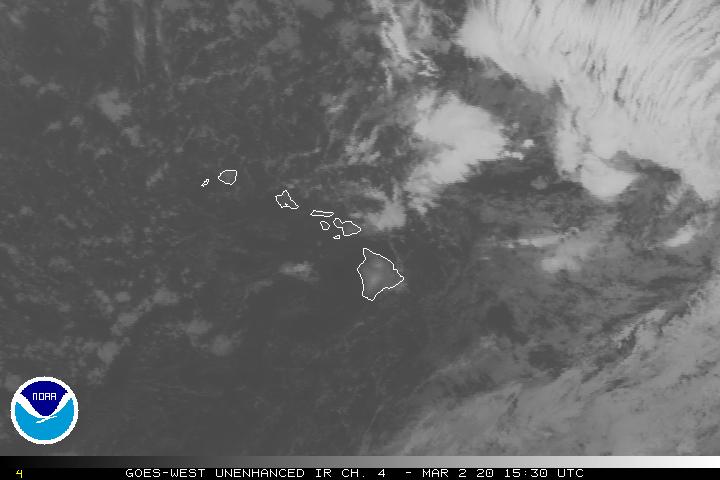


Jeff King Says:
Aloha Kakahiaka, Hoaloha, Is it me or do the early storms this hurricane season seem to keep kicking up much further east and south than usual. If – in fact – that is the case, do you think that gives them more, or less chance of gaining enough momentum to make it to the Central Pacific.~~~Hi Jeff, that’s a good question. Well, so far none of the three tropical cyclones that have formed offshore from Mexico, in the eastern Pacific, have had any inclination to head west in our direction. This particular storm, Carlotta, will remain near Mexico throughout her life cycle as well. We’ll have to wait and see what future storms do in regards your question…lets hope they don’t get near our fragile islands Jeff. My inclination is to say that they are apt to remain closer to Mexico than Hawaii. Aloha, Glenn