











Air Temperatures – The following maximum temperatures were recorded across the state of Hawaii Tuesday:
Lihue, Kauai – 82
Honolulu airport, Oahu – 84
Kaneohe, Oahu – M
Molokai airport – 80
Kahului airport, Maui – 83
Kona airport – 85
Hilo airport, Hawaii – 81
Air Temperatures ranged between these warmest and coolest spots near sea level – and on the highest mountain tops…as of 5pm Tuesday evening:
Barking Sands, Kauai – 83
Molokai airport – 77
Haleakala Crater – 46 (near 10,000 feet on Maui)
Mauna Kea – 32 (near 13,800 feet on the Big Island)
Hawaii’s Mountains – Here’s a link to the live web cam on the summit of near 13,800 foot Mauna Kea on the Big Island of Hawaii. This web cam is available during the daylight hours here in the islands…and when there’s a big moon shining down during the night at times. Plus, during the nights you will be able to see stars, and the sunrise and sunset too…depending upon weather conditions. Here's the Haleakala Crater webcam on Maui…although this webcam is not always working correctly.
Tropical Cyclone activity in the eastern and central Pacific – Here’s the latest weather information coming out of the National Hurricane Center, covering the eastern north Pacific. You can find the latest tropical cyclone information (once the season begins June 1) for the central north Pacific (where Hawaii is located) by clicking on this link to the Central Pacific Hurricane Center. A satellite image, which shows the entire ocean area between Hawaii and the Mexican coast…can be found here. Here's a tropical cyclone tracking map for the eastern and central Pacific.
Aloha Paragraphs

Strong and gusty trade winds, just a few passing
windward showers, very few leeward…increasing
Thursday into Friday
Small craft wind advisory coastal and channel
waters statewide through 6pm Wednesday,
wind advisories on the upper slopes of the
Haleakala Crater on Maui, and the upper slopes
on the Big Island…through 6am Wednesday
As this weather map shows, we have two near 1026 millibar high pressure systems to the north and northeast of the islands…with an associated ridge extending far to the west across the International Dateline. Our local winds will continue to be from the trade wind direction…remaining locally strong and gusty.
The following numbers represent the most recent top wind gusts (mph), along with directions as of Tuesday evening:
29 Port Allen, Kauai – NE
46 Kuaokala, Oahu – ESE
38 Molokai – NE
44 Kahoolawe – ENE
44 Kaupo Gap, Maui – NNE
42 Lanai – NE
35 Pali 2, Big Island – SE
We can use the following links to see what’s going on in our area of the north central Pacific Ocean. Here's the latest NOAA satellite picture – the latest looping satellite image…and finally the latest looping radar image for the Hawaiian Islands.
Here are the latest 24-hour precipitation totals (inches) for each of the islands as of Tuesday evening:
0.22 Mount Waialeale, Kauai
0.18 Oahu Forest NWR, Oahu
0.00 Molokai
0.00 Lanai
0.00 Kahoolawe
0.17 Puu Kukui, Maui
0.26 Glenwood, Big Island
Sunset Commentary: The trade winds will remain stronger than normal through Wednesday, and then should begin to mellow out…a little thereafter. The NWS forecast office in Honolulu is keeping the small craft wind advisories active across the entire state. Meanwhile, the winds are strong on the upper slopes of the Haleakala Crater, Maui, and the Big Island summits too, warranting the current wind advisory through 6am Wednesday morning.
The overlying atmosphere is stable now, and also somewhat drier than normal. As this satellite image shows, there are just a few lower level clouds upstream of the islands at the moment. These cumulus and stratocumulus clouds will bring a few windward showers, but not many through most of Wednesday. We can also see some high cirrus clouds coming our way now too, both from the southwest and northeast. As we get into Thursday, and lasting perhaps 24 hours or so, our lower level clouds and showers will increase…especially in the windward areas.
Here in Kula, Maui at 610pm, it was partly cloudy with light breezes, with an air temperature of 75.7F degrees. As a recap, our late spring trade wind flow will remain on the strong and gusty side of the wind spectrum through Wednesday, and then drop a notch Thursday onwards. Off and on generally light showers will continue to arrive along our windward sides at times, mostly during the night and early morning hours…increasing some Thursday into Friday. ~~~ It should be a good colorful sunset around the state this evening. I'll be back early Wednesday morning with your next new weather narrative, I hope you all have a great Tuesday night until then! Aloha for now…Glenn.
Worldwide tropical cyclone activity:
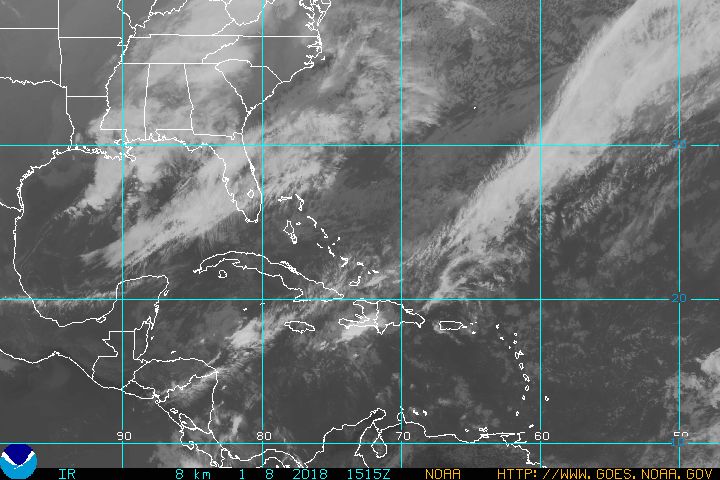
Atlantic Ocean: Tropical depression Beryl remains inland over Georgia. This tropical depression will remain inland Tuesday…as a classic rainmaker. It was located 85 miles west-southwest of Charleston, South Carolina, and 15 miles west-northwest of Savannah, Georgia, with 30 mph winds. Here is the NHC graphical track map, along with a satellite image of this area. This tropical system will bring rain, gusty winds, and thunderstorms to the area. The forecast shows this system moving back over the Atlantic later in the day Wednesday…at which point it is expected to strengthen again into a tropical storm.
~~~ Conditions in the atmosphere and the ocean favor a near-normal hurricane season in the Atlantic Basin this season. For the entire six-month season, which begins June 1, NOAA’s Climate Prediction Center says there’s a 70 percent chance of nine to 15 named storms (with top winds of 39 mph or higher), of which four to eight will strengthen to a hurricane (with top winds of 74 mph or higher) and of those one to three will become major hurricanes (with top winds of 111 mph or higher, ranking Category 3, 4 or 5). Based on the period 1981-2010, an average season produces 12 named storms with six hurricanes, including three major hurricanes.
Eastern Pacific: There are no active tropical cyclones. The NHC has announced that climate conditions point to a near-normal hurricane season in the Eastern Pacific this year. The outlook calls for a 50 percent probability of a near-normal season, a 30 percent probability of a below-normal season and a 20 percent probability of an above-normal season.
Seasonal hurricane forecasters estimate a 70 percent chance of 12 to 18 named storms, which includes 5 to 9 hurricanes, of which 2 to 5 are expected to become major hurricanes (Category 3, 4 or 5 on the Saffir-Simpson Hurricane Wind Scale).
An average Eastern Pacific hurricane season produces 15 named storms, with eight becoming hurricanes and four becoming major hurricanes. The Eastern Pacific hurricane season runs from May 15 through Nov. 30, with peak activity from July through September.
Central Pacific: There are no active tropical cyclones. Here in the central part of the Pacific, the hurricane season begins as of June 1. The Central Pacific Hurricane Center in Honolulu is forecasting 2-4 tropical cyclones in this part of the Pacific Basin…which is slightly below the average number. An average season has 4-5 tropical cyclones, which include tropical depressions, tropical storms and hurricanes.
Western Pacific Ocean: There are no active tropical cyclones.
Interesting: The Indus Valley Civilization was a Bronze Age civilization (3300—1300 BCE) located in what are now Pakistan, northwest India, and eastern Afghanistan. Flourishing in the Indus River basin, the civilization extended east into the Ghaggar-Hakra River valley and the upper reaches of the Ganges; it extended west to the Makran coast of Baluchistan and north to northeastern Afghanistan.
The civilization was spread over some 1,260,000 km², making it the largest of the ancient civilizations. Why did it end and what happened to it? A fundamental shift in the Indian monsoon has occurred over the last few millennia, from a steady humid monsoon that favored lush vegetation to extended periods of drought, reports a new study led by researchers at the Woods Hole Oceanographic Institution.
The study has implications for our understanding of the monsoon’s response to climate change.A monsoon of the Indian subcontinent is among the several geographically distributed observations of such. In the subcontinent, it is one of oldest weather observations, an economically important weather pattern and the most anticipated weather event and unique weather phenomenon.
Yet it is only partially understood and notoriously difficult to predict. Several theories have been proposed explaining the origin, the process, the strength, the variability, the distribution and the general vagaries of the monsoon of the Indian subcontinent, but understanding of the phenomenon and its predictability are still evolving.
"If you know what’s happening there, you know more or less what’s happening in the rest of India," said Camilo Ponton, a student in the MIT-WHOI Joint Program in Oceanography and lead author of the study recently published in Geophysical Research Letters, Holocene Aridification of India.
"Our biggest problem has been a lack of evidence from this region to extend the short, existing records." Monsoon is a tropical phenomenon. The Indian subcontinent, lying northwards of the equator up to the Himalayas and Hindukush, lies primarily in the tropical zone of the Northern Hemisphere. It involves winds blowing from the south-west direction (known as South-West Monsoon) from the Indian Ocean onto the Indian landmass during the months of June through September.
These are generally rain-bearing winds, blowing from sea to land, and bring rains to most parts of the subcontinent. They split into two branches, the Arabian Sea Branch and the Bay of Bengal Branch near the southern-most end of the Indian Peninsula. They are eagerly awaited in most parts of India for their agricultural and economic importance.
The study makes use of a sediment core collected by the National Gas Hydrate Program of India in 2006. Extracted from a "sweet spot" in the Bay of Bengal where the Godavari River drains the central Indian peninsula and over which monsoon winds carry most of the precipitation, the core has provided the basis for a 10,000-year reconstruction of climate in the Indian peninsula.
"We are fortunate to have this core from close to the river mouth, where it accumulates sediment very fast," said Ponton. "Every centimeter of sediment contains 10 to 20 years’ worth of information. So it gives us the advantage of high temporal resolution to address the problems."
When put together, the research tells the story of growing aridity in India, enables valuable insights into the impact of the monsoon on past cultures, and points scientists toward a way to model future monsoons. To assemble the 10,000-year record, the team looked to both what the land and the ocean could tell them.
Contained within the sediment core’s layers are microscopic compounds from the trees, grasses, and shrubs that lived in the region and remnants of plankton fossils from the ocean. "About 10,000 years ago to about 4500 ago, the Godavari River drained mostly terrain that had humidity-loving plants.
Stepwise changes starting at around 4,000 years ago and again after 1,700 years ago changed the flora toward aridity-adapted plants. That tells us that central India — the core monsoon zone — became drier." said Giosan.
Analyses of the plankton fossils support the story reconstructed from plant remains and reveal a record of unprecedented spikes and troughs in the Bay of Bengal’s salinity — becoming saltier during drought periods and fresher when water from the monsoon filled the river and rained into the Bay.
Similar drought periods have been documented in shorter records from tree rings and cave stalagmites within India lending further support to this interpretation. "What the new paleo-climatic information makes clear is that the shift towards more arid conditions around 4,000 years ago corresponds to the time when agricultural populations expanded and settled village life began," says Fuller of the Institute of Archaeology, University College London.
"Arid-adapted food production is an old cultural tradition in the region, with cultivation of drought-tolerant millets and soil-restoring bean species. There may be lessons to learn here, as these drought-tolerant agricultural traditions have eroded over the past century, with shift towards more water and chemical intensive forms of modern agriculture."
Together, the geological record and the archaeological evidence tell a story of the possible fate of India’s earliest civilizations. Cultural changes occurred across the Indian subcontinent as the climate became more arid after ~4,000 years. In the already dry Indus basin, the urban Harappan civilization failed to adapt to even harsher conditions and slowly collapsed.
But aridity favored an increase in sophistication in the central and south India where tropical forest decreased in extent and people began to settle and do more agriculture. Human resourcefulness proved again crucial in the rapid proliferation of rain-collecting water tanks across the Indian peninsula, just as the long series of droughts settled in over the last 1,700 years.
What can this record tell us about future Indian monsoons? According to Ponton, "How the monsoon will behave in the future is highly controversial. Our research provides clues for modeling and that could help determine whether the monsoon will increase or decrease with global warming."
The study found that the type of monsoon and its droughts are a function of the Northern Hemisphere’s incoming solar radiation — or insolation. Every year, the band of heavy rain known as the Inter-Tropical Convergence Zone, or ITCZ, moves north over India. "We found that when the Asian continent is least heated by the sun, the northward movement of the rain appears to hesitate between the Equator and Asia, bringing less rain to the north," said Giosan.
 Email Glenn James: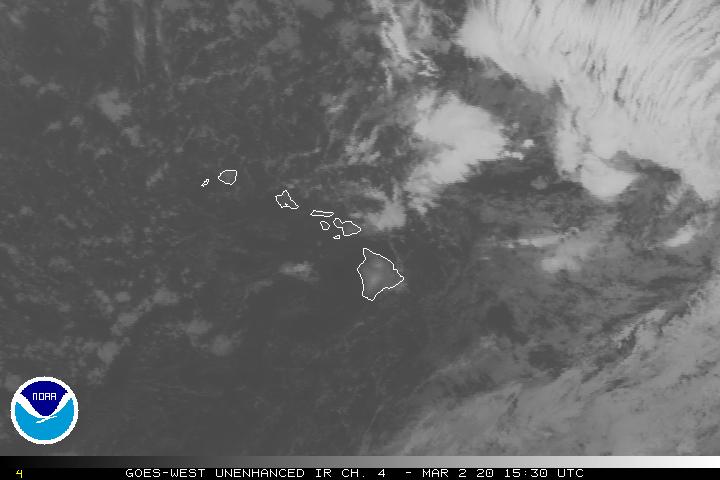

Sharon Says:
Glenn, you've done it again!
The ITCZ location driven by insolation and resulting effect on climate, too cool!
Pondering our bit of the ITCZ,
S.~~~Yes, Sharon, its all very interesting! Aloha, Glenn
Rosemary Says:
Question:I know spring brings strong trade winds but many people think they have been stronger than normal this spring. Curious if you know why. Thanks Glenn~~~Hi Rosemary, they certainly have been stronger than usual recently, although will ease up now going forward. I’d say that despite those several times when the trade winds have been stronger than usual, this spring will likely turn out to be more or less normal in terms of their strength. Aloha, Glenn