Air Temperatures – The following maximum temperatures were recorded across the state of Hawaii Tuesday:
Lihue, Kauai – 81
Honolulu airport, Oahu – 82
Kaneohe, Oahu – 80
Molokai airport – 79
Kahului airport, Maui – 83 (Record high temperature for Tuesday – 88 / 1953)
Kona airport – 80
Hilo airport, Hawaii – 80
Air Temperatures ranged between these warmest and coolest spots near sea level – and on the highest mountain tops…as of 5pm Tuesday evening:
Honolulu, Oahu – 80
Princeville, Kauai – 75
Haleakala Crater – 46 (near 10,000 feet on Maui)
Mauna Kea – 34 (near 13,800 feet on the Big Island)
Hawaii’s Mountains – Here’s a link to the live web cam on the summit of near 13,800 foot Mauna Kea on the Big Island of Hawaii. This web cam is available during the daylight hours here in the islands…and when there’s a big moon shining down during the night at times. Plus, during the nights you will be able to see stars, and the sunrise and sunset too…depending upon weather conditions. Here's the Haleakala Crater webcam on Maui…although this webcam is not always working correctly.
Aloha Paragraphs

Honolulu
Locally strong trades – windward showers, with
localized leeward showers too
Wind Advisory for the Big Island summits
As this weather map shows, we have a large near 1030 millibar high pressure system to the north-northeast of the islands. Our local winds will remain locally strong and gusty into mid-week…then gradually lighter into the weekend.
The following numbers represent the most recent wind gusts (mph), along with directions as of Tuesday evening:
18 Princeville, Kauai – ENE
30 Honolulu, Oahu – NE
30 Molokai – NE
42 Kahoolawe – E
37 Kahului, Maui – NE
00 Lanai
33 South Point, Big Island – NE
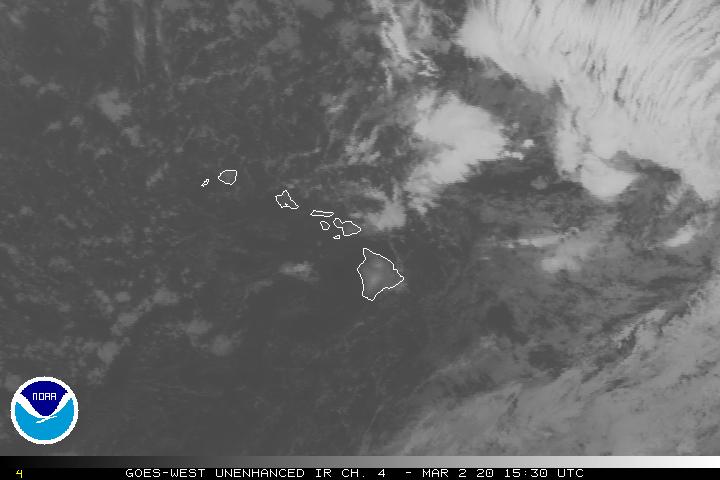
We can use the following links to see what’s going on in our area of the north central Pacific Ocean. Here's the latest NOAA satellite picture – the latest looping satellite image…and finally the latest looping radar image for the Hawaiian Islands.
Here are the latest 24-hour precipitation totals (inches) for each of the islands as of Tuesday evening:
1.10 Mount Waialeale, Kauai
0.23 Oahu Forest NWR, Oahu
0.00 Molokai
0.01 Lanai
0.00 Kahoolawe
1.68 Puu Kukui, Maui
1.53 Kawainui Stream, Big Island
Sunset Commentary: Our winds continue to blow from the trade wind direction, and will remain locally strong and gusty through the next several days. These trade winds will carry showers into the windward sides at times. The leeward sides in contrast should remain drier, although a few showers will fall in these areas on the smaller islands locally as well.
As mentioned above, high pressure will continue its normal presence to our northeast and north, thus keeping our springtime trade winds blowing. They will be strongest around Maui County and the Big Island, which is often the case. Small craft wind advisory flags have been dropped in all areas except around parts of those eastern islands now. The summits on the Big Island will experience gusty winds, where a wind advisory remains in place for areas above the 6,000 foot levels through 6am Wednesday morning.
~~~ Here in Kula, Maui at 530pm, skies were partly cloudy with light breezes, and an air temperature of 71.8F degrees. Our trade winds will remain quite blustery, although as we move through the rest of this week, they will tend to mellow out at least some into the weekend. As for precipitation, there will be some showers along the windward sides in particular. This satellite image shows another batch of moisture being carried our way on the gusty trade winds to the east…which will increase showers tonight into Wednesday morning, from Maui up the chain through Oahu to Kauai for the most part. Just such a band of showery clouds rode in on the trade winds last night, which brought showers into this morning. Wednesday should turn out to be a pretty nice day in most areas, like today was, after those showers gradually moved westward across the chain. ~~~ I'll be back early Wednesday morning with your next new weather narrative. I hope you have a great Tuesday night until then! Aloha for now…Glenn.
Interesting: How fast can an animal run? Speed is important for running away as well as catching up. The fastest land animal is neither the biggest nor the smallest, but something in between according to new research by Harvard University. Clemente (Harvard) and his team studied monitor lizards to show that that the same principle applies within species as well as across species, and to identify why this is the case.
Because adult monitor lizards vary substantially in size, they are an ideal species for testing how size affects speed. The researchers timed and photographed monitors ranging from two to 12 pounds, as sprinted across a 45-foot track.The cheetah is usually considered the fastest land animal and is able to achieve speeds upwards of 70 miles per hour.
It cannot, however, maintain this speed for very long, and prey that has a bit of luck can "wear down" the cheetah by avoiding it for about 10-15 seconds. The Cheetah may be the fastest running animal reaching speeds of up to 75 mph but its speed of movement is small in comparison with the Eastern Diamondback Rattlesnake with documented strike speeds of 175 mph.
The researchers found that the midsize lizards were fastest—and they discovered why. Using high-speed cameras and markers placed at key spots on the lizards' bodies, the researchers created computer models comparing characteristics of the lizards' running strides. "We then looked at how the mechanics of the stride changed with body size, and we found that the changes in the stride were consistent with the changes in speed," Clemente said.
"Above a certain size, lizards were changing the way they ran, perhaps due to a decreased ability of the bones and muscles to support a larger body mass." Testing this phenomenon within a single species helps clear up questions about why the biggest animals aren't the fastest.
Large animals tend to be closely related evolutionarily. So it's hard to tell whether slower speeds are due to biomechanical issues stemming from size, or from any number of other factors stemming from a shared evolutionary history. Looking at individuals within a species rather than making cross-species comparisons helps to eliminate this phylogenetic bias.
The results bolster the hypothesis that large size creates biomechanical constraints. "Larger lizards' legs can no longer support their body weight, and they have to change their style of running, making them slower," Clemente said. So big animals are not the fastest but something similar and smaller (mid-size) may well be the fastest.
 Email Glenn James: