











Air Temperatures – The following maximum temperatures were recorded across the state of Hawaii Tuesday:
Lihue, Kauai – 75
Honolulu airport, Oahu – 75
Kaneohe, Oahu – 73
Molokai airport – 77
Kahului airport, Maui – 83 (Highest recorded temperature for this date – 87 / 1981)
Kona airport – 82
Hilo airport, Hawaii – 80
Air Temperatures ranged between these warmest and coolest spots near sea level – and on the highest mountain tops…as of 7pm Tuesday evening:
Kailua-kona – 73
Molokai airport – 66
Haleakala Crater – 36 (near 10,000 feet on Maui)
Mauna Kea – 25 (near 13,800 feet on the Big Island)
Hawaii’s Mountains – Here’s a link to the live web cam on the summit of near 13,800 foot Mauna Kea on the Big Island of Hawaii. This web cam is available during the daylight hours here in the islands…and when there’s a big moon shining down during the night at times. Plus, during the nights you will be able to see stars, and the sunrise and sunset too…depending upon weather conditions. Here's the Haleakala Crater webcam on Maui…although this webcam is often not working correctly.
Aloha Paragraphs

(you will have to reload/refresh this page to get the latest radar image…if you stay on this page)
Hazardous surf along the east shores – high surf warning on those beaches…advisory level north shores
Improving weather Wednesday into Thursday…
with strong trade winds going into the weekend…along with
frequent showers…mostly along the windward sides
As this weather map shows, we have strong high pressure systems far to the northeast and northwest of the islands. At the same time we have a low pressure system closer to the north, with its associated cold front/trough located near Oahu. Our winds will be variable in direction and speed…becoming stronger trades going into Thursday through the upcoming weekend.
The following numbers represent the strongest wind gusts (mph), along with directions Tuesday evening:
39 Barking Sands, Kauai – NNE
16 Wheeler AFB, Oahu – NW
23 Molokai – SSE
22 Kahoolawe – SE
17 Lipoa, Maui – S
08 Lanai – SW
18 South Point, Big Island – NE
We can use the following links to see what’s going on in our area of the north central Pacific Ocean Tuesday evening. Looking at this NOAA satellite picture we see low, middle and high level clouds over the ocean, stretching across most of the island chain. We can use this looping satellite image to see heavy duty showery clouds over parts of the state, with thunderstorms popping-up in places. Checking out this looping radar image we see light to moderate showers, with heavy ones too…especially between Oahu and Maui County at the time of this writing.
Here are the 24-hour precipitation totals (inches) for each of the islands as of Tuesday evening
12.74 Wainiha, Kauai
9.15 Waimanalo, Oahu!
1.41 Molokai
0.04 Kahoolawe
0.23 Mahinahina, Maui
0.17 Keaumo, Big Island
Sunset Commentary: The atmosphere remains unstable and shower prone over the islands tonight, especially over Maui County. There are still those showery clouds that continue to bring rainfall, some of it heavy…with even few thunderstorms locally to the southwest of the islands too. Meanwhile, there continues to be lots of moisture in our area, which will keep conditions off and on wet tonight, tapering off some as we move through the day Wednesday. As we move into Thursday, through the weekend, showers will be carried our way on the returning trade winds, falling generally along the windward coasts and slopes. The computer models are now showing yet another unsettled weather pattern sliding over the state this weekend, which will keep showers active along the windward areas...although carried over into the leeward sides at times too.
A cold front/trough is approaching Maui now, after passing over Kauai and Oahu during the day. This frontal boundary will act as a focus for more locally heavy rainfall, and thus keeping the possibility of more flooding for at least a few of the islands. The Big Island won't be under this most intense rain shield, although will find shower activity continuing at times too. It appears that we'll finally find some relief from this long lasting threat of heavy flooding precipitation Wednesday into Thursday. As noted above, as we push into Friday and the weekend time frame, we could slip back into another possible inclement weather pattern…more information about this as soon as possible, stay tuned.
Here in Kula, Maui at 800pm HST, we had breezy conditions, mostly cloudy skies…with showers falling. The air temperature was a cool 59.2F degrees. Satellite imagery still shows copious amounts of rainy clouds out over the ocean, which are spreading over parts of the island chain. As the radar image shows below, the rains seem to be focusing over Maui County the most, at the time of this writing. Kauai and the Big Island are currently outside of this swath of rainfall, some of which is heavy! This looping radar image confirms this quite clearly. By the way, the blue color is light rain, the green is heavier, while the yellow and red is the heaviest. All of the islands have received some of this wet weather, with more showers taking aim on the entire state at various times through the rest of the night.
I would strongly suggest that folks drive with extreme care, if you're out and about driving. At the same time, please stay away from streams, gulches, canals, and other low areas prone to flooding. The soils over many parts of the state are totally saturated, which means that more precipitation will lead to quick flooding problems. I'll continue to keep a close eye on this very wet and unsettled weather pattern, and will come back online with my next regularly scheduled weather narrative come 530am HST Wednesday morning. Aloha for now…Glenn.
545pm update -I have been looking down the mountain towards the Central Valley, including Kihei, Wailuku and Kahului, and I can see a major area of what looks like heavy showers down there! It looks to be heading up here, which is an impressive sight, I'll let you know if it in fact…we get a big downpour soon. At the moment, before it arrives, there's only a light shower falling.
645pm update – Well, I hung out up here in my Kula weather tower for the last hour, watching this cloud band crawl up the slopes of this Haleakala Crater, with not too much more than light to almost moderately heavy showers. They have been constant, although the heavy stuff just didn't arrive, or hasn't yet. Although, just as I'm writing these words, the rain is getting somewhat heavier! I'm going to go downstairs and make dinner now, and will come back up here afterwards to give you one more update before bedding down. I go to bed typically on the weekdays around 830pm, as my alarm goes off at 450am…early Wednesday morning. Oops, just as I was leaving my computer, I just heard a pretty good thunder clap in the distance!
810pm update – It's still raining, with no let up that I can discern, out there in the dark. I don't hear anymore thunder, and haven't seen any lightning either. The way that the looping radar image appears, and with this precipitation coming up out of the southwest…it looks like more rainfall is on the way, maybe even another thunderstorm, at least at the time of this writing. Things will change during the night of course, so that by the time I begin preparing your new sunrise commentary early in the morning, it may be a totally different story. Time will tell, and I'm going to be spending it under my warm down comforter, snug as a bug in a rug, isn't that a saying that we've heard before? Kden, as we say here in the islands, over and out for now. Aloha, Glenn
Extra: Webcam atop the Mauna Kea summit on the Big Island of Hawaii…showing snow – or at least it will again at first light Wednesday morning.
Extra: Youtube music videos, by Olomana…Ku'u Home O Kahalu'u – Seabird
Extra: We had some of these Lenticular clouds in the skies over Maui at mid-day Tuesday
Interesting: National Hurricane Center Director Bill Read said Monday that science will improve to the point where forecasters can reliably issue forecasts showing where a hurricane will be a week ahead of time. "We're two to five years from a seven-day forecast," Read told reporters while attending a conference with representatives of other federal agencies to discuss hurricane forecasting and warning.
He noted the National Weather Service now issues regular daily weather forecasts a week out — but not yet for hurricanes. "But no one makes decisions based on that kind of forecast that can kill them," Read said. "There is plenty of time to recover from a bad decision to play golf on Saturday when it's Monday; it's not going to kill you.
If you start moving nursing home patients at seven days (ahead) you could kill them." Read said the Hurricane Center, which now issues five-day forecasts on the giant storms, doesn't want to issue a seven-day forecast until there is greater confidence in the predictions. But, he said, better forecasts won't help the public if they ignore them.
"The biggest challenge is to crack the denial. If you haven't cracked the 'it won't happen to me thought process' you can do everything else right and they are going to say it won't happen to me and not do it," he said. "If you can get past the denial, the rest of it is not as difficult as you think. He said that although Hurricane Irene tracked up the East Coast last August, causing $7 billion in damage and claiming 41 lives, people won't remember it long.
"We will have about a five-year window when people are teachable from Irene and if nothing else happens. I used to think if you were hit once you were good for a generation," he said. But research has shown that after only five years people "remember it differently. They don't remember it as badly as it was.
It's natural five years later you forget the things that got you in trouble the last time." While the National Oceanic and Atmospheric Administration doesn't release until May its prediction for the six-month Atlantic hurricane season that starts June 1, Read said that very early indications are that the season may be average – around 11 named storms – after last year's busy season when there were 19.
But he said there is very little confidence in a forecast issued this far ahead of the season. "My guys don't think seasonal forecasts have any meaningfulness," he added, saying the Hurricane Center is focused on warning people so they get out of harm's way. He noted that, 20 years ago, there was a relatively quiet hurricane season. But one of those storms that season in 1992, he said, was Hurricane Andrew that hit south Florida causing 26 deaths and an estimated $25 billion damage.
Interesting2: Because of its hostile climate and remote location, Antarctica is one of the most pristine environments on Earth. But the icy continent is playing host to ever-increasing numbers of scientists and tourists, and a new study finds that these visitors are bringing some unintended baggage: the seeds of potentially invasive plants. Climate change is projected to render the frigid continent more hospitable to such plants in coming decades, says the study's lead author, Steven Chown, an environmental scientist at Stellenbosch University in South Africa.
Recently, Chown and his colleagues conducted the first continentwide assessment of the risk of invasive plants. In late 2007 and early 2008, the researchers inspected the travel gear of more than 850 scientists, tourists, support personnel, and ships' crew (with their permission).
That's approximately 2% of Antarctic visitors during that period, Chown notes. Using vacuum cleaners at the visitors' first stop on the continent, they collected almost 2700 seeds from equipment including outerwear, footwear, day packs, and camera bags.
Although about 20% of tourists had unwittingly carried seeds to Antarctica, more than 40% of the scientists and support personnel at research stations had brought botanical stowaways—and more than half of the scientists doing field research and tourist support personnel, such as tour guides, harbored hitchhikers.
Overall, the researchers estimate that all visitors to Antarctica that field season brought about 71,000 seeds. On average, each seed-bearing visitor carried more than nine seeds, Chown and his colleagues report online today in the Proceedings of the National Academy of Sciences.
Analyses of the types of seeds gathered, together with information from questionnaires about the visitors' travel habits in the year before their Antarctic visit, suggest that between 50% and 60% of the seeds reaching Antarctica arrived from areas with similarly cold climates—and therefore pose a threat of gaining a foothold.
By 2100, climate change could dramatically boost the risk of nonnative species becoming established, especially along the western Antarctic Peninsula and in ice-free coastal areas west of the Amery Ice Shelf and along the western Ross Sea, the researchers estimate.
Previous studies had estimated the risk of invasive species for limited areas of Antarctica and were based only on the numbers of visitors or the amount of cargo shipped, Chown says. "This is an extremely important paper," says Peter Convey, an ecologist with the British Antarctic Survey in Cambridge, U.K.
"This research was an obvious next step, but a big one," he notes. "Their risk estimates are based on objective data rather than hand waving." Philip Hulme, an ecologist at Lincoln University in New Zealand, agrees: "Now we know what's coming in and what might get established."
Many factors influence whether a seed could actually take hold in Antarctica, he notes, including the nutrient content and pH of soil. Nevertheless, he adds, researchers can't presume that Antarctica is immune to invasion. "In the long term, it's going to be a big problem," he notes.
In the meantime, there are a few inexpensive and easily implemented measures that visitors can take to help stem the tide of invasive species, Chown says. Tourists can clean their equipment thoroughly, including vacuuming their gear bags and emptying the pockets of their outerwear, especially if they've recently visited arctic or alpine environments where they could have inadvertently picked up seeds of cold-adapted plants.
Also, scientists can pay attention to where cargo destined for Antarctica is stored, especially if it's been stored outdoors. Sometimes, Hulme says, researchers get the most out of their investment in cold-weather gear by using the equipment in Antarctic fieldwork half the year and then transporting it to arctic environments, where it can easily pick up stowaway seeds.
 Email Glenn James: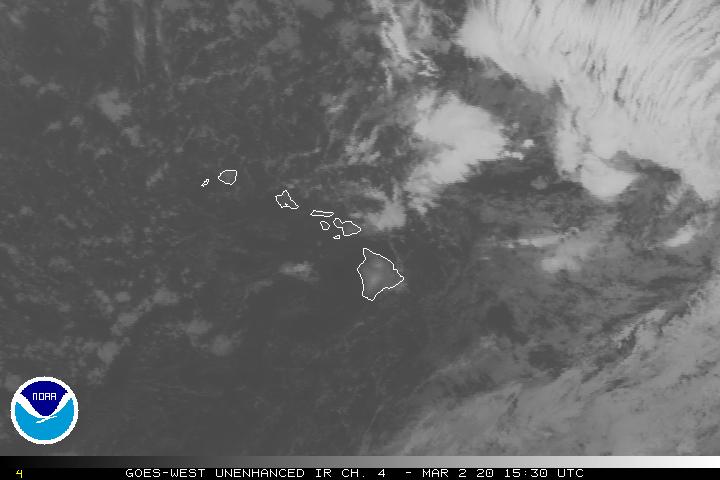

Elif Says:
Hi Glen!
We'll be in Maui tomorrow and it looks like it will be terrible weather when we're there? How unlucky…~~~ Elif, should be nice Thursday, probably not that bad if you are in Kihei or Lahaina through the weekend…probably nice after that. Don’t get too down, I think you’ll be surprised how much you love it! Aloha, Glenn.
Lisa Says:
Hi Glenn,
I just came across your site and it has been useful in predicting the weather there. Is this a typical weather pattern for you with so much rain? I am from the NW and hoping it will be sunny by the time I get there. Any thoughts on what's going on or what can be expected for end of the month?
-Lisa (Vancouver, WA)~~~Hi Lisa, no, this isn’t a typical weather pattern, and I doubt whether anything like it will be happening for you at the end of the month…although who knows from here? I’d say check the weather out as your departure dates draws nearer. I would imagine that you will have great weather, hopefully! Aloha, Glenn
Jay Says:
Would be interesting on the total rain that has dropped on Kauai in the last two weeks or so…guess you would have to pick a spot…these are impressive numbers!~~~Hi Jay, that would be an impressive number, will try and come up with that for us. Aloha, Glenn