Air Temperatures – The following maximum temperatures were recorded across the state of Hawaii Wednesday:
Lihue, Kauai – 77
Honolulu airport, Oahu – 79
Kaneohe, Oahu – M
Molokai airport – 83
Kahului airport, Maui – 80
Kona airport – 80
Hilo airport, Hawaii – 76
Air Temperatures ranged between these warmest and coolest spots near sea level – and on the highest mountain tops…as of 5pm Wednesday evening:
Kailua-kona – 78
Hilo, Hawaii – 68
Haleakala Crater – 39 (near 10,000 feet on Maui)
Mauna Kea – 32 (near 13,800 feet on the Big Island)
Hawaii’s Mountains – Here’s a link to the live web cam on the summit of near 13,800 foot Mauna Kea on the Big Island of Hawaii. This web cam is available during the daylight hours here in the islands…and when there’s a big moon shining down during the night at times. Plus, during the nights you will be able to see stars, and the sunrise and sunset too…depending upon weather conditions. Here's the Haleakala Crater webcam on Maui.
Aloha Paragraphs

Locally strong and gusty winds – windward
showers…a few elsewhere on the smaller islands –
rough high surf along our east facing beaches
through Friday – high cirrus clouds – showers
increasing as a cold front moves through the
state Sunday into Monday – stronger trades
following in its wake for several days
As this weather map shows, we have a near 1033 millibar high pressure system to the north-northeast of the islands. At the same time we have a weak low pressure system to the west of Kauai. Our winds will be locally quite gusty from the trade wind direction over the next several days.
The following numbers represent the strongest wind gusts (mph), along with directions Wednesday evening:
09 Barking Sands, Kauai – SE
29 Bellows, Oahu –ENE
06 Molokai – W
45 Kahoolawe – ESE
30 Lipoa, Maui – ESE
05 Lanai – SW
30 Upolu Point, Big Island – NE
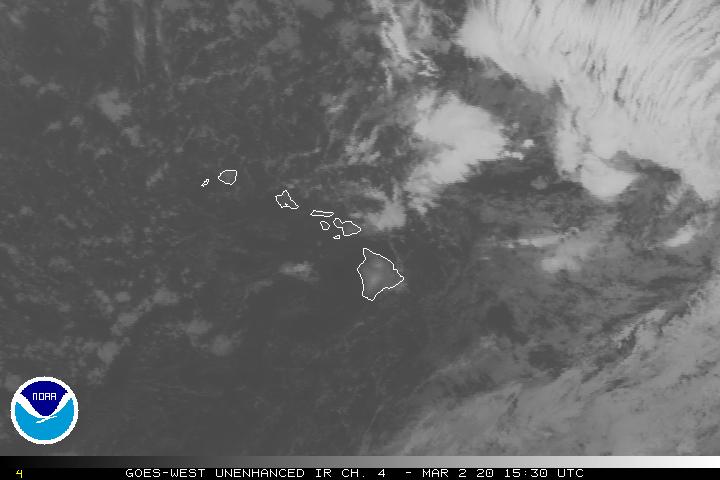
We can use the following links to see what’s going on in our area of the north central Pacific Ocean Wednesday evening. Looking at this NOAA satellite picture we see low, middle and high level clouds over the ocean, stretching over the islands in places…with a few thunderstorms to the west and northwest of Kauai. We can use this looping satellite image to see a low pressure system to the northwest of Kauai, with thunderstorms to the west and northwest of the state. The upper flow of winds is carrying a considerable amount of high cirrus clouds, off the tops of these thunderstorms our way. Checking out this looping radar image we see light to moderate showers, with a few heavy ones…especially over the ocean around Kauai, and south of Oahu, and south and southeast of the Big Island at the time of this writing.
Here are the 24-hour precipitation totals (inches) for each of the islands as of Wednesday evening:
6.93 Mount Waialeale, Kauai
1.43 Nuuanu Upper, Oahu
0.07 Molokai
0.00 Kahoolawe
1.57 Kaupo Gap, Maui
3.03 Glenwood, Big Island
Sunset Commentary: The threat of heavy showers remains only for the island of Kauai, as the trough of low pressure still isn't very far away to the west and northwest of Kauai. Satellite imagery shows some heavy showers over the ocean to the west and northwest of that island…with even a few embedded thunderstorms. Meanwhile, high pressure to our north-northeast is helping to bring locally rather strong and gusty trade winds our way. These winds will carry showery clouds towards us at times through the rest of this week. This moisture will generally fall upon the windward coasts and slopes, with a few making it over into the leeward sides on the smaller islands. Looking further ahead, our trade winds will once again give way to somewhat lighter breezes ahead of a frontal cloud band that is forecast to move down through the state later Sunday into next Monday. The trade winds will surge in the wake of this potentially wet frontal passage.
Here in Kula, Maui at 530pm HST, we had light breezes, lots of high clouds…and an air temperature of 64.8F degrees. Looking at that satellite image above, we can see lots of high cirrus clouds out to our west…which continue moving over the state. These icy cirrus will filter and dim our late winter sunshine during the day again Thursday. Meanwhile, the trade winds will be blowing, remaining quite strong and gusty through Friday, gradually easing up some into the weekend. These of course will carry showers to our windward sides at times. The leeward sides will be in better shape, although some of these showery clouds may travel over from the windward sides on the smaller islands at times as well. The trade winds will become quite a bit stronger in the wake of a frontal boundary as it moves through the state…remaining active for several days into next week. These stronger than usual trades will necessitate small craft wind advisories statewide, with perhaps other advisories over some parts of the island chain too. We still have lots of time to fine tune this potential windy reality. ~~~ I'll be back early Thursday morning with your next new weather narrative. I hope you have a great Wednesday night wherever you happen to be spending it! Aloha for now…Glenn.
Interesting: Wild dolphins use specific melodies called signature whistles to introduce themselves when they come across new groups of dolphins, researchers have discovered. They say the tuneful exchanges are an important part of a greeting sequence that allows dolphins to recognise each other in the wild.
'These signature whistles are special, because they contain the dolphin's identity in the modulation pattern, or tune if you like, which the dolphin invents,' explains Dr Vincent Janik from the University of St Andrews, who led the study. Signature whistles were first discovered in the 1960s.
'Researchers had already brought up the idea that they're whistles that dolphins use to identify themselves,' Janik says. Scientists also noticed that captive dolphins use these whistles when apart from the rest of the group. But no-one had actually demonstrated their use in the wild – until now.
'People thought that dolphins use signature whistles to update others about where they are. After all, they live in a 3D world, with no real landmarks,' says Janik. 'Beyond that, we didn't know much about what they use signature whistles for.' Janik and his colleague, Dr Nicola Quick – also from the University of St Andrews – figured that if these intelligent creatures use signature whistles to tell others who they are, they should exchange them when groups meet.
So, they decided to analyse when and how a 200-strong dolphin population around the east coast of Scotland uses these whistles. Janik and Quick expected every individual in the pod to introduce themselves whenever they came across a new group. But – much to their surprise – they didn't find that at all.
Instead, it seems that it's enough for just one dolphin to identify itself to elicit a reply from a member of the other group. 'It's like a greeting ceremony between a couple of individuals in two different groups. These individuals have a close interaction, but the others are more passive,' says Janik.
Dolphins have a huge repertoire of whistles, which make it hard to work out which one was the signature. Not just that, but the creatures whistle with a special structure in their foreheads. This means they don't open their mouths. So once Janik and Quick had identified which whistle could be labelled a signature whistle, they then had the added problem of working out which dolphin it came from.
'We used four sensors and then worked out the time of arrival of the whistle to say which dolphin made the tune,' explains Janik. They also noticed that when individuals meet a new group, they repeatedly replay their signature tune. Janik reports in Proceedings of the Royal Society B that this almost certainly helps with correct identification.
Dolphin social structure is much like ours; they have a fission-fusion system, in which individuals in each group change all the time. So if only one individual from a fairly fluid group introduces themselves, how does the group know who the others are? Janik explained that it's likely the dolphins also use active sonar to identify each other.
But right now, they're not sure how much. 'We know their echolocation is incredibly finely tuned: they can pick up an object which is just seven centimetres across from 100 metres away,' says Janik. 'So they could be using this to identify features in others.'
He says the next step will be to see how bigger populations of dolphins which live in larger area of the ocean use these signature whistles. 'To complete the picture, it would also be important to look into how echolocation is used to perceive who's around them,' he adds.
 Email Glenn James: