











Air Temperatures – The following maximum temperatures were recorded across the state of Hawaii Tuesday:
Lihue, Kauai – 79
Honolulu airport, Oahu – 78
Kaneohe, Oahu – 79
Molokai airport – 76
Kahului airport, Maui – 74
Kona airport – 81
Hilo airport, Hawaii – 81 (Record high temperature on this date – 90F – 1968)
Air Temperatures ranged between these warmest and coolest spots near sea level – and on the highest mountain tops…as of 5pm Tuesday evening:
Kailua-kona- Hawaii – 78
Princeville, Kauai – 66
Haleakala Crater – 39 (near 10,000 feet on Maui)
Mauna Kea – 28 (near 13,800 feet on the Big Island)
Hawaii’s Mountains – Here’s a link to the live web cam on the summit of near 13,800 foot Mauna Kea on the Big Island of Hawaii. This web cam is available during the daylight hours here in the islands…and when there’s a big moon shining down during the night at times. Plus, during the nights you will be able to see stars, and the sunrise and sunset too…depending upon weather conditions. Here's the Haleakala Crater webcam on Maui.
Aloha Paragraphs
Strong and gusty kona winds ahead of a cold
front…from the southwest and west…strong winds
over Haleakala, Maui and Big Island summits –
rough surf on our north, west and south shores,
which will become very large and dangerous
Wednesday on the north and west shores,
with high tides – A period of showers with
a cold front into the night…followed by cool
and clearing northerly breezes Wednesday –
improving weather with moderately strong
and gusty trade winds, and smaller surf
Thursday through Saturday
As this weather map shows, we have low pressure systems to the north through northeast of the islands, with an active cold front moving through the islands from the northwest. At the same time, we have a weak high pressure system far to the east, and another stronger high pressure cell far to the west-northwest. Our winds are locally strong ahead of the cold front today…which will then become blustery and cooler from the north in the wake of the frontal passage into Wednesday.
The following numbers represent the strongest wind gusts (mph), along with directions Tuesday evening:
24 Port Allen, Kauai – WNW
36 Wheeler Field, Oahu – W
21 Molokai – SW
29 Kahoolawe – SW
31 Kahului, Maui – SW
14 Lanai – SW
40 South Point, Big Island – SW
We can use the following links to see what’s going on in our area of the north central Pacific Ocean Tuesday evening. Looking at this NOAA satellite picture we clouds over the central islands associated with a fast moving cold front moving down through the Aloha state. We can use this looping satellite image to see the cold front moving down through the island chain from the northwest, the leading edge was passing over Maui County this evening…heading towards the Big Island. Checking out this looping radar image we see generally moderate showers, although some heavier ones too, along the leading edge of this frontal cloud band…with lighter residual showers arriving in the wake of the frontal passage.
Here are the 24-hour precipitation totals (inches) for each of the islands as of Tuesday evening:
2.96 Kilohana, Kauai
2.68 Schofield South, Oahu
2.30 Molokai
0.02 Kahoolawe
2.29 Puu Kukui, Maui
0.14 Kamuela upper, Big Island
Sunset Commentary: The winds became strong to very strong as expected today, from the southwest today…in association with a rapidly moving cold front. This last front in a series of three, reached the islands today, and will continue down to the Big Island tonight, bringing briefly heavy showers with it. Cooler and drier northerly winds will fill in behind this cold front, bringing a relatively short period of chilly weather to the state for a day or two. The computer models then predict that we'll see returning trade winds later Thursday through the weekend into early next week. These moderately strong trades will carry at least some showers to our windward sides…with a few stretching over into the leeward sides on the smaller islands.
Larger than normal surf has been breaking along our north and west shores lately. An even larger northwest swell will arrive tonight into Wednesday. Those folks who live along the beaches of our north and west shores should be very aware of swell activity, especially early Wednesday and Thursday mornings, when these swells will coincide with higher than normal high tides. During this period between tonight and Thursday we'll see high surf advisories and high surf warnings being in force, with hazardous surf levels occurring Wednesday. This is serious business, and beach goers and property owners should be exercising great caution. Fortunately, the east facing shores aren't seeing these large waves breaking, so that these beaches will be much more user friendly to the ordinary citizen wanting gentle beach conditions today. The one problem for the south shores will be the onshore gusty kona winds that occur Tuesday ahead of the next cold front…and then the gusty and chilly northerly winds on Wednesday. These winds will kick up rough surf Tuesday on our leeward sides. The surf community, especially those big wave riders…may be able to put these winter high surf conditions to good use, before the cooler northerly winds blow this surf out in the wake of the cold front at mid-week!
Here in Kula, Maui at 6pm HST, we have stiff southwest breezes blowing, with showers falling…and an air temperature of 60.3F degrees. Here's a satellite image showing this cold front moving quickly down through the state. The front arrived this morning over Kauai, which brought increasing clouds and showers, and then spread down through Oahu and Maui County Wednesday afternoon into the early evening. Here's a looping satellite image so we can watch it bring its clouds and showers. Most places in the island chain have picked up showers and rain from this frontal passage. Here's a looping radar image so we can keep track of the incoming showers on the kona winds ahead of the cold front. The front is moving quickly enough that there shouldn't be serious flooding problems, although there is likely to be at least some pooling of water on roadways here and there. The front has passed over Kauai and Oahu, with winds having shifted from southwest to northwest at the time of this writing on Kauai in places.
We expect a rather strong push of cool and dry northerly winds funneling down across the state in the wake of this front's passage. This will catch our attention, as unusually cool air rushes into the state on those gusty northerly breezes for a day or so. High temperatures Wednesday will be several degrees cooler than normal, and won't be able to reach 80F degrees anywhere in the state for a change. Our weather will improve Thursday and Friday into the upcoming weekend, in association with the returning trade winds. The trade winds will carry some showers to our windward sides, although there's nothing unusual about that. ~~~ I'll be back early Wednesday morning with your next new weather narrative. Please drive carefully as the roads will be wet and slick, so please use extra caution when behind the wheel. Aloha for now…Glenn.
Interesting: Sand dunes flow over the land subject to the winds like ocean waves or rivers. What makes them move? What makes them start or stop? In a study at the White Sands National Monument in New Mexico, University of Pennsylvania researchers have uncovered a unifying mechanism to explain the beautiful dune patterns that occur.
The findings may also hold implications for identifying when dune landscapes like those in Nebraska's Sand Hills may reach a tipping point under climate change, going from valuable grazing land to barren desert. The research paper was published in Nature Geoscience.
Much of the study's data was collected during field trips taken by students in an undergraduate and graduate course Jerolmack (author)teaches at Penn, Geology 305: Earth Systems Processes. Each year, the class has traveled to White Sands to do fieldwork during spring break.
White Sands National Monument, located near Alamogordo in south-central New Mexico, is an enclosed basin that housed an ancient lake during the last ice age. Unlike most dune fields, which are composed of quartz sand, it's the world's largest dune field made of gypsum.
Its blindingly white dunes cover 275 square miles. The dune fields' groundwater table is located just a a few feet below the surface. "So it means you're in a very hot arid place, but when you walk around you feel moisture on your feet," Jerolmack said. The moisture creates a somewhat sticky surface, he added, "so, if the sand blows off a dune and lands, it sticks to the surface and can get deposited and left behind." White Sands has long been the site of geologic inquiry.
Scientists have put forward theories to explain individual elements of the dunes, including their shape, their movements over time and the presence or absence of plants. The novelty of this study lies in showing how all of these problems are a consequence of the interaction of wind with the dunes.
The researchers began by analyzing high-resolution elevation maps, measured each year for five years using aerial laser scans of the dune field surface. These data showed that dunes migrated fastest at the upwind (western) edge of the dune field, where the field transitioned into a flat and barren plain.
Moving along the prevailing wind direction (northeast) into the dune field, the speed of the moving dunes consistently slowed down. The researchers reasoned that the friction resulting from the dunes was likely causing the wind to slow down over the dune field. Small specks in the high-resolution images, which indicate where plants grow, also showed that the wind and dune migration activity appeared to impact vegetative growth.
"There is a rapid transition from bare dunes to dunes that are almost entirely covered with vegetation," said Jerolmack. According to the researchers' observations, dunes that are hit with stronger winds have fewer plants, as the plants cannot grow roots quickly enough to keep up with the shifting sands.
By contrast, the dunes that experience the slower-moving winds are stable enough to support plants. The plants then exert their own influence on dune shapes, as their root systems help stabilize the sand in which they grow. Because plants generally take hold first to a dune horns — the narrow slopes of boomerang-shaped dunes — before reaching the center, the researchers observed that dunes with plant-stabilized horns inverted as the wind blew the center inside out.
Where plants grew, the underlying groundwater was fresher and farther below the surface than areas bare of plants. The Penn researchers demonstrated that plants impacted the groundwater, rather than the other way around. By taking up water, the plants draw the groundwater table down.
This also lowers the evaporation at the groundwater table, leaving the groundwater less salty than in unvegetated areas with high evaporation rates. The Sand Hills is a region of mixed-grass prairie on grass-stabilized sand dunes in north-central Nebraska, covering just over one quarter of the state.
The Sand Hills sit atop the massive Ogallala Aquifer; thus both temporary and permanent shallow lakes are common in low-lying valleys between the grass-stabilized dunes prevalent in the Sand Hills. Under some climate change predictions, rainfall could decline in the upper Midwest.
Even a small reduction in rainwater could mean that the grasses that stabilize the Sand Hills' dunes would no longer be able to survive. The dunes would then go back to being a barren migrating dune field, no longer serving the half-a-million cattle that now graze there. This would be the return of the dust bowl era where this land would become a desert of shifting dunes.
Interesting2: According to new research, Mars may have been arid for over 600 million years, making it inhospitable for life to survive. Researchers spent three years analyzing data on Martian soil that was collected during the 2008 NASA Phoenix mission to Mars.
Phoenix touched down in the northern arctic region of the Red Planet to look for signs that it was habitable to support life by analyzing ice and soil on the surface. They found that the surface of Mars has been arid for hundreds of millions of years, despite the presence of ice and the fact that previous research has shown that the planet may have had a warmer and wetter period in its earlier history 3 billion years ago.
The team also believes the soil on Mars had been exposed to liquid water for at the most, 5,000 years ago since its formation billions of years ago. Satellite images and previous studies show that the soil on Mars is uniform across the planet, suggesting that the results from the team’s analysis applies to all of Mars.
“We found that even though there is an abundance of ice, Mars has been experiencing a super-drought that may well have lasted hundreds of millions of years,” Dr Pike, from the Department of Electrical and Electronic Engineering at Imperial and lead author on the study, said in a press release.
“We think the Mars we know today contrasts sharply with its earlier history, which had warmer and wetter periods and which may have been more suited to life. Future NASA and ESA missions that are planned for Mars will have to dig deeper to search for evidence of life, which may still be taking refuge underground.”
The scientists formed one of 24 teams based at mission control in the University of Arizona, operating part of the spacecraft’s onboard laboratories. By using an optical microscope to produce images of larger sand-sized particles of soil samples dug up by a robot arm, they were able to produce 3D images of the surface of particles as small as 100 microns.
The team has been cataloging individuals particles sizes to understand more about the history of the Martian soil. They looked for microscopic clay particles in the study that are formed when rock is broken down by water. These particles are an important marker of contact between liquid and water and the soil.
The researchers calculated that even if the few particles they saw in this size range were clay, they made up less than 0.1 percent of the total proportion of the soil in the samples. Clay on Earth can make up 50 percent or more of the soil content, so such a small portion on Mars suggests that the soil has had a very arid history.
The team estimated that the soil they were analyzing had only been exposed to liquid water for a maximum of 5,000 years by comparing their data with the slowest rate that clays could form on Earth. They also found evidence to support the idea that the soil on Mars has been largely dry throughout its history by comparing soil data from Mars, Earth and the Moon.
They concluded that the soil was being formed in a similar way on Mars and the Moon because they were able to match the distribution of soil particle sizes. On Mars, they determined that physical weathering by the wind and meteorites breaks down the soil into smaller particles.
On the Moon, they found that meteorite impacts break down rocks into soil, because there is no liquid water or atmosphere to wear the particles down. The study was published in the journal Geophysical Research Letters.
 Email Glenn James: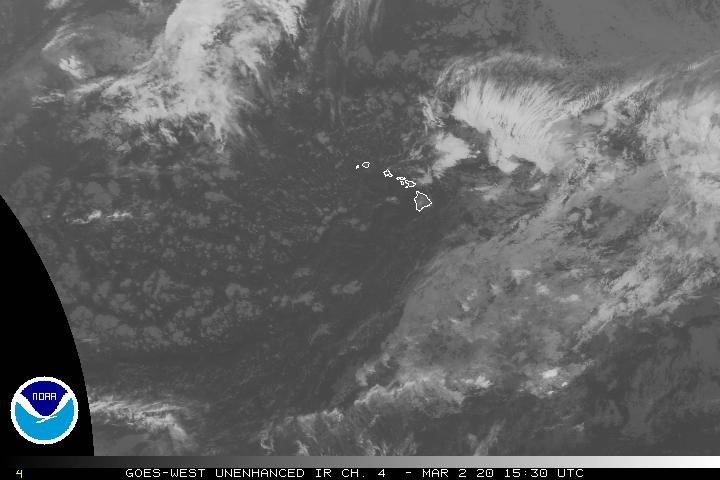
Eliza Says:
Aloha Glenn –
Wheeee! What strong breezes from the kona direction here in upper Pukalani (near the intersection of Loha and 'Iolani Sts.. Egads… my wind chimes are just going off. Fortunately, they are a tuned set. Plus the wheeled county trash bin got moved in the carport with one gust. Just another amazing weather system this winter. Never a dull moment, huh?
Thanks for the discussion above about the box jellies. So interesting that we have so few here. I remember someone on a tour boat, snorkeling off Lana'i, got zapped bad by one many years ago.
Happy day ~ Eliza~~~Hi Eliza, yes indeed, wheeee up here in Kula too. I feel so fortunate that I can be home all day and just witness this atmospheric event. My wind chimes are going off like crazy too, and I can see the cloud band coming up the southwest flank of Haleakala early this afternoon. Radar shows that the showers aren’t far away, glad you are enjoying this too! Aloha, Glenn
Jeff Says:
Aloha Glenn,
We did a story on Maui TV News about four years ago on the box jellies. When the warnings go up for Honolulu, they are usually posted here on Maui on lifeguard towers. However, when we followed one "influx" the total was about 10 jellies along Kamaole I, II and III Beach Parks. Neither John Gorman at Maui Ocean Center, nor the curator of the Waikiki Aquarium could explain why it happens. The most common surmission was currents. Maybe there are more box jellies…somewhere offshore…but most don't make to the beach.~~~Hi Jeff, thanks so much for your feedback, I’ve always found this to be a rather interesting story as well. The main thing is that we have a minimum here on Maui, although I feel sorry for those folks in Waikiki, as from my own experience…they sting! Aloha, Glenn
Skip Says:
Hi Glenn,
The Full Moon comment and the jelly fish "interesting" brings to mind a question that you may have previously addressed, and I may have missed, yet one that I've often wondered about.
HNL TV weather personalities always mention the box jelly fish invasion within 8-10 days following a full moon, especially in the Waikiki beach areas.
Does the same phenomena occur on Maui beaches and throughout the rest of the state, or is it only limited to Oahu?
Mahalo, Skip~~~Hi Skip, good question. I always hear about these jelly fish in Waikiki, as you point out, but never hear a word about them here on Maui…fortunately! Aloha, Glenn