











Air Temperatures – The following maximum temperatures were recorded across the state of Hawaii Monday:
Lihue, Kauai – 85
Honolulu airport, Oahu – 88 (record high for the date – 92 in 1987)
Kaneohe, Oahu – 83
Molokai airport – 84
Kahului airport, Maui – 86
Kona airport 86
Hilo airport, Hawaii – 84
Air Temperatures ranged between these warmest and coolest spots near sea level – and on the highest mountain tops…as of 5pm Monday evening:
Barking Sands, Kauai – 85
Hilo, Hawaii – 75
Haleakala Crater – 48 (near 10,000 feet on Maui)
Mauna Kea Summit – 37 (over 13,500 feet on the Big Island)
Here are the 24-hour precipitation totals (inches) for each of the islands as of Monday evening:
0.14 Mount Waialeale, Kauai
0.33 Manoa Lyon Arboretum, Oahu
0.00 Molokai
0.00 Lanai
0.00 Kahoolawe
0.06 Oheo Gulch, Maui
0.41 Mountain View, Big Island
Satellite and Radar Images: To view the cloud conditions we have here in Hawaii, please use the following satellite links, starting off with this Infrared Satellite Image of the islands to see all the clouds around during the day and night. This next image is one that gives close images of the islands during the daytime hours, and is referred to as a Close-up visible image. Finally, here's a Looping IR satellite image, making viewable the clouds around the islands 24 hours a day. To help you keep track of where any showers may be around the islands, here’s the latest animated radar image.
Hawaii’s Mountains – Here’s a link to the live web cam on the summit of near 13,500 foot Mauna Kea on the Big Island of Hawaii. This web cam is available during the daylight hours here in the islands…and when there’s a big moon shining down during the night at times. Plus, during the nights you will be able to see stars, and the sunrise and sunset too…depending upon weather conditions. The Haleakala Crater webcam on Maui just came back online, after being on the blink for several weeks.
Tropical Cyclone activity in the eastern and central Pacific – Here’s the latest weather information coming out of the National Hurricane Center, covering the eastern north Pacific. You can find the latest tropical cyclone information for the central north Pacific (where Hawaii is located) by clicking on this link to the Central Pacific Hurricane Center. A satellite image, which shows the entire ocean area between Hawaii and the Mexican coast…can be found here. Here's a tropical cyclone tracking map for the eastern and central Pacific.
Aloha Paragraphs

Trade wind weather pattern…generally nice
Our trade winds will remain locally breezy, then mellow out some Tuesday through Friday…picking up again into the weekend briefly. Glancing at this weather map, it shows two near 1023 millibar high pressure systems to our north and northeast. Our locally trade winds will continue in the moderately strong realms through the day. It looks like we’ll start to get into a lighter wind flow going into the middle part of this new week through most of Friday. The trade winds will increase again temporarily during the weekend, before easing off as we push into early next week…perhaps even turning south ahead of a cold front next Monday.
Trade winds continue…the following numbers represent the strongest gusts (mph), along with directions Monday evening:
29 Port Allen, Kauai – NE
27 Kahuku, Oahu – NE
25 Molokai – NE
27 Kahoolawe – SE
31 Kapalua, Maui – NNE
20 Lanai – NE
30 Upolu Point, Big Island – NE
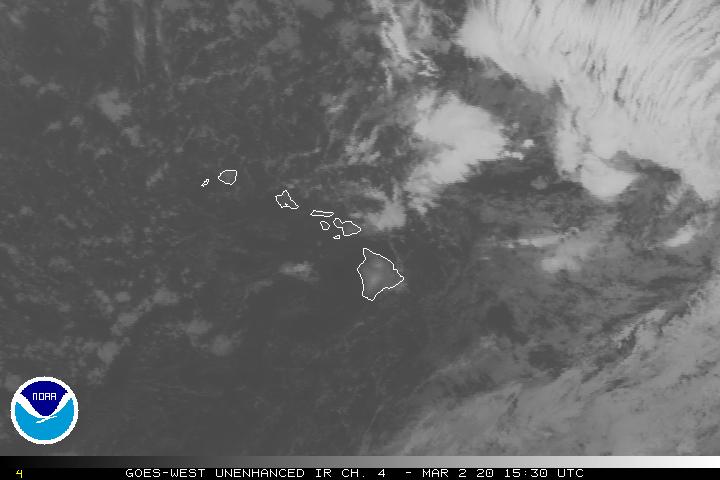
We can use the following links to see what’s going on in our area of the north central Pacific Ocean Monday night. Looking at this NOAA satellite picture we find low clouds generally offshore of the islands…although they are being carried over the islands locally. We can use this looping satellite image to see those low clouds moving along in the trade wind flow. There are lots of high level clouds located offshore, mostly just north and northwest of the state. Checking out this looping radar image we see showers over the ocean, moving along in the trade wind flow, impacting the windward sides in places…generally in the light to moderately heavy category.
Sunset Commentary: We’ve just come through a perfectly good first day of the work week, with the trade winds blowing, and a fairly typical array of windward biased showers here and there. The rather long lasting high cirrus clouds were gone for the most part, although loom again just to our northwest through north. The small craft wind advisory for those windiest coastal and channel waters around Maui County and the Big Island…are still active for the moment.
It appears that we will start to push into a lighter trade wind flow starting tomorrow. This will likely end the small craft wind advisories, with gradually lighter winds continuing through the work week. The trade winds won’t stop altogether, so that showers will be carried into our windward sides at times. Otherwise, there shouldn’t be all that much difference in our local weather conditions through Friday.
The latest forecast shows that a cold front may drop down into the state later Friday into Saturday morning. It’s interesting that the GFS model shows this clearly happening, with a second cold front approaching the state early next week. It’s still a bit early in the week, so that there may be some additional fine tuning as we move through the next several days. It's getting to be that time of the year when we would normally look for more frequent cold fronts to begin arriving…especially as we have a La Nina influence here in the Pacific. Typically, La Nina can provide somewhat more than the normal amount of precipitation during our late autumn through spring seasons.
Here in Kihei, Maui at around 530pm HST Monday evening, skies are mostly clear, with just a few very thin wisps of high cirrus clouds. I expect to see nice weather again on Tuesday, with little change expected through most of the week. The first subtle change that we'll see will be the lighter trade winds beginning tomorrow. The next more significant change will be the arrival of a cold front, and its associated showers later Friday into Saturday. This will bring slightly cooler weather in its wake Sunday, with trade winds returning briefly, with slightly cooler temperatures. Then, and this is getting pretty far out there to be for sure, although the latest computer forecast models are showing a second cold front arriving Sunday night or early next Monday. ~~~ I'm heading back up the mountain to Kula now, and will enjoy seeing that nearing full October moon tonight, which will be at its fullest extent just before midnight Tuesday night. I hope you have a great Monday night, as I'll catch up with you again early Tuesday morning! Aloha for now…Glenn.
Extra: Hall and Oates music video…Sarah
Interesting: As Earth’s climate cycles between warm and cool periods, species often must move to stay within suitable conditions. Scientists have now mapped how fast species have had to migrate in the past to keep up with changing climate. They found that small-ranged species – which constitute much of Earth’s biodiversity – are concentrated in regions where little migration has been required.
Climate change due to human activities will drastically increase the required migration rates in many of these locations, putting their unique faunas at risk. During the Last Glacial Maximum (21,000 years ago) Earth's climate was much cooler and many species were forced to occupy very different areas than they do today.
In northern Europe, for example, many of the species found today are relatively recent arrivals from their refuges in southern Europe.
A team of ecologists and computer scientists have asked how fast species around the world have had to migrate to keep up with this massive historical climate change and whether there are differences in the modern communities between places with low and high required migration rates.
Required migration rates were estimated by calculating how fast climate conditions have moved over Earth's surface at a point.
This velocity depends on both the rate of temperature change through time and on local topography. On steep topography, a short distance traveled can produce a large difference in temperature, leading to small climate-change velocities. What happens if a species cannot migrate as fast as it must to keep up with the velocity of climate change?
Its range may shrink and, in some cases, the species may go extinct. This is most likely when climate-change velocity is high relative to species' dispersal abilities.
The researchers tested this by mapping patterns of small-ranged species diversity for all terrestrial amphibians, mammals and birds. High concentrations of small-ranged species occurred where velocities were low (for example, the South American Andes), and small-ranged species rarely occurred at all where velocities were high (much of northern Europe, for example).
Weak dispersers (amphibians) were most strongly affected by velocity, while the strongest dispersers (birds) were least affected. Within the mammals, bats showed patterns more similar to birds, while non-flying mammals were more like the amphibians.
Thus, there appears to be a direct connection between the required migration velocity, a species' ability to disperse in response, and ultimately, the probability that a species will be driven to extinction by climate change. This research provides the first evidence that past regional climate shifts interact with local topography and species dispersal abilities with long-lasting important consequences for the global distribution of biodiversity.
Anthropogenic climate change is leading to increased climate-change velocities. Moreover, there are several regions in the world including the Amazon basin and much of Africa where velocities have historically been rather low but are expected to increase rapidly in the next 70 years.
These areas, by virtue of their historically low velocities, have high concentrations of small-ranged species. These species will likely be at particular risk as velocities increase over the next several decades.
 Email Glenn James:

peter mac Says:
I agree, everyone's voice matters. A problem, as I see it, is that "Free-Trade Agreements", imposed by, and for the powerful in signatory nations, generally silence those with less power. If this APEC conference has the intent or effect of silencing, and further marginalizing the, may I say it, the 99% in the pacific rim, then what should we do so everyone, and the rest of nature gets to decide what happens. Thank you for your thoughtfulness. Aloha, PeterMac~~~Peter, I can tell you have heart felt feelings about this issue, and so please allow me thank you for your thoughtful discourse about this charged issue as well. I trust the earth, I trust the universe to take care of its self, we are a small part of the bigger picture, although it certainly makes a big difference on how the earth turns out in our life times, and the kids, and their kids, such seemingly important decisions need to be made. Aloha, Glenn
peter mac Says:
Hey Glenn- Next month there will be two conferences on Oahu; the well known APEC (asia-pacific economic council) and the less well known Moana Nui conference. APEC pushes corporate interests, so-called free trade, extractive industry agendas, while Moana Nui brings to their conference issues of indigenous rights, biosphere protection, and small nation-state sustainable development and autonomy.
Moana Nui is a hui of Pacific island nations and grass roots organizations. APEC represents 7, I think, of the most powerful nations of the Pacific rim, led by corporate interests of the United States. Can you reflect on these conflicting paradigms. Aloha, PeterMac~~~Hi Peter, I appreciate your asking me to respond. My feelings are that they both have their places in the world. They both represent groups of people, and as such have the right to express themselves. I personally could probably relate to the grass roots organizations more readily, as I live on a small island here in the Pacific too, and have feelings about keeping a peaceful stature in general…despite all the action films that I see! Aloha, Glenn
Richard Says:
Howzit Glenn
Do you know what the forecast for the upcoming winter season in Hawaii is likely to be?~~~Hi Richard, we’ll have a second winter with the La Nina influence, so it could mirror last winter pretty closely…in that there is liable to be somewhat more than the average amount of precipitation here in the islands. Aloha, Glenn