May 25-26, 2010
Air Temperatures – The following maximum temperatures were recorded across the state of Hawaii Tuesday afternoon:
Lihue, Kauai – 82
Honolulu, Oahu – 84
Kaneohe, Oahu – 80
Kaunakakai, Molokai – 85
Kahului, Maui – 86
Hilo, Hawaii – 80
Kailua-kona – 84
Air Temperatures ranged between these warmest and coolest spots near sea level around the state – and on the highest mountains…at 5pm Tuesday evening:
Barking Sands, Kauai – 84F
Princeville, Kauai – 75
Haleakala Crater – 48 (near 10,000 feet on Maui)
Mauna Kea summit – 37 (near 14,000 feet on the Big Island)
Precipitation Totals – The following numbers represent the largest precipitation totals (inches) during the last 24 hours on each of the major islands, as of Tuesday afternoon:
1.95 Mount Waialaele, Kauai
2.24 Moanalua RG, Oahu
0.14 Molokai
0.00 Lanai
0.00 Kahoolawe
0.51 West Wailuaiki, Maui
0.71 Waiakea Uka , Big Island
Marine Winds – Here’s the latest (automatically updated) weather map showing a 1028 millibar high pressure system to our north-northeast…with elongated ridges of high pressure extending from its center northeast and west of our islands. The trade winds will remain locally blustery…gradually becoming lighter.
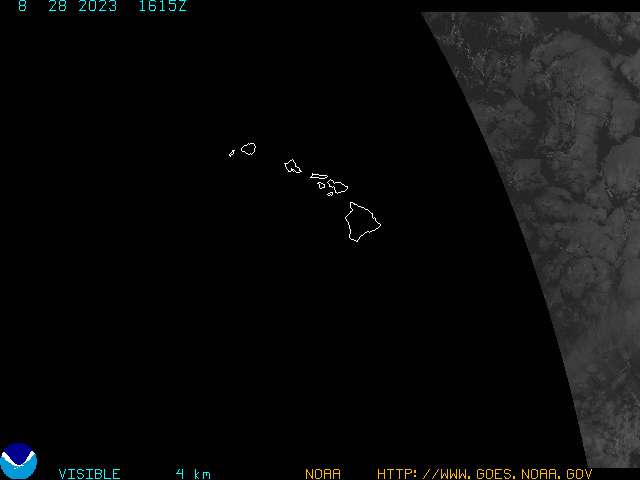
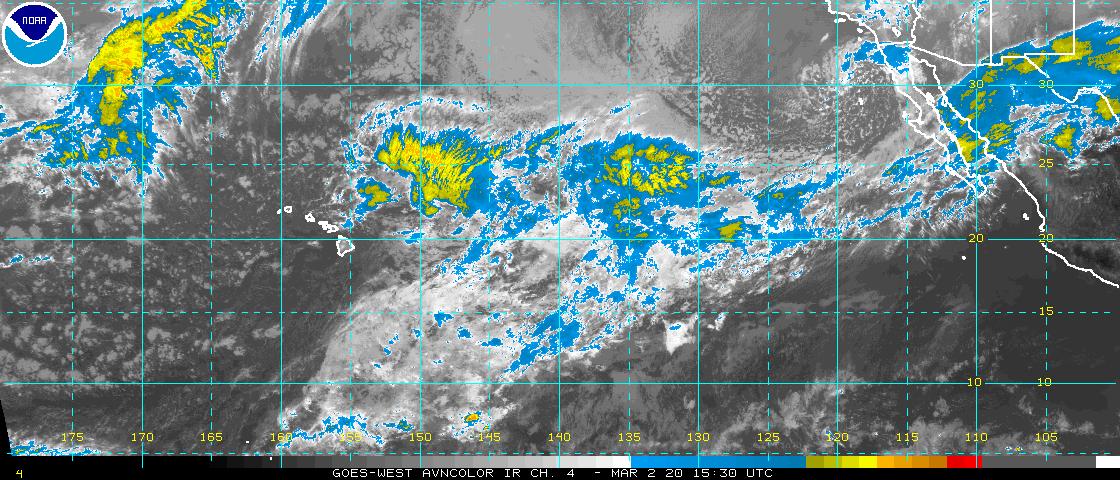
Satellite and Radar Images: To view the cloud conditions we have here in Hawaii, please use the following satellite links, starting off with this Infrared Satellite Image of the islands to see all the clouds around the state during the day and night. This next image is one that gives close images of the islands only during the daytime hours, and is referred to as a Close-up visible image. This next image shows a larger view of the Pacific…giving perspective to the wider ranging cloud patterns in the Pacific Ocean. Finally, here’s a Looping IR satellite image, making viewable the clouds around the islands 24 hours a day. To help you keep track of where any showers may be around the islands, here’s the latest animated radar image.
Hawaii’s Mountains – Here’s a link to the live webcam on the summit of near 14,000 foot Mauna Kea on the Big Island of Hawaii. The tallest peak on the island of Maui is the Haleakala Crater, which is near 10,000 feet in elevation. These two webcams are available during the daylight hours here in the islands…and when there’s a big moon rising just after sunset for an hour or two! Plus, during the nights and early mornings you will be able to see stars, and the sunrise too…depending upon weather conditions.
Tropical Cyclone activity in the eastern and central Pacific – Here’s the latest weather information coming out of the National Hurricane Center, covering the eastern north Pacific. You can find the latest tropical cyclone information for the central north Pacific (where Hawaii is located) by clicking on this link to the Central Pacific Hurricane Center. Here’s a tracking map covering both the eastern and central Pacific Ocean. A satellite image, which shows the entire ocean area between Hawaii and the Mexican coast…can be found here. Of course, as we know, our hurricane season won’t begin again until June 1st here in the central Pacific.
Aloha Paragraphs

Nice wall paper!
The moderately strong trade winds will gradually slow down in speed through mid-week, weaken further Thursday and Friday…before rebounding into the holiday weekend. Checking out this weather map, we see a weaker trade wind producing high pressure system located to the north-northeast of the islands…weighing-in at a reduced 1028 millibars Tuesday night. The small craft wind advisory flags are still active across all the major channels from Kauai down through the
Showers carried our way on the trade winds will fall along the windward sides at times, stretching over to the leeward sides locally. A trough of low pressure is near the
It’s Tuesday evening as I begin writing this last section of today’s narrative. The trade winds will remain rather strong and gusty. To get an idea how strong they are, here were the top gusts Tuesday evening on each of the islands:
Kauai – 31 mph
Oahu – 30
Molokai – 31
Lanai – 15 – blocked from the strong trade winds
Kahoolawe – 42
Maui – 39
Big Island – 35
The winds will taper off some later Wednesday, and then even more so Thursday and Friday. The computer models show the winds veering around to the southeast, which would put the smaller islands into a wind shadow behind the Big Island. As the winds become southeast, we sometimes find volcanic haze being carried from the vents on the Big Island, to the other islands. At the same time, light winds will bring muggy conditions to the state, and prompt afternoon cloud buildups over the leeward slopes…with showers falling locally. As we move into the upcoming holiday weekend, our trade winds will pick up again, bringing relief from the humid conditions, and shift the showers back over to the windward sides. ~~~ As I prepare to leave Kihei, there are mostly sunny skies over all of Maui County. The winds are blowing, although here near the south coast beaches, its not all that gusty. The windward sides are almost totally clear, with hardly any clouds at all. I would imagine there will be some clouds being carried our way, although nothing too unusual is expected. I’ll be back early Wednesday morning with your next new weather narrative. I hope you have a great Tuesday night until then! Aloha for now…Glenn.
Interesting: Seventy percent of firms with revenue of $1 billion or more say they plan to increase spending on climate change initiatives in the next two years, a global survey reported on Tuesday. Nearly half of the 300 corporate executives who responded to a survey conducted for the accounting and consulting giant Ernst & Young said their climate change investments will range from 0.5 percent to more than 5 percent of revenues by 2012.
More than four out of five respondents, or 82 percent, said they plan to invest in energy efficiency in the next 12 months, with 92 percent saying energy costs will be an important driver over that period. Corporate executives were committed to taking action even though they said complying with regulations that vary from state to state or country to country would make that a challenge.
The fact that 70 percent of executives said they planned to spend more on climate change programs was "one of the more stunning findings" of the survey, according to Melanie Steiner of Ernst & Young. Despite regulatory uncertainty on climate change, "companies are really taking action anyway, because they’re seeing that this is a business issue and an opportunity to generate new revenue," Steiner said in a telephone interview.
While action to deal with the effects of climate change used to be a matter of public relations, it has now become an opportunity to make money through new services and products, save money through enhanced efficiency and limit risk, she said.
One sign of this change is that more than 90 percent of those surveyed said climate change governance rests with top executives or board members, with 36 percent saying that the CEO is the most senior person responsible on this issue.
Interesting2: Closing fishing areas and regulating the use of fishing gear can result in more profitable catches that boost fishermen’s incomes, according to a study. The conclusion has emerged from a long-term investigation in Kenya on the effects of fishery closures on fishermen’s profits. The study, published today in Conservation Biology, used data on 27,000 fish caught in three locations off the Kenyan coast over a period of 12 years.
One location was next to a closed fishing area, one far from the closed area but with restrictions on vertically hanging fishing nets (seine nets), and one far from any fishing restrictions. Fishing close to an area with fishery closures led to larger catches of fish with a higher market value. And the ban on seine nets also increased fishermen’s income, the study found.
"Resistance to closures and to gear restrictions from fishermen and the fishing industry is based largely on the perception that these options are a threat to profits," said Tim McClanahan, a senior conservationist at the US-based Wildlife Conservation Society, which conducted the study. "These findings challenge those perceptions." "By showing that prized species and larger fish are entering fisheries indirectly through the closures, we see that closures are a direct benefit to the fishermen," he said.
Craig Leisher, senior social science adviser at The Nature Conservancy, a conservation organization also based in United States, told SciDev.Net: "It helps the fishermen when you close an area because the fish then have a chance to grow bigger, and we know that bigger fish have many more offspring."
He added that the study was unusual because it differentiated the effects of fishery closures from those of other initiatives. Leisher said that resistance to fishery closures was partly an issue of semantics. "We call them regeneration zones. Because then it’s clear what the purpose is, and it’s not just about saying ‘you can’t fish here’. In these cases you get much better local government support."
Interesting3: Manufacturers have been adding the germ fighter triclosan to soaps, hand washes, and a range of other products for years. But here’s a dirty little secret: Once it washes down the drain, that triclosan can spawn dioxins.
Dioxins come in 75 different flavors, distinguished by how many chlorine atoms dangle from each and where those atoms have attached (their locations indicated by the numbers in the front part of a dioxin’s name).
The most toxic is 2,3,7,8-tetrachlorodibenzo-p-dioxin, or TCDD. Some related kin bearing four to eight chlorines are also toxic, just less so. Triclosan’s dioxin progeny belong to this infamous family, but aren’t the ones that have typically tainted the environment. And, before you ask: No one knows how toxic triclosan’s dioxins are.
Few investigations have been conducted because chemists considered them arcane and too rare to pose a threat. Patented in 1964, triclosan quickly found use in medical supplies. By 1987, manufacturers were adding it to liquid hand soaps for the consumer market. Within a little more than a dozen years, three-quarters of all such liquid hand soaps would contain the chemical.
And as these soaps were used, triclosan washed down residential drains along with chlorinated tap water, forming super-chlorinated triclosan. In wastewater treatment plants, the bonus chlorine atom or two that tap water had added to the molecule tends to be stripped off, notes William Arnold, an environmental engineer at the University of Minnesota in Minneapolis.
But in the finishing stage at those treatment plants, most water gets one last chlorine-disinfection step, which "will re-chlorinate the triclosan," he says, before the water is released out into rivers. Arnold’s group and others have demonstrated in the lab that that in the presence of sunlight, the super-chlorinated triclosan can undergo transformations that beget a series of dioxins.
They include 2,8-dichlorodibenzo-p-dioxin, 2,3,7- and 1,2,8-trichlorodibenzo-p-dioxin, and 1,2,3,8-tetrachlorodibenzo-p-dioxin. The genesis of these compounds isn’t just some laboratory curiosity. Triclosan’s odd dioxins also develop in the environment – big time, Arnold’s group reported May 18 online, ahead of print, in Environmental Science & Technology.
Interesting4: New reports are surfacing every day about the immediate impacts of the Deepwater Horizon oil spill on Gulf Coast wildlife, especially as the oil reaches the sensitive marshlands along the coast. But how will these communities be affected over time? Scientists currently know very little about how long it takes for the hydrocarbons and heavy metals in crude oil to work their way through marine food webs.
To address this issue, Academy scientist Peter Roopnarine is working with Laurie Anderson from Louisiana State University and David Goodwin from Denison University to collect and analyze three different types of mollusks from the Gulf Coast.
These animals are continually building their shells, and if contaminants are present in their environment, they can incorporate those compounds into their shells. Roopnarine and his colleagues will study growth rings in the shells — much like scientists would study tree rings — to determine how quickly harmful compounds from the oil become incorporated into the animals’ homemade armor.
They will also sample tissues from the animals over the next four months to test for hydrocarbons, and will measure changes in growth rate and survivorship. In addition to its value in informing conservation and policy decisions, this research will have direct implications for the region’s commercial oyster fisheries.
"We know that mollusks can capture this kind of information in their shells because of our ongoing work in San Francisco Bay," says Roopnarine, Curator of Geology at the California Academy of Sciences.
"We have been analyzing shellfish from across the Bay over the past three years, and we have documented that the animals from the more polluted areas, like the waters around Candlestick Park, have incorporated vanadium and nickel into their shells — two metals that are common in crude oil.
It appears that the metals can be substituted for calcium as the animals build their calcium-carbonate shells." By studying oysters, tellinid clams, and periwinkles in the Gulf, the scientists will be able to monitor three different pathways for hydrocarbons into the food web, since oysters are stationary filter feeders that eat mostly plankton, tellinid clams are stationary bottom feeders that eat mostly detritus, and periwinkles are mobile grazers that eat mostly algae.
If the team’s results show that all of these animals are incorporating hydrocarbons into their shells at the same rate, this would indicate that they are likely pulling these compounds directly from the water column. However, if there is a difference in how quickly hydrocarbons show up in their shells, it would suggest that the animals are acquiring the contaminants at different rates through their food sources.
The scientists collected their first set of specimens in early May from the vicinities of Grand Isle, Louisiana and Dauphin Island, Alabama, before the oil had reached those regions. These specimens will provide pre-spill baseline data for the study. Over the course of the summer, they will collect additional specimens from both sites to monitor the change in hydrocarbon levels as the oil spreads and begins to work its way through the food chain.
As primary consumers in the food chain, oysters, clams, and periwinkles will likely be among the first animals to begin accumulating hydrocarbons and heavy metals, but they will not be the last. In much the same way that mercury becomes concentrated in large, predatory fish, the harmful compounds released during an oil spill may get passed on to the marine organisms that feed on shellfish.
While hydrocarbons are organic compounds that will eventually break down over time, the staying power and long-term impacts of heavy metals like vanadium and nickel in the food web are unknown. Additionally, many hydrocarbons are known to be carcinogenic, and they could cause any number of physiological problems for animals that ingest them in high quantities.
While much remains unknown, Roopnarine’s research provides a framework to answer some of these questions, by monitoring and predicting community response over both short and long time horizons.
 Email Glenn James: