











May 22-23, 2010
Air Temperatures – The following maximum temperatures were recorded across the state of Hawaii Saturday afternoon:
Lihue, Kauai – 84
Honolulu, Oahu – 86
Kaneohe, Oahu – 82
Kaunakakai, Molokai – 86
Kahului, Maui – 88
Hilo, Hawaii – 83
Kailua-kona – 84
Air Temperatures ranged between these warmest and coolest spots near sea level around the state – and on the highest mountains…at 5pm Saturday evening:
Port Allen, Kauai – 84F
Hilo, Hawaii – 72
Haleakala Crater – 46 (near 10,000 feet on Maui)
Mauna Kea summit – 30 (near 14,000 feet on the Big Island)
Precipitation Totals – The following numbers represent the largest precipitation totals (inches) during the last 24 hours on each of the major islands, as of Saturday afternoon:
0.31 Mount Waialaele, Kauai
0.08 Oahu Forest NWR, Oahu
0.01 Molokai
0.00 Lanai
0.00 Kahoolawe
0.68 West Wailuaiki, Maui
1.65 Kawainui Stream, Big Island
Marine Winds – Here’s the latest (automatically updated) weather map showing a rather strong 1035 millibar high pressure system to our northeast…with elongated ridges of high pressure extending from its center southeast and southwest of our islands. The trade winds will remain locally blustery through Monday.
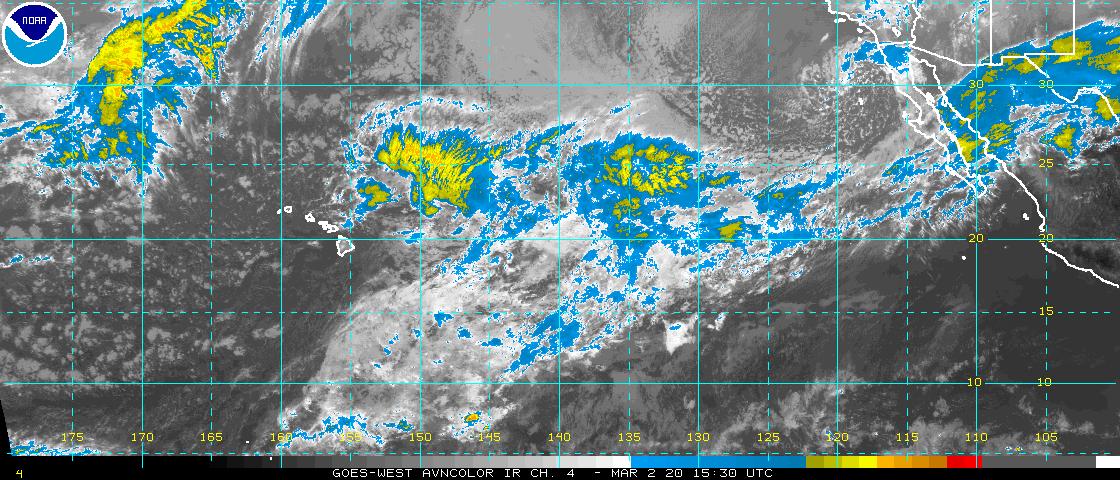
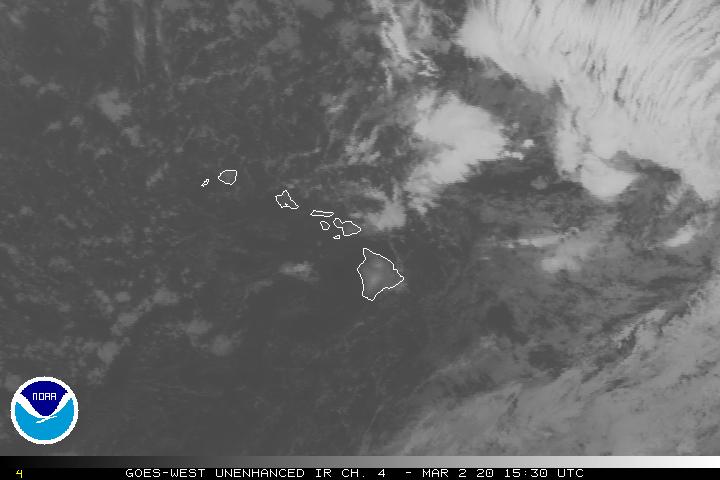
Satellite and Radar Images: To view the cloud conditions we have here in Hawaii, please use the following satellite links, starting off with this Infrared Satellite Image of the islands to see all the clouds around the state during the day and night. This next image is one that gives close images of the islands only during the daytime hours, and is referred to as a Close-up visible image. This next image shows a larger view of the Pacific…giving perspective to the wider ranging cloud patterns in the Pacific Ocean. Finally, here’s a Looping IR satellite image, making viewable the clouds around the islands 24 hours a day. To help you keep track of where any showers may be around the islands, here’s the latest animated radar image.
Hawaii’s Mountains – Here’s a link to the live webcam on the summit of near 14,000 foot Mauna Kea on the Big Island of Hawaii. The tallest peak on the island of Maui is the Haleakala Crater, which is near 10,000 feet in elevation. These two webcams are available during the daylight hours here in the islands…and when there’s a big moon rising just after sunset for an hour or two! Plus, during the nights and early mornings you will be able to see stars, and the sunrise too…depending upon weather conditions.
Tropical Cyclone activity in the eastern and central Pacific – Here’s the latest weather information coming out of the National Hurricane Center, covering the eastern north Pacific. You can find the latest tropical cyclone information for the central north Pacific (where Hawaii is located) by clicking on this link to the Central Pacific Hurricane Center. Here’s a tracking map covering both the eastern and central Pacific Ocean. A satellite image, which shows the entire ocean area between Hawaii and the Mexican coast…can be found here. Of course, as we know, our hurricane season won’t begin again until June 1st here in the central Pacific.
Aloha Paragraphs

Gusty trade winds this weekend
Gusty trade winds will remain active through the weekend…into the new week ahead. Checking out this weather map, we see a strong trade wind producing high pressure system located to the northeast of the islands…weighing-in at 1035 millibars Saturday night. The small craft wind advisory flags are still active across all the major channels from Kauai down through the
The windward sides will benefit from off and on passing showers…into the new week. The computer forecast models continue to show a trough of low pressure edging closer to the islands Sunday into Monday…remaining around for several days thereafter. This trough will destabilize our atmosphere to some degree, making the incoming clouds more shower prone along our windward sides. As the trade winds are so strong now, we could see a few showers flying over into the leeward sides on the smaller islands too. In addition, as the cold air associated with the trough of low pressure gets more directly overhead, the leeward slopes on Maui and the
It’s Saturday evening as I begin writing this last section of today’s narrative.
The trade winds will remain blustery this weekend. To get an idea how strong they are, here were the top gusts early Saturday evening on each of the islands:
Kauai – 35 mph
Oahu – 39
Molokai – 37
Lanai – 00 – blocked from the strong trade winds
Kahoolawe – 44
Maui – 48
Big Island – 40
Our local winds became strong and gusty Saturday, actually didn’t become, but remained that way since Friday. Despite all the wind, our weather will remain generally ok, with just those off and on passing showers along our windward sides at times. Later Sunday into Monday or Tuesday, we may find an increase in showers, which may be augmented further by around Wednesday into Thursday.
~~~ Friday evening after work I went to see the new film called Robin Hood film (2010), starring Russell Crowe and Cate Blanchett…among others. I got there plenty early, although even then, the show that I wanted to see was sold out! I quickly adjusted my plan, and bought a ticket for the film Oceans (2010), by Walt Disney. A synopsis: Featuring spectacular never-before-seen imagery, this documentary chronicles the creatures and mysteries that lie beneath the sea…narrated by Pierce Brosnan
. The critics are giving this film a solid B, while the viewers are giving it a slightly better B+ grade. I have to agree with the B+ rating, as I really enjoyed seeing our lovely planet Earth, and the ocean in particular…portrayed in such a beautiful way! I was stimulated and moved by the photography, and the overall high quality of this film. I could recommend it to anyone, as who doesn’t love the ocean, and all the amazing creatures that live below the surface. Just in case you’re interested, here’s a trailer for the film.
~~~ Saturday was a good day, with lots of very warm sunshine beaming down. The high temperature in Kahului, Maui hit 88F degrees. This was a long ways from topping the record high temperature for the date however, which was a hot 94 degrees back in 1953. Nonetheless, it was a warm one, with even up here in Kula reaching almost 75 degrees, and was still 72.7 at 615pm. It was a windy day, with our local winds almost reaching 50 mph at one of our windiest places, which happens to be here on Maui. Here in Kula, it’s even rather breezy too, with my wind chimes sounding off rather loudly at times. I went down to Paia to the beach early this afternoon, and took a nice swim. I swam out towards this rock jetty, and enjoyed being in the frothy water where small waves were breaking. I like to think during those times that waves are generated by winds out to sea, and when they break, they release lots of energy…which is energizing. I’ll be back Sunday morning with your next new weather narrative, I hope you have a great Saturday night until then! Aloha for now…Glenn.
Extra: Gorilla reunion with an old friend…heart warming
Interesting: No one is lowering their guard just yet, but the chances are diminishing that significant amounts of oil from the ongoing Deepwater Horizon spill will soon make it to southern Florida. In part, it is the behavior of the Gulf of Mexico’s increasingly infamous Loop Current that could lower the threat. "The oil is in the Loop Current," says physical oceanographer Robert Weisberg of the University of South Florida (USF) in St. Petersburg, but that does not mean Florida is doomed.
The Loop Current flows north past the Yucatán Peninsula into the gulf, reverses and heads south out of the gulf, and exits eastward into the Atlantic Ocean through the Florida Strait at the tip of Florida. As some of the spilled oil drifted in recent days southeastward into a northward-extended loop, the specter of oil spreading along the Florida Keys, hard past Miami, and up the East Coast raised alarm.
But Weisberg’s forecast model of eastern gulf currents as well as other forecast models he runs at USF are showing the oil entraining in what looks increasingly like an eddy. The Loop Current sometimes extends so far northward that it forms a closed loop that pinches off from the main current and becomes an independent, clockwise-rotating eddy out in the middle of the gulf.
"That’s the best thing that could possibly happen," says Weisberg. "It would stay in the eddy. It would be a sort of a valve to drain some of the oil away without it going to Miami." Failing a cooperative Loop Current, the amount of oil being entrained in it is looking to be small. In a teleconference with reporters today, Jane Lubchenco, administrator of the National Oceanic and Atmospheric Administration (NOAA), noted that there "is only a very small amount in the Loop Current."
She described it as a sheen—NOAA’s smallest characterization—with possible subsurface tar balls. "By the time [the oil] makes it to the Florida Strait, it likely will have transformed into tar balls and streamers, and that may not make it to the beach." NOAA scientists will know more about the Loop Current’s future behavior after a P-3 "Hurricane Hunter" aircraft flies over it tomorrow and drops instrumented probes of the subsurface.
Interesting2: Norwegian oil and gas producer Statoil said on Friday it had evacuated the Gullfaks C platform in the North Sea after changes in well pressure led to a fault on one of two valves designed to prevent a blowout. Environmental group Bellona said the situation was "very critical" and highlighted continued risks of offshore oil and gas exploration in the wake of BP’s well blowout and environmental disaster in the Gulf of Mexico.
"There are no leaks and no injuries," Statoil spokesman Gisle Johanson said. "The situation on the platform is stable and we are planning for further operations to normalize the situation." Johanson said the evacuation of about 90 people was caused by an "unstable pressure situation" in a Gullfaks well, which he said meant "too much or too little" pressure.
"They have a situation in which there is uncontrolled pressure from the well, one of the barriers is gone and one barrier is left," said Frederic Hauge, head of Bellona, one of the leading environmentalist groups in Norway. "Uncontrolled pressure is very serious and has the capability of being a large accident," he said, adding that in the first quarter of 2010, eight incidents took place in the Norwegian oil industry that had "large scale potential."
"That is very serious," Hauge said. "Regulatory work in Norway may look nice from outside, but we have a lot of security issues in the Norwegian industry," he said. Gullfaks is an oil and gas-producing field in the Tampen area of the Norwegian section of the North Sea. It produces 78,000 barrels of oil per day and 420 million standard cubic meters of gas per year. Gullfaks C is one of three platforms at the site, which handle oil and gas from the Gimle, Tordis, Vigdis, Visund, Gullfaks and Gullfaks Soer fields. The sea depth at the site is 130 to 220 meters, with the reservoirs 1,700 to 2,000 meters below the sea level.
Interesting3: SINTEF oil-spill researchers are helping the American authorities to estimate what happens to the oil that is leaking out into the Gulf of Mexico. "The results of our calculations are helping the authorities to select measures to limit the overall environmental damage caused by the spill," says research manager Mark Reed of SINTEF Materials and Chemistry.
"Soap" in the deep The American authorities have decided to employ dispersants on the oil-slicks in the Gulf of Mexico. These soap-like chemicals break the oil down into tiny droplets that then become mixed into the water column, before the oil reaches the shore.
Most of the soap-like chemicals are released from aircraft flying over the oil-slicks on the surface. However, the blow-out in the Gulf of Mexico is the first in which the cleanup teams are also injecting dispersant directly into the flow of oil and gas leaking out at the seabed. This is why the Americans contacted SINTEF.
"The US environmental authorities are demanding evidence that spraying at the seabed is not producing undesirably high concentrations of oil in the water column, as far as fish and other marine organisms are concerned. Our calculations show that the concentrations in the water column will not be significantly higher than they would have been without injection of dispersant at the wellhead," says Reed.
Highly diluted "What we see, in fact, is that the oil in the water column becomes highly diluted, because the volumes and depths involved are so great in this part of the ocean. The concentration of oil in the water column will be only slightly higher than it would have been in any case as a result of nature’s own ability to break the oil-slicks down into droplets. Since the difference is so small, we do not believe that the use of dispersants in the water column in the Gulf has made matters worse for fish and other marine organisms," says Reed.
Less oil on the beaches According to the SINTEF scientist, it is more likely instead that the injection of dispersants at seabed level in this case has actually reduced the overall environmental impact of the spill. "Our calculations show that the dispersants added at seabed level have prevented large amounts of oil from reaching the shore in the form of oil-slicks, with all that these would mean for birds, for example. The picture that we have arrived at via our calculations also matches observations of what has happened so far on the shores of the United States," says Reed.
"What effects could such large quantities of dispersants deployed from aircraft have on the concentration of oil in the water column?" "That question lies outside our remit, so we have not simulated their effects. The dispersants have probably increased the concentration of oil in the upper layers of the water column. Whether it will remain high will depend on the weather conditions. Strong winds will tend to dilute the concentration in the upper layers."
Toxicity debate "People are also claiming that dispersants are toxic. Are we at risk of solving one environmental problem by creating another?" "It is true that on precautionary grounds we are wary of the widespread use of dispersant during periods when fish are spawning.
But it is important to remember that modern dispersants are less toxic than oil. When the environmental effects of such measures are being evaluated, we cannot compare them with a situation in which an oil-spill has not occurred. As long as the oil continues to gush out of the well, we need to adopt the strategy that causes the least damage to the environment."
Numerical model that looks into the water column SINTEF was awarded its Gulf of Mexico contract by the National Oceanic and Atmospheric Administration (NOAA), which is an arm of the US Department of Commerce. This is far from being the first time that the Trondheim scientists have been approached from afar to predict where oil-slicks are likely to end up.
Mark Reed explains that SINTEF has developed a computer model that includes most aspects of how oil behaves in the wake of a spill. "As far as we are aware, our simulation model is the best one available for calculating oil concentrations in the water column after a spill, which is why we were awarded the contract. Traditional models are only capable of predicting how oil-slicks will move on the surface," he says.
Interesting4: How much "green exercise" produces the greatest improvement in mood and sense of personal well-being? A new study in the American Chemical Society’s semi-monthly journal Environmental Science & Technology has a surprising answer. The answer is likely to please people in a society with much to do but little time to do it: Just five minutes of exercise in a park, working in a backyard garden, on a nature trail, or other green space will benefit mental health.
Jules Pretty and Jo Barton explain in the study that green exercise is physical activity in the presence of nature. Abundant scientific evidence shows that activity in natural areas decreases the risk of mental illness and improves the sense of well-being. Until now, however, nobody knew how much time people had to spend in green spaces to get those and other benefits.
"For the first time in the scientific literature, we have been able to show dose-response relationships for the positive effects of nature on human mental health," Pretty said. From an analysis of 1,252 people (of different ages, genders and mental health status) drawn from ten existing studies in the United Kingdom, the authors were able to show that activity in the presence of nature led to mental and physical health improvements.
They analyzed activities such as walking, gardening, cycling, fishing, boating, horse-riding and farming. The greatest health changes occurred in the young and the mentally-ill, although people of all ages and social groups benefited. All natural environments were beneficial including parks in urban settings. Green areas with water added something extra. A blue and green environment seems even better for health, Pretty noted.
From a health policy perspective, the largest positive effect on self-esteem came from a five-minute dose. "We know from the literature that short-term mental health improvements are protective of long-term health benefits," Pretty said. "So we believe that there would be a large potential benefit to individuals, society and to the costs of the health service if all groups of people were to self-medicate more with green exercise," added Barton.
A challenge for policy makers is that policy recommendations on physical activity are easily stated but rarely adopted widely as public policy, Pretty noted, adding that the economic benefits could be substantial. Policy frameworks that suggest active living point to the need for changes to physical, social and natural environments, and are more likely to be effective if physical activity becomes an inevitable part of life rather than a matter of daily choice .
 Email Glenn James: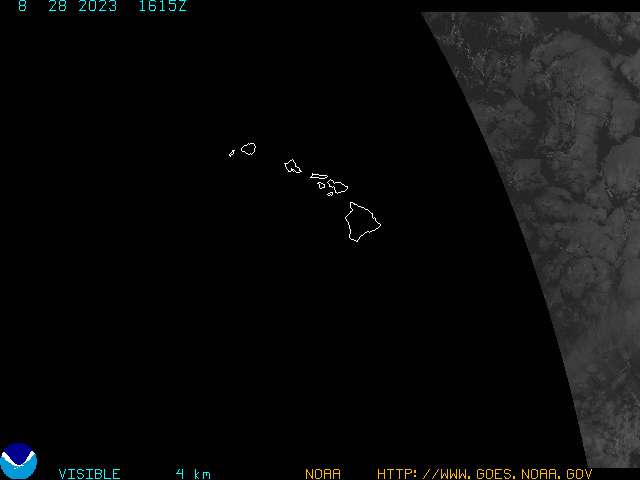


Glenn Says:
Great link about the gorilla reunion! Loved it. Very touching.
Thanks
Glenn in South Jersey~~~Hi Glenn, yes, that was touching, I greatly appreciate our close relationships with the animal world. You would likely enjoy the film I saw last night, called Oceans. Thanks for letting us know of your enjoyment of the gorilla piece. Aloha, Glenn