May 7-8, 2010
Air Temperatures – The following maximum temperatures were recorded across the state of Hawaii Friday afternoon:
Lihue, Kauai – 81
Honolulu, Oahu – 84
Kaneohe, Oahu – 80
Kaunakakai, Molokai – 82
Kahului, Maui – 83
Hilo, Hawaii – 81
Kailua-kona – 82
Air Temperatures ranged between these warmest and coolest spots near sea level around the state – and on the highest mountains…at 5pm Friday evening:
Barking Sands, Kauai – 82F
Kapalua, Maui – 75
Haleakala Crater – 59 (near 10,000 feet on Maui)
Mauna Kea summit – 48 (near 14,000 feet on the Big Island)
Precipitation Totals – The following numbers represent the largest precipitation totals (inches) during the last 24 hours on each of the major islands, as of Friday afternoon:
0.74 Kilohana, Kauai
0.25 Nuuanu Upper, Oahu
0.03 Molokai
0.00 Lanai
0.00 Kahoolawe
0.39 Puu Kukui, Maui
0.12 Mountain View, Big Island
Marine Winds – Here’s the latest (automatically updated) weather map showing high pressure systems far to the north through north-northeast of the islands. The trade winds will remain active Saturday, locally strong and gusty...gradually becoming lighter and shifting to the ESE or even SE later Sunday.
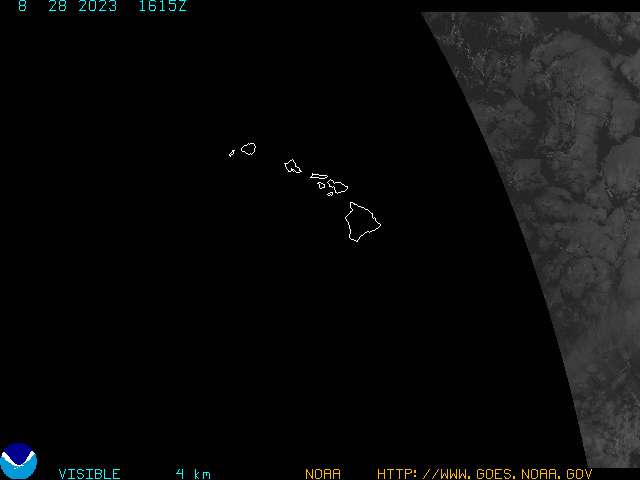
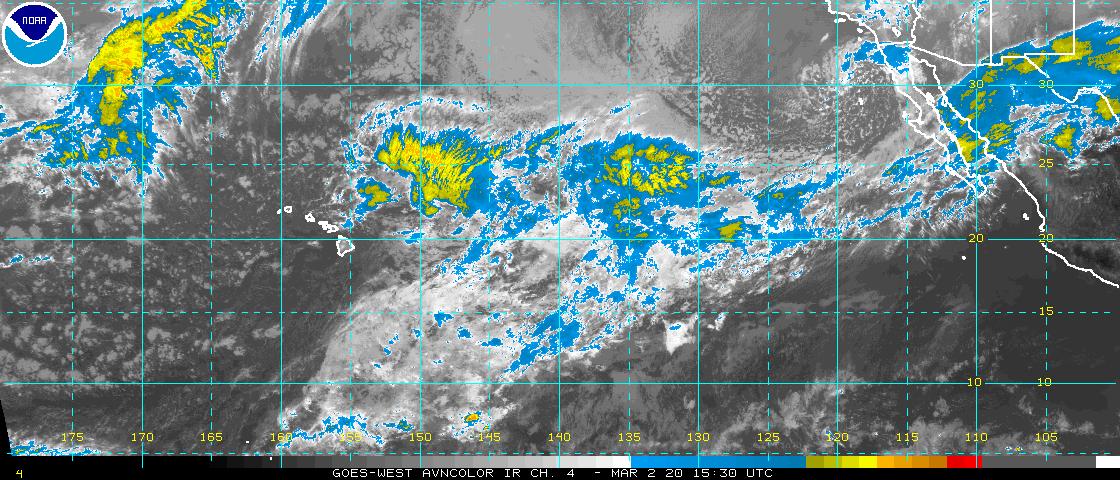
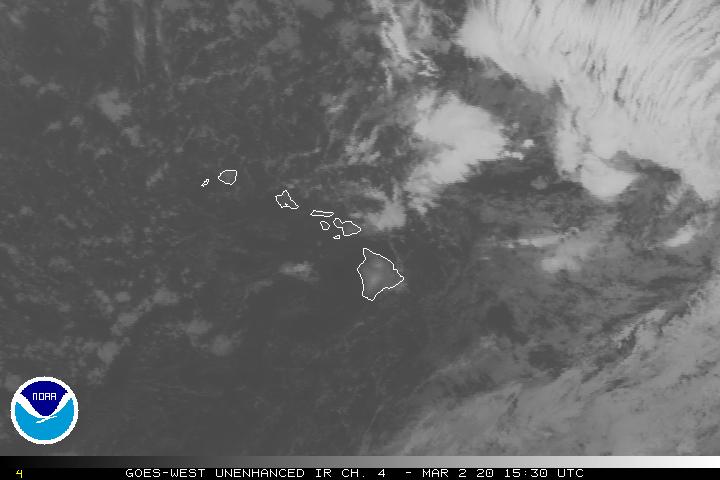
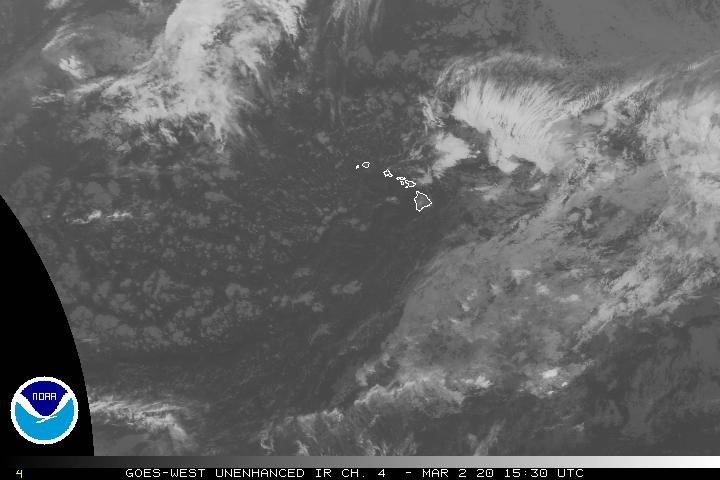
Satellite and Radar Images: To view the cloud conditions we have here in Hawaii, please use the following satellite links, starting off with this Infrared Satellite Image of the islands to see all the clouds around the state during the day and night. This next image is one that gives close images of the islands only during the daytime hours, and is referred to as a Close-up visible image. This next image shows a larger view of the Pacific…giving perspective to the wider ranging cloud patterns in the Pacific Ocean. Finally, here’s a Looping IR satellite image, making viewable the clouds around the islands 24 hours a day. To help you keep track of where any showers may be around the islands, here’s the latest animated radar image.
Hawaii’s Mountains – Here’s a link to the live webcam on the summit of near 14,000 foot Mauna Kea on the Big Island of Hawaii. The tallest peak on the island of Maui is the Haleakala Crater, which is near 10,000 feet in elevation. These two webcams are available during the daylight hours here in the islands…and when there’s a big moon rising just after sunset for an hour or two! Plus, during the nights and early mornings you will be able to see stars, and the sunrise too…depending upon weather conditions.
Tropical Cyclone activity in the eastern and central Pacific – Here’s the latest weather information coming out of the National Hurricane Center, covering the eastern north Pacific. You can find the latest tropical cyclone information for the central north Pacific (where Hawaii is located) by clicking on this link to the Central Pacific Hurricane Center. Here’s a tracking map covering both the eastern and central Pacific Ocean. A satellite image, which shows the entire ocean area between Hawaii and the Mexican coast…can be found here. Of course, as we know, our hurricane season won’t begin again until June 1st here in the central Pacific.
Aloha Paragraphs
Barking Sands…Kauai
The trade winds will remain active Saturday, and then begin to ease up in strength later Sunday into Monday or Tuesday. Once again today, as was the case Thursday, winds were gusting up over 30 mph on Kauai, Oahu, Molokai, Maui and the
These low pressure systems won’t be getting anywhere near to us, although an associated cold front will swing down in our general direction. This area of low pressure will help to push our high pressure systems eastward. This in turn will cause an easing up of our trade winds, and may veer them around to the southeast near
As the trade winds are still rather blustery, we’re seeing quite a few clouds, some with showers, being carried our way. These showers will predominately fall along the windward sides, although a few could stretch across the islands into the leeward sides. This looping radar image shows showers generally taking aim on the islands from Oahu down through the
Opening up our view a bit, using this larger satellite picture, we see some good thunderstorms far to our south, with a couple of brighter whiter patches of high clouds to our north and northwest. As noted above, our trade winds will be faltering some later this weekend into the first day or two of the new week. This may bring a light wind convective weather pattern into play, especially on the
It’s Friday evening as I begin writing this last section of today’s narrative. As noted above, the trade winds will remain blustery through the first half of the weekend, with the small craft wind advisory flags still up over those windiest coastal and channel waters around Maui and the Big Island. As the winds turn lighter later this weekend, we should see this advisory being dropped. The other thing is that we’re receiving a few more showers now too, particularly along the windward coasts and slopes. This looping radar image shows the nature of these incoming showery clouds. As the winds drop down, the days will begin to feel a bit muggy by Sunday and Monday, especially if they come down as much as expected. The Big Island end of the island chain has the best chance of remaining in a trade wind flow, while the Kauai side may very well see southeast winds, with a bit of vog too. This hybrid weather pattern will have some characteristics of both the trade winds and a light winded convective weather pattern. The trade winds will take over full duty as we get towards Tuesday, and then through the rest of the week.
~~~ Since it’s Friday, I’ve decided to go see a new film, this one called Kick-Ass (2010), starring Aaron Johnson, Nicholas Cage, and Christopher Mintz-Plasse among others. A short synopsis: an average comic book-obsessed teenager, with absolutely no super powers, decides to suit up and fight crime as a super hero. I know its hard to believe, but the critics and users both are giving this film good grades: B and A-. If this sparks your interest, here’s a trailer to check it out. I’ll be sure to let you know what I think when I get back online again Saturday morning. I hope you have a great Friday night until then! Aloha for now…Glenn.
Interesting: A new study led by the University of Adelaide’s Environment Institute in Australia has ranked most of the world’s countries for their environmental impact. The research uses seven indicators of environmental degradation to form two rankings — a proportional environmental impact index, where impact is measured against total resource availability, and an absolute environmental impact index measuring total environmental degradation at a global scale.
Led by the Environment Institute’s Director of Ecological Modeling Professor Corey Bradshaw, the study has been published in the on-line, peer-reviewed science journal PLoS ONE. The world’s 10 worst environmental performers according to the proportional environmental impact index (relative to resource availability) are: Singapore, Korea, Qatar, Kuwait, Japan, Thailand, Bahrain, Malaysia, Philippines and Netherlands.
In absolute global terms, the 10 countries with the worst environmental impact are (in order, worst first): Brazil, USA, China, Indonesia, Japan, Mexico, India, Russia, Australia and Peru. The indicators used were natural forest loss, habitat conversion, fisheries and other marine captures, fertilizer use, water pollution, carbon emissions from land use and species threat. "The environmental crises currently gripping the planet are the corollary of excessive human consumption of natural resources," said Professor Bradshaw.
"There is considerable and mounting evidence that elevated degradation and loss of habitats and species are compromising ecosystems that sustain the quality of life for billions of people worldwide." Professor Bradshaw said these indices were robust and comprehensive and, unlike existing rankings, deliberately avoided including human health and economic data – measuring environmental impact only.
The study, in collaboration with the National University of Singapore and Princeton University, found that the total wealth of a country (measured by gross national income) was the most important driver of environmental impact. "We correlated rankings against three socio-economic variables (human population size, gross national income and governance quality) and found that total wealth was the most important explanatory variable – the richer a country, the greater its average environmental impact," Professor Bradshaw said.
There was no evidence to support the popular idea that environmental degradation plateaus or declines past a certain threshold of per capital wealth (known as the Kuznets curve hypothesis). "There is a theory that as wealth increases, nations have more access to clean technology and become more environmentally aware so that the environmental impact starts to decline. This wasn’t supported," he said.
Interesting2: Every day since January 1, 1896, an observer has hiked to a spot at The Mohonk Preserve, a resort and nature area some 90 miles north of New York City, to record daily temperature and other conditions there. It is the rarest of the rare: a weather station that has never missed a day of temperature recording; never been moved; never seen its surroundings change; and never been tended by anyone but a short, continuous line of family and friends, using the same methods, for 114 years.
On top of that, observers have for decades recorded related phenomena such as first appearances of spring peepers, migratory birds and blooming plants. At a time when scientists are wrestling to ensure that temperature readings from thousands of divergent weather stations can be accurately compared with one another to form a large-scale picture, Mohonk offers a powerful confirmation of warming climate, as well as a compelling multigenerational yarn.
The story is told in an article by researchers from Columbia University’s Lamont-Doherty Earth Observatory and Mohonk in the current issue of the Journal of Applied Meteorology and Climatology. Mohonk was founded in 1869 by the Smileys, a close-knit Quaker family that still runs the 7,200-acre property on a high ridge in the Shawangunk Mountains.
When the fledgling United States Weather Bureau (later the National Weather Service) founded an official station there, it supplied thermometers, log sheets and other materials; Albert K. Smiley, one of the twin brothers who founded the place, volunteered to man it. The thermometer (occasionally replaced by a new duplicate over the decades) has always been kept in a box out of direct sun, in the same place, a short walk from the Mohonk hotel; a brass rain gauge at the end of a boat dock is the 1896 original. In 1906, Albert’s half-brother, Daniel, took over the readings.
In 1930, Daniel’s sons Bert and Doc followed. In 1937, Bert’s son Daniel Smiley Jr., picked up the job. In addition, Daniel Jr., an old-school amateur naturalist, started recording many other observations, including first spring sightings of various creatures, on some 15,000 index cards. In 1988, the year before Daniel Jr. passed away, he handed his duties to Paul Huth, a longtime friend and employee.
Today Huth or one of his staff still walks up to the box at 4 pm every day. The weather log, for many decades kept on hand-written sheets, lacks only 37 days of precipitation data from 1901, 1908 and 1909, due to a missing data sheet, and a few days when observers apparently didn’t look at the rain gauge.
The temperature record is complete. Enter another father-son team. In 1971, Edward R. Cook, then serving as a military policeman at nearby West Point, became friends with Daniel Smiley Jr. Later, Cook became a tree-ring scientist and climatologist at Lamont, and began studying conifer trees at Mohonk–some of which turned out to be over 400 years old. From these, he extracted a rough record of weather in the Hudson Valley before Europeans settled.
Then Edward Cook’s son, Benjamin I. Cook, became a climate modeler at Lamont. It was under Benjamin’s leadership that the Cooks and their colleagues at Mohonk began studying the instrumental readings and other data. Starting in 1990s, Mohonk staffers spent hundreds of hours digitizing the records so they could be analyzed. "It is incredibly rare to have the level of continuity that we have at Mohonk," said Benjamin Cook.
"Any one record cannot tell you anything definitively about climate globally or even regionally. But looking closely at sites like this can boost our confidence in the general trends that we see elsewhere, and in other records." Indeed, the new study finds remarkable correlations with many other widely spread, but less continuous records. At Mohonk, average annual temperatures from 1896-2006 went up 2.63 degrees Fahrenheit.
Global measurements in the same time over both land and oceans put the rise at about 1.2 to 1.4 degrees; but land temperatures are rising faster than those over the oceans, and those at Mohonk track the expected land trend closely. As expected also, temperatures are up in all seasons, but increases have been especially evident in summer heat waves, and this has been accelerating in recent years.
Prior to 1980, it was rare for the thermometer to surpass about 89 degrees more than 10 days a year; since then, such events have come to Mohonk on at least 10 days a year — and often, on more than 20 days. At the same time, the number of freezing days has been decreasing–about a day less every five years over the long term, but since the 1970s, at the accelerated rate of a day every two years.
This also matches wide-scale observations in North America and elsewhere. The Mohonk records do not match wider trends in one area. The start of the growing season — the date on which freezing temperatures end — has been advancing steadily in many places, but not here. Instead, the total number of yearly above-freezing days is increasing because more unusually warm days are puncturing the winter.
As described in an earlier study in the International Journal of Climatology, also by the Cooks and Mohonk staff, the effect has been a sort of an intermittent false spring that may expose some early-flowering plants to frost damage. The earliest flowering native plants like hepatica, bloodroot and red-berried elder are likely to be most affected, said Benjamin Cook. He said it is still too early to tell the ecological effects of such disruptions, but added: "The data from Mohonk will be invaluable for expanding our knowledge of how ecosystems respond to climate change."
Temperature data after 2006 has not yet been analyzed, but Mohonk maintains an up-to-date online archive of the weather data accessible to the public. The new study comes at a time when some skeptics have questioned the accuracy of long-term weather records, on the basis that many stations have been moved or that surroundings have changed, occasionally putting instruments nearer to buildings, parking lots or other possible heat sources that could skew readings upward.
However, recent studies including one by scientists at the National Oceanic and Atmospheric Administration have found that such year-to-year inconsistencies cut both ways, and that instruments near developed spots actually more often read too cool rather than too hot. Researchers say every effort has been made to adjust for errors, and that errors one way or the other at individual stations basically cancel each other out, leaving the averages correct.
"Pictures, anecdotes, and cursory glances of poorly sited or maintained sites and weather stations may suggest problems, but until the data is analyzed it is impossible to conclude that the record is compromised by cold or warm biases," said Cook. "The advantage to Mohonk is that we can revisit the record in detail, with minimal corrections. This helps confirm the large-scale trends, and it helps us identify stations with errors that need to be corrected." As for the long history behind the studies, he said: "We and the Smileys all just happened to be in the right place, at the right time."
 Email Glenn James: