April 27-28, 2010
Air Temperatures – The following maximum temperatures were recorded across the state of Hawaii Tuesday afternoon:
Lihue, Kauai – 81
Honolulu, Oahu – 84
Kaneohe, Oahu – 80
Kaunakakai, Molokai – 81
Kahului, Maui – 85
Hilo, Hawaii – 80
Kailua-kona – 82
Air Temperatures ranged between these warmest and coolest spots near sea level around the state – and on the highest mountains…at 4pm Tuesday afternoon:
Port Allen, Kauai – 84F
Molokai airport – 77
Haleakala Crater – 48 (near 10,000 feet on Maui)
Mauna Kea summit – 37 (near 14,000 feet on the Big Island)
Precipitation Totals – The following numbers represent the largest precipitation totals (inches) during the last 24 hours on each of the major islands, as of Tuesday afternoon:
0.18 Mount Waialaele, Kauai
0.14 Oahu Forest NWR, Oahu
0.03 Molokai
0.00 Lanai
0.00 Kahoolawe
0.12 Hana airport, Maui
0.15 Honaunau, Big Island
Marine Winds – Here’s the latest (automatically updated) weather map showing a 1029 millibar high pressure system to the north of the islands…moving eastward. This pressure configuration will keep gusty trades Wednesday, slowing down Thursday.
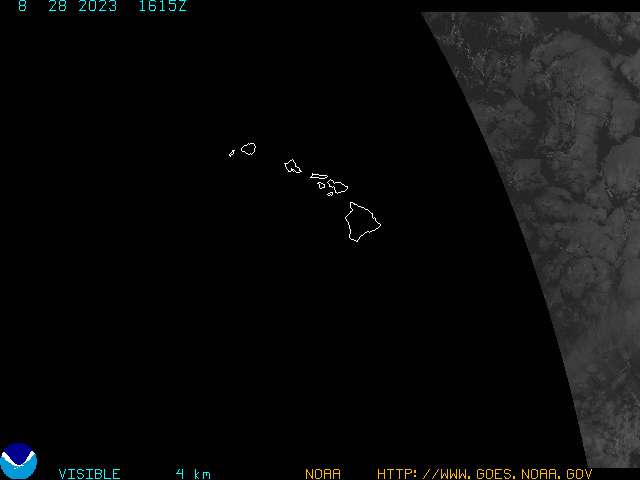
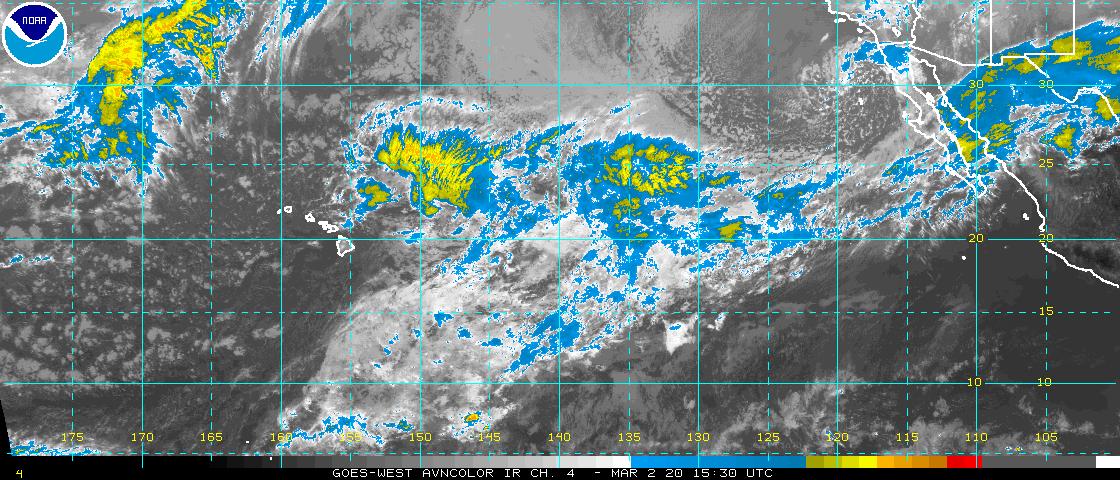
Satellite and Radar Images: To view the cloud conditions we have here in Hawaii, please use the following satellite links, starting off with this Infrared Satellite Image of the islands to see all the clouds around the state during the day and night. This next image is one that gives close images of the islands only during the daytime hours, and is referred to as a Close-up visible image. This next image shows a larger view of the Pacific…giving perspective to the wider ranging cloud patterns in the Pacific Ocean. Finally, here’s a Looping IR satellite image, making viewable the clouds around the islands 24 hours a day. To help you keep track of where any showers may be around the islands, here’s the latest animated radar image.
Hawaii’s Mountains – Here’s a link to the live webcam on the summit of near 14,000 foot Mauna Kea on the Big Island of Hawaii. The tallest peak on the island of Maui is the Haleakala Crater, which is near 10,000 feet in elevation. These two webcams are available during the daylight hours here in the islands…and when there’s a big moon rising just after sunset for an hour or two! Plus, during the nights and early mornings you will be able to see stars, and the sunrise too…depending upon weather conditions.
Tropical Cyclone activity in the eastern and central Pacific – Here’s the latest weather information coming out of the National Hurricane Center, covering the eastern north Pacific. You can find the latest tropical cyclone information for the central north Pacific (where Hawaii is located) by clicking on this link to the Central Pacific Hurricane Center. Here’s a tracking map covering both the eastern and central Pacific Ocean. A satellite image, which shows the entire ocean area between Hawaii and the Mexican coast…can be found here. Of course, as we know, our hurricane season won’t begin again until June 1st here in the central Pacific.
Aloha Paragraphs

April full moon tonight
The trade winds will remain on the blustery side locally Wednesday…and then begin winding down into Thursday. The NWS forecast office has pared back the small craft wind advisory to only those windiest locations around Molokai and the
There continues to be signals of an impending change up ahead however, one encompassing both the winds…and possibly precipitation too. The first signs of this change will occur in the wind department, as the trade winds slow down over the next couple of days. As this weather map shows, we have a 1029 millibar high pressure system to the north of our state. This high pressure cell will continue its journey eastward, as a series of low pressure systems, with their associated cold fronts…move eastward at the same time. As this trade wind producing high pressure system moves further away, our winds will gradually calm down. The computer models show the winds veering around to the southeast Friday into the weekend.
Southeast winds can bring added moisture into our area, as well as split around the
There is still some uncertainty surrounding the precipitation aspect of this upcoming weather forecast. The thing though, is that the computer forecast models have latched onto this prospect, for quite a long time. This consolidation of the models, in terms of their mutual outlooks, adds credence to the likelihood of something coming our way. The thought continues to be that an old cold front could push in our direction, from the northeast at some point Thursday into Friday…bringing showers with it. Then, the second chance would be if a late season cold front would arrive this weekend from the northwest direction. This might all come off as expected, which would be a great thing, providing some much needed rainfall to our water starved island chain…at least in some of those leeward areas in
It’s Tuesday evening as I begin writing this last section of today’s narrative. The weather Tuesday, was very similar to what we’ve seen the past three days, with not all that much change as we push into Wednesday. There may be a few more showers along our windward sides, although nothing unusual by any means. Looking out the window here in Kihei, Maui, before I take the drive back upcountry to Kula, it’s mostly clear again. We’re becoming very used to feeling the trade winds blowing, and having lots of sunshine beaming down these days! Looking a bit further ahead, our winds will be slowing way down, and we’ll begin seeing more clouds later this week. As noted above, we could actually see some locally heavy rains arriving later this week, and not just on the windward sides, as is often the case. It appears that just about anywhere could get under a wet cloud by the weekend, although it will be hit and miss, rather than a widespread deluge. As a matter of fact, there are still some details to be sorted out by the computer models, so that the weekend weather still has some question marks involved with it. ~~~ It’s the full moon now, so I hope you have a chance to step outside tonight, to check out this bright disk. It will be shining in my windows all night, so I’ll be sure witnessing it directly. I’ll be back early Wednesday morning with your next new weather narrative, I hope to see you again then! Aloha for now…Glenn.
Interesting: More than 50 new surface earthquake faults have been discovered in California over the last two decades, according to a new state map that officials hope will help guide future development decisions and emergency planning. The state’s fault activity map, produced by the California Geological Survey, is the first in 16 years and offers a sober reminder of California’s quake risks.
The new faults range from small ones that don’t pose much threat for major temblors to very large ones, like that responsible for the 7.1 Hector Mine earthquake that shook Southern California in 1999. Most of the faults have been known to researchers, and information on them is contained in scientific files.
But state officials and quake experts hope that putting all the faults on one map will educate the state about quake risk zones and help residents grasp the geography of the fault lines. "I think every classroom in California should have these maps on the wall," said Caltech seismologist Lucy Jones.
"I don’t think we do enough to educate the general public about these features. We turn it into something for the specialists, as if science is only for scientists. But if you’re going to buy a house, would you like to know what fault is under your house?" About 50 new faults might not seem like a lot in a state with thousands of them. But experts say the new maps point to a basic fact of seismology: The more scientists study quakes in California, the more faults — and dangers — they find.
"These maps are used to make a lot of other maps, to map landslides, areas where you have liquefaction because of earthquakes, for tsunami coastal mapping," state geologist John Parrish said. "They can be used to make decisions on where to build schools and hospitals, where you need a higher standard of construction. They can tell you what kind of a surface you’re building on, and how close you are to a fault.
The release of the map comes amid an increased interest in quakes in California and beyond. Last month’s 7.2 quake south of Mexicali produced thousands of aftershocks, including dozens registering above magnitude 4.0. As a result, officials said 2010 is shaping up to have significantly more quakes greater than 4.0 than any year in the last decade.
Parrish said the map represent the state’s best efforts at compiling information on the faults across California and will hopefully be used to enhance earthquake preparedness. With the new digital images as a base, The Times has produced its own map of Southern California’s earthquake exposure, showing the potential magnitude of quakes.
The Times map couples the surface faults on the state map with estimates in the 2007 Uniform California Earthquake Rupture Forecast, a study of the likelihood and probable magnitude of quakes. Parrish and others stressed that residents should not necessarily be alarmed if they live or work near one of California’s estimated 15,000 faults. Many of those are fairly short, and experts have found no evidence that they have generated sizable temblors.
But others can produce major quakes. Some of the new faults were discovered after a large quake erupted there. Scientists, however, found others through research and say they have a history of major seismic activity that could date back thousands of years. The new faults are spread across the region and include some along Santa Monica Bay and the Orange County coast as well as some — like Hector Mine — in the Mojave Desert.
One new fault of concern to seismologists is the Maacama, which runs along the coastal mountains of Northern California. Parrish said one goal of the new maps was to make them easier for the public to understand. The map uses color-shaded relief to better show the paths of fault lines and contours of the geology around them. "The 1994 map was very good for the time," he said. "But there’s been a lot of mapping done in the intervening years, with more details here and there.
New areas have been mapped, with new interpretations." The map shows only surface faults; those below the surface, like the one that caused the Northridge quake, are not included. The California Geological Survey also released a new geology map, identifying the composition of rock and soil across the state — key to how earthquakes inflict damage — for the first time since 1977. Formed because of the Gold Rush, the office that became the survey was initially created to provide detailed information about mining.
Despite numerous devastating earthquakes over the years, it wasn’t until a 7.3 magnitude quake struck Kern County in 1952 and killed a dozen people that the office got involved in public safety. The fault activity map is the fourth the state has released. Wally Lieu, engineering section manager for the Metropolitan Water District of Southern California, said his agency is eager to review the new map.
He said that the MWD already uses seismic maps in planning projects but that the state map provides additional useful information. "Anything they have is of interest to us, especially in electronic form," Lieu said. "We have a mapping team in engineering, and they have responsibility for updating our maps as we collect information." Parrish said the digital version of the new maps should be updated far more rapidly than in the past. If a new fault is discovered, it could be only months before its location is reflected electronically, he said.
Interesting2: This morning, another significant earthquake has rocked the ground; this time the quake was in Taiwan. The quake is another in a series of strong earthquakes that has happened this year. According to Major earthquake hits off Taiwan coast, "the 6.5-magnitude quake hit at 10:59 a.m."
So, far, there have been no reported deaths due to the tremor. Fortunately, there was little damage too. Also, there is not any trepidation about tsunamis. With such a big earthquake, why is there little to write about. The main reason is that the earthquake struck "195 miles (off the southern Taiwan city of Taitung."
Thus, since the epicenter was so far from land, it caused modest damage. In fact, people were more concerned about several people supposedly trapped from a landslide from Sunday than the recent earthquake. Yet, how does this earthquake compare with others? Other Earthquakes in Taiwan This is not the first time a strong quake has hit the region of Taiwan.
In fact, earthquakes frequent the area. Over 10 years ago, in 1999, a 7.6 earthquake struck central Taiwan. This time over 2,400 people were killed. According to wikipedia.com, the toll of this quake was "2,416 deaths (including missing people) and 11,443 severely wounded.
The quake also caused a lot of structural harm "with 44,338 houses completely destroyed, 41,336 houses severely damaged, and a total of NT$300 billion (US$9.2 billion) worth of damage." Days later, an aftershock measuring "6.8 on the Richter scale," shook Taiwan again, killing three more people and ruining more structures.
Location Matters By comparing quakes, we can see the relationship between location and casualties. As we have seen this year, earthquakes in more populous areas often have more deaths and inflict more destruction. In addition, earthquakes in less developed regions with low-socioeconomic status often have more damage due to poorly built structures.
Interesting3: An eruption at Guatemala’s Santiaguito volcano has sent a plume of ash 27,300 feet above sea level, dusting parts of at least four provinces. Disaster response agency spokesman David De Leon says the volcano has calmed since Monday’s big burst – though it is still seeing weak to moderate explosions.
De Leon says the eruption damaged local flower harvests, but caused no injuries. The agency says schools were closed in 10 communities as a precaution and flights have been banned for 12 miles around the volcano. Santiaguito is a crater on the slope of the 12,375-foot Santa Maria volcano about 120 miles (200 kilometers) northwest of Guatemala City.
Interesting4: A team of physicists led by a professor at UC San Diego has pinpointed the location of a long lost light reflector left on the lunar surface by the Soviet Union nearly 40 years ago that many scientists had unsuccessfully searched for and never expected would be found. The French-built laser reflector was sent aboard the unmanned Luna 17 mission, which landed on the moon November 17, 1970, releasing a robotic rover that roamed the lunar surface and carried the missing laser reflector.
The Soviet lander and its rover, called Lunokhod 1, were last heard from on September 14, 1971. "No one had seen the reflector since 1971," said Tom Murphy, an associate professor of physics at UCSD. He heads a team of scientists engaged in a long-term effort to look for deviations of Einstein’s theory of general relativity by measuring the shape of the lunar orbit to within an accuracy of one millimeter, or about the thickness of a paperclip.
This is accomplished by timing the reflections of pulses of laser light from reflectors left on the moon by Apollo astronauts and turning the timing measurement into a distance. "We routinely use the three hardy reflectors placed on the moon by the Apollo 11, 14 and 15 missions," said Murphy, "and occasionally the Soviet-landed Lunokhod 2 reflector — though it does not work well enough to use when illuminated by sunlight. But we yearned to find Lunokhod 1."
Three reflectors are required to lock down the orientation of the moon. A fourth adds information about tidal distortion of the moon, and a fifth enhances that information. "Lunokhod 1, by virtue of its location, would provide the best leverage for understanding the liquid lunar core, and for producing an accurate estimate of the position of the center of the moon — which is of paramount importance in mapping out the orbit and putting Einstein’s gravity to a test," said Murphy.
 Email Glenn James: